Your ad platforms are telling you one story. Your CRM is telling you another. And somewhere in the middle, your budget decisions are being made on data that doesn't quite add up.
This is the daily reality for most B2B SaaS marketing teams. Meta reports 47 conversions last week. Google claims credit for 31. Your CRM shows 18 new leads. The numbers overlap, contradict each other, and leave you guessing which campaigns are actually working. It's not a reporting glitch. It's a structural problem rooted in how most teams are tracking conversions in the first place.
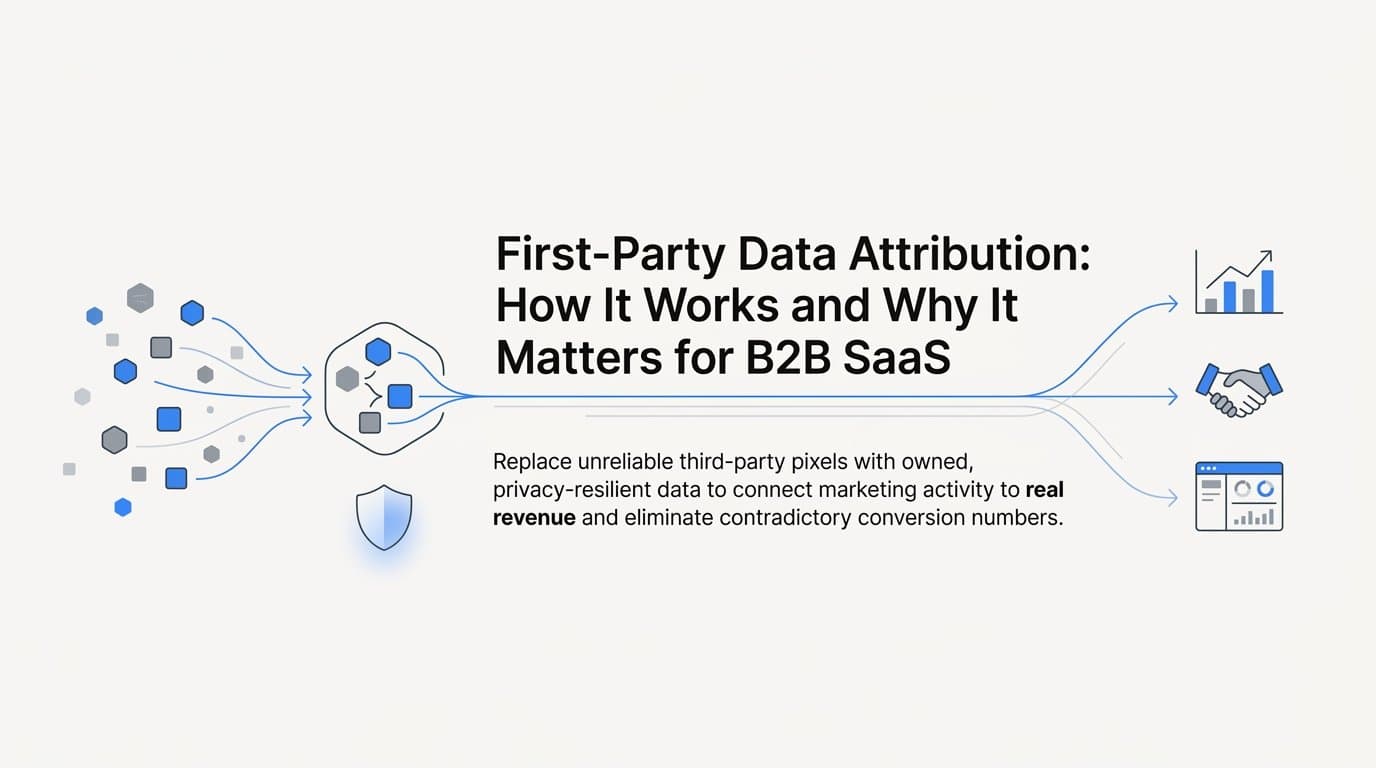
The culprit is a heavy reliance on third-party pixels and browser-based tracking, tools that were never designed for the privacy-first environment we're operating in today. As those mechanisms become less reliable, the gap between platform-reported data and actual business outcomes keeps growing. First-party data attribution is the approach that closes that gap. Instead of depending on ad platform pixels to tell you what happened, you use data your business owns and controls to connect marketing activity to real revenue outcomes.
This article breaks down exactly how first-party data attribution works, why it matters specifically for B2B SaaS, and what it takes to build a setup that gives your team accurate, actionable data rather than educated guesses.
The Tracking Gap That's Costing Marketers Clarity
For years, the standard approach to conversion tracking was simple: drop a pixel on your website, fire events when users complete key actions, and let the ad platform handle attribution. It worked reasonably well when browsers cooperated and users moved through predictable paths. That era is effectively over.
Safari's Intelligent Tracking Prevention (ITP) has been aggressively limiting third-party cookie lifespans for several years. Firefox blocks third-party cookies by default. Chrome has been navigating its own cookie deprecation timeline, and regardless of where that lands, the direction of travel is clear. Add widespread ad blocker adoption across desktop and mobile, and a meaningful share of your site traffic is already invisible to client-side pixels.
Then came iOS privacy updates, which introduced app tracking transparency and required users to explicitly opt in to cross-app tracking. Most users opt out. This hit mobile advertising measurement particularly hard, making it significantly more difficult to attribute conversions that originated from mobile ad interactions.
The result is attribution blind spots. Conversions happen, but the pixel doesn't see them. Or the pixel fires, but the cookie that would have connected that conversion to an earlier ad click has already expired. The ad platform fills in the gaps with modeled data, which sounds reasonable until you realize the model is optimizing based on incomplete inputs.
Here's where it gets expensive. When platform-reported conversion numbers look strong, the natural response is to scale spend. But if those numbers are inflated by modeled attribution or double-counting across platforms, you're scaling based on a fiction. Budgets shift toward channels that appear to be performing well, while channels that are genuinely driving pipeline get starved because their contribution isn't being captured accurately.
Growth teams end up in a frustrating loop: spend more, see platform metrics improve, check the CRM, wonder why pipeline isn't growing at the same rate. The disconnect isn't a coincidence. It's the predictable outcome of building your measurement stack on tracking infrastructure that can no longer do the job reliably.
The solution isn't to find a better pixel. It's to fundamentally change where your conversion data originates and who controls it.
Defining First-Party Data Attribution
First-party data is information you collect directly from your own users through your website, product, CRM, and customer interactions. You own it, you control it, and it reflects real behavior from real people who have engaged with your business. It's the opposite of third-party data, which is sourced from external brokers or inferred by ad platform algorithms from behavioral signals across the web.
First-party data attribution takes that owned data and uses it to connect specific marketing touchpoints, channels, and campaigns to conversion outcomes. Instead of asking an ad platform's pixel what drove a conversion, you're using your own records to answer that question. Which ad did this user first click? What channel brought them back when they signed up for a trial? Which campaign was running when their deal closed in your CRM?
This is a fundamentally different approach from last-click attribution, which assigns all credit to whatever touchpoint immediately preceded a conversion. Last-click is simple to implement but systematically misleading, especially in B2B where buyers interact with multiple channels over extended periods before converting. It rewards the final touchpoint and ignores everything that built awareness and intent along the way.
Platform-native attribution has its own problems. Each ad platform measures conversions through its own lens, using its own tracking mechanisms and its own attribution windows. Meta takes credit for conversions it influenced. Google takes credit for conversions it influenced. When you look at both reports side by side, the total often exceeds your actual conversion count because both platforms are claiming the same events. There's no unified view, just competing narratives from platforms with an incentive to show favorable results.
First-party data attribution creates a single source of truth. Because the data originates from your own systems rather than from platform-siloed tracking, you can apply consistent attribution logic across all channels simultaneously. You're not reconciling competing reports. You're working from one dataset that reflects what actually happened across the entire customer journey.
The practical implication is significant. When your attribution data is accurate and unified, budget decisions become grounded in reality rather than platform spin. You can see which channels are genuinely driving pipeline and which are claiming credit they don't deserve.
How First-Party Attribution Works in Practice
Understanding the concept is one thing. Understanding the mechanics helps you evaluate whether your current setup is actually capturing what it should.
The foundation of first-party data attribution is server-side event tracking. Traditional pixel-based tracking fires from the user's browser, which means it's subject to all the browser-level restrictions described earlier. Server-side tracking fires from your server instead. When a user completes a conversion action, your server sends that event data directly to the ad platform's API, bypassing the browser entirely.
The two most widely adopted implementations of this are Meta's Conversions API (CAPI) and Google's Enhanced Conversions. Both work on the same principle: instead of relying on a browser pixel to report a conversion, your server sends the event with enriched first-party data attached. This includes hashed identifiers like email addresses, phone numbers, or user IDs that the platform uses to match the conversion back to the ad interaction that preceded it.
This matching process is where first-party identifiers become critical. When someone clicks a Meta ad and later converts on your site, the platform needs a way to connect those two events. A third-party cookie used to handle that connection. Now, a hashed email address or customer ID does the job more reliably, because it's based on data the user provided directly to your business rather than a tracking cookie that may have been blocked or expired.
The CRM integration layer adds another dimension. In B2B SaaS, the most important conversion events don't happen on your website. They happen in your CRM: a lead becoming a qualified opportunity, a deal moving to proposal stage, a contract getting signed. Connecting those CRM events back to the original ad interactions requires a system that can match CRM records to the marketing touchpoints that preceded them.
This is where multi-touch attribution models come into play. Once you have first-party data flowing from your server, your CRM, and your ad platforms into a unified system, you can apply attribution models that distribute credit across every touchpoint in the customer journey. A linear model gives equal credit to each touchpoint. A time-decay model gives more credit to touchpoints closer to conversion. A data-driven model uses statistical analysis to assign credit based on each touchpoint's actual influence on the outcome.
The result is attribution that reflects the full customer journey from the first ad click to the closed-won deal, with credit distributed in a way that matches how your buyers actually make decisions.
Why B2B SaaS Teams Specifically Need This Approach
First-party data attribution matters for any business running paid advertising. But the stakes are particularly high for B2B SaaS, and the reasons are structural.
B2B buying cycles are long. Depending on your product and deal size, a prospect might interact with your brand for weeks or months before signing a contract. During that time, they might click a LinkedIn ad, read a blog post, attend a webinar, respond to a sales email, and sit through two product demos. A last-click model gives all the credit to whatever touchpoint happened right before they signed. A first-click model gives all the credit to the LinkedIn ad. Neither reflects the collaborative reality of how the deal came together.
Multiple decision-makers compound the complexity. In many B2B SaaS deals, the person who first discovers your product through an ad is not the same person who signs the contract. The economic buyer, the technical evaluator, and the end user may all interact with your marketing through different channels and different devices. Browser-based tracking, which ties attribution to individual sessions and cookies, is structurally incapable of connecting these dots.
Revenue attribution is the real goal, not lead attribution. Many B2B marketing teams measure success at the lead or trial signup stage because that's where their tracking stops. But a lead that never converts to a paying customer is not a marketing success. Without connecting ad spend data to CRM pipeline stages and actual closed revenue, you cannot answer the question that matters most: which campaigns are generating revenue, not just activity?
Growth teams that lack this connection end up optimizing for vanity metrics. Cost per lead looks great. Trial signups are up. But pipeline is flat and revenue targets are being missed. The disconnect happens because the metrics being optimized don't reflect business outcomes. They reflect the top of the funnel in isolation.
First-party data attribution solves this by extending the measurement window all the way to closed revenue. When your attribution system can connect a LinkedIn ad click from three months ago to a deal that just closed in your CRM, you have the information you need to make real budget decisions. You stop optimizing for cheap leads and start optimizing for the campaigns that generate revenue.
Building a First-Party Data Attribution Stack
Knowing why first-party data attribution matters is the starting point. Building the infrastructure to make it work requires a few core components working together.
Server-Side Tracking Setup: This is the foundation. You need a way to send conversion events from your server rather than the user's browser. This typically involves implementing a server-side tag management solution or working directly with the APIs of the platforms you're advertising on. The goal is to ensure that conversion events are captured regardless of browser restrictions or ad blockers.
CRM Integration: Your CRM is the system of record for your pipeline and revenue. Connecting it to your attribution infrastructure means that deal stage changes, closed-won events, and revenue data can be tied back to the original marketing touchpoints that initiated the customer journey. Without this connection, attribution stops at the lead stage and cannot inform revenue-level decisions.
Conversion API Connections: Meta CAPI and Google Enhanced Conversions should be configured to receive enriched conversion events from your server. This means sending not just the event itself but the first-party identifiers that improve match rates: hashed emails, phone numbers, and customer IDs. Higher match rates mean more conversions are correctly attributed to the ads that drove them.
Centralized Attribution Platform: The individual data sources need to feed into a unified system where attribution logic can be applied consistently across all channels. A platform like Cometly is built specifically for this, connecting ad platform data, CRM events, and revenue data into a single view of the customer journey. Instead of toggling between Meta Ads Manager, Google Ads, and your CRM, you see the full picture in one place.
Enriching your conversion events is equally important. When you send a conversion event to Meta or Google, the quality of that event matters. An event that includes a hashed email, the lead source, the deal stage, and the associated revenue value gives the platform's algorithm far more to work with than a bare conversion signal. Better signals lead to better optimization, which is a concrete, measurable benefit of investing in first-party data infrastructure.
Attribution model selection is the final decision layer. For most B2B SaaS companies with sales cycles longer than a few weeks, linear or time-decay models provide a more honest picture of channel contribution than first-click or last-click. If your conversion volume is high enough, data-driven attribution uses statistical modeling to assign credit based on actual influence, which is the most accurate approach available. The right choice depends on your sales cycle length, channel mix, and the volume of conversion data you're working with.
Turning Attribution Data Into Smarter Ad Spend
Accurate attribution data is only valuable if it changes how you make decisions. Here's where the investment pays off in concrete ways.
The most immediate benefit is confident budget reallocation. When you can see which campaigns are generating real pipeline and closed revenue rather than just form fills, you have a defensible basis for shifting spend. Channels that looked underperforming by last-click standards often reveal significant pipeline contribution when multi-touch attribution is applied. Channels that looked strong often show a different picture when you trace their leads through to revenue.
This visibility lets you stop funding campaigns that generate cheap leads with low close rates and redirect that spend toward campaigns that initiate deals that actually close. Over time, this kind of reallocation compounds. The budget gets progressively better aligned with what actually drives revenue.
The second benefit is improving the ad platform algorithms themselves. Meta and Google optimize campaign delivery based on the conversion signals they receive. When those signals are incomplete because browser tracking missed conversions, the algorithm is working with a distorted picture of what good performance looks like. When you send enriched, first-party conversion events via CAPI or Enhanced Conversions, the algorithm gets a cleaner signal. It learns more accurately which users, placements, and creative approaches lead to real outcomes, and it adjusts targeting and bidding accordingly.
Cometly is built to support exactly this feedback loop. It captures every touchpoint from ad click to CRM event, uses AI to identify which campaigns and channels are driving real revenue, and sends enriched conversion signals back to ad platforms to improve their optimization. The result is a system where better data leads to better targeting, which generates cleaner data for future attribution.
The compounding effect is real. Teams that invest in first-party data infrastructure early don't just get better attribution today. They build a measurement foundation that improves over time as the system accumulates more data, better signal quality, and more accurate models. Teams that delay are not just working with imperfect data now. They're falling further behind as the gap between browser-based tracking and actual performance widens.
The Bottom Line on First-Party Data Attribution
First-party data attribution is not a technical upgrade you can defer until the tracking environment gets worse. The tracking environment is already unreliable, and the B2B SaaS teams making the best budget decisions are the ones who have already moved past pixel dependency.
The core argument is straightforward. Third-party pixels and browser-based tracking cannot reliably capture the full customer journey in today's privacy-first environment. That gap creates attribution errors that flow directly into budget decisions. When you're scaling spend based on platform-reported numbers that overcount or misattribute conversions, you're not optimizing. You're guessing with confidence.
First-party data attribution replaces that guesswork with owned data, server-side tracking, and a unified view of the customer journey from first ad click to closed revenue. It's the infrastructure that lets B2B SaaS marketing teams answer the questions that actually matter: which campaigns are generating pipeline, which channels are driving revenue, and where the next dollar of ad spend should go.
Cometly is built to make this infrastructure accessible and actionable. It connects your ad platforms, CRM, and website data into a single attribution source of truth, with multi-touch attribution across 70+ native integrations, server-side conversion tracking, Conversion API support, and AI-powered recommendations for scaling what's working. If your team is ready to move from platform-reported metrics to revenue-level attribution, Get your free demo and see exactly which campaigns are driving your growth.