If you're running paid ads across multiple channels and still relying on platform-native reporting to measure results, you're making decisions with incomplete data. Meta tells you Meta is working. Google tells you Google is working. The reality is often messier, and without a dedicated attribution tool, you have no reliable way to know which channels are actually driving revenue.
A proper marketing attribution tool connects your ad spend, website behavior, CRM data, and revenue into a single view. For SMBs, this isn't a luxury anymore. It's the difference between scaling what works and burning budget on what sounds like it works. The tools below were evaluated on setup simplicity, attribution model depth, integration quality, pricing transparency, and practical fit for teams without dedicated data engineers.
1. Cometly
Best for: B2B SaaS SMBs that need to connect ad spend directly to pipeline and closed-won revenue.
Cometly is a marketing attribution and analytics platform built specifically for B2B SaaS companies that want to see exactly which ads and channels drive real revenue, not just clicks or leads.
 9 Best Attribution Platforms for Agencies in 2026
Where This Tool Shines
Most attribution tools track conversions. Cometly tracks revenue. By connecting your ad platforms, CRM, website, and Stripe data into a single dashboard, it gives you a complete picture of the customer journey from first ad click to closed deal. That distinction matters enormously for SaaS teams where the gap between a lead and paying customer can span weeks or months.
The AI ads manager is a standout feature for lean marketing teams. Rather than manually analyzing performance across channels, Cometly surfaces recommendations on which campaigns to scale, which to pause, and where budget is being wasted. Combined with server-side tracking and Conversion API support, it also stays accurate as third-party cookie deprecation continues to impact pixel-based tracking.
Key Features
Multi-Touch Attribution: Tracks every touchpoint across all major ad channels using multiple attribution models so you can see full channel contribution, not just last click.
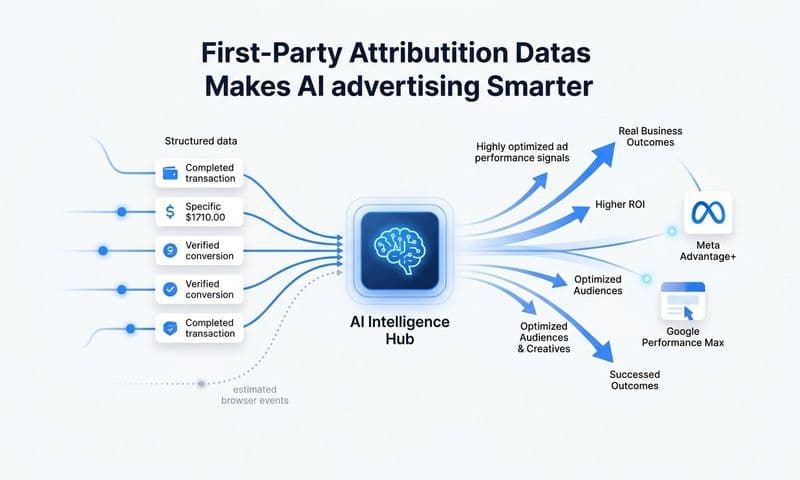
Server-Side Tracking and Conversion API: Sends enriched conversion data back to Meta, Google, and other platforms to improve targeting accuracy and compensate for browser-based tracking limitations.
AI Ads Manager: Identifies high-performing campaigns and delivers actionable recommendations to help you scale what's working with confidence.
Pipeline and Revenue Attribution: Connects to Stripe and CRM platforms to attribute closed-won revenue back to specific ads, campaigns, and channels.
Customer Journey Analytics: Visualizes the full path from first touch to conversion with 70+ native integrations across ad platforms, CRMs, and analytics tools.
Best For
B2B SaaS marketing teams and growth leaders who need to prove which ads are driving pipeline and revenue, not just traffic. Particularly strong for SMBs running paid campaigns across multiple channels who want a single source of truth without building a custom data stack.
Pricing
Paid plans available with pricing based on data volume and features. Contact Cometly directly for current SMB-specific pricing options.
2. Triple Whale
Best for: Shopify-based DTC ecommerce brands focused on post-iOS attribution accuracy.
Triple Whale is an attribution and analytics platform built for Shopify merchants who want reliable conversion data in a world where Meta's native pixel often undercounts.
 9 Best Marketing Attribution Tools for SMBs in 2026
Where This Tool Shines
Triple Whale's first-party pixel is its core differentiator. It captures conversion data directly from your Shopify store and matches it against ad platform data, giving you a more accurate read on which campaigns are actually driving purchases. The summary dashboard is designed for founders and small teams who need a quick daily read on performance without digging through reports.
The creative analytics feature is particularly useful for DTC brands running high volumes of ad creatives. It surfaces which visuals and copy are driving the most attributed revenue, making creative testing more systematic.
Key Features
First-Party Pixel: Tracks conversions directly from your store for more accurate post-iOS attribution than relying solely on Meta or Google pixels.
Shopify Revenue Attribution: Native Shopify integration ties ad spend directly to actual order revenue.
Blended ROAS Dashboard: Aggregates performance across Meta, Google, and TikTok in a single view.
Creative Analytics: Identifies top-performing ad creatives by attributed revenue to inform testing decisions.
Summary Dashboard: Clean, founder-friendly interface designed for fast daily performance reviews.
Best For
Ecommerce SMBs running on Shopify with active paid social campaigns. Less suited to B2B SaaS or service-based businesses, but a strong fit for DTC brands scaling Meta and TikTok spend.
Pricing
Starts at approximately $129/month for smaller Shopify stores; pricing scales with store revenue.
3. Northbeam
Best for: Ecommerce and DTC brands with significant paid media spend needing ML-powered attribution and media mix modeling.
Northbeam is a multi-touch attribution and media mix modeling platform built for brands that want to move beyond simple pixel-based attribution into more sophisticated modeling.
 9 Best AI Marketing Insights Software Tools in 2026
Where This Tool Shines
Northbeam uses machine learning to model attribution across channels, accounting for the reality that most conversions involve multiple touchpoints across multiple sessions. Its media mix modeling layer adds strategic context, helping budget allocation decisions go beyond what last-click or even linear attribution would suggest.
For ecommerce SMBs with meaningful ad budgets, the predictive analytics features can help forecast campaign performance and identify where incremental spend is likely to generate the best returns.
Key Features
ML-Powered Attribution: Uses machine learning to model channel contribution more accurately than rule-based attribution models.
Media Mix Modeling: Provides strategic-level budget allocation insights based on modeled channel performance.
Custom Lookback Windows: Configurable attribution windows to match your actual sales cycle length.
Predictive Analytics: Forecasts campaign performance to support proactive budget decisions.
Creative and Channel Reporting: Granular reporting at both the channel and individual creative level.
Best For
Ecommerce and DTC brands with higher monthly ad spend who need more than basic attribution. Better suited to SMBs that have outgrown simpler tools and need modeling-level insights to make larger budget decisions.
Pricing
Custom pricing based on ad spend volume. Contact Northbeam directly for a quote.
4. HubSpot Marketing Hub
Best for: SMBs already running on HubSpot CRM who want built-in attribution without adding another tool.
HubSpot Marketing Hub is an all-in-one marketing platform with native attribution reporting that connects campaign performance directly to CRM contacts and deal revenue.
 9 Best Ad Attribution Platforms Compared for B2B SaaS Teams in 2026
Where This Tool Shines
If your team is already in HubSpot, the attribution reporting available on Professional and Enterprise tiers is a logical starting point before investing in a dedicated tool. Because it lives inside your CRM, contact-level attribution is native, meaning you can see which campaigns influenced specific deals without any additional data syncing.
The trade-off is depth. HubSpot's attribution reporting covers the core models and integrates cleanly with its own ecosystem, but it doesn't match the granularity of dedicated attribution platforms. For teams with complex multi-channel mixes or long sales cycles, it may hit its limits quickly.
Key Features
CRM-Native Attribution: Ties campaign touchpoints directly to HubSpot contacts and deal revenue without external integrations.
Multi-Touch Attribution Models: Available on Professional and Enterprise tiers, covering first touch, last touch, linear, and other standard models.
Campaign Reporting: Tracks performance across email, ads, landing pages, and content in one place.
Ecosystem Integration: Works seamlessly with HubSpot Sales Hub and Service Hub for full-funnel visibility.
No Additional Setup: Attribution reporting activates within the existing HubSpot environment.
Best For
SMBs already committed to the HubSpot ecosystem who want baseline attribution without adding a new vendor. Not the best choice if you need deep cross-channel attribution or use a non-HubSpot CRM.
Pricing
Marketing Hub Professional starts at $800/month; multi-touch attribution is included at this tier.
5. Rockerbox
Best for: SMBs with diverse channel mixes including offline channels who need unified marketing measurement.
Rockerbox is a unified marketing measurement platform that combines multi-touch attribution, media mix modeling, and incrementality testing in a single solution.
 9 Best Self-Service Attribution Tools for B2B SaaS in 2026
Where This Tool Shines
Rockerbox stands out for its ability to centralize data across paid, organic, email, direct, and even offline channels. For SMBs running a mix of digital and non-digital marketing, this breadth is valuable. Most attribution tools are built primarily around digital paid channels, so offline attribution is often an afterthought rather than a core capability.
The incrementality testing feature is increasingly important as teams try to validate whether their paid channels are actually driving incremental revenue or simply claiming credit for conversions that would have happened anyway.
Key Features
Multi-Touch Attribution: Covers digital and offline channels in a single attribution framework.
Media Mix Modeling: Supports strategic budget allocation across your full channel portfolio.
Incrementality Testing: Tests whether specific channels are driving genuinely incremental conversions.
Centralized Data View: Aggregates paid, organic, email, and direct traffic into one reporting layer.
Flexible Attribution Model Comparison: Allows side-by-side comparison of different attribution approaches.
Best For
SMBs with more complex channel mixes that extend beyond pure digital paid. Particularly useful for teams that want to validate channel performance rather than just measure it.
Pricing
Custom pricing. Contact Rockerbox for SMB-specific plan options.
6. Ruler Analytics
Best for: B2B SMBs and agencies with long sales cycles that need visitor-level journey tracking tied to CRM revenue.
Ruler Analytics is a B2B-focused attribution tool that tracks individual visitor journeys across sessions and channels, then syncs closed revenue from your CRM back to the originating marketing touchpoints.
 8 Best Attribution Tools with Onboarding Support in 2026
Where This Tool Shines
Ruler's core strength is its visitor-level tracking combined with CRM revenue sync. Rather than attributing aggregate conversions, it tracks each visitor's full journey and matches their eventual closed deal back to the specific ads, channels, and content that influenced them. This is especially valuable for B2B businesses where the path from first touch to signed contract can span months.
Call tracking and form tracking are built in, making Ruler a strong fit for businesses where phone calls and form submissions are primary conversion events rather than ecommerce transactions.
Key Features
Visitor-Level Journey Tracking: Tracks individual visitors across multiple sessions and channels before conversion.
CRM Revenue Sync: Pulls closed deal values from your CRM and attributes them back to originating marketing touchpoints.
Call and Form Tracking: Captures offline and online conversion events for businesses where leads convert through calls or forms.
Multiple Attribution Models: Supports linear, time decay, first touch, last touch, and other standard models.
CRM and Ad Platform Integrations: Connects with HubSpot, Salesforce, Pipedrive, and major ad platforms.
Best For
B2B agencies and SMBs with longer sales cycles, phone-based conversions, or complex lead nurturing processes. Less suited to ecommerce or short-cycle SaaS with self-serve conversion flows.
Pricing
Starts at approximately $199/month; scales with tracked visitor volume and feature requirements.
7. Attribution (Attribution Inc.)
Best for: Teams that want visual multi-touch attribution with side-by-side model comparison and minimal technical setup.
Attribution is a multi-touch attribution platform focused on making customer journey data visually clear and easy to interpret without requiring heavy technical configuration.
 9 Best Marketing Attribution Tools for SMBs in 2026
Where This Tool Shines
Attribution's visual journey timelines are its defining feature. Rather than presenting attribution data in tables and charts, it maps each converting user's path visually, making it easier to spot patterns in how customers move through your funnel before converting. This clarity is particularly valuable for teams that need to communicate attribution findings to stakeholders who aren't deep in analytics.
The side-by-side model comparison lets you see how different attribution models would allocate credit across the same set of conversions, which helps teams make more informed decisions about which model to use for budget planning.
Key Features
Visual Customer Journey Timelines: Maps each converting user's touchpoints visually for intuitive analysis.
Side-by-Side Model Comparison: Shows how different attribution models allocate credit across the same conversion data.
Ad Platform and CRM Integrations: Connects with major paid channels and CRM tools for unified data.
Cohort Analysis: Groups conversions by cohort to identify trends over time.
LTV Reporting: Tracks lifetime value attribution to evaluate long-term channel performance.
Best For
Marketing teams that want clear, visual attribution reporting without a complex implementation process. Good for SMBs that need to present attribution data to leadership or clients in an accessible format.
Pricing
Custom pricing. Contact Attribution Inc. for current SMB plan details.
8. Wicked Reports
Best for: Email-heavy businesses, info product marketers, and service providers with extended nurture funnels.
Wicked Reports is an attribution platform designed specifically for businesses where conversions happen weeks or months after the first touch, often through email sequences and multi-step retargeting.
Where This Tool Shines
Most attribution tools are optimized for short conversion windows. Wicked Reports is built for the opposite scenario: businesses where a prospect might click an ad, enter a nurture sequence, receive dozens of emails over several months, and then convert long after the original ad impression is forgotten by other platforms. That long-cycle tracking capability is genuinely rare.
The email platform integrations are deep and practical. If your marketing stack includes ActiveCampaign, Klaviyo, or Infusionsoft, Wicked Reports can attribute revenue back through email sequences in a way that most other tools simply can't.
Key Features
Long-Cycle Conversion Tracking: Tracks attribution across weeks or months to capture conversions from extended nurture funnels.
Email Platform Integrations: Deep integration with ActiveCampaign, Klaviyo, Infusionsoft, and other major email platforms.
First-Click and Multi-Touch Attribution: Supports multiple models to evaluate both acquisition sources and nurture influence.
ROI Reporting: Breaks down return on investment by channel, campaign, and individual ad.
Retargeting Attribution: Tracks how retargeting campaigns contribute to conversions across long sales cycles.
Best For
Info product businesses, coaches, consultants, and service providers with email-heavy marketing and sales cycles that extend well beyond the standard 7 to 30-day attribution window.
Pricing
Starts at approximately $250/month; scales with contact volume and tracked revenue.
9. Google Analytics 4
Best for: SMBs that need a free baseline attribution layer before investing in a dedicated tool.
Google Analytics 4 is Google's free web analytics platform with a built-in data-driven attribution model, making it a practical starting point for SMBs with limited budgets.
Where This Tool Shines
The most obvious advantage is the price. GA4 is free for most SMBs and provides event-based tracking, conversion reporting, and a data-driven attribution model that distributes credit across touchpoints based on observed conversion patterns rather than a fixed rule. For teams just starting to think about attribution, it's a reasonable first step.
The native integration with Google Ads and Search Console makes it particularly useful for businesses that lean heavily on Google's ecosystem. The limitation is that GA4's cross-channel attribution is strongest within Google's own properties and becomes less reliable when tracking across paid social, email, and offline channels.
Key Features
Free to Use: No cost for standard use, making it accessible to any SMB regardless of budget.
Data-Driven Attribution: Distributes conversion credit across touchpoints using observed data rather than fixed rules.
Event-Based Tracking: Flexible conversion configuration based on custom events across your website and app.
Google Ecosystem Integration: Native connections to Google Ads, Search Console, and BigQuery for deeper analysis.
Cross-Device Reporting: Uses Google-signed-in user data to track conversions across devices where possible.
Best For
SMBs with limited budgets who need a baseline analytics and attribution layer, particularly those running Google Ads as their primary paid channel. Best used as a supplementary tool alongside a dedicated attribution platform rather than as a standalone solution.
Pricing
Free for standard use. GA4 360 is a paid enterprise upgrade for organizations with higher data volume requirements.
Choosing the Right Attribution Tool for Your Business
The right tool depends heavily on your business model, the channels you run, and how your CRM stack is set up. There's no single best answer, but there are clear patterns based on use case.
B2B SaaS SMBs should prioritize tools that connect ad spend to pipeline and revenue, not just lead volume. Cometly is built specifically for this context, with Stripe and CRM integration, server-side tracking, and AI-driven campaign recommendations. Ruler Analytics is a solid alternative if visitor-level journey tracking and CRM revenue sync are the primary requirements.
Ecommerce and DTC brands on Shopify will get the most value from Triple Whale for its pixel accuracy and founder-friendly dashboard, or Northbeam if the ad budget justifies more sophisticated ML-based modeling.
Teams already in HubSpot should evaluate HubSpot Marketing Hub's built-in attribution before adding another tool. It won't match the depth of a dedicated platform, but it removes the integration complexity for teams that are already CRM-native.
Email-heavy businesses with long nurture cycles should look closely at Wicked Reports. Its ability to track attribution across months of email sequences is genuinely difficult to replicate with general-purpose tools.
SMBs with tight budgets can start with Google Analytics 4 as a free baseline, but should plan to graduate to a dedicated attribution tool as paid channel complexity grows.
If you run a B2B SaaS business and want to stop guessing which ads are actually driving revenue, Cometly is purpose-built for exactly that problem. Get your free demo and see how it connects every touchpoint from first ad click to closed-won deal in a single, accurate view.