
You have data everywhere. Your ad platforms are full of it. Your CRM is packed with it. Your website analytics are generating more of it every hour. And yet, when someone asks you which campaigns are actually driving revenue, you hesitate.
That hesitation is the marketing data silos issue in its purest form. Data silos are not just a technical inconvenience. They are the reason your Google Ads dashboard tells a completely different story than your HubSpot pipeline, and why your website analytics seem to exist in their own parallel universe. Each tool captures a slice of reality, but none of them can show you the full picture.
For B2B SaaS teams specifically, this problem is especially damaging. Your buyers do not convert after a single touchpoint. They see a LinkedIn ad, read a blog post, attend a webinar, get a sales email, and then maybe, weeks later, book a demo. Every one of those interactions lives in a different tool. Without a way to connect them, you are making budget decisions based on fragments rather than facts.
The stakes are high. Misattribution does not just inflate vanity metrics. It actively redirects budget away from the channels that are genuinely driving pipeline and toward the ones that simply look good in their own dashboards. Over time, that compounds into a significant revenue gap.
This article breaks down how the marketing data silos issue forms, what it costs you, why B2B SaaS companies are uniquely vulnerable, and what a practical path to unified attribution actually looks like. If you have ever felt like you are flying blind on ad performance, this is where to start.
How Marketing Data Gets Trapped in Silos
A marketing data silo is exactly what it sounds like: an isolated pocket of data stored inside a tool that does not communicate with the rest of your stack. Your Meta Ads account knows what it knows. Your Salesforce instance knows what it knows. Neither one talks to the other by default, and that gap is where attribution goes to die.
Here is the important thing to understand about how silos form: they are almost never the result of a single bad decision. They accumulate gradually as teams adopt the best tool for each job. You pick the best email platform. You pick the best CRM. You pick the best ad analytics tool. Each one is excellent in isolation. But without a unified data layer connecting them, you end up with a stack of best-in-class tools that collectively produce a fragmented, contradictory picture of your marketing performance.
This is not a failure of the tools themselves. It is a structural gap in how marketing stacks are typically built. The tools are designed to optimize within their own domain. They were not built to hand off data seamlessly to every other platform in your ecosystem.
In B2B SaaS, the three most common silo types tend to follow a predictable pattern.
Paid media silos: Ad platforms like Google, Meta, and LinkedIn each have their own attribution windows, their own conversion definitions, and their own reporting logic. When you look at performance inside each platform, you are seeing the world through that platform's lens. Cross-channel comparison becomes nearly impossible without pulling data into a neutral, unified environment.
CRM silos: Your CRM holds the most commercially valuable data in your entire stack: lead quality, opportunity stages, deal values, close dates, and revenue. But most CRMs are not designed to connect that data back to the specific ad campaigns or channels that sourced those leads. The pipeline data sits in one place, the marketing source data sits in another, and the connection between them is either missing or manually maintained.
Website analytics silos: Tools like Google Analytics capture behavioral data about how visitors interact with your site, but they operate independently from both your ad platforms and your CRM. They can tell you someone visited your pricing page three times, but they cannot tell you whether that person eventually became a closed deal worth a specific amount of revenue.
Each of these silos captures something real and valuable. The problem is that without a layer connecting them, you cannot see the full customer journey from first ad impression to closed-won revenue. And in B2B SaaS, that full journey is the only one that actually matters.
The Real Cost of Disconnected Marketing Data
When people talk about the marketing data silos issue, they often frame it as a reporting problem. It is that, but it is also much more. Disconnected data creates three distinct costs that compound on each other over time: misattribution, budget misallocation, and team misalignment.
Misattribution is the most immediate consequence. When you cannot see the full customer journey across touchpoints, you end up crediting the wrong channel for a conversion. A prospect clicks a paid search ad, engages with a retargeting campaign on LinkedIn, reads two blog posts, and then converts after clicking a branded search ad. Last-touch attribution gives all the credit to branded search. The LinkedIn campaign and the content that warmed up the prospect get nothing. This is not just an analytics quirk. It is a systematic distortion that shapes every decision you make about where to invest next.
The budget allocation problem flows directly from misattribution. When you cannot connect ad spend to pipeline and revenue, you are forced to optimize on the metrics that are available inside each platform: impressions, clicks, cost-per-lead, and form fills. These metrics are not meaningless, but they are not the same as revenue. Channels that generate a high volume of cheap leads may be producing low-quality pipeline that rarely closes. Channels that generate fewer, more expensive leads may be producing your best customers. Without connecting the data, you cannot tell the difference.
This creates a dangerous dynamic where budget flows toward what looks good in platform dashboards rather than what actually drives revenue. Over a quarter or two, this compounds into a meaningful misallocation of spend, with high-performing channels starved of budget and underperforming channels over-invested.
The team alignment cost is subtler but equally damaging. When sales and marketing are working from different data realities, every conversation about pipeline quality, lead volume, and forecasting becomes a negotiation between competing narratives. Marketing points to the lead numbers in their platform. Sales points to the close rates in the CRM. Neither team is wrong, but neither team is looking at the same picture. This friction slows down decision-making, erodes trust between teams, and makes it nearly impossible to align on a shared growth strategy.
Taken together, these three costs mean that the marketing data silos issue is not just a technical problem you can defer. Every quarter you operate with fragmented data is a quarter where budget decisions are distorted, optimization is based on incomplete signals, and the gap between what you are spending and what you are earning from that spend remains invisible.
Why B2B SaaS Companies Face This Problem More Than Most
Every business with a marketing stack deals with some version of the data silo problem. But B2B SaaS companies face it with particular intensity, and the reason comes down to the nature of the buying cycle itself.
B2B SaaS purchases are rarely impulsive. A prospect might interact with a paid ad on LinkedIn, find your blog through organic search, attend a webinar, receive a nurture email, sit through a sales call, and then convert weeks or months after the first touchpoint. Each of those interactions is captured by a different tool. The LinkedIn ad lives in your LinkedIn Campaign Manager. The blog visit lives in your website analytics. The webinar attendance lives in your marketing automation platform. The sales call lives in your CRM. Without a unified attribution layer, you have no way to stitch those touchpoints into a coherent journey or understand which combination of them is most likely to produce a high-value customer.
Account-based motions add another layer of complexity. In a typical B2B SaaS deal, you are not selling to a single person. You are selling to a buying committee. Multiple stakeholders from the same company interact with different channels at different times. The CFO clicks a LinkedIn ad. The VP of Marketing reads a case study. The IT lead attends a webinar. All of them are part of the same deal, but each of their interactions is tracked separately, often without any connection back to the account they belong to. Stitching together a coherent account-level journey without a unified data layer is effectively impossible.
The pipeline attribution gap is where this problem becomes most commercially significant. Most analytics tools are designed to track marketing activity through the lead stage. They can tell you how many leads a campaign generated. What they cannot tell you is whether those leads progressed through the pipeline, became qualified opportunities, or closed as revenue. This gap means that marketing teams are often optimizing for lead volume without any visibility into lead quality or revenue contribution.
This is particularly costly in B2B SaaS because lead quality varies enormously by channel, campaign, and audience. A campaign that generates a high volume of form fills from small businesses may look successful by standard lead metrics. A campaign that generates fewer leads from enterprise accounts may look less impressive. But if the enterprise leads close at a higher rate and at a higher contract value, the second campaign is delivering far more revenue per dollar spent. Without connecting CRM data back to marketing source data, you cannot see this. You optimize for the wrong thing and pay for it in pipeline quality.
What Breaks When Attribution Cannot Cross the Silo Boundary
When data cannot move freely across your marketing stack, attribution does not just become less accurate. It breaks in specific, predictable ways that systematically distort your understanding of what is working.
The most common failure mode is last-click bias. When data is siloed, teams default to last-touch attribution because it is the only model that works within a single platform's data set. You can see the last thing someone clicked before converting, because that click and the conversion both happened inside the same platform's tracking window. But you cannot see the six touchpoints that preceded it. The result is that last-touch attribution consistently overvalues bottom-of-funnel channels like branded search and direct traffic, while systematically undervaluing the awareness and consideration channels that built the relationship in the first place. Teams that rely on last-click attribution end up cutting the channels that fill the top of their funnel while doubling down on the channels that simply happen to be present at the moment of conversion.
Server-side tracking gaps and pixel degradation make this problem worse. Client-side pixel tracking, which has been the standard for years, is increasingly unreliable. Browser privacy changes, ad blockers, and iOS privacy updates strip out the first-party signals that would otherwise help connect touchpoints across the customer journey. When pixels fail to fire or get blocked, conversions go untracked, attribution windows shrink, and the data that reaches your analytics tools becomes increasingly incomplete. This means that even teams trying to do attribution properly are working with a degraded signal that understates the true impact of their campaigns.
Server-side tracking and Conversion API integrations address this by sending conversion events directly from the server to ad platforms, bypassing client-side limitations entirely. But this only helps if the data being sent is already unified across your stack. A server-side pixel that only captures website events still cannot tell you whether the lead became a closed deal.
The reporting theater problem compounds everything else. Without unified data, marketing teams spend significant time manually pulling exports from multiple platforms, merging them in spreadsheets, and attempting to reconcile conflicting numbers. This process is slow, error-prone, and produces reports that are already outdated by the time they reach the people who need to act on them. More importantly, it consumes the time and attention that should be going toward actual optimization. When your team is spending hours building reports instead of improving campaigns, the cost of fragmented data extends well beyond the attribution errors themselves.
Breaking Down Silos with a Unified Attribution Layer
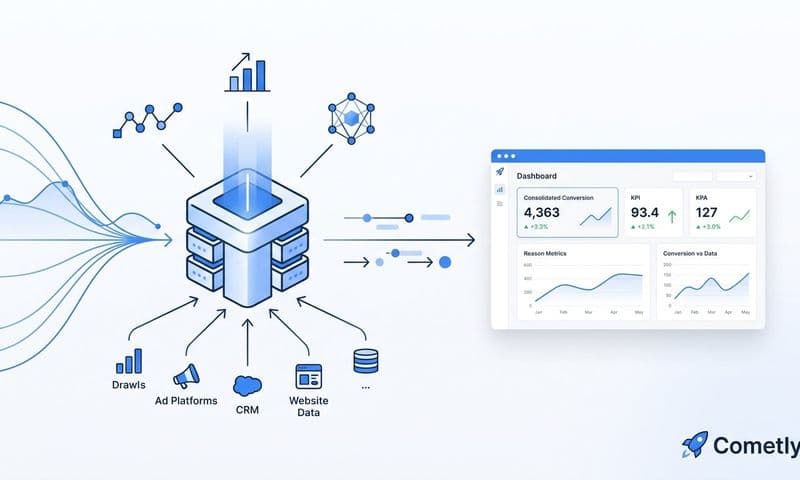
The solution to the marketing data silos issue is not adding more tools. It is connecting the ones you already have through a single, unified attribution layer that can ingest signals from across your entire stack and produce a coherent, complete view of the customer journey.
The concept of a single source of truth for marketing data is straightforward in principle. One platform ingests data from your ad platforms, your CRM, your website, and your revenue systems. It connects those signals at the customer level, creating a continuous record of every touchpoint from the first ad impression to the closed deal. Instead of four separate dashboards telling four separate stories, you have one unified view where every piece of data is connected and contextualized.
This is what makes multi-touch attribution models viable. When data is siloed, multi-touch attribution is theoretically appealing but practically impossible. You cannot apply a linear or time-decay model to a journey you can only see in fragments. But once silos are removed and all touchpoints are unified in one place, you can evaluate multiple attribution models side by side and compare their outputs against actual pipeline and revenue outcomes. You can ask not just which channel gets credit under a given model, but which model most accurately predicts which channels produce your best customers.
The data foundation matters as much as the attribution logic built on top of it. A unified attribution layer is only as good as the data flowing into it. This is where server-side tracking and Conversion API integrations become critical. By capturing conversion events server-side and sending them directly to ad platforms, you bypass the client-side limitations that degrade pixel data. You also create the ability to send downstream CRM events, such as a lead becoming a qualified opportunity or a deal reaching closed-won status, back into the attribution layer. This means your attribution is not just tracking form fills. It is tracking revenue.
Platforms like Cometly are built specifically to create this unified layer for B2B SaaS teams. By connecting ad platforms, CRM data, website behavior, and revenue signals in one place, Cometly gives marketing teams the complete, connected view of the customer journey they need to make confident decisions. The result is not just better reporting. It is a fundamentally different way of understanding what your marketing is actually producing.
Turning Unified Data into Smarter Ad Decisions
Solving the marketing data silos issue is not the end goal. It is the starting point for a completely different kind of optimization conversation. When you can connect ad spend to closed-won revenue, the metrics you use to evaluate campaigns change entirely.
Instead of asking which campaign generated the most leads at the lowest cost-per-lead, you start asking which campaign generated the most pipeline at the best pipeline ROI. Instead of optimizing for form fills, you optimize for qualified opportunities and closed deals. This shift sounds simple, but it fundamentally changes where budget goes and how campaigns are structured. Channels that looked expensive on a cost-per-lead basis may look highly efficient on a cost-per-revenue basis. Channels that looked cheap may reveal themselves as generators of low-quality pipeline that rarely closes.
AI-driven recommendations become significantly more accurate and actionable when they are fed enriched, cross-channel data rather than isolated platform signals. An AI system that can see the full customer journey, including which touchpoints preceded the highest-value closed deals, can surface patterns that would be invisible to a human analyst working from fragmented reports. It can identify which combinations of channels, creatives, and audiences produce the best pipeline, and it can recommend where to scale with a level of confidence that siloed data simply cannot support.
Cometly's AI-driven recommendations work precisely this way. By analyzing enriched, unified data across every channel, Cometly helps marketing teams identify the campaigns and touchpoints that are genuinely driving revenue, not just the ones that look good in their own platform dashboards. This means scaling decisions are grounded in actual revenue contribution rather than surface-level metrics.
Feeding enriched conversion events back to ad platforms closes the loop in the other direction. Meta and Google use machine learning to optimize targeting and delivery, and the quality of that optimization depends entirely on the quality of the conversion signals they receive. When you send back only form-fill events, the platform optimizes for people likely to fill out forms. When you send back enriched, downstream events like qualified leads and closed deals, the platform optimizes for people likely to become actual customers. This is a meaningful difference in targeting quality, and it compounds over time as the platform's model learns from better data.
This is the full value of breaking down silos: not just cleaner reports, but a smarter, more efficient optimization loop where every decision is grounded in complete data and every signal you send back to ad platforms makes your targeting more precise.
Putting It All Together
The marketing data silos issue is not a reporting problem you can solve with a better spreadsheet. It is a strategic liability that distorts every budget decision, every attribution model, and every growth forecast your team produces. When your data lives in disconnected tools, you are not just missing information. You are actively being misled by the partial information you do have.
The answer is not to add more tools to an already fragmented stack. It is to connect the tools you have through a unified attribution layer that creates a single, accurate view of the customer journey from first ad click to closed-won revenue. Once that layer is in place, multi-touch attribution becomes viable, budget decisions become grounded in actual revenue contribution, and the optimization loop between your marketing data and your ad platforms becomes genuinely intelligent.
For B2B SaaS teams dealing with long buying cycles, account-based motions, and the persistent gap between lead data and pipeline data, this is not a nice-to-have. It is the foundation of a marketing operation that can scale with confidence.
Cometly is built specifically to solve this problem. It connects your ad platforms, CRM, website, and revenue data in one place, giving you real-time visibility into which channels and campaigns are actually driving pipeline and revenue. With server-side tracking, Conversion API integrations, and AI-driven recommendations, Cometly helps you capture every touchpoint, understand every conversion, and feed better signals back to the platforms doing your targeting.
If you are ready to stop guessing and start optimizing on data that actually reflects reality, Get your free demo and see how Cometly connects your ad spend to pipeline and revenue in real time.