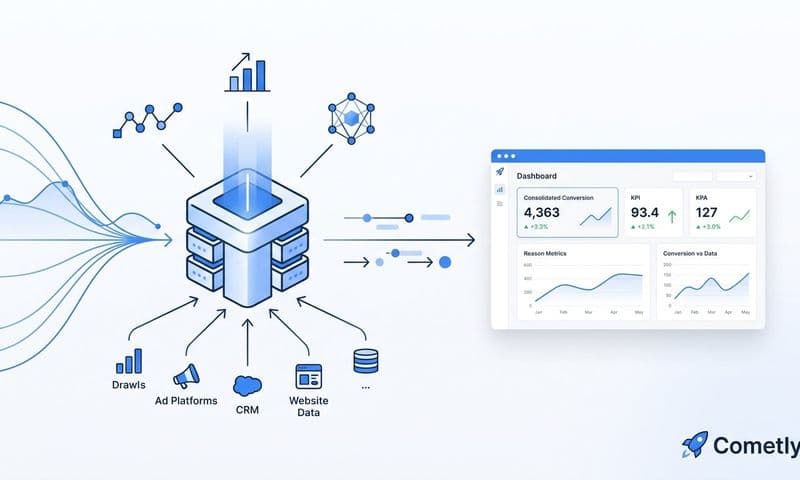
If you are running paid ads across multiple channels, managing a growing marketing budget, or trying to justify spend to a leadership team, you already know the frustration: data is everywhere, but clarity is rare. Marketing performance monitoring tools solve that problem by consolidating campaign data, tracking conversions, and connecting spend to actual revenue in one place.
The challenge is that not every tool does this equally well. Some are built for broad web analytics, others for specific channels, and a few are purpose-built for B2B SaaS teams that need to connect ad spend directly to pipeline and closed-won revenue. Selection criteria for this list include attribution depth, integration breadth, ease of use, and value for B2B SaaS teams. Here are the top tools worth evaluating in 2026.
1. Cometly
Best for: B2B SaaS teams that need full-funnel attribution from ad click to closed-won revenue.
Cometly is a marketing attribution and analytics platform built specifically for B2B SaaS companies that need to connect ad spend directly to pipeline and revenue.
 9 Best Marketing Attribution Platforms to Compare in 2026
Where This Tool Shines
Most attribution tools stop at the lead level. Cometly goes further by integrating with Stripe and CRM data to show which campaigns are actually generating closed-won deals, not just form fills. That distinction matters enormously for B2B SaaS teams where sales cycles are long and MQLs do not always convert to revenue.
The server-side conversion tracking and Conversion API integration address one of the most pressing issues in modern marketing: signal loss. As browser-based tracking becomes less reliable due to ad blockers and privacy changes, Cometly's server-side approach ensures accurate conversion data reaches your ad platforms, which improves targeting and optimization downstream.
Key Features
Multi-Touch Attribution Models: Supports first-touch, last-touch, linear, and time-decay models so teams can analyze performance from multiple angles rather than relying on a single, potentially misleading view.
Server-Side Conversion Tracking: Delivers accurate conversion signals to ad platforms even when browser-based tracking fails, reducing data loss from iOS changes and ad blockers.
Stripe Revenue Integration: Connects ad spend directly to closed-won revenue by pulling billing data into the attribution model, giving teams a true revenue ROI view.
AI Ads Manager: Surfaces actionable recommendations on which campaigns to scale and which to cut, reducing time spent manually analyzing dashboards.
Customer Journey Analytics: Tracks every touchpoint from the first ad click through to conversion, giving teams visibility into the full path to purchase.
70+ Native Integrations: Connects with major ad platforms, CRMs, and billing tools to serve as a single source of truth for marketing performance data.
Best For
Cometly is the strongest fit for growth marketers, demand gen leaders, and marketing ops teams at B2B SaaS companies who need to move beyond lead-level reporting and connect marketing activity to pipeline and revenue. It is particularly valuable for teams managing spend across multiple paid channels who want AI-driven recommendations without building custom analytics infrastructure.
Pricing
Paid plans are available. Visit cometly.com for current pricing details and plan options.
2. Google Analytics 4
Best for: Teams that need a free, flexible web analytics foundation with strong Google Ads integration.
Google Analytics 4 is Google's free, event-based web analytics platform that provides traffic analysis, conversion tracking, and audience insights.
 11 Best Marketing Analytics Tools to Track and Optimize Campaign Performance in 2026
Where This Tool Shines
GA4's event-based data model is a significant improvement over its predecessor. It gives teams the flexibility to track virtually any user interaction as a conversion event, which is useful for SaaS products with complex onboarding flows or multiple conversion points.
The native integration with Google Ads is where GA4 earns its place in most marketing stacks. Importing conversion events directly into Google Ads improves Smart Bidding performance and gives teams a clearer view of which campaigns are driving meaningful actions on the site. For teams running significant Google Ads spend, this connection alone justifies the setup investment.
Key Features
Event-Based Tracking: Flexible conversion measurement that tracks any user interaction without requiring custom code for every event type.
Native Google Ads Integration: Seamlessly connects campaign performance data with on-site behavior for closed-loop reporting within the Google ecosystem.
Predictive Audiences: Machine learning models identify users likely to convert or churn, enabling more targeted remarketing campaigns.
Cross-Device Reporting: Stitches user journeys across devices and platforms for a more complete view of the path to conversion.
Exploration Reports: Custom funnel and path analysis tools for deeper investigation of user behavior without requiring SQL knowledge.
Best For
GA4 is a strong foundation for any marketing team that needs free, reliable web analytics. It works best for teams heavily invested in the Google Ads ecosystem. Its limitations become apparent for B2B teams that need multi-channel revenue attribution beyond the Google stack.
Pricing
GA4 is free for standard use. GA4 360, the enterprise tier with higher data limits and SLA guarantees, is a paid product with pricing available through Google's sales team.
3. HubSpot Marketing Hub
Best for: Inbound-focused B2B teams already using HubSpot CRM who want native marketing attribution.
HubSpot Marketing Hub is a marketing platform that combines email, landing pages, ads management, and analytics with a native CRM connection.
For a deeper dive into this space, see our AI ads management software guide.
 9 Best Marketing Attribution Software Tools That Actually Work in 2026
Where This Tool Shines
The core advantage of HubSpot Marketing Hub is the native CRM integration. Because marketing activity and contact records live in the same system, attribution reporting can tie a specific campaign or email to a contact record, a deal, and ultimately closed revenue. This closed-loop visibility is something many standalone analytics tools cannot replicate without significant custom integration work.
For teams running inbound marketing programs, the combination of content, email, ads management, and attribution in one platform reduces the operational overhead of managing multiple disconnected tools. The tradeoff is that the most valuable attribution features sit on higher-tier plans.
Key Features
Native CRM Connection: Links every marketing touchpoint directly to contact and deal records for true closed-loop attribution.
Multi-Touch Revenue Attribution: Available on Professional and Enterprise tiers, this ties marketing activity to revenue across multiple touchpoints.
Ad Management and Tracking: Manages and tracks campaigns across Google, Meta, and LinkedIn from within the HubSpot interface.
Campaign Performance Dashboards: Customizable reports that pull data from across the HubSpot ecosystem into a single view.
Sales Hub Integration: When paired with HubSpot Sales Hub, provides full-funnel visibility from first touch through closed deal.
Best For
HubSpot Marketing Hub is the natural choice for B2B teams already operating within the HubSpot ecosystem. Teams that have invested in HubSpot CRM will get the most value here. It is less compelling for teams that use Salesforce or other CRMs as their system of record.
Pricing
A free tier is available with limited features. Paid plans span Starter, Professional, and Enterprise tiers. Visit hubspot.com for current pricing.
4. Triple Whale
Best for: DTC ecommerce brands running paid social at scale who need blended ROAS visibility and creative analytics.
Triple Whale is a performance analytics platform built for direct-to-consumer ecommerce brands that centralizes paid social data and provides creative-level performance insights.
 9 Best Marketing Performance Monitoring Tools in 2026
Where This Tool Shines
Triple Whale's creative analytics capability is a genuine differentiator. Rather than just reporting on campaign or ad set performance, it surfaces which specific ad creatives are driving purchases, which helps creative teams and media buyers make faster, more informed decisions about what to produce and what to scale.
The blended ROAS dashboard gives brands a single view of performance across Meta, TikTok, and Google, which is valuable when ad platform reporting inflates numbers through overlapping attribution windows. Triple Pixel, their first-party data collection tool, helps maintain attribution accuracy as third-party tracking becomes less reliable.
Key Features
Unified ROAS Dashboard: Blended performance view across Meta, TikTok, and Google in a single interface.
Creative Analytics: Identifies top-performing ad creatives by revenue contribution, helping teams scale what works.
Triple Pixel: First-party attribution data collection that maintains accuracy as third-party cookies decline.
Cohort Analysis: Customer lifetime value and cohort reporting to understand long-term revenue contribution by acquisition source.
Spend Pacing Tools: Budget management features that track spend against targets in real time.
Best For
Triple Whale is purpose-built for DTC ecommerce brands, particularly those with significant paid social budgets on Meta and TikTok. It is not designed for B2B SaaS use cases and lacks the CRM and pipeline attribution features that B2B teams need.
Pricing
Paid plans are based on store revenue. Visit triplewhale.com for current pricing details.
5. Northbeam
Best for: Performance marketing teams managing large budgets who need machine learning attribution and media mix modeling.
Northbeam is a machine learning-based attribution and media mix modeling platform designed for performance marketing teams operating at scale across multiple channels.
 9 Best Attribution Software with API Access in 2026
Where This Tool Shines
Northbeam's machine learning attribution models go beyond rule-based approaches like first-touch or last-click. The platform builds probabilistic models based on actual conversion data, which tends to produce more accurate channel credit assignments when a brand has sufficient volume to train the model effectively.
The media mix modeling capability is particularly useful for budget planning. Rather than just reporting on past performance, Northbeam provides guidance on how to allocate budget across channels to maximize return, which is a meaningful step beyond standard attribution reporting.
Key Features
Machine Learning Attribution: Probabilistic models that assign channel credit based on actual conversion patterns rather than fixed rules.
Media Mix Modeling: Budget allocation guidance based on modeled channel contribution to help teams optimize spend distribution.
Spend Pacing and Forecasting: Real-time tracking of spend against targets with forward-looking projections.
Cross-Channel Reporting: Unified performance view across paid, organic, and email channels.
Custom Attribution Windows: Flexible lookback windows and model comparison tools for deeper analysis.
Best For
Northbeam is best suited for ecommerce and performance marketing teams with substantial ad budgets across multiple channels. The machine learning models perform better with higher data volume, making it less suitable for smaller or earlier-stage teams.
Pricing
Enterprise pricing model. Contact Northbeam directly through northbeam.io for a quote.
6. Rockerbox
Best for: Brands with complex channel mixes that include offline channels like TV, podcast, and direct mail alongside digital.
Rockerbox is a marketing attribution platform that normalizes data from paid, organic, and offline channels into a single, unified attribution layer.
 9 Best D2C Brand Analytics Software Tools in 2026
Where This Tool Shines
Most attribution platforms handle digital channels well but struggle with offline. Rockerbox is built to handle both. Its ability to attribute conversions to TV spots, podcast sponsorships, and direct mail campaigns alongside digital channels makes it a strong fit for brands that have expanded beyond purely digital acquisition.
The model comparison capability within a single dashboard is a practical feature that is easy to undervalue. Being able to switch between attribution models and immediately see how credit shifts across channels helps teams have more informed conversations about channel investment.
Key Features
Unified Attribution Layer: Centralizes paid, organic, and offline channel data into a single view for consistent comparison.
Offline Channel Attribution: Supports attribution for TV, podcast, direct mail, and other non-digital channels.
Attribution Model Comparison: View performance under multiple attribution models simultaneously within the same dashboard.
First-Party Data Collection: Pixel and server-side tracking options to maintain data accuracy as third-party tracking declines.
Incrementality Testing: Built-in tools to measure the true incremental lift of marketing campaigns beyond correlation-based attribution.
Best For
Rockerbox fits brands that have a meaningful mix of online and offline marketing channels and need a single attribution view across all of them. It is particularly relevant for consumer brands scaling into TV and podcast advertising alongside their digital programs.
Pricing
Paid plans are available. Contact Rockerbox through rockerbox.com for pricing details.
7. Supermetrics
Best for: Analysts and marketing ops teams who need to pipe data from multiple sources into existing BI infrastructure.
Supermetrics is a data connector platform that pulls marketing data from 100+ sources into Google Sheets, Looker Studio, BigQuery, and other destinations.
Where This Tool Shines
Supermetrics is not an analytics platform in the traditional sense. It is a data movement tool, and it does that job exceptionally well. If your team has an existing BI setup in Looker, Tableau, or BigQuery and you need to reliably pull in data from every major ad platform, Supermetrics removes a significant amount of manual work and custom engineering.
The breadth of source connectors is a genuine strength. With 100+ integrations covering all major ad platforms, social channels, SEO tools, and CRMs, Supermetrics can serve as the data layer for nearly any marketing reporting stack a team has already built.
Key Features
100+ Source Connectors: Covers all major ad platforms, social channels, SEO tools, and CRMs for comprehensive data collection.
Flexible Destinations: Pushes data to Google Sheets, Looker Studio, BigQuery, Snowflake, and more to fit existing infrastructure.
Automated Refresh Schedules: Keeps reports current without manual data pulls through configurable refresh intervals.
Pre-Built Report Templates: Ready-to-use templates for common marketing KPIs that reduce setup time for standard reporting needs.
API Access: Enables custom data pipeline builds for teams with more complex or unique reporting requirements.
Best For
Supermetrics is the right choice for analysts and marketing ops professionals who already have a BI environment and need a reliable, maintained data pipeline from marketing sources. It is not a standalone analytics or attribution tool and requires users to build their own analysis layer on top.
Pricing
Paid plans are structured by destination and data source combination. Visit supermetrics.com for current pricing options.
8. Databox
Best for: Teams that need fast, visual KPI dashboards without engineering support or SQL knowledge.
Databox is a no-code business intelligence and dashboard platform that connects to 70+ data sources and provides real-time KPI tracking with pre-built templates.
Where This Tool Shines
Databox's primary strength is speed to insight. The combination of pre-built dashboard templates and a drag-and-drop builder means a marketing team can have a functional, connected performance dashboard running in hours rather than weeks. For teams without dedicated analytics engineers, this accessibility is a significant practical advantage.
The benchmarking feature is a useful addition that many teams overlook. Databox aggregates anonymized performance data from its user base to provide industry benchmarks, giving teams context for whether their conversion rates, click-through rates, or engagement metrics are competitive relative to peers.
Key Features
Pre-Built Dashboard Templates: Ready-to-use dashboards for Google Ads, Meta, HubSpot, and other common platforms that reduce setup time.
70+ Native Integrations: Connects to ad platforms, CRMs, and analytics tools without requiring custom code or API work.
Goal Tracking and Alerts: Sets performance targets and sends notifications when metrics fall above or below thresholds.
Drag-and-Drop Builder: No SQL required for building custom dashboards, making it accessible to non-technical marketing teams.
Benchmarking Data: Industry performance comparisons based on aggregated, anonymized data from the Databox user community.
Best For
Databox works well for small to mid-size marketing teams that need centralized KPI visibility without the overhead of a full BI platform. It is a strong reporting and visualization layer but does not offer the attribution depth that dedicated attribution tools provide.
Pricing
A free tier is available with limited connections. Paid plans start at a monthly fee with expanded integrations and features. Visit databox.com for current pricing.
9. Ruler Analytics
Best for: B2B companies where phone calls and offline conversions are a meaningful part of the pipeline.
Ruler Analytics is a B2B-focused marketing attribution platform that specializes in call tracking and offline conversion attribution, tying phone leads and form submissions back to the original marketing source.
Where This Tool Shines
Ruler Analytics fills a gap that most attribution platforms ignore: what happens when a prospect picks up the phone instead of filling out a form. For B2B companies in industries where phone consultations are a common conversion path, standard digital attribution misses a significant portion of pipeline. Ruler connects those phone call conversions back to the specific campaign, keyword, or channel that drove the call.
The visitor-level journey tracking is another strength. Ruler tracks individual visitors across multiple sessions and touchpoints before they convert, which gives B2B teams a more accurate picture of how long and complex the path to a lead actually is.
Key Features
Call Tracking Attribution: Attributes inbound phone calls to the original marketing source, campaign, or keyword that drove the call.
Visitor-Level Journey Tracking: Follows individual visitors across sessions and touchpoints to build a complete pre-conversion path.
Revenue Attribution: Connects closed deals back to the originating marketing campaign through CRM integration.
CRM and Marketing Automation Integrations: Syncs with CRM systems to enable closed-loop reporting from lead source to closed revenue.
Multi-Touch Attribution Models: Supports first-touch, last-touch, and linear attribution models for flexible analysis.
Best For
Ruler Analytics is the best fit for B2B companies in professional services, consulting, or other sectors where phone calls are a primary lead conversion mechanism. It complements rather than replaces broader attribution platforms for teams where offline conversions represent a meaningful share of pipeline.
Pricing
Paid plans are available. Visit ruleranalytics.com for current pricing details.
Which Tool Is Right for Your Team?
The right marketing performance monitoring tool depends heavily on your business model, channel mix, and the specific questions you need to answer about your marketing data.
B2B SaaS teams that need full-funnel attribution from ad click to closed-won revenue should start with Cometly. Its combination of server-side tracking, multi-touch attribution, Stripe revenue integration, and AI recommendations makes it purpose-built for exactly this use case. If your team is managing paid spend across multiple channels and needs to connect that spend to pipeline and revenue, it is the strongest fit on this list.
Teams heavily invested in Google Ads will find Google Analytics 4 a strong free foundation, though it works best as part of a broader stack rather than a standalone attribution solution. HubSpot Marketing Hub is the logical choice for teams already operating within the HubSpot ecosystem, where the native CRM connection delivers closed-loop attribution without custom integration work.
For ecommerce and DTC brands, Triple Whale and Northbeam are the standout options. Triple Whale is the better choice if creative analytics and blended ROAS are the priority. Northbeam fits teams with larger budgets that need media mix modeling for strategic budget allocation. Rockerbox belongs in the conversation for any brand running meaningful offline channels alongside digital.
Supermetrics serves analysts who need a reliable data pipeline into existing BI tools. Databox is the right pick for teams that want visual dashboards fast without engineering support. Ruler Analytics is the best option for B2B companies where phone calls and offline conversions represent a significant share of pipeline activity.
The most effective marketing stacks often combine a dedicated attribution platform with a reporting or visualization layer. If your team is a B2B SaaS company trying to connect ad spend to pipeline and revenue, explore how Cometly can serve as your single source of truth for marketing performance. Get your free demo and start capturing every touchpoint to maximize your conversions.