B2B SaaS marketers are caught in a constant squeeze. Sales cycles stretch for months, buying decisions involve multiple stakeholders across different roles, and every quarter brings renewed pressure to justify every dollar of ad spend. Meanwhile, the generic marketing playbooks built for e-commerce or B2C brands simply do not translate. Running more campaigns without a coherent system rarely solves the problem. It usually makes it worse.
The challenge is structural. A SaaS company is not selling a one-time purchase. It is selling a subscription, which means the economics of acquisition are fundamentally tied to retention, expansion, and lifetime value. When your north star metrics are CAC and LTV rather than conversion volume, the way you plan, execute, and measure marketing has to change entirely.
Most B2B SaaS teams know this in theory. The problem is execution. They inherit a mix of tactics from previous growth phases, layer on new channels without a clear strategy, and end up with fragmented data that makes it nearly impossible to know what is actually working. Leadership asks for ROI. Marketing points to MQLs. Sales questions lead quality. Nobody agrees on the numbers because everyone is looking at a different dashboard.
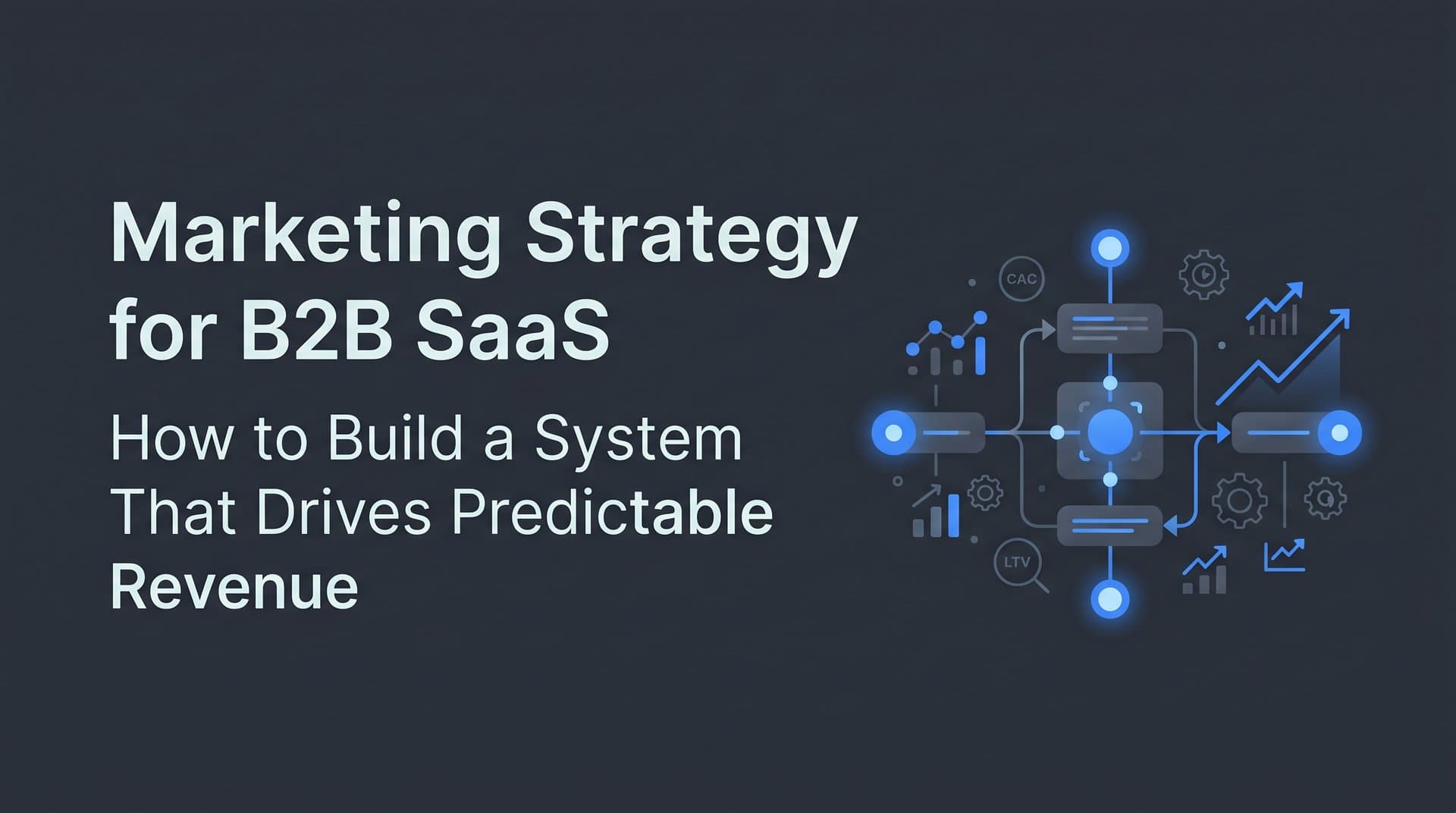
This article is about fixing that. What follows is a practical framework for building a B2B SaaS marketing strategy that connects acquisition, nurture, and revenue attribution into one cohesive system. You will learn how to define your ideal customer profile with precision, structure your channel mix based on your sales motion, build a paid acquisition engine that scales, and measure performance against metrics that actually reflect business outcomes. By the end, you will have a clear picture of what a purpose-built marketing strategy looks like for SaaS, and how to start building one that drives predictable revenue.
Why B2B SaaS Marketing Operates by Different Rules
Pick up any general marketing framework and you will find advice built around a simple model: attract attention, capture a lead, close the sale. That model assumes a relatively short decision cycle, a single buyer, and a transaction that ends at purchase. B2B SaaS breaks every one of those assumptions.
A typical SaaS deal involves an economic buyer who controls budget, a technical evaluator who assesses fit with the existing stack, and end users who will live with the product daily. Each of these stakeholders has different concerns, consumes different content, and needs to be addressed with different messaging. A campaign that speaks only to one persona will stall the deal at the stakeholder who feels ignored.
The subscription model adds another layer of complexity. Because revenue is recurring, acquiring a customer who churns in three months is often worse than not acquiring them at all. This is why CAC and LTV are the north star metrics in SaaS, not raw conversion volume. A marketing strategy that fills the funnel with low-quality leads might look productive on a dashboard while quietly destroying unit economics.
There is also a critical distinction that many B2B SaaS teams conflate: demand generation versus lead generation. Demand generation creates awareness and interest in a problem or category. Lead generation captures contact information from people who have already shown interest. These are related but distinct strategies, and underinvesting in demand generation is one of the most common reasons lead generation campaigns produce poor results. If you have not built awareness at the top of the funnel, the leads you capture at the bottom tend to be lower quality and harder to close.
Finally, the rise of product-led growth has added a new strategic fork in the road. Companies with a PLG motion optimize for free trial activations and product qualified leads. Companies with a sales-led motion focus on demo requests and MQL-to-SQL conversion rates. The right marketing channels, content types, and conversion offers look very different depending on which path you are on. Trying to run both motions simultaneously without a clear strategy often results in neither working particularly well.
Understanding these dynamics is not just academic. It shapes every tactical decision that follows, from which channels you invest in to how you define a qualified lead to what your attribution model needs to capture.
The Core Pillars Every B2B SaaS Marketing Strategy Needs
Before you write a single ad or publish a piece of content, you need three foundational pillars in place. Without them, even well-executed tactics will underperform.
Positioning and ICP definition: This is where everything starts. Your ideal customer profile should go well beyond industry and company size. It should include growth stage, tech stack, the specific pain point your product solves, and the trigger events that cause a company to start looking for a solution. The more granular your ICP, the more precisely you can target, the more your messaging will resonate, and the higher your conversion rates will be at every stage of the funnel. Campaigns built for everyone convert for no one.
Channel strategy aligned to your sales motion: Not every channel makes sense for every SaaS company. LinkedIn Ads excel for enterprise and mid-market B2B SaaS because of the precision of professional targeting by job title, seniority, and company size. Google Ads captures high-intent search demand from buyers who are already looking for a solution. Meta can be effective for SMB-focused SaaS or retargeting audiences who have already engaged with your brand. The right mix depends on your average contract value, sales cycle length, and where your ICP actually spends time. A $50,000 ACV deal warrants a different channel investment than a $500 per month self-serve product.
A full-funnel framework: B2B SaaS buyers move through awareness, consideration, and decision stages, and each stage requires a different approach. Awareness-stage content builds category recognition and surfaces your brand to buyers who do not yet know they have a problem you can solve. Consideration-stage content helps buyers evaluate solutions and positions your product favorably against alternatives. Decision-stage content removes friction and drives conversion. Most SaaS marketing teams over-invest in the bottom of the funnel and neglect the top, which creates a pipeline that looks healthy in the short term but dries up over time. A well-structured B2B SaaS marketing funnel is essential to sustaining long-term pipeline health.
These three pillars are not a one-time exercise. As your product evolves, your ICP may shift. As your market matures, your channel mix will need to adapt. The companies that build durable growth treat these pillars as living documents, revisiting and refining them regularly rather than setting them once and moving on.
Building a Paid Acquisition Engine That Actually Scales
Paid acquisition is often where B2B SaaS marketing budgets are largest and where the most money is wasted. The difference between a paid engine that scales and one that plateaus usually comes down to structure, not spend.
Start with audience segmentation by funnel stage. Cold audiences who have never heard of your brand need different messaging than warm audiences who have visited your pricing page or watched a demo video. Running the same ad to both groups is one of the most common mistakes in B2B paid campaigns. Segment your audiences deliberately, and match your creative and offer to where each segment sits in the buying journey.
Your offer strategy matters as much as your targeting. In B2B SaaS, the right conversion offer depends on intent signals. High-intent buyers who are actively evaluating solutions respond well to demo requests or free trials. Mid-funnel buyers who are still building their understanding of the problem respond better to content offers: a detailed guide, a benchmark report, or a webinar that helps them think through their options. Pushing a demo offer to someone who is not yet aware they have a problem is a fast way to burn budget on clicks that never convert.
On the platform question, here is a practical way to think about allocation. LinkedIn is typically the right primary channel for enterprise and mid-market SaaS with longer sales cycles and high ACVs, because it lets you reach specific job titles at specific company sizes with precision that other platforms cannot match. Google Ads works best when there is clear search demand for the problem your product solves, capturing buyers who are actively searching for a solution. Meta is often underestimated for B2B SaaS retargeting, where you can re-engage warm audiences at a lower cost per impression than LinkedIn.
The attribution problem in paid B2B SaaS deserves its own attention. Last-click reporting tells you which ad a buyer clicked immediately before converting. It says nothing about the six other touchpoints they had with your brand over the previous three months. In a long sales cycle, last-click attribution systematically undervalues top-of-funnel channels like content, brand awareness campaigns, and LinkedIn prospecting, while over-crediting the bottom-of-funnel retargeting ad that happened to be the final click. Budget decisions made on last-click data will gradually defund the channels that actually build pipeline and over-invest in the channels that just close it.
Multi-touch attribution models, whether linear, time-decay, or data-driven, give a far more accurate picture of which campaigns are contributing to revenue across the full journey. This is not just a measurement preference. It is a strategic necessity for any B2B SaaS company trying to scale paid acquisition with confidence. Understanding B2B revenue attribution across sales-led and PLG motions is critical to choosing the right model for your business.
Measuring What Actually Moves the Revenue Needle
Vanity metrics are comfortable because they tend to go up and to the right. Impressions grow. Click-through rates improve. MQL volume increases. And then the board asks how much revenue marketing drove last quarter, and the answer gets complicated.
The SaaS marketing metrics that connect to business outcomes are a specific set. MQLs and SQLs matter, but only as leading indicators. What leadership ultimately cares about is pipeline velocity (how quickly deals move through the funnel), CAC (how much it costs to acquire a customer), CAC payback period (how long it takes to recoup that investment), and revenue attribution by channel (which sources are actually contributing to closed-won deals). Each of these connects marketing activity directly to business health in a way that impressions and clicks simply do not. Tracking the right SaaS marketing metrics is what separates teams that can defend their budget from those that cannot.
Connecting ad spend data to CRM pipeline and closed-won revenue is the step where most marketing teams fall short. The data exists in multiple systems: ad platforms hold spend and click data, the CRM holds deal and revenue data, and the website holds behavioral data. When these systems are siloed, marketing can only report on the top of the funnel. When they are connected, marketing can show its contribution to the bottom line, not just the volume of leads it generated.
Accurate conversion tracking is the backbone of all of this. Browser-based pixels have become increasingly unreliable due to privacy changes, ad blockers, and cookie deprecation. Server-side tracking via Conversion APIs, including Meta CAPI and Google Enhanced Conversions, restores signal quality by sending conversion events directly from the server rather than relying on the browser. This matters for two reasons: it gives you more accurate attribution data for your own reporting, and it sends better signals back to the ad platforms, which improves their optimization algorithms and ultimately your campaign performance.
First-party data strategy is increasingly important in this context. Companies that build robust first-party data collection, through their own CRM, product analytics, and server-side tracking, are less exposed to the signal loss that affects teams relying entirely on third-party cookies and platform-reported conversions. This is not a technical nicety. It is a competitive advantage in an environment where data quality is becoming a key differentiator in marketing efficiency.
The goal is a measurement system where every dollar of ad spend can be traced to its contribution to pipeline and revenue. That level of visibility changes the quality of every budget decision you make.
Using Data to Optimize and Scale With Confidence
Having good data is only valuable if you act on it. The optimization layer of a B2B SaaS marketing strategy is where attribution data translates into smarter decisions and compounding returns.
Start with channel and campaign-level attribution. When you can see which channels are generating the highest-quality pipeline, not just the most leads, you can reallocate budget toward what is working and away from what is not. This sounds obvious, but it is surprisingly rare in practice. Most teams make budget decisions based on cost per lead or last-click conversions rather than pipeline contribution and revenue attribution. The difference in outcomes can be significant. The best marketing attribution tools for B2B SaaS make this level of channel-level visibility achievable without requiring a dedicated data team.
AI-driven recommendations are changing what is possible in marketing optimization. Modern attribution platforms can surface insights that would take an analyst days to find manually, such as identifying which ad creatives are driving the highest pipeline value, which audience segments have the best CAC-to-LTV ratio, or which campaigns are generating leads that consistently stall at a specific stage in the sales cycle. These are the kinds of insights that allow you to make precise, high-confidence adjustments rather than educated guesses.
Feeding better signals back to ad platforms is another dimension of this. When you send enriched, conversion-ready events back to Meta, Google, and other platforms, their machine learning algorithms have better data to optimize against. Instead of optimizing for a form fill, the platform can optimize for the types of conversions that actually become customers. This closes a loop that many B2B SaaS teams leave open, and it often produces meaningful improvements in campaign efficiency without requiring any change to creative or targeting.
A unified marketing dashboard is the operational foundation for all of this. When leadership can see ad performance, customer journey data, and revenue attribution across every channel in one place, decision-making becomes faster and more confident. The alternative, pulling data from five different tools and reconciling it in a spreadsheet, is slow, error-prone, and almost always results in someone making a decision based on incomplete information. A data-driven marketing strategy built on unified reporting is what enables teams to move quickly without sacrificing accuracy.
The compounding effect of good data is real. Better measurement leads to better decisions. Better decisions lead to more efficient spend. More efficient spend generates more pipeline per dollar, which improves CAC payback period, which gives you more room to invest in growth. This virtuous cycle is what separates marketing organizations that scale sustainably from those that grow erratically and struggle to explain why.
From Strategy to Scalable Growth: Your Starting Point
A complete marketing strategy can feel overwhelming to build from scratch, especially if your current setup is a patchwork of tools, channels, and campaigns that evolved organically over time. The good news is that you do not need to rebuild everything at once. You need to start in the right order.
Begin with an honest audit of your current state. Where are the gaps in your tracking? Are you capturing every touchpoint from first ad click to closed-won revenue, or are there stages in the journey where data disappears? Are your ad platforms, CRM, and website analytics connected, or are they siloed? Do you have a clear, documented ICP, or is your targeting based on assumptions that have never been validated? These gaps are worth identifying before you add more spend to the system.
Next, get your measurement foundation right. Instrument your server-side tracking, connect your conversion events to your CRM data, and make sure your attribution model reflects the reality of your sales cycle rather than the convenience of last-click reporting. This step is unglamorous, but it is the one that makes everything else more effective. You cannot optimize what you cannot measure accurately.
Once your tracking is solid, layer in your channel strategy and paid acquisition engine with the confidence that comes from knowing your data is reliable. Start with the one or two channels most aligned to your ICP and sales motion, build proof of concept, and then expand. Trying to run five channels simultaneously before you have attribution clarity is a common and expensive mistake.
The compounding effect of connecting your ad platforms, CRM, and analytics into one attribution system takes time to build, but the payoff is a marketing operation that improves continuously. Better data leads to better decisions. Better decisions lead to more efficient growth. That is the system every B2B SaaS marketing team should be building toward.
Building a Marketing System That Drives Predictable Revenue
B2B SaaS marketing success is not about running more campaigns. It is about building a system where every touchpoint is tracked, every dollar is accountable, and decisions are driven by real revenue data rather than top-of-funnel proxies.
The framework outlined in this article, from ICP clarity and channel strategy to paid acquisition structure, revenue-connected measurement, and AI-driven optimization, is designed to give you that system. Each element reinforces the others. Strong positioning makes your paid campaigns more effective. Accurate tracking makes your attribution reliable. Reliable attribution makes your optimization decisions smarter. Smarter decisions compound into more efficient growth over time.
This is where Cometly fits in. Cometly is the attribution and analytics layer that connects your ad platforms, CRM, and website data into one clear picture of what is actually driving revenue. With multi-touch attribution, server-side conversion tracking, Conversion API integrations, and AI-driven recommendations, Cometly gives B2B SaaS marketing teams the visibility they need to move beyond vanity metrics and start making decisions based on pipeline and revenue data.
Whether you are trying to understand which campaigns are generating your best customers, prove marketing's contribution to closed-won revenue, or feed better signals back to your ad platforms to improve targeting, Cometly provides the infrastructure to do it accurately and at scale.
The B2B SaaS companies that win are the ones that treat marketing as a system, not a collection of campaigns. If you are ready to build that system, start with the data foundation that makes everything else possible.
Get your free demo today and see how Cometly connects every touchpoint to revenue so you can scale your marketing strategy with confidence.