You pause your paid campaigns for a week to run a budget review. You expect pipeline to dip. It barely moves. Then you turn the ads back on, and the dashboard immediately shows strong ROAS again. Something does not add up.
This is one of the most disorienting experiences in SaaS marketing, and it happens more often than most teams admit. The ad platform reports look healthy. The attribution model assigns credit confidently. But the underlying business signal tells a different story.
The disconnect comes down to a fundamental limitation in how most teams measure advertising performance. Attribution models are credit-allocation systems. They observe which touchpoints were present before a conversion and distribute credit among them. What they cannot tell you is whether those touchpoints actually caused the conversion, or whether the user would have converted anyway through organic search, a colleague's referral, or a direct visit they would have made regardless of any ad.
Incrementality testing solves that problem. Instead of asking "which touchpoints were present?" it asks "which touchpoints caused something that would not have happened otherwise?" That shift from correlation to causation is the difference between optimizing toward reported performance and optimizing toward real business impact.
This guide is written for SaaS marketing and growth teams who are ready to move beyond vanity metrics and understand the true causal lift their ad spend is generating. We will cover what incrementality testing is, how to run it, where it breaks down, and how to connect the findings to smarter budget decisions.
Why Attribution Leaves SaaS Marketers Guessing
Attribution models do a useful job of mapping the customer journey. They show you which channels and campaigns were present before a conversion event, and they distribute credit according to a set of rules, whether that is last click, first click, linear, or data-driven. The problem is that credit and causation are not the same thing.
Consider a classic scenario. A prospect searches for your brand name, clicks a Google ad, and signs up for a trial. Last-click attribution gives full credit to that branded search campaign. But here is the honest question: would that person have found you anyway? If they were already searching your brand name, the answer is probably yes. The ad captured existing intent rather than creating new demand.
This distinction matters enormously in B2B SaaS, where buying cycles are long and multi-touch. A typical SaaS prospect might encounter your content through organic search, see a LinkedIn ad three weeks later, visit a review site like G2, receive a retargeting ad, and then convert through a direct visit. Every attribution model will slice that journey differently, but none of them can tell you which of those touchpoints genuinely moved the needle versus which ones simply happened to be present.
Retargeting campaigns are a particularly common example of this problem. Retargeting audiences are high-intent by definition. They have already visited your site, which means many of them are already on a path toward conversion. When a retargeting ad reaches them and they convert, the ad receives attribution credit. But if a meaningful portion of that audience would have converted anyway, the spend is partially wasteful even though the dashboard looks great.
The practical consequence is budget misallocation at scale. Teams increase spend on channels that look productive in attribution reports but are largely harvesting demand that would have arrived regardless. Meanwhile, channels that are actually generating new demand get undervalued because they operate earlier in the funnel where attribution credit is harder to capture.
For SaaS companies with complex, multi-stakeholder buying processes, this misallocation compounds over time. The longer the sales cycle and the more touchpoints involved, the wider the gap between what attribution reports and what is actually happening in the market.
The Mechanics of Incrementality Testing
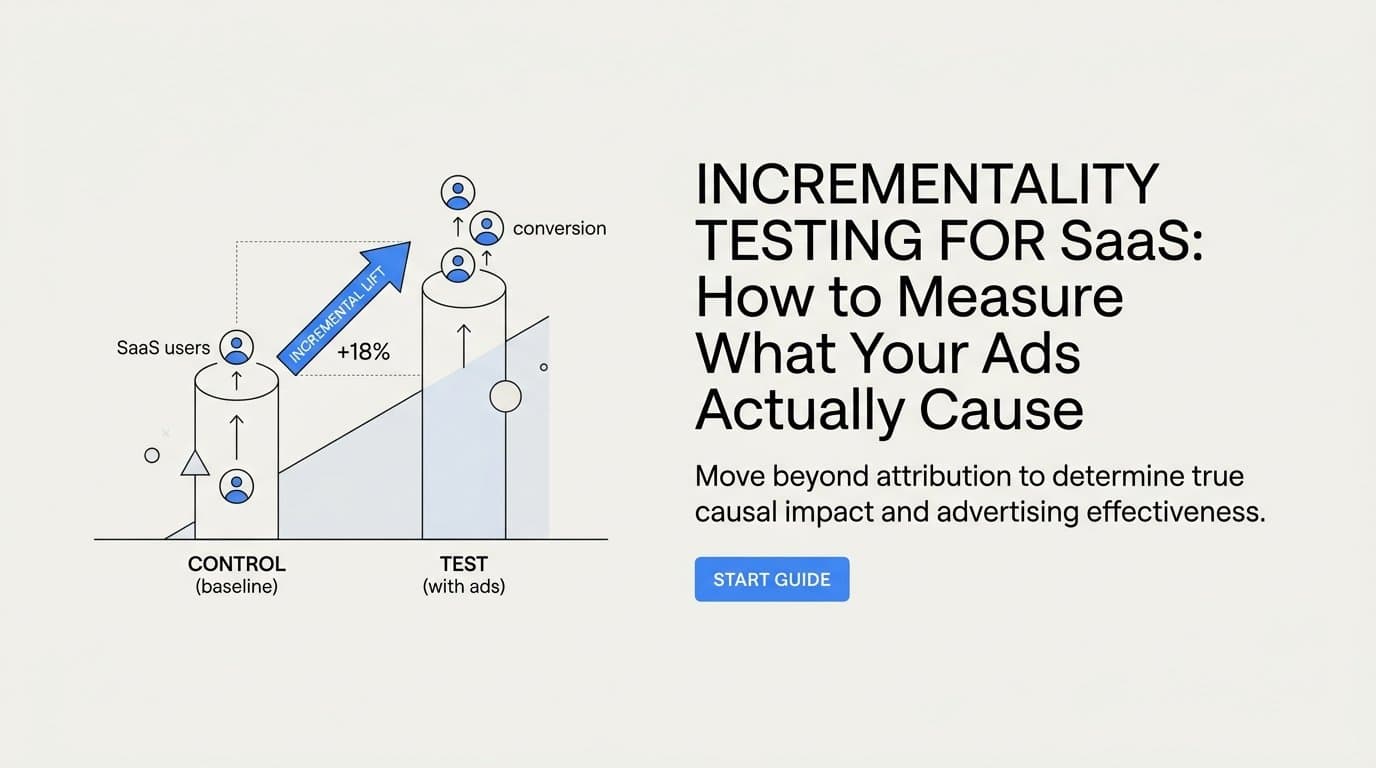
Incrementality testing is rooted in causal inference methodology. The core concept is establishing a counterfactual: what would have happened if the ad had never been shown? Since you cannot simultaneously show and withhold an ad from the same person, incrementality tests use a controlled experiment to approximate that counterfactual.
The structure is straightforward. You divide your audience into two groups. The test group receives ads as normal. The control group, sometimes called the holdout group, is withheld from seeing those ads. After the test runs for a sufficient period, you compare conversion rates between the two groups. The difference represents the true incremental lift the ads produced.
If your test group converts at a rate of 4% and your control group converts at 3.2%, your incremental lift is 0.8 percentage points. That gap is the portion of conversions you can genuinely attribute to the ad exposure. Everything else would have happened anyway.
For SaaS teams, there are two primary test structures worth understanding.
Geo-based holdout tests: You withhold ads in specific geographic regions while running them normally in others. The regions that do not receive ads serve as your control group. This approach is operationally simpler and works well when your audience is geographically distributed. The tradeoff is that regional differences in audience composition, competitive dynamics, or seasonal behavior can introduce noise into your results.
User-level holdout tests: You randomly suppress ads for a selected percentage of your audience, typically 10 to 20 percent, and compare their conversion behavior to the audience that received ads. This approach produces cleaner results because the randomization controls for audience composition differences. The challenge is that it requires ad platform support for holdout groups and sufficient conversion volume to reach statistical significance.
One nuance worth understanding is the difference between measuring incrementality at the channel level versus the campaign level. A channel-level test asks whether paid social as a whole is driving incremental conversions. A campaign-level test asks whether a specific prospecting campaign is driving lift beyond what your other campaigns would produce. Both are valuable, but they answer different questions and require different test designs.
For most SaaS teams starting out with incrementality measurement, beginning at the channel level with your highest-spend channel is the most practical entry point. It produces the clearest signal with the least operational complexity.
Running an Incrementality Test: A Practical Framework
Incrementality testing sounds rigorous, and it is, but the execution does not need to be overwhelming. Breaking it into three clear steps makes the process manageable for most SaaS marketing teams.
Step one: Define the right conversion event. This is where many teams go wrong. It is tempting to measure incrementality against easy-to-count events like clicks or landing page visits because they generate more volume and reach statistical significance faster. But for SaaS companies, the conversion events that matter are trial starts, demo requests, qualified pipeline, and paid conversions. The incremental value of an ad looks very different depending on where in the funnel you measure. An ad might generate significant lift in trial starts but negligible lift in trial-to-paid conversion. Knowing which conversion event you care about before you design the test keeps your findings actionable.
Step two: Design a clean test and control split. Three elements determine whether your test produces reliable results.
First, randomization. The test and control groups must be randomly assigned. Any systematic difference in how groups are constructed will contaminate your results. If your control group skews toward a particular region, company size, or traffic source, the conversion rate difference you observe may reflect that composition difference rather than the effect of the ads.
Second, sample size. Statistical significance requires enough conversion events in both groups to distinguish a real signal from random variation. SaaS companies with lower monthly conversion volumes may need to run longer tests or use geo-based holdouts that aggregate conversions across larger populations. Running a test with 30 conversions in each group and declaring a winner is a common mistake that produces unreliable conclusions.
Third, test duration. This is especially important for SaaS. If your average sales cycle from first touch to trial start is three weeks, running a one-week test will not capture the full effect of the ads you are measuring. A useful rule of thumb is to run tests for at least one to two full sales cycle lengths. For products with 30 to 60 day average cycles, that means tests should run for four to eight weeks minimum.
Step three: Interpret results with context. A positive incremental lift confirms that the channel is generating conversions it genuinely caused, and that is a signal to maintain or increase investment. A near-zero lift means the channel is largely capturing demand that would have arrived anyway, which is a signal to reduce spend or restructure the campaign toward audiences with less existing intent. A negative lift, while uncommon, can occur when ad exposure actually suppresses conversions, for example, if aggressive retargeting is creating friction for users who were already close to converting organically.
Interpret results against your specific business context. A 0.5% incremental lift on a high-ACV SaaS product might represent significant revenue impact even if it looks modest as a percentage.
Common Pitfalls That Distort Incrementality Results
Even well-designed incrementality tests can produce misleading results if certain failure modes are not anticipated. Understanding these pitfalls before you run a test is far more useful than discovering them after you have made budget decisions based on flawed data.
Group contamination in B2B environments. This is the most common and most underappreciated problem for SaaS teams specifically. In B2B SaaS, you are often selling to buying committees, not individuals. A single company might have five people involved in the evaluation process. If two of those people are in your test group and three are in your control group, your holdout is no longer clean. Ad exposure at the account level creates spillover effects that blur the line between test and control.
The solution is to design holdouts at the account level rather than the user level when you are running B2B campaigns. Suppress or allow ads for all known contacts at a given company domain, not just individual users. This requires more sophisticated audience management but produces far more reliable results in B2B contexts.
Seasonality and external demand shocks. If your test period overlaps with a product launch, a major industry event, a competitor announcement, or a pricing change, the external signal will overwhelm the incremental signal you are trying to measure. SaaS teams should avoid running incrementality tests during periods of unusual demand volatility. Picking a stable, representative period in your marketing calendar gives you the cleanest baseline to work from.
Testing too many variables simultaneously. It is tempting to run incrementality tests across multiple channels at the same time to accelerate learning. The problem is that when you withhold ads from multiple channels simultaneously, you lose the ability to isolate which variable drove the observed difference in conversion rates. Start with your highest-spend channel and test it in isolation. Once you have a reliable baseline reading for that channel, you can expand to multi-channel incrementality measurement with a clearer framework for interpreting results.
Undercounting conversions in the control group. If your conversion tracking has gaps, whether from pixel failures, ad blocker interference, or iOS privacy restrictions, your control group's conversion rate will appear artificially low. That makes the lift from the test group look larger than it actually is. This is why tracking quality is not just a data hygiene issue. It is a prerequisite for credible incrementality measurement.
Connecting Incrementality Testing to Your Attribution Data
A common misconception is that incrementality testing and attribution are competing methodologies. They are not. Incrementality testing calibrates attribution. The two work together to give you a fuller picture of what your marketing is actually doing.
Think of it this way. Attribution tells you the story of which touchpoints were present across your converting customers' journeys. Incrementality testing tells you how much of that story reflects genuine causation versus coincidence. When you run an incrementality test and compare the results to what your attribution model is reporting, you can identify where your model is over-crediting or under-crediting specific channels.
For example, if your data-driven attribution model shows Google Search driving a significant share of conversions, but an incrementality test on that channel reveals only modest lift, that is a meaningful signal. It suggests your attribution model is giving credit for demand that would have arrived through organic means anyway. You do not necessarily stop investing in Google Search, but you recalibrate how much weight that channel carries in your budget allocation decisions.
This calibration process depends entirely on the quality of the underlying conversion data. Incrementality testing amplifies both the strengths and weaknesses of your tracking infrastructure. If your conversion events are incomplete because of pixel gaps, if your CRM is not connected to your ad platform data, or if you are missing touchpoints from the middle of the funnel, the baseline conversion rates you are measuring will be inaccurate. Inaccurate baselines produce unreliable lift calculations.
Server-side tracking and Conversion API integrations address this problem by capturing conversion signals that client-side pixels miss. When a user converts in an environment where a browser pixel would be blocked, server-side tracking ensures that event is still recorded accurately. That completeness is what makes the control group baseline trustworthy.
This is where platforms like Cometly create a meaningful advantage for SaaS teams running incrementality analysis. By connecting ad platform data, CRM events, and website behavior in a single unified view, Cometly provides the enriched, complete conversion data that incrementality tests depend on. When every touchpoint is captured accurately, from the first ad click to the closed-won event in your CRM, the signal-to-noise ratio in your tests improves dramatically. You are measuring real behavior, not a partial picture of it.
Turning Incrementality Findings into Smarter Budget Decisions
Incrementality testing is only valuable if it changes how you allocate budget. The findings should translate directly into a tiered channel strategy based on measured causal impact rather than reported attribution credit.
Channels with high incremental lift deserve increased investment. These are the channels that are genuinely creating demand, reaching audiences who would not have found you through organic means, and producing conversions that would not have happened otherwise. Non-brand paid search, social prospecting campaigns targeting new audiences, and content syndication that reaches buyers outside your existing network often fall into this category.
Channels with low incremental lift should be reduced or restructured. Low lift does not necessarily mean zero value. Branded search, for example, typically shows high attribution credit but low incremental lift because users searching your brand name are already on a path toward conversion. The question is whether the marginal cost of capturing that traffic through paid ads is justified, or whether organic presence would capture most of it anyway.
Channels with negative or near-zero lift should be paused or replaced with demand generation alternatives that reach audiences outside your existing intent pool. Spending budget to reach people who were already going to convert is not just inefficient. It crowds out investment in channels that could be expanding your addressable market.
The cadence of testing matters as much as the methodology. Incrementality findings from a test run six months ago may not reflect current reality. Audience saturation changes as you exhaust high-fit segments. Creative fatigue reduces ad effectiveness over time. Competitive dynamics shift. Building a quarterly or bi-annual testing cadence ensures your budget allocation reflects what is working now, not what worked historically.
The ultimate goal is a measurement system where every dollar of ad spend is connected to genuine pipeline and revenue impact. When incrementality data is layered on top of multi-touch attribution and real-time conversion tracking, SaaS marketing teams gain the measurement confidence to scale winning channels aggressively and cut wasteful spend without second-guessing themselves.
Moving From Correlation to Causation in Your Growth Strategy
Incrementality testing represents a fundamental shift in how SaaS marketing teams think about measurement. Attribution tells you a story about correlation. Incrementality testing tells you the truth about causation. For teams managing meaningful ad budgets across complex, multi-touch buying journeys, that distinction is worth a significant amount of money.
SaaS companies have more to gain from this approach than almost any other business model. Long sales cycles, multi-stakeholder buying committees, and layered conversion funnels create the exact conditions where the gap between reported performance and real performance is widest. The more complex your buying environment, the more valuable it is to know what your ads are actually causing versus what they are simply coinciding with.
The path forward starts with data quality. You cannot run credible incrementality tests without accurate, complete conversion tracking. Server-side event capture, CRM integration, and a unified view of the customer journey are not optional enhancements. They are the infrastructure that makes causal measurement possible.
If you are ready to build that foundation and start connecting ad spend to genuine pipeline impact, Cometly gives SaaS marketing teams the accurate, enriched conversion data that makes both attribution analysis and incrementality testing reliable. Get your free demo and see how complete customer journey visibility transforms the confidence behind your growth decisions.