Every day, marketers make budget decisions based on data they trust but probably should not. They look at their ad platform dashboards, see the conversion numbers, calculate a cost-per-acquisition, and decide where to scale. The problem is that those numbers are often wrong, and not by a small margin.
Browser-based tracking has been quietly breaking down for years. Ad blockers, iOS privacy changes, and increasingly strict browser restrictions have created a growing gap between what actually happens and what your pixels report. The conversions that disappear into that gap do not show up as missing. They just vanish, leaving you with a dashboard that looks complete but is telling an incomplete story.
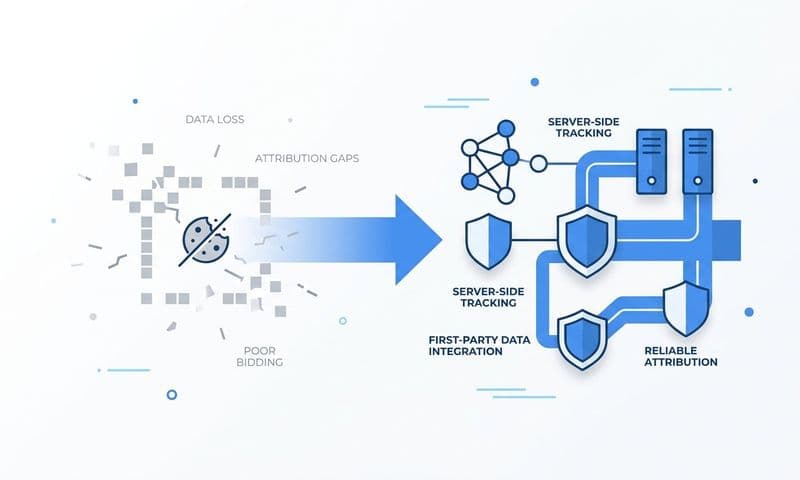
This is why server-side tracking platforms provide the most reliable foundation for modern marketing measurement. By moving event-firing logic off the user's browser and onto a server you control, you sidestep the browser-level interference that silently corrupts client-side data. The result is a more accurate, more complete picture of what your ads are actually doing, and that accuracy has real consequences for how you allocate budget, optimize campaigns, and grow revenue.
This article breaks down exactly why browser-based tracking is failing, how server-side tracking works, and what to look for in a platform that can give you data you can actually trust.
The Quiet Collapse of Browser-Based Tracking
Client-side tracking sounds simple in theory. A user clicks your ad, lands on your website, completes a purchase, and a JavaScript pixel fires to record the conversion. Clean, straightforward, reliable. Except it is increasingly none of those things.
Ad blockers are one of the most visible culprits. When a user has an ad blocker installed, it often prevents tracking scripts from loading entirely. The conversion happens, the revenue hits your account, but the pixel never fires. From your ad platform's perspective, that customer does not exist. The gap this creates is not random noise. It is systematic under-reporting that skews every metric downstream.
Browser privacy settings compound the problem. Safari's Intelligent Tracking Prevention, commonly known as ITP, limits how long cookies can persist on a user's device. In some cases, first-party cookies set by JavaScript are capped at just seven days, or even twenty-four hours under certain conditions. That means a user who clicks your ad today and converts next week may never be connected back to the original touchpoint. The attribution chain breaks, and your campaign gets no credit for a sale it drove.
Then there is the iOS App Tracking Transparency framework, which gave users an explicit opt-out from cross-app tracking. When users decline tracking, the data that would have connected an ad impression to a downstream conversion simply does not flow. For campaigns running on Meta and other mobile-heavy platforms, this created a meaningful reduction in reported conversion data, particularly for iOS audiences.
What makes this especially damaging is that the data loss is invisible from inside your dashboard. You are not seeing red flags or error messages. You are seeing lower conversion numbers, higher cost-per-acquisition figures, and campaign performance metrics that look like strategic problems when they are actually measurement problems.
The downstream effect on ad platform algorithms is significant. Platforms like Meta and Google use reported conversion data to optimize delivery. When your pixel under-reports conversions, the algorithm learns from an incomplete signal. It may deprioritize audiences that are actually converting well, or continue spending on placements that look efficient in the data but are only appearing efficient because their conversions are being captured while others are not.
The result is a feedback loop where bad data produces worse optimization, which produces worse results, which leads marketers to draw the wrong conclusions about what is and is not working. Understanding what a tracking pixel is and how it works makes it easier to see why server-side tracking breaks that loop at the source.
Server-Side Tracking: The Architecture Shift That Changes the Equation
To understand why server-side tracking solves what client-side tracking cannot, it helps to understand the fundamental difference in how events are fired.
With browser-based tracking, the event-firing logic lives in the user's browser. Your pixel is a piece of JavaScript that runs on the visitor's device. If anything in that environment interferes with the script, whether it is an ad blocker, a privacy setting, or a browser restriction, the event does not get recorded. You have no control over what happens inside someone else's browser.
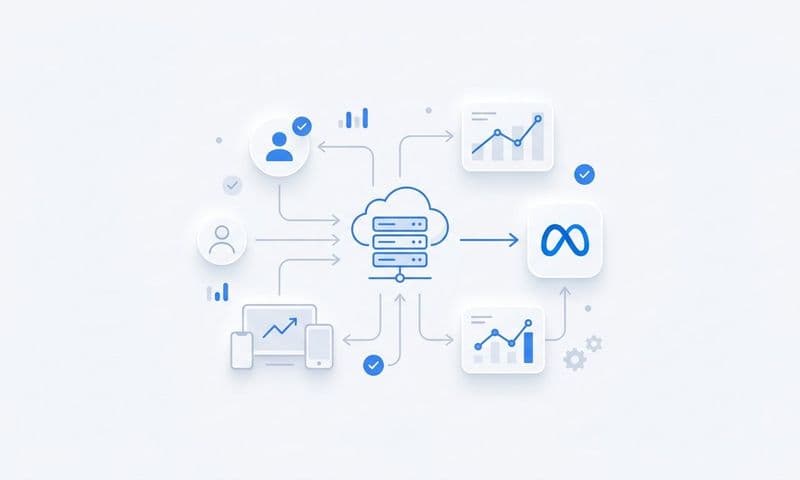
Server-side tracking moves that logic to a server you control. When a conversion occurs, your server captures the event and sends it directly to the ad platform's API. For Meta, that is the Conversions API. For Google, it is Enhanced Conversions. For TikTok, it is the Events API. Each of these is a server-to-server connection that bypasses the browser entirely. Ad blockers cannot block a server-to-server API call. Browser privacy settings cannot interfere with it. Cookie restrictions are irrelevant.
The event fires because your server fires it, not because the user's browser cooperated.
This architectural shift has a second major advantage beyond reliability: data enrichment. When you control the server sending the event, you can attach additional information to that event before it reaches the ad platform. CRM data, order values, customer lifetime value signals, hashed email addresses, phone numbers, and other identifiers can all be appended to the conversion event.
This matters enormously for platforms like Meta, which use an Event Match Quality score to measure how well the customer information in an event matches an actual Meta user profile. A pixel-only setup typically sends limited data because it is constrained by what the browser can access at the moment of the event. A server-side setup can pull from your CRM and send a richer, more complete customer profile alongside the conversion signal.
Higher event match quality means better attribution. Better attribution means the algorithm knows more precisely who converted and can use that information to find more people like them. The enrichment capability of server-side tracking is not just a nice-to-have. It is a direct input into how well your ad campaigns optimize.
Google's Enhanced Conversions works on a similar principle, using hashed first-party data to improve the accuracy of conversion measurement when cookies and pixels fall short. By sending this data server-side, you ensure it reaches Google's systems regardless of browser behavior. Exploring the top server-side tracking tools available today can help you identify which solution fits your infrastructure best.
The Core Advantages Server-Side Platforms Provide Over Pixel-Only Setups
Once you understand the mechanics, the practical advantages of server-side tracking become concrete and measurable in how your campaigns perform.
Higher Event Match Quality on Meta: As mentioned, Meta's Conversions API rewards richer data with better match quality scores. When your server sends a conversion event that includes a hashed email, phone number, and name alongside the standard event parameters, Meta can match that event to a real user profile with much greater confidence. This directly improves how the algorithm attributes conversions and how it optimizes future delivery. A pixel-only setup sends less data, scores lower on match quality, and gives the algorithm less to work with.
More Complete Conversion Data for Algorithmic Learning: Ad platform algorithms are only as good as the data they train on. When your conversion data is incomplete because pixels are being blocked or cookies are expiring, the algorithm learns from a distorted sample. It may over-index on certain audiences, devices, or times of day simply because those happen to be the ones where tracking is more reliable. Server-side tracking produces a more representative data set, which gives the algorithm a more accurate picture of what is actually converting. Over time, this compounds into better audience targeting, stronger lookalike audiences, and more efficient budget allocation.
Reduced Data Loss Across the Customer Journey: Multi-touch journeys that span multiple devices, multiple sessions, or multiple days are particularly vulnerable to pixel-based data loss. A user who clicks an ad on their phone, does research on a desktop, and converts a week later on a tablet is almost impossible to track accurately with cookies alone. Server-side tracking, especially when connected to CRM data, can stitch these touchpoints together using persistent identifiers like hashed email addresses rather than relying on browser cookies that may have expired or been blocked.
A More Accurate View of True Return on Ad Spend: When you are under-reporting conversions, your calculated return on ad spend is artificially low. You may be pulling budget from channels that are actually performing well because the data makes them look inefficient. Server-side tracking closes that gap, giving you a conversion count that more closely reflects reality. The channels you were about to cut may turn out to be your strongest performers once the full picture is visible. Reviewing the best conversion tracking tools can help you find a solution that captures this complete picture across every channel.
These advantages are not theoretical. They are the direct result of sending cleaner, more complete signals to the systems that determine how your ad budget gets spent.
What to Look for in a Server-Side Tracking Platform
Not all server-side tracking solutions are built the same. If you are evaluating platforms, there are a few capabilities that separate a genuinely useful solution from one that solves only part of the problem.
Multi-Platform Conversion Sync: Your ad spend is almost certainly spread across more than one channel. A server-side tracking platform should be able to send enriched conversion events to Meta, Google, TikTok, and other ad platforms from a single source of truth. Maintaining separate server-side integrations for each platform individually is operationally complex and creates inconsistencies in how data is processed. Look for a platform that centralizes this sync so the same enriched event data flows to every channel simultaneously.
Native CRM and Website Integration: The power of server-side tracking comes from the data you can attach to events. That data lives in your CRM, your website, and your order management systems. A platform that integrates natively with these sources can automatically enrich events with customer identifiers, deal values, and lifecycle stage information. This is what enables the richer event match quality scores and more complete attribution that make server-side tracking valuable. A platform that only captures page-level events without connecting to downstream CRM data is capturing only part of the customer journey.
Attribution Modeling Built Into the Platform: Raw server-side data tells you what happened. Attribution modeling tells you why it happened and which channels deserve credit. Look for a platform that layers attribution analysis on top of the server-side tracking infrastructure, giving you the ability to compare first-touch, last-touch, linear, and multi-touch credit models side by side. Understanding the most common ad attribution models is especially important for teams managing campaigns across multiple channels, where understanding how touchpoints interact is as valuable as knowing which individual touchpoint preceded a conversion.
Transparency and Data Visibility: You should be able to see your event data, understand how it is being processed, and verify that events are being sent and matched correctly. A platform that treats its tracking logic as a black box makes it difficult to diagnose issues or audit data quality. Look for platforms that surface event match quality scores, show you which events are being synced to which platforms, and give you visibility into the customer journey data that is flowing through the system.
How Accurate Server-Side Data Translates Into Better Ad Decisions
Cleaner data does not just improve your reporting. It changes what you do with your budget, and it changes what the ad platforms do with your budget on your behalf.
When Meta or Google receives more complete, higher-quality conversion signals, their optimization algorithms have more to work with. These algorithms are designed to find more people like your converters. The more accurately they can identify who your converters are, the better they can target future delivery. This is not a one-time improvement. It compounds. Each campaign cycle builds on the learning from the previous one, and that learning is only as good as the data feeding into it.
For marketers, the practical impact is the ability to make budget decisions with genuine confidence. When you know your conversion data is accurate, you can look at a channel's cost-per-acquisition and trust that it reflects reality. You can scale spend on channels that are actually driving revenue, not just channels that appear to be driving revenue because their conversions happen to be captured more reliably by your pixel.
This distinction matters more than it might seem. Pixel-based tracking tends to over-report conversions on channels where users are less likely to have ad blockers or strict privacy settings, and under-report conversions where those factors are more prevalent. This creates a systematic bias in your data that makes some channels look better than they are and others look worse. Server-side tracking removes that bias by capturing conversions consistently across all channels and devices.
AI-powered attribution tools amplify this advantage further. When an AI system is analyzing your campaign data to surface recommendations about which ads, audiences, and channels to scale, the quality of that analysis depends entirely on the completeness of the underlying data. An AI working from server-side enriched data can identify patterns and opportunities that would be invisible in a pixel-only data set. The recommendations it surfaces are grounded in a more complete picture of what is actually driving revenue. Leveraging the right ad tracking tools to scale using accurate data is what separates teams that grow efficiently from those that guess their way through budget decisions.
The practical outcome is a tighter feedback loop between what you spend and what you learn. Better data produces better optimization, which produces better results, which gives you better data to optimize from. This is the compounding advantage that server-side tracking unlocks over time.
Building a Tracking Foundation That Supports Long-Term Growth
It is tempting to think of server-side tracking as a technical fix for a specific measurement problem. It is more accurate to think of it as a foundational infrastructure decision that improves every downstream marketing activity.
Reporting becomes more reliable when the event data feeding your dashboards is complete. Forecasting becomes more accurate when your historical conversion data reflects what actually happened rather than what your pixels managed to capture. Budget planning becomes more defensible when you can point to clean, verified conversion data rather than numbers that carry an unknown margin of error.
The long-term compounding effect extends to your ad platform relationships as well. Platforms like Meta and Google reward advertisers who send high-quality signals. Better data quality translates into better algorithmic performance, which translates into better results at the same or lower cost. Over time, the gap between advertisers running server-side tracking and those relying on pixels alone is likely to widen as algorithms become more sophisticated and more dependent on first-party data quality.
Combining server-side tracking with multi-touch attribution setup gives marketing teams the most complete picture available. Server-side tracking ensures the raw event data is accurate and complete. Multi-touch attribution ensures that credit is assigned to channels in a way that reflects how they actually contribute to conversions, not just which one happened to be last. Together, they answer both the "what happened" and the "why it happened" questions that drive smart budget decisions.
Platforms like Cometly are built to operationalize exactly this combination. Cometly's server-side tracking captures events across the full customer journey, from first ad click through to closed revenue, and its Conversion Sync feature sends enriched event data back to Meta, Google, and other ad platforms automatically. On top of that, its multi-touch attribution and AI-powered analysis give marketing teams the ability to compare attribution models, identify high-performing campaigns, and get recommendations about where to scale, all from a single platform without stitching together multiple tools.
For teams that want to move from data they hope is accurate to data they know is accurate, that kind of integrated infrastructure is the difference between guessing and knowing.
The Bottom Line on Tracking Accuracy and Ad Performance
The central argument of this article is straightforward: server-side tracking platforms provide the most accurate, complete data available to modern marketers, and that accuracy has a direct and compounding impact on ad performance, budget allocation, and revenue growth.
Browser-based tracking was never designed to survive the privacy-first environment that now defines the web. Ad blockers, ITP, iOS privacy frameworks, and cookie restrictions have collectively created a world where pixel-only measurement is structurally unreliable. The conversions you are not seeing are not a minor rounding error. They are the signal your ad platforms need to optimize, and without them, you are flying partially blind.
Server-side tracking restores that signal. It captures events your pixels miss, enriches them with data that improves match quality, and sends them directly to the ad platforms that need them. The result is a more accurate view of what is working, a more efficient optimization loop, and the confidence to make budget decisions based on data you can actually trust.
Before you make your next budget decision, it is worth asking: how complete is the data behind it? If you are relying on pixels alone, there is a good chance the answer is "not complete enough."
Ready to elevate your marketing game with precision and confidence? Discover how Cometly's AI-driven recommendations can transform your ad strategy. Get your free demo today and start capturing every touchpoint to maximize your conversions.