
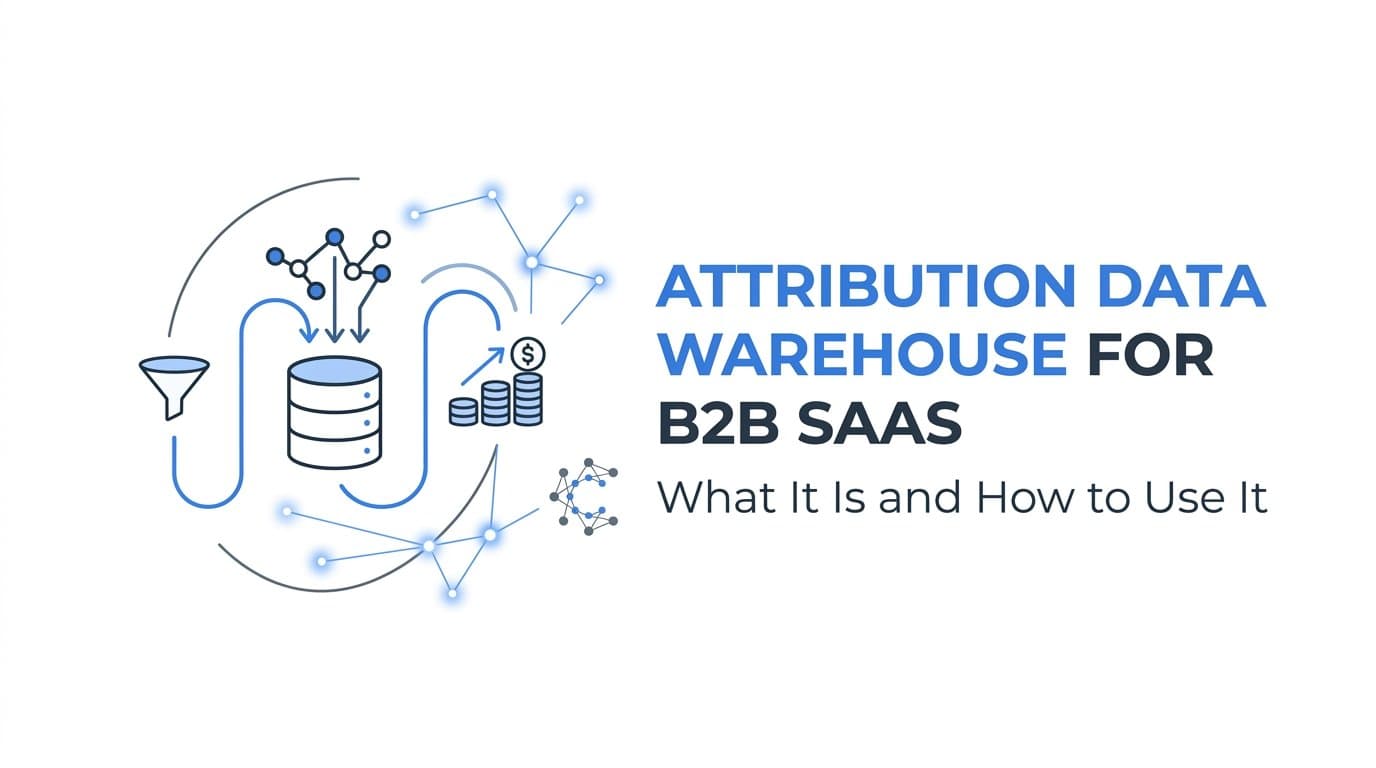
An attribution data warehouse for B2B SaaS is a centralized repository that consolidates touchpoint data from ad platforms, CRMs, and product analytics so revenue can be traced back to specific campaigns and channels. It is the connective tissue that links a Google Ad click in January to a closed-won deal in July, giving marketing and revenue teams a single, accurate picture of what is actually driving growth.
Cometly is built specifically for this problem. Rather than requiring a custom data warehouse build, Cometly connects your ad spend directly to pipeline and closed-won revenue through 70+ native integrations, multi-touch attribution, and Stripe revenue data, delivering the insights of a sophisticated data layer without the engineering overhead. For B2B SaaS teams that need answers now, not after a six-month data infrastructure project, that distinction matters enormously.
Here is why this matters so much for B2B SaaS specifically: the buying cycle is fundamentally different from e-commerce or B2C. Deals involve multiple stakeholders, span months or even quarters, and touch dozens of channels before a contract is signed. A prospect might discover your product through a LinkedIn ad, read three blog posts, attend a webinar, engage with a retargeting campaign, and then convert through a sales rep's outreach. Without a centralized attribution data layer that captures and connects every one of those moments, your budget decisions are built on guesswork.
Why B2B SaaS Attribution Breaks Without a Central Data Layer
Think about where your data actually lives today. Your ad platforms hold impression and click data. Your CRM tracks lead stages, opportunity progression, and closed deals. Your product analytics tool captures in-app behavior. Your billing platform records revenue. Each of these systems tells a coherent story within its own walls, but none of them can see what the others know.
This fragmentation is not just an inconvenience. It is the root cause of bad attribution. When data lives in disconnected silos, the default fallback is simple attribution models like last-click or first-touch. Last-click gives all the credit to whatever channel a prospect engaged with immediately before converting. First-touch gives all the credit to the very first interaction. Both models ignore everything in between, which in a B2B SaaS context can represent months of nurturing, multiple campaigns, and significant budget.
The practical consequence plays out in budget allocation. Imagine a channel that consistently assists pipeline creation, showing up early in the buyer journey and warming prospects before they engage with sales. Under last-click attribution, that channel gets zero credit because it rarely closes deals directly. So it gets cut. Meanwhile, the channel that happens to be the final touchpoint before a demo request gets over-funded, even though it was not the one doing the heavy lifting.
This misallocation compounds over time. Marketing teams cut the channels that are actually building pipeline and double down on channels that are simply capturing intent that other channels created. The result is slower growth, rising customer acquisition costs, and a marketing team that cannot explain why performance is declining despite spending more.
A centralized attribution data layer solves this by creating a unified record of every touchpoint across every channel, linked to the same customer journey. Instead of four partial stories, you get one complete one. And with that complete picture, attribution models can accurately distribute credit across all the channels and campaigns that contributed to a deal, not just the last one standing.
What an Attribution Data Warehouse Actually Contains
Understanding what lives inside an attribution data warehouse helps clarify why it is so powerful and why building one from scratch is more complex than it first appears.
At the core, an attribution warehouse consolidates several distinct categories of data. Ad impression and click events from platforms like Google, Meta, and LinkedIn form the top of the funnel. CRM stage progressions, tracking a contact's movement from MQL to SQL to opportunity to closed-won, represent the middle and bottom of the funnel. Website session data captures behavioral signals between paid touchpoints. Server-side conversion events provide a more reliable signal than browser-based pixels alone. And revenue data from billing tools like Stripe closes the loop by connecting marketing activity to actual dollars collected.
The structural challenge is stitching all of this together. Each data source uses different identifiers. Your ad platform knows a user by a click ID. Your CRM knows them by an email address or contact record. Your billing tool knows them by a customer ID. An attribution system must resolve these identities into a single persistent record so that every touchpoint from the first ad impression to the final invoice is linked to the same person and the same deal.
This is where the difference between a raw data warehouse and a purpose-built attribution platform becomes significant. A raw warehouse like Snowflake, BigQuery, or Amazon Redshift can store all of this data. But storing it is only the beginning. Someone still needs to write the SQL models that stitch identities together, define attribution logic, handle edge cases like multi-account contacts, and build the dashboards that surface insights. That work typically requires dedicated data engineering resources and ongoing maintenance as data schemas change.
A purpose-built attribution platform like Cometly handles all of that pre-built. Multi-touch attribution models, pipeline attribution, revenue attribution, and AI-driven insights are delivered out of the box. The 70+ native integrations pull data from your ad platforms, CRM, and billing tools automatically. The identity resolution and journey stitching happen in the background. What your marketing team sees is a clean, actionable view of which campaigns are driving pipeline and revenue, without writing a single line of SQL.
For teams with strong data engineering capacity and a need for highly customized data exploration, the raw warehouse path can make sense. For most B2B SaaS marketing teams, the purpose-built path delivers faster time-to-insight and lower total cost of ownership.
Attribution Models That Run on Warehouse-Level Data
Not all attribution models are created equal, and the model you choose has a direct impact on which campaigns receive budget and which get cut. The same underlying data can produce dramatically different credit allocations depending on the model applied.
First-touch attribution gives all credit to the first interaction a prospect had with your brand. It is useful for understanding awareness and top-of-funnel channel performance, but it ignores everything that happened between awareness and conversion. Last-click attribution does the opposite, crediting only the final touchpoint. Linear attribution spreads credit evenly across all touchpoints in the journey. Time-decay attribution gives progressively more credit to touchpoints that occurred closer to the conversion event.
Each of these models has legitimate use cases, but none of them are as accurate as data-driven attribution, which uses machine learning to assign credit based on the actual statistical contribution of each touchpoint to conversion outcomes. The catch is that data-driven attribution requires a sufficient volume of touchpoint data and a complete data set to be statistically reliable. If your data is fragmented across disconnected systems, data-driven attribution simply cannot function correctly because it is working with an incomplete picture of the customer journey.
This is why warehouse-level data is a prerequisite for sophisticated attribution, not a nice-to-have. When all touchpoint data feeds into one centralized system, data-driven models have the complete input they need to produce accurate credit allocation.
For B2B SaaS specifically, there is an additional layer of complexity: the relevant KPIs are not just conversion events. A lead that fills out a demo form is not revenue. A deal that closes six months after the original ad click is. This means pipeline attribution and revenue attribution are more meaningful measures than conversion-based attribution alone. Pipeline attribution credits campaigns for opportunities created. Revenue attribution credits campaigns for deals closed. Both require a data layer that connects ad activity to CRM outcomes and billing data, which is exactly what a well-structured attribution system provides.
How to Build or Buy an Attribution Data Warehouse for B2B SaaS
When it comes to standing up an attribution data layer, there are two distinct paths: build it yourself using raw infrastructure, or buy a purpose-built platform. The right choice depends on your team's engineering capacity, your time-to-insight requirements, and what you actually need the system to do.
The Build Path: This approach starts with a cloud data warehouse, typically Snowflake, Google BigQuery, or Amazon Redshift. ETL tools like Fivetran or dbt are used to extract data from ad platforms, CRMs, and billing tools and load it into the warehouse in a structured format. A BI tool like Looker or Tableau is then layered on top for visualization and reporting. This path offers maximum flexibility. You can model data exactly the way your business needs it, create custom attribution logic, and build reports that answer highly specific questions.
The trade-off is significant. The build path requires data engineering resources to design schemas, write transformation logic, maintain pipelines as data sources change their APIs, and troubleshoot data quality issues. For a B2B SaaS company with a dedicated data team and complex, unique attribution requirements, this investment can be justified. For most marketing teams, it represents months of work before the first attribution insight is available.
The Buy Path: Purpose-built attribution platforms like Cometly take a different approach. Ad platform data, CRM data, server-side conversion events via Conversion API, and Stripe revenue data are all consolidated through native integrations with no custom engineering required. Multi-touch attribution models, pipeline attribution, and revenue attribution are pre-built and ready to use from day one. The AI ads manager surfaces recommendations based on the complete data set, so your team can act on insights rather than spending time building the infrastructure to generate them.
How to Decide: Consider four factors. First, team size and engineering capacity: if you do not have data engineers available to build and maintain pipelines, the build path will stall. Second, time-to-insight: if you need attribution data this quarter, a purpose-built platform is the only realistic option. Third, the specificity of your requirements: if your attribution needs are standard multi-touch models applied to common B2B SaaS data sources, a platform like Cometly covers everything. Fourth, the goal: if you need flexible data exploration and custom modeling, a raw warehouse gives you that flexibility. If you need fast, actionable attribution answers that connect ad spend to revenue, a purpose-built platform gets you there without the infrastructure investment.
Feeding Ad Platforms Better Data From Your Attribution Layer
One of the most underutilized benefits of a centralized attribution data layer is what you can do with that data beyond your own reporting. When your attribution system becomes the source of truth, it also becomes the engine for improving the ad platform algorithms that drive your acquisition.
Server-side tracking and Conversion API integration, available through platforms like Meta CAPI and Google Enhanced Conversions, allow enriched, first-party conversion events to flow back to the ad platforms directly from your server rather than from a browser-based pixel. This matters because browser-based tracking is increasingly unreliable. Ad blockers, cookie restrictions, and browser privacy changes all degrade pixel-based signal. Server-side events bypass these limitations, ensuring that the ad platforms receive a more complete and accurate picture of what is converting.
But the real advantage comes from the quality of the events being sent back. When your attribution warehouse is the source of truth, the conversion events you send to Meta and Google are not just raw pixel fires. They are deduplicated, enriched with CRM context, and tied to actual business outcomes. Instead of sending a generic "lead form submitted" event, you can send an event that says "this contact became a qualified opportunity with an estimated deal value of X." That context allows ad platform algorithms to optimize toward the leads that actually convert to revenue, not just the leads that fill out forms.
The compounding effect of this feedback loop is significant. Better data sent to ad platforms improves audience targeting and campaign optimization. Better targeting generates higher-quality leads. Higher-quality leads produce cleaner, more consistent attribution data in the next cycle. Over time, your acquisition efficiency improves not just because your reporting is better, but because the ad platforms themselves are working with better inputs.
Cometly's Conversion API integration is built to enable exactly this workflow, sending enriched, conversion-ready events back to Meta, Google, and other platforms from the same system that is tracking your full customer journey.
Related Questions About Attribution Data Warehouses
Does B2B SaaS need a separate attribution tool or is a data warehouse enough?
A raw data warehouse stores data but does not apply attribution models, resolve customer identities across sources, or surface actionable insights. It is infrastructure, not intelligence. An attribution platform does both: it consolidates the data and applies the logic needed to translate raw touchpoints into credit allocation and budget recommendations. For most B2B SaaS teams, a purpose-built attribution platform delivers faster, more actionable results than a raw warehouse alone.
What is the difference between pipeline attribution and revenue attribution?
Pipeline attribution credits marketing campaigns for opportunities created in the CRM. Revenue attribution credits campaigns for deals that actually closed. In B2B SaaS, where the gap between pipeline creation and revenue recognition can span quarters, the distinction is critical. A campaign that generates a high volume of opportunities but closes few deals looks very different under pipeline attribution versus revenue attribution. Revenue attribution is the more accurate measure of marketing ROI because it connects spend to actual dollars collected.
Can server-side tracking replace a data warehouse?
Server-side tracking improves data capture and reduces signal loss by bypassing browser-based limitations, but it is one input into an attribution system, not a replacement for the centralized data layer that connects all sources. Server-side events tell you that a conversion happened. A full attribution system tells you which campaigns, channels, and touchpoints across the entire customer journey contributed to that conversion. Both are necessary; neither replaces the other.
How long does it take to get value from an attribution data warehouse?
With a custom-built warehouse, meaningful attribution insights typically take months to materialize after accounting for data engineering, pipeline setup, and modeling work. With a purpose-built platform like Cometly, integrations connect in hours and attribution data begins flowing immediately, so teams can start making data-informed budget decisions within days rather than quarters.
Putting It All Together
B2B SaaS companies with long sales cycles and multi-channel acquisition cannot make accurate budget decisions without a centralized attribution data layer. The fragmentation of data across ad platforms, CRMs, product analytics, and billing tools is not a minor inconvenience. It is the reason marketing budgets get misallocated, high-performing channels get cut, and revenue teams cannot explain what is driving growth.
The solution is a system that consolidates every touchpoint into a single record, applies attribution models that reflect the complexity of B2B buying behavior, and connects ad spend directly to pipeline and closed-won revenue. You can build that system with a raw data warehouse and dedicated engineering resources, or you can use a purpose-built platform that delivers the same capabilities without the infrastructure investment.
Cometly is built for exactly this use case. Multi-touch attribution, pipeline and revenue attribution, server-side conversion tracking, Conversion API integration, Stripe revenue data, and AI-driven insights are all available out of the box, connected through 70+ native integrations and designed specifically for B2B SaaS teams that need accurate attribution without a six-month engineering project.
If your team is ready to stop guessing and start making budget decisions based on what is actually driving revenue, Get your free demo today and see how Cometly connects every touchpoint to the outcomes that matter.