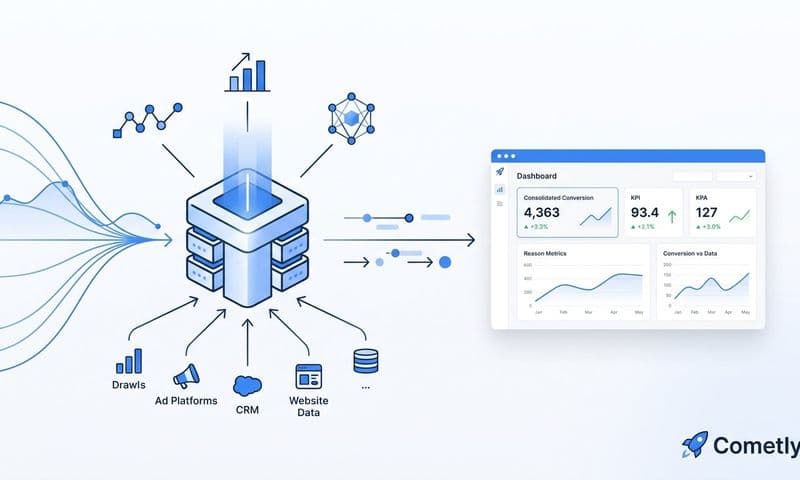


Most B2B SaaS companies have invested significantly in their marketing technology stack. They're running paid campaigns across Meta, Google, and LinkedIn. They have a CRM tracking every lead and deal. They've connected automation tools, set up website analytics, and built dashboards that pull data from multiple sources. And yet, when the question comes up in a leadership meeting, "Which channels are actually driving revenue?", the room goes quiet.
The problem isn't a lack of tools. It's a lack of connection between them. Each platform in your stack reports its own version of the truth, and those versions rarely agree. This is where marketing technology stack analytics becomes essential. It's the discipline of aggregating, connecting, and interpreting data across every tool in your stack so that your marketing decisions are grounded in revenue reality, not platform-reported vanity metrics.
Fragmented data creates blind spots. When your ad platforms, CRM, and automation tools each operate in their own silo, you're making budget decisions based on incomplete signals. You might be scaling a channel that looks strong in Google Ads but contributes almost nothing to closed revenue. You might be underfunding a channel that consistently sources your best customers because it never gets credit in last-click reports. Marketing technology stack analytics solves this by creating a unified layer above your tools that translates raw data into decisions you can act on with confidence.
The Layers of a Modern Marketing Technology Stack
To understand why unified analytics matters, it helps to map out what a typical B2B SaaS martech stack actually looks like and how each layer generates its own isolated data.
At the top of the stack are your paid ad platforms: Meta, Google Ads, LinkedIn, TikTok, and others. Each of these platforms tracks impressions, clicks, and conversions using its own pixel or tracking mechanism. They report performance in their own dashboards using their own attribution logic. Meta might report 40 conversions from a campaign while Google claims 35 from the same time period, and neither number aligns with what your CRM shows.
Below that sits your CRM, whether HubSpot, Salesforce, or another system. This is where leads become opportunities and opportunities become revenue. The CRM tracks deal stages, close dates, and contract values. It knows which leads converted into customers. But it often doesn't know which ad, campaign, or channel sourced those leads in the first place.
Then there's marketing automation: email platforms, lead nurturing tools, and workflow systems. These tools measure engagement metrics like open rates, click-through rates, and sequence completions. They tell you who engaged with your content, but they rarely connect that engagement to pipeline or revenue.
Website analytics tools like Google Analytics 4 track on-site behavior, sessions, and goal completions. They provide a view of the customer journey on your website but struggle to connect anonymous web sessions to known CRM contacts or closed deals.
Each of these layers measures success differently. Ad platforms optimize for impressions and clicks. CRMs track pipeline and revenue. Automation tools focus on engagement. Analytics tools report sessions and conversions. Data fragmentation across these layers isn't a configuration problem you can fix with a few integrations. It's the default state of a modern martech stack, and it's why so many growth teams feel like they're flying blind.
The solution is a unified analytics layer that sits above all of these tools and aggregates their data into a single source of truth. This layer doesn't replace your existing stack. It connects it, translating each tool's native metrics into a shared language centered on revenue outcomes.
What Marketing Technology Stack Analytics Actually Measures
Once you have a unified analytics layer in place, the question becomes: what should it actually be measuring? The answer goes well beyond the surface-level metrics that most ad platforms default to.
Surface-level metrics include clicks, impressions, click-through rates, and cost per click. These numbers are easy to collect and easy to report, but they tell you almost nothing about whether your marketing is generating revenue. A campaign can have an excellent CTR and a terrible return on ad spend. A channel can drive thousands of clicks and zero closed deals.
Revenue-connected metrics are what marketing technology stack analytics is designed to surface. These include pipeline attribution by channel and campaign, cost per opportunity, cost per acquisition by source, and ultimately, revenue ROI by ad creative. These metrics require connecting data across multiple layers of your stack, which is exactly why most teams don't have them readily available. Understanding the right marketing analytics metrics to track is the first step toward building this measurement framework.
At the core of this measurement framework is the customer journey. In B2B SaaS, a buyer rarely converts on their first interaction. They might see a LinkedIn ad, read a blog post, click a retargeting ad on Meta, attend a webinar, and then respond to a sales email before booking a demo. Each of these touchpoints plays a role in the eventual conversion, and a robust analytics layer captures all of them.
This is where attribution models become critical. Attribution is the process of assigning credit to the touchpoints that contributed to a conversion. Different models distribute that credit differently, and the model you rely on shapes the budget decisions you make.
Last-click attribution: All credit goes to the final touchpoint before conversion. Simple to implement, but it systematically ignores every channel that built awareness and consideration earlier in the journey.
First-touch attribution: All credit goes to the initial touchpoint. Useful for understanding what drives awareness, but it ignores everything that happened between awareness and conversion.
Linear attribution: Credit is distributed evenly across all touchpoints. More balanced, but it treats every interaction as equally valuable regardless of its actual influence on the conversion decision.
Data-driven attribution: Credit is assigned algorithmically based on the actual conversion paths in your data. This model requires sufficient data volume to work well, but it produces the most accurate picture of how each touchpoint contributes to revenue.
For B2B SaaS companies with long, multi-touch sales cycles, multi-touch attribution models provide a fundamentally more accurate picture of marketing's contribution to revenue than any single-touch model. The goal isn't to pick one model and stick with it forever. It's to compare models side by side and understand what each one reveals about your funnel.
Why Siloed Data Kills Marketing ROI for B2B SaaS Teams
Here's a scenario that many B2B SaaS marketing teams will recognize. You're preparing for a quarterly budget review. You pull reports from Meta Ads, Google Ads, and LinkedIn Campaign Manager. Each platform shows its own conversion numbers. You cross-reference with your CRM and the numbers don't match. You spend hours trying to reconcile the discrepancy and still aren't confident in the final report. Sound familiar?
This is the daily reality of operating a martech stack without a unified analytics layer. When ad platforms, CRMs, and automation tools don't communicate, marketers are forced to make budget decisions based on incomplete or contradictory data. The result isn't just frustration. It's misallocated spend.
Last-click attribution, the default in most ad platforms, makes this problem significantly worse for B2B SaaS companies. Because B2B buyers go through long, research-heavy journeys before converting, the final click before a form submission is often a branded search or a direct visit. This means branded search and retargeting campaigns consistently get credited with conversions that were actually driven by awareness campaigns on LinkedIn or YouTube that introduced the buyer to your product weeks earlier. The attribution challenges in marketing analytics run deep for teams relying on single-touch models.
When budget decisions are made based on last-click data, the natural outcome is to cut spending on top-of-funnel channels that aren't getting credit and double down on bottom-of-funnel channels that are. Over time, this erodes the pipeline because there are fewer new prospects entering the funnel to nurture toward conversion.
The downstream consequences compound quickly. Misallocated ad spend means you're paying more to acquire each customer than you need to. Underinvestment in high-performing awareness channels shrinks the top of your funnel. And without accurate pipeline attribution, forecasting becomes guesswork. Growth leaders lose confidence in their projections, and finance teams lose confidence in marketing's ability to demonstrate ROI.
For B2B SaaS companies where sales cycles can span weeks or months and customer lifetime value is high, the cost of these blind spots is substantial. Getting attribution right isn't just a reporting exercise. It's a competitive advantage.
Building an Analytics Layer That Connects Your Entire Stack
Connecting your martech stack for unified analytics requires more than plugging tools into a dashboard. It starts with solving a fundamental data quality problem: the signals your ad platforms receive are often incomplete, delayed, or inaccurate.
Browser-based pixels, the traditional mechanism for tracking ad conversions, are increasingly unreliable. Safari's Intelligent Tracking Prevention (ITP), ad blockers, and the broader shift away from third-party cookies all degrade the quality of pixel-based data. When your pixel misses conversions, your ad platform's machine learning models optimize on incomplete signals, which leads to worse targeting and higher costs.
Server-side tracking and Conversion API (CAPI) integrations solve this problem by sending event data directly from your server to the ad platform, bypassing browser limitations entirely. This approach captures conversion events that browser pixels would miss, improving data accuracy and giving your ad platforms a more complete picture of which campaigns are actually driving results.
For B2B SaaS companies, server-side tracking is especially important because many of the most valuable conversion events, such as demo bookings, trial activations, and opportunity creation in the CRM, happen outside the browser session where a pixel would fire. These events need to be captured and attributed correctly to understand the true impact of your ad spend. Choosing the right marketing analytics platform is critical to ensuring these server-side events flow into a unified reporting layer.
CRM integration is the second foundational requirement. This is where revenue attribution becomes possible. When your CRM is connected to your analytics layer, you can trace a closed-won deal back to the specific ad, campaign, and channel that first sourced that lead. You can calculate true customer acquisition cost by channel. You can see which campaigns are generating high-value pipeline versus low-quality leads that never progress past the first sales call.
Data enrichment and event deduplication are the finishing touches that make this system reliable. Enrichment means appending additional context to events, such as company size, industry, or deal value, so you can segment performance by the characteristics that matter most to your business. Deduplication ensures that the same conversion event isn't counted multiple times across different tracking mechanisms, which would inflate your reported results and mislead your optimization decisions.
Together, server-side tracking, CRM integration, and clean data practices form the foundation of a martech analytics layer that produces trustworthy, revenue-connected insights.
From Data to Decisions: Using Analytics to Scale What Works
Having a unified analytics layer is only valuable if it changes how you make decisions. The real payoff comes when you move from reporting on what happened to actively using data to scale what's working and cut what isn't.
This is where AI-powered analysis transforms the way growth teams operate. Manually reviewing performance data across dozens of campaigns, hundreds of ad creatives, and multiple channels is time-consuming and prone to human bias. AI marketing analytics can surface patterns in large datasets that manual reporting would miss, identifying which ad creatives consistently drive high-quality pipeline, which audience segments have the best conversion rates from lead to closed deal, and which channels are underperforming relative to their share of the budget.
The ability to compare attribution models side by side within a unified platform is another capability that fundamentally changes budget decisions. When you can see how a LinkedIn campaign performs under first-touch attribution versus linear attribution versus data-driven attribution, you get a much richer understanding of its actual contribution to revenue. A channel that looks weak under last-click might be the top driver of new pipeline under first-touch. That insight changes how you allocate budget.
Feeding enriched conversion data back to ad platforms creates a compounding performance advantage. When Meta or Google receives accurate, enriched conversion signals through CAPI, their machine learning models can optimize targeting and bidding more effectively. They learn which user behaviors actually predict high-value conversions rather than just clicks or form fills. Over time, this feedback loop improves the quality of traffic your campaigns generate, which lowers your cost per acquisition and increases the return on every dollar you spend.
This is the practical difference between a martech stack that generates reports and one that generates revenue. The analytics layer doesn't just tell you what happened. It creates a continuous improvement cycle where better data leads to smarter optimization, which leads to better results, which generates even better data to learn from. Teams that invest in a robust marketing analytics strategy are the ones that turn this feedback loop into a durable competitive advantage.
Growth teams that build this feedback loop into their stack gain a structural advantage over competitors who are still reconciling spreadsheets and guessing at attribution.
Putting It All Together: Making Your Martech Stack Work as One
The strategic shift that marketing technology stack analytics enables is moving from treating your tools as independent systems to treating your entire stack as one interconnected revenue engine. Ad platforms, CRM, automation tools, and analytics all become part of a single system where data flows freely and every decision is grounded in revenue reality.
The goal isn't more dashboards. Many marketing teams already have too many. The goal is better decisions: knowing with confidence where to invest your next dollar of ad spend, which campaigns to scale because they're generating real pipeline, and which to cut because they're consuming budget without producing revenue.
This requires an analytics platform that was built for exactly this purpose. Not a general-purpose BI tool that requires months of configuration, and not a single ad platform's native reporting that only shows you its own slice of the picture. You need a platform designed specifically for B2B SaaS companies that connects your entire stack and translates that data into clear, actionable insights.
Cometly is built to be that analytics layer. It connects your ad platforms, CRM, and website tracking into a single source of truth for marketing performance. With multi-touch attribution, server-side conversion tracking, and Conversion API integration, Cometly captures every touchpoint across the customer journey and ties it back to closed revenue. Its AI-driven analysis surfaces the patterns that matter most, identifying which ads, audiences, and channels are driving your best customers so you can scale with confidence rather than guesswork.
When your martech stack works as one, marketing stops being a cost center and starts being a predictable growth engine.