

You're running campaigns across Facebook, Google, LinkedIn, and email. Your dashboard shows clicks, impressions, and conversions. But here's what keeps you up at night: a prospect clicked your Facebook ad three weeks ago, opened two emails, visited your pricing page twice, and finally converted after a Google search. Which channel gets the credit? Which interaction actually mattered?
Most marketers can't answer that question. They're staring at fragmented data across five different platforms, each claiming credit for the same conversion, with no way to see the actual path their customers took. It's like trying to solve a puzzle when half the pieces are scattered across different rooms.
This is the visibility problem that's costing you real money. When you can't see which touchpoints drive revenue, you're making budget decisions based on incomplete information. You're scaling campaigns that look good in isolation but might be riding on the coattails of other channels. You're cutting spend from sources that appear weak but are actually critical steps in your customer journey.
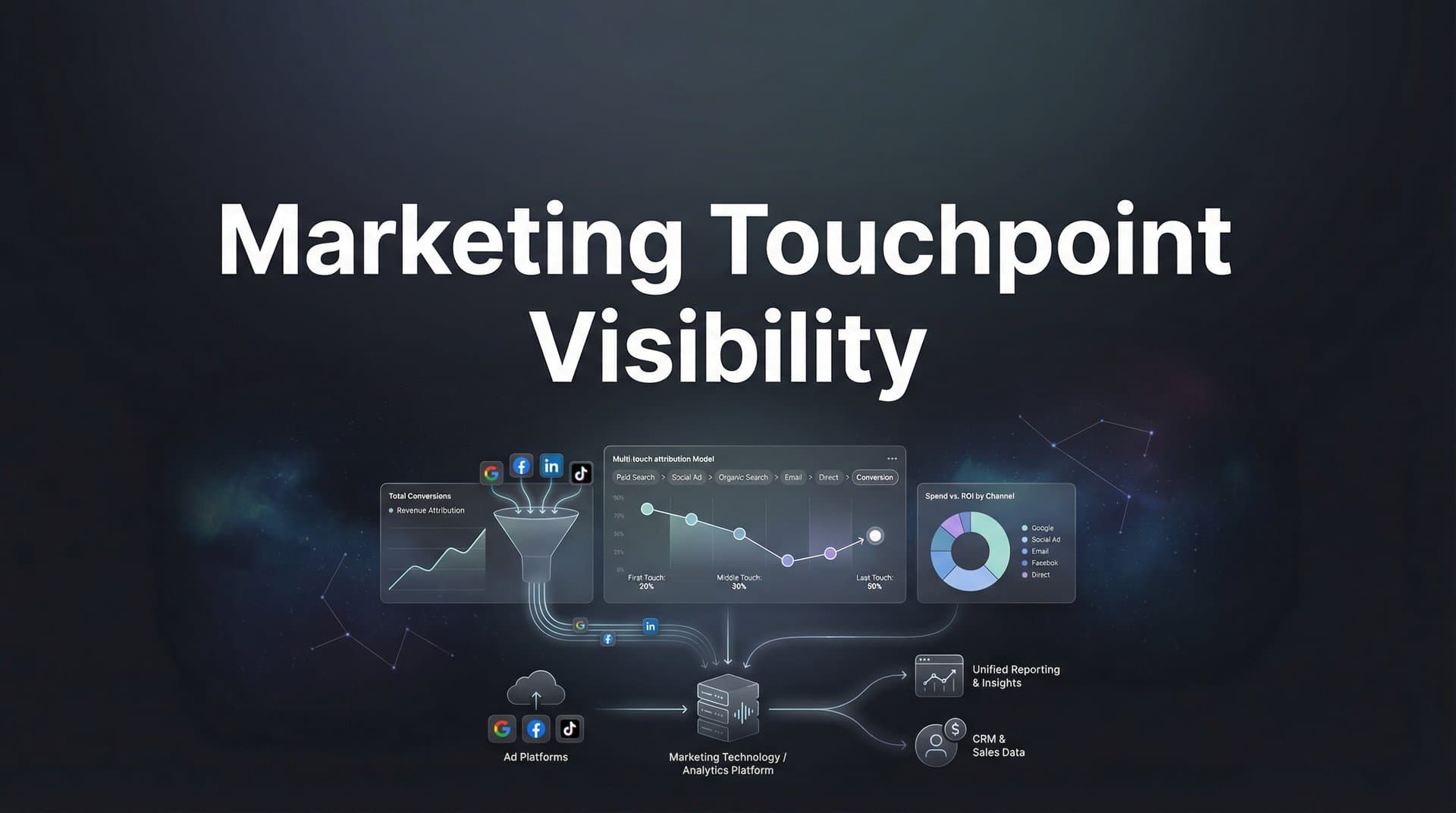
Marketing touchpoint visibility solves this. It's the ability to see, track, and analyze every customer interaction across the entire journey, from that first ad click to the final purchase and beyond. Not just knowing these touchpoints exist, but actually measuring them, connecting them, and understanding how they work together to drive conversions.
This guide breaks down what touchpoint visibility really means, why most marketing teams don't have it, and how to build a system that shows you exactly which interactions drive revenue. Let's start with the fundamentals.
What Actually Counts as a Marketing Touchpoint
A marketing touchpoint is any interaction between a prospect and your brand. That's the simple definition. The reality is more nuanced.
Think of touchpoints as moments of contact. When someone clicks your Facebook ad, that's a touchpoint. When they open your email, that's another. When they visit your website, watch a demo video, download a guide, or talk to your sales team, each of these is a distinct touchpoint. They're the building blocks of the customer journey.
Digital touchpoints are the easiest to understand because they happen online and leave data trails. These include paid ad clicks across platforms like Meta, Google, and LinkedIn. They include organic search visits, social media engagement, email opens and clicks, website page views, form submissions, and content downloads. Every time someone interacts with your digital presence, you're creating a touchpoint that can theoretically be tracked.
But here's where it gets interesting: offline touchpoints matter just as much, and they're harder to capture. A phone call with your sales team is a touchpoint. An in-person meeting at a conference is a touchpoint. A conversation at a trade show booth is a touchpoint. Even word-of-mouth recommendations, though nearly impossible to track directly, influence the journey.
The distinction that really matters isn't between online and offline. It's between touchpoint awareness and touchpoint visibility. Awareness means you know these interactions are happening. You know people click your ads, visit your site, and talk to sales. Visibility means you can actually see these interactions in your data, connect them to individual customers, and measure their impact on revenue. Understanding marketing touchpoint analysis is the first step toward closing this gap.
Most marketing teams have awareness. They know the touchpoints exist. What they lack is visibility into how these touchpoints connect, which combinations drive conversions, and which are just noise. When someone converts, you might see they clicked an ad yesterday. But you're missing the three website visits last week, the email they opened two weeks ago, and the LinkedIn post they engaged with a month before that.
That gap between awareness and visibility is where budget gets wasted. It's where you make decisions based on the last click instead of the full journey. And it's exactly what we need to fix.
The Data Fragmentation Problem
Your marketing data lives in silos. Facebook Ads Manager shows you one story. Google Analytics tells you another. Your CRM has a third version. And none of them agree on what actually drove that conversion.
This isn't a minor inconvenience. It's a fundamental problem that breaks your ability to make smart decisions. Each platform tracks what happens within its own walls, but customer journeys don't respect those boundaries. Someone might discover you through a Facebook ad, research you via Google search, sign up through a LinkedIn campaign, and convert after an email. Each platform will claim credit for the conversion, and each will be partially right and completely wrong.
The technical reasons for this fragmentation run deep. Ad platforms use their own tracking pixels and cookies. Your CRM tracks sales activities and deal stages. Your analytics tool monitors website behavior. These systems weren't built to talk to each other. They were built to optimize their own metrics, which means they're incentivized to take credit for conversions even when they're just one piece of a larger puzzle. This is why so many teams struggle with marketing touchpoints not being credited properly.
Privacy changes have made this worse. iOS updates now block tracking by default, meaning a significant portion of your mobile traffic is invisible to traditional tracking methods. Browsers are deprecating third-party cookies, the technology that's powered cross-site tracking for years. When someone switches from their phone to their laptop, traditional tracking loses them. It sees two different people instead of one customer journey.
The cost of this poor visibility shows up in your budget allocation. You might be pouring money into Facebook because it reports strong conversion numbers, not realizing those conversions were actually initiated by Google search campaigns that get no credit. You might be underinvesting in LinkedIn because it shows weak direct conversions, missing the fact that it's generating awareness that leads to conversions through other channels later.
Many marketing teams operate on what I call "platform truth" instead of "customer truth." Platform truth is what each ad platform tells you about its own performance. Customer truth is what actually happened in the real journey. The gap between these two versions of reality determines whether you're optimizing for what looks good in dashboards or what actually drives revenue. Navigating the attribution challenges in marketing analytics requires understanding this distinction.
Here's a scenario that plays out constantly: A prospect clicks your Google ad, doesn't convert. Three days later, they see your Facebook retargeting ad and click it, but still don't convert. A week after that, they search your brand name, click your Google ad again, and this time they convert. Google Ads claims a conversion because it was the last click. Facebook sees an assisted conversion. Your organic search traffic gets no credit even though the brand search was crucial. And that first Google ad that started the whole journey? Completely invisible in most attribution models.
Without visibility into the complete journey, you're making decisions based on which platform is best at claiming credit, not which channels actually drive results. You need a system that tracks the customer, not just the clicks.
Connecting the Dots Across Your Marketing Stack
Building complete touchpoint visibility means creating a single source of truth that captures every interaction across all your platforms. This requires connecting systems that were never designed to work together.
The foundation is integrating your ad platforms with your CRM. When someone clicks a Facebook ad, that event needs to flow into your CRM and attach to their contact record. When they later become a customer, that revenue event needs to flow back to your attribution system so you can connect the dots. This isn't just about tracking clicks. It's about tracking the entire lifecycle from anonymous visitor to paying customer, and attributing revenue to every touchpoint along the way. A robust marketing campaign attribution platform makes this integration possible.
Server-side tracking solves the limitations of browser-based tracking. Instead of relying on cookies and pixels that browsers can block, server-side tracking captures events on your server and sends them directly to your analytics platform. When someone converts on your website, your server records that conversion and sends the data to your attribution system, regardless of whether their browser is blocking tracking scripts. This gives you visibility into conversions that traditional tracking would miss entirely.
The technical implementation matters less than the outcome: you need every touchpoint, from every channel, flowing into a unified system that can connect them to individual customer journeys. That means connecting Meta Ads, Google Ads, LinkedIn, your email platform, your website analytics, and your CRM into a single attribution platform that tracks customers across all these touchpoints.
Multi-touch attribution models then assign credit across these touchpoints instead of giving all the credit to the first or last interaction. A linear model might give equal credit to every touchpoint in the journey. A time-decay model gives more credit to recent interactions. A position-based model emphasizes the first and last touchpoints while still crediting the middle interactions. The specific model matters less than having the data to use any model at all. Learning about different attribution models in digital marketing helps you choose the right approach for your business.
What this looks like in practice: A prospect sees your LinkedIn ad (touchpoint 1), clicks it and visits your site but doesn't convert (touchpoint 2). Three days later, they open your email (touchpoint 3) and click through to a case study (touchpoint 4). A week later, they search your brand name (touchpoint 5), land on your pricing page (touchpoint 6), and request a demo (touchpoint 7). Your sales team calls them (touchpoint 8) and they become a customer (touchpoint 9).
With complete visibility, you can see this entire path. You can see that LinkedIn initiated the journey, email re-engaged them, and the case study was the content that moved them toward conversion. You can see that the brand search indicates strong intent, and that the sales call was the final push. Each channel gets appropriate credit based on its actual role in the journey.
Without this visibility, you might only see touchpoint 5 and 7: the brand search and demo request. You'd miss the LinkedIn ad that started everything, the email that re-engaged them, and the case study that educated them. You'd make budget decisions based on incomplete information.
The goal isn't perfect tracking of every possible interaction. The goal is visibility into the touchpoints that matter, connected in a way that shows you how they work together to drive conversions. When you have that, you can start making decisions based on the full customer journey instead of fragmented platform data.
From Tracking to Strategic Decisions
Visibility is only valuable if it changes what you do. The point of tracking every touchpoint isn't to have more data. It's to make better decisions about where to invest your budget and how to optimize your campaigns.
Start with understanding which campaigns drive qualified leads versus just clicks. Your Facebook campaign might generate 500 clicks and 50 conversions. Looks great. But when you connect that data to your CRM, you might discover that only 5 of those 50 conversions became qualified opportunities, and only 1 closed into revenue. Meanwhile, your LinkedIn campaign generated 100 clicks and 10 conversions, but 8 of those became qualified opportunities and 4 closed into revenue. The platform metrics told you Facebook was winning. The revenue data tells you LinkedIn is four times more efficient at driving actual business outcomes.
This is where touchpoint visibility transforms your strategy. Instead of optimizing for conversions, you optimize for revenue. Instead of celebrating high click-through rates, you focus on the channels that drive customers who actually buy. The metrics that matter shift from vanity metrics to business metrics. Understanding marketing revenue attribution is essential for making this shift.
Budget allocation becomes data-driven when you can see the full journey. You might discover that your Google search campaigns rarely close deals on their own, but they're crucial touchpoints in journeys that start with Facebook and close through email. That doesn't mean you should cut Google spend. It means you should understand its role as a mid-funnel research channel rather than a direct conversion driver. You optimize for the journey, not the individual touchpoint.
Feeding enriched conversion data back to ad platforms improves their targeting algorithms. When Meta's algorithm only sees conversions happening on your website, it optimizes for people who convert quickly. When you send back data showing which conversions became customers and generated revenue, Meta can optimize for people who look like your actual customers, not just people who fill out forms. This is conversion sync in action: using your CRM data to teach ad platforms what a valuable conversion actually looks like.
The practical application looks like this: You're spending $10,000 per month across Meta, Google, and LinkedIn. Your attribution data shows that Meta drives the most initial touchpoints, Google captures high-intent searches, and LinkedIn generates the highest-value customers. Without visibility, you might allocate budget based on conversion volume and give Meta the biggest share. With visibility, you might increase LinkedIn spend because those customers have 3x higher lifetime value, even though the conversion volume is lower. You're making a decision based on revenue impact, not platform metrics. Implementing AI-powered marketing budget allocation can automate these decisions at scale.
You can also identify underperforming campaigns within channels. Your Facebook prospecting campaigns might drive awareness touchpoints that lead to conversions through other channels. Your Facebook retargeting campaigns might be getting last-click credit for conversions that were actually driven by email. With touchpoint visibility, you can see which campaigns are truly driving new customer journeys versus which are just claiming credit for journeys other channels started.
The shift is from reactive optimization to strategic planning. Instead of tweaking bids based on yesterday's performance, you're analyzing patterns across complete customer journeys and making decisions about which channels to scale, which touchpoints to emphasize, and where to invest in content or creative that moves prospects through the journey more efficiently.
Closing the Gaps in Your Tracking
Even with solid attribution infrastructure, most marketing teams have visibility gaps that distort their understanding of what's working. Identifying and closing these gaps is the difference between good tracking and complete visibility.
The most common gap sits between marketing-qualified leads and sales-qualified leads. Your marketing automation platform tracks form fills and assigns MQL status. Your sales team evaluates those leads and determines which are actually worth pursuing. If you're not connecting these two stages, you're missing crucial data about which marketing sources drive leads that sales actually wants to work. You might be generating hundreds of MQLs from a particular campaign, celebrating the volume, while sales is quietly ignoring 90% of them because they're not qualified. That disconnect wastes budget on campaigns that look successful in marketing reports but fail in sales reality. Addressing marketing touchpoint analysis gaps starts with bridging this divide.
Closing this gap means integrating your CRM lead stages into your attribution tracking. When a lead moves from MQL to SQL to opportunity to customer, each stage should be visible in your attribution data. This lets you see not just which campaigns drive form fills, but which campaigns drive leads that progress through your sales funnel. The difference in insights is dramatic. A campaign that generates 100 MQLs but only 2 SQLs is fundamentally different from a campaign that generates 50 MQLs but 25 SQLs, even though traditional marketing metrics would favor the first campaign.
Touchpoints that happen outside your owned properties create another visibility challenge. When someone reads a review on G2 or Capterra before converting, that's an influential touchpoint. When a prospect mentions they heard about you from a colleague, that's word-of-mouth impact. When someone sees your CEO's LinkedIn post and then visits your site, that's a touchpoint that's hard to track directly. These interactions influence the journey, but they're invisible in most attribution systems. Many teams face ongoing customer touchpoint visibility issues because of these blind spots.
You can't track everything, but you can capture indicators. Ask new customers how they heard about you during onboarding. Include "How did you hear about us?" in your form submissions. Track referral parameters when prospects come from partner sites or review platforms. Look for patterns in your analytics: spikes in direct traffic often follow offline events or word-of-mouth moments. Build these qualitative insights into your understanding of the customer journey, even if they don't fit neatly into your attribution model.
Real-time visibility versus delayed reporting affects your ability to optimize quickly. Many attribution systems process data in batches, meaning you're looking at yesterday's or last week's performance when making today's decisions. For fast-moving campaigns, this lag creates a gap between what's happening and what you can see. If a campaign starts underperforming in the morning, you want to know by afternoon, not next week.
The solution is streaming data architecture that processes touchpoints as they happen. When someone clicks an ad, that event should appear in your attribution dashboard within minutes, not hours or days. When they convert, that conversion should immediately connect to their previous touchpoints. This real-time visibility lets you respond to performance changes while they're happening, not after the damage is done. Using the right marketing touchpoint analysis tools makes this level of responsiveness achievable.
Another gap appears in mobile app interactions. If your business includes a mobile app, touchpoints within that app need to connect to your web-based attribution. Someone might discover you through a Facebook ad on their phone, download your app, use it for a week, then convert on desktop. If your app events aren't flowing into your attribution system, you're missing a crucial part of the journey. Mobile measurement partners and app analytics platforms need to integrate with your overall attribution infrastructure.
The final gap is historical data. When you implement new attribution tracking, you typically only capture data going forward. This makes it hard to compare performance before and after changes, or to understand seasonal patterns. Where possible, backfill historical data from your existing platforms to create a complete timeline. This gives you context for current performance and helps you spot trends that only become visible over longer time periods.
Making Visibility Your Competitive Advantage
Marketing touchpoint visibility isn't just a nice-to-have analytics upgrade. It's the foundation of data-driven marketing that actually drives business results. When you can see every interaction that contributes to revenue, you stop guessing about what works and start knowing.
The transformation happens at multiple levels. Tactically, you make better daily decisions about bid adjustments, budget allocation, and campaign optimization. Strategically, you understand which channels and touchpoints drive your most valuable customers, and you build your marketing plan around those insights. Culturally, your team shifts from debating which platform deserves credit to collaborating on how to move prospects through the complete journey more effectively.
Companies with complete touchpoint visibility operate differently. They don't panic when a platform reports declining performance because they can see the full context. They don't waste time in attribution debates because the data shows the actual customer journey. They don't scale campaigns blindly because they understand which combinations of touchpoints drive revenue.
The path forward starts with evaluating your current visibility gaps. Where are you flying blind? Which touchpoints are you missing? How much of your customer journey can you actually see and measure? Once you know the gaps, you can prioritize closing them based on where they're costing you the most.
For most marketing teams, the biggest impact comes from connecting ad platform data to CRM outcomes. This single integration transforms your understanding of campaign performance by showing which marketing activities drive actual customers, not just leads. From there, you can layer in additional touchpoints, implement server-side tracking, and build increasingly sophisticated attribution models.
The goal isn't perfection. The goal is having enough visibility to make confident decisions about where to invest your marketing budget. When you can see which touchpoints drive revenue, you can scale what works and cut what doesn't. You can optimize for business outcomes instead of platform metrics. You can build a marketing strategy based on how customers actually behave, not how you wish they behaved.
Ready to elevate your marketing game with precision and confidence? Discover how Cometly's AI-driven recommendations can transform your ad strategy. Get your free demo today and start capturing every touchpoint to maximize your conversions.



