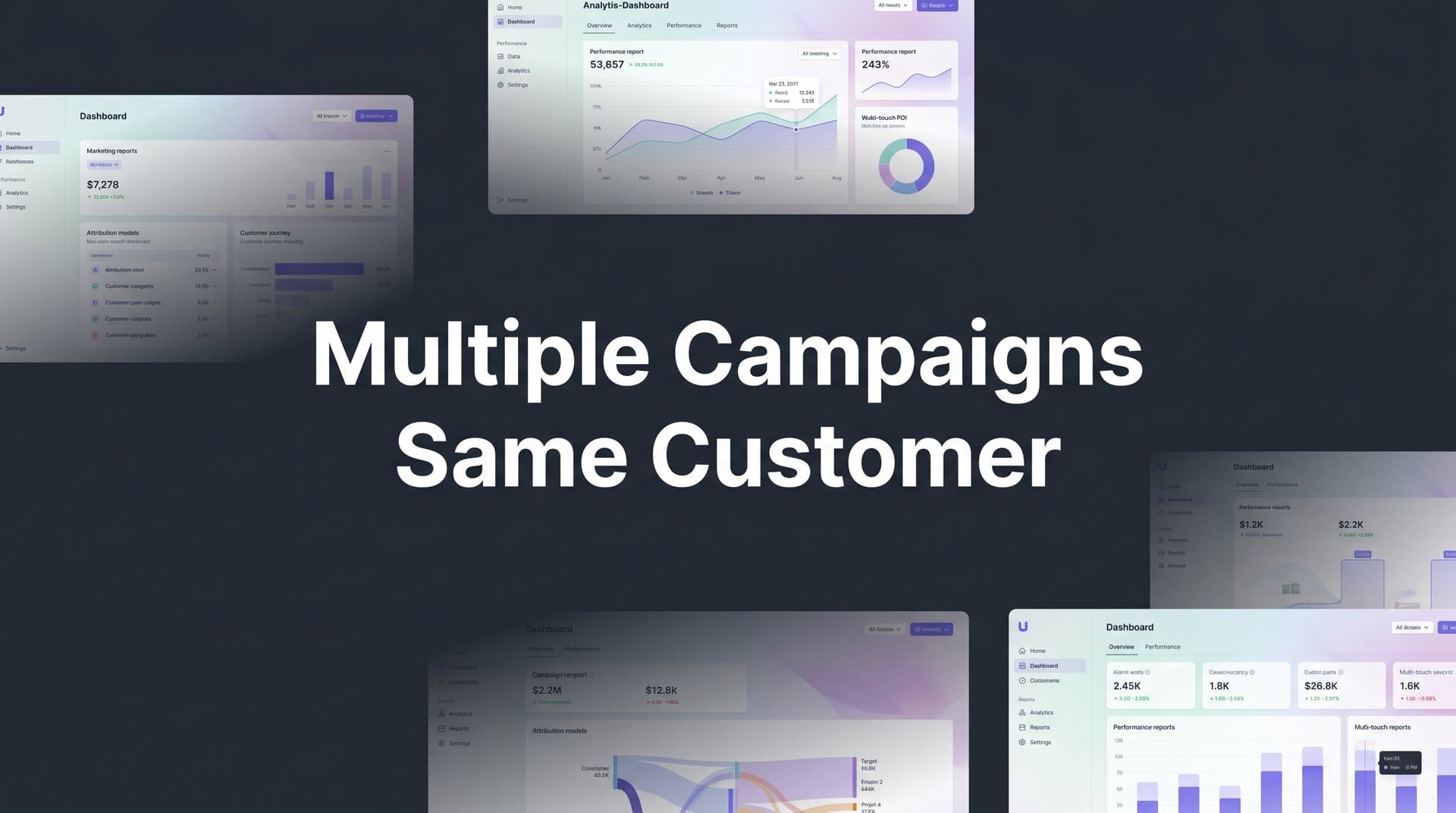
Most B2B SaaS buyers don't convert the first time they encounter your brand. A prospect might scroll past your LinkedIn ad on a Tuesday morning, search for your category on Google two weeks later, click a search ad, browse your pricing page, leave, and then convert through a retargeting campaign a month after that. Three campaigns. Multiple sessions. One customer.
The question that follows is deceptively simple: which campaign gets the credit?
If you're relying on platform-native reporting to answer that question, you're likely getting three different answers from three different platforms, each claiming full credit for the same deal. That's not a minor reporting inconvenience. It's a fundamental distortion of your data that leads to misallocated budgets, scaled campaigns that don't deserve it, and cut campaigns that were quietly driving revenue all along.
This is the core attribution problem created when the same customer touches multiple campaigns. And in B2B SaaS, where buying cycles are long and multi-channel journeys are the norm rather than the exception, it's one of the most consequential measurement challenges your marketing team will face. Get it wrong, and you'll optimize toward the wrong signals. Get it right, and you'll have a clear line of sight from ad spend to pipeline to closed revenue.
This article breaks down why cross-campaign attribution is so difficult, how different attribution models handle it, where tracking typically breaks down technically, and what a practical solution looks like for growth-focused B2B SaaS teams.
The Attribution Problem Hidden in Your Campaign Reports
B2B buyers have long consideration cycles. Unlike a consumer purchasing a $30 product on impulse, a SaaS buyer evaluating a platform that will cost thousands of dollars per year is going to take their time. They'll consume awareness content, compare alternatives, attend a demo, discuss internally, and revisit your site multiple times before making a decision.
This means a single prospect will routinely interact with your awareness campaigns, your nurture campaigns, and your conversion campaigns before closing. Each of those interactions happens in a different context, often on a different device, and almost always through a different ad platform. The result is overlapping attribution windows across multiple campaigns, all pointing to the same customer.
Here's where the reporting problem compounds. Each ad platform operates as its own attribution system. Meta tracks conversions based on its own pixel data and attribution window. Google does the same. LinkedIn does the same. When a prospect converts, each platform looks at its own data, sees that this person interacted with one of its ads within its attribution window, and claims the conversion.
The practical outcome is that your combined reported conversions across platforms often exceed your actual conversions. Your reported ROAS across channels can look mathematically impossible when you add it all up. Marketing leaders who have tried to reconcile platform-reported numbers against CRM data will recognize this immediately. The numbers simply don't match.
The deeper issue underneath all of this is identity resolution. Connecting the same person across different sessions, different devices, and different ad platforms is technically hard. Without a unified system that can stitch those interactions together, you're not looking at a customer journey. You're looking at a series of disconnected fragments, each owned by a different platform, each telling a self-serving story about its own contribution.
The consequence for budget decisions is significant. If you can't accurately see which campaigns are contributing to conversions, you end up scaling campaigns that look good in isolation but may be riding the coattails of earlier touchpoints you're not measuring. You cut awareness campaigns because they don't show last-click conversions, even though they're consistently present at the start of every deal that closes.
How Attribution Models Distribute Credit Across Campaigns
Attribution models are the rules that determine how conversion credit gets distributed across the campaigns a customer touched before converting. Different models tell very different stories about the same customer journey, and understanding those differences is essential when the same customer has touched multiple campaigns.
First-touch attribution gives all credit to the campaign that first introduced the prospect to your brand. If a LinkedIn ad was the first touchpoint, LinkedIn gets 100% of the credit regardless of what happened afterward. This model is useful for understanding which campaigns are best at generating awareness and bringing new prospects into your funnel.
Last-click attribution gives all credit to the final campaign the customer interacted with before converting. This is the default model in many ad platforms and in Google Analytics. It systematically undervalues top-of-funnel campaigns that introduce prospects but don't close them, and it overvalues bottom-of-funnel campaigns that happen to be the last touchpoint before a decision that was already largely made.
Linear attribution distributes credit equally across every campaign touchpoint in the journey. If a prospect touched four campaigns before converting, each gets 25% of the credit. This model acknowledges that every touchpoint played a role, though it doesn't differentiate between a touchpoint that sparked initial interest and one that was a brief mid-funnel interaction.
Time-decay attribution gives more credit to touchpoints closer to the conversion event, operating on the logic that recent interactions had more influence on the final decision. This can be a reasonable model for shorter sales cycles but tends to undervalue awareness campaigns in long B2B buying journeys.
Data-driven attribution uses algorithmic weighting to assign credit based on which touchpoints statistically correlate with conversion across your actual customer data. Rather than applying a fixed rule, it learns from patterns in your pipeline and revenue data to estimate each campaign's true contribution. This is generally the most accurate model when you have sufficient data volume and when multiple campaigns are regularly touching the same customers.
The model you choose directly affects which campaigns appear to be performing well and which appear to be underperforming. A top-of-funnel LinkedIn awareness campaign will look like a poor investment under last-click attribution. Under first-touch or linear attribution, it may look like one of your most important channels. Neither view is complete on its own. The most useful approach is to compare a campaign's performance across multiple models simultaneously, which reveals its actual role in the funnel rather than the role a single model assigns to it. For a deeper look at how these models compare, see our guide on choosing the best attribution model for your campaigns.
Mapping the Multi-Campaign Journey in B2B SaaS
In B2B SaaS, the customer journey typically moves through three distinct stages, each involving different campaigns, different channels, and often different teams within your marketing organization.
The awareness stage is where prospects first encounter your brand. This often happens through content-driven channels: blog posts surfaced through organic search, social ads on LinkedIn or Meta, or sponsored content in industry publications. The goal at this stage is visibility and initial interest, not conversion. The campaigns here are often broad in targeting and educational in message.
The consideration stage is where prospects actively evaluate options. This is where comparison ads, demo offer campaigns, and retargeting campaigns come into play. A prospect who visited your pricing page but didn't convert is a prime candidate for a retargeting campaign that addresses common objections or highlights a specific use case. Multiple campaigns may be running simultaneously at this stage, each designed to nudge the prospect closer to a decision.
The decision stage involves campaigns targeted at prospects who are close to converting. Trial offers, direct outreach sequences, and high-intent search campaigns all live here. These campaigns often get the last-click credit because they're closest to the conversion event, even though the prospect's decision was shaped significantly by earlier touchpoints.
Understanding this typical sequence matters because it shifts the question you're asking about campaign performance. Instead of asking "which campaign performed best?" you start asking "which combination of campaigns consistently appears in the journeys of customers who converted at high deal values?" That's a fundamentally more useful question for budget allocation.
Touchpoint analysis at the journey level reveals patterns that campaign-level reporting obscures. You might find that customers who engaged with a specific awareness campaign at the top of the funnel and then saw a retargeting campaign within 30 days convert at a much higher rate than customers who only saw the retargeting campaign. That insight is invisible if you're looking at each campaign's performance in isolation. Understanding what customer journey touchpoints are and how they connect is foundational to this kind of analysis.
It also reveals which campaigns appear in the journeys of customers who churned or never converted, which is equally valuable. If a particular campaign consistently attracts prospects who don't close, that's a signal about audience targeting or message-market fit that campaign-level ROAS data won't surface.
Where Cross-Campaign Tracking Breaks Down Technically
Understanding the conceptual challenge is one thing. The technical reality of why tracking breaks down across campaigns is another, and it's worth addressing directly because it explains why platform-native reporting is structurally incapable of solving this problem.
Browser-based pixel tracking is the foundation of most ad platform measurement. When a prospect clicks your ad and lands on your site, a pixel fires and records that session. The problem is that this approach is session-based and device-specific. When a prospect sees your LinkedIn ad on their phone during a commute and then converts via a Google search ad on their work laptop two weeks later, most pixel-based systems will treat those as two separate users. The thread connecting those interactions is lost.
Cookie deprecation and browser privacy settings compound this. As major browsers have restricted third-party cookies and users have become more aware of privacy settings, the reliability of browser-based tracking has declined. Pixels that would previously have tracked a prospect across multiple sessions now frequently lose that connection, creating gaps in the journey data that make attribution even less accurate.
Attribution window conflicts between platforms create another layer of distortion. If Meta uses a 7-day click and 1-day view window, and Google uses a 30-day click window, and LinkedIn uses a 30-day click window, all three platforms can legitimately claim credit for the same conversion under their own rules. When you sum up conversions across platforms, you're adding up overlapping claims rather than a deduplicated count of actual customers.
Server-side tracking and Conversion API integrations from Meta and Google address a significant portion of this problem. Rather than relying on a browser pixel to fire correctly, server-side tracking captures conversion events directly from your server and sends them to the ad platform via API. This approach is less susceptible to browser restrictions, ad blockers, and cookie loss. It produces more complete conversion data and, when implemented with proper deduplication logic, reduces the double-counting problem that occurs when both a pixel and a server-side event fire for the same conversion.
First-party CRM data is the other critical component. Your CRM knows exactly who converted, when they converted, and what their deal value was. Connecting that data to your ad platform touchpoints through consistent UTM tagging and identity matching creates a much more accurate picture of which campaigns contributed to real revenue, not just reported conversions.
Building a Measurement System for Multi-Campaign Customers
Knowing where tracking breaks down points directly toward what a reliable measurement system needs to do. The goal is a single, unified view of every customer's journey across every campaign they touched, connected all the way to pipeline and closed revenue.
The first requirement is a single attribution platform that ingests data from all of your ad channels, your CRM, and your website. When each channel reports through its own native dashboard, double-counting is inevitable. A unified platform pulls all of that data into one place, deduplicates conversion events, and builds a single customer timeline that reflects what actually happened rather than what each platform claims happened.
UTM parameter consistency is the foundation of accurate cross-campaign tracking. Every campaign, every ad set, and every ad needs to be tagged with UTM parameters that identify the source, medium, campaign name, and relevant identifiers. When a prospect clicks an ad and lands on your site, the UTM data gets captured and stored. When that prospect eventually converts, the UTM data from their first touch and all subsequent touches can be stitched together to reconstruct the full journey. Without consistent UTM tagging, you're missing the connective tissue that links ad interactions to CRM records.
Combining UTM data with first-party CRM data is what closes the loop from ad click to closed revenue. When your attribution platform can match a lead in your CRM to the UTM-tagged sessions that preceded their conversion, you can see not just which campaign drove the lead but which campaign combinations drove the deals that actually closed and at what deal value. This is the foundation of attributing revenue to specific campaigns with confidence.
Comparing campaign performance across multiple attribution models within the same platform is the final piece. When you can see how a campaign performs under first-touch, linear, and data-driven attribution side by side, you get a complete picture of its role in the funnel. A campaign that looks weak under last-click but strong under first-touch is likely doing important awareness work that deserves budget. A campaign that looks strong under every model is genuinely performing across the funnel. This kind of multi-model comparison prevents the common mistake of cutting campaigns that are quietly influencing deals simply because they don't show up well in last-click reports.
Using Multi-Campaign Attribution Data to Allocate Budget Smarter
Accurate attribution data is only valuable if it changes how you make decisions. Once you can see which campaigns appear most frequently in high-value customer journeys, the budget allocation logic shifts from optimizing individual campaigns to optimizing campaign combinations.
This is a meaningful shift in perspective. Instead of asking "is this awareness campaign generating enough conversions to justify its cost?" you start asking "do customers who engage with this awareness campaign convert at a higher rate and higher deal value when they later see our retargeting campaign?" The answer to that question is a much better basis for budget decisions than any single campaign's reported ROAS.
Multi-touch attribution data also clarifies the distinct roles different channels play in your funnel. Some channels are consistently strong at introducing new prospects. Others are consistently strong at closing prospects who are already in consideration. When you can see that distinction clearly, you can right-size investment in each channel based on its actual function rather than its last-click performance. Awareness campaigns that never get last-click credit but regularly appear at the start of winning journeys deserve budget. Closing campaigns that perform well in isolation but rarely appear after strong awareness touchpoints may be less valuable than their reported numbers suggest.
Feeding enriched, multi-touch conversion data back to ad platforms through Conversion API integrations creates a compounding benefit. When Meta and Google receive accurate signals about which customers actually converted, which deal values they represented, and through what journey they arrived, their optimization algorithms have much better data to work with. Instead of optimizing toward surface-level click events or incomplete pixel-based conversions, the platform algorithms can optimize toward the audience profiles and behaviors that actually correlate with revenue. This improves targeting quality over time and makes your ad spend more efficient across every campaign in your portfolio. For a practical framework on how to track marketing campaigns end-to-end, this approach is the foundation.
The teams that get this right move away from a model where each channel team defends its own reported numbers and toward a shared view of the full customer journey. That shared view is what makes it possible to have an honest conversation about where to invest, where to pull back, and which campaign combinations are consistently producing the outcomes that matter most. Understanding SaaS revenue attribution at this level is what separates teams that scale efficiently from those that guess.
Putting It All Together
When the same customer touches multiple campaigns before converting, single-platform reporting and last-click attribution give you a distorted view of what is actually driving revenue. Each platform claims credit, conversion counts inflate, and the campaigns that quietly influence deals at the top and middle of the funnel get systematically undervalued.
The solution is a unified attribution system that tracks every touchpoint across every campaign, applies the right attribution model for the question you're trying to answer, and connects ad spend directly to pipeline and closed revenue. This isn't a technical luxury for large teams with sophisticated data infrastructure. It's a business necessity for any B2B SaaS team that wants to make accurate budget allocation decisions in a world where buyers routinely interact with multiple campaigns before converting.
Cometly is built to solve exactly this problem. It connects your ad platforms, CRM, and website into a single attribution platform that tracks every customer touchpoint in real time, supports multi-model attribution comparison, and feeds enriched conversion data back to Meta, Google, and other ad platforms through Conversion API integrations. With Cometly, you can see which campaign combinations drive the highest-value customers, not just which campaign happened to be last before a conversion.
If your team is ready to move beyond fragmented platform reports and build a clear line of sight from ad spend to revenue, Get your free demo and see how Cometly connects every campaign touchpoint to the outcomes that matter.