

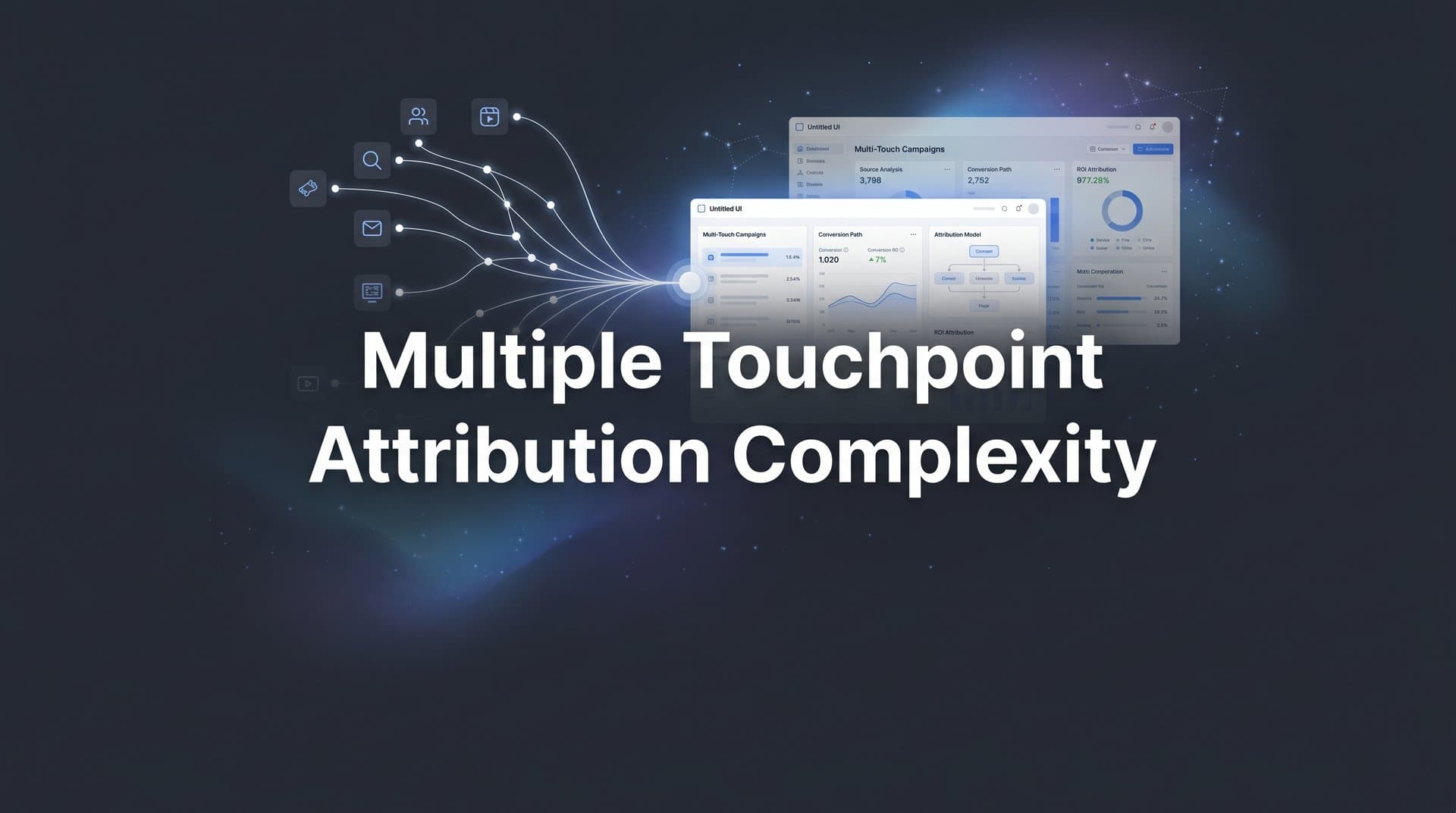
You're staring at three different dashboards. Google Ads says it drove 47 conversions this month. Meta claims 52. Your CRM shows 38 new customers. The math doesn't add up—and your CFO wants to know which channels are actually working.
This isn't a reporting error. It's the reality of modern marketing attribution.
Today's customers don't follow neat, linear paths from ad click to purchase. They bounce between devices, interact with multiple channels, and take days or weeks to convert. That single sale your CRM recorded? It likely involved a Facebook ad on mobile, a Google search on desktop, three email opens, a retargeting click, and a direct visit before the purchase finally happened.
Each platform wants credit. Each dashboard tells a different story. And somewhere in that chaos, you need to make confident decisions about where to spend your budget next month.
This is multiple touchpoint attribution complexity—the challenge of assigning conversion credit across numerous customer interactions spanning different channels, devices, and time periods. As customer journeys have expanded to include 20+ touchpoints, attribution has shifted from a simple tracking problem to a sophisticated data challenge that impacts every marketing decision you make.
Understanding why this complexity exists and how to navigate it is no longer optional. It's the difference between scaling with confidence and throwing money at channels that might not be working as well as you think.
The Anatomy of a Modern Customer Journey
Let's trace what actually happens when someone becomes your customer.
Picture a marketing director at a growing SaaS company. She first encounters your brand through a LinkedIn ad on her phone during her morning commute. Interesting, but she's not ready to engage. Three days later, she searches for solutions to her problem on Google at work and clicks your paid search ad. She reads a blog post, then closes the tab.
A week passes. She sees your retargeting ad on Facebook and clicks through to your pricing page. Still not convinced. She receives your nurture email and forwards it to her team. Two colleagues visit your site directly. One downloads a case study.
Another week goes by. She searches your brand name directly, reads reviews on G2, then visits your site again. She signs up for a demo. After the demo, she receives three follow-up emails. Finally, she returns via a direct visit and converts.
That's one customer journey. Twelve distinct touchpoints. Four different devices. Three weeks from first impression to conversion.
This isn't an extreme example. For B2B buyers, journeys involving multiple touchpoints before conversion have become standard. Even B2C purchases often involve three to five interactions, especially for considered purchases above $100.
Compare this to marketing ten years ago. A customer might see a TV ad, visit your website directly, and purchase. Or click a Google ad and convert immediately. Attribution was simpler because journeys were simpler—mostly linear, mostly single-device, mostly short.
Today's fragmented landscape has created touchpoint proliferation. Your prospects interact with paid social, organic search, paid search, display ads, email, SMS, influencer content, review sites, comparison tools, and direct visits. They switch between phones, tablets, laptops, and desktops. They research at work and purchase at home.
Each additional channel you activate creates exponentially more possible journey combinations. Two channels create a handful of potential paths. Five channels create hundreds. Ten channels create thousands.
This proliferation isn't just a tracking headache. It fundamentally changes how you need to think about marketing performance. When a customer touches your brand twelve times before converting, which interaction deserves credit? Which one actually influenced the decision? Which channels are working together, and which are redundant?
The answers aren't obvious, and that's exactly why attribution has become so complex.
Why Single-Touch Models Fall Short
Most marketers start with the simplest attribution approach: give all the credit to one touchpoint.
First-touch attribution assigns 100% of conversion credit to the initial interaction. In our earlier example, the LinkedIn ad would get full credit. Last-touch attribution does the opposite, giving everything to the final touchpoint before conversion—the direct visit in this case.
These models are appealingly simple. They're easy to implement, easy to explain, and give you clear answers about which channels are "working." But those clear answers are often wrong.
First-touch attribution creates a massive blind spot for everything that happens after initial awareness. Yes, that LinkedIn ad introduced your brand, but did it actually drive the conversion? Or did the prospect forget about you completely until your retargeting campaign brought them back three weeks later?
When you optimize based on first-touch data, you end up overinvesting in top-of-funnel awareness channels while starving the mid-funnel and bottom-funnel touchpoints that actually close deals. Your reports show LinkedIn driving tons of conversions, so you increase spend there—only to find that more awareness doesn't translate to more revenue because you haven't invested in the nurture and retargeting that converts aware prospects into customers.
Last-touch attribution creates the opposite problem. It gives all the credit to whatever happened right before conversion, which is often a branded search or direct visit. These touchpoints get credit for conversions they didn't really create—they just happened to be last.
Think about it: if someone searches your brand name and converts, that's not really a "win" for your branded search campaign. Something earlier in their journey made them aware of your brand and interested enough to search for it. Last-touch attribution makes branded search and direct traffic look like your best channels when they're often just the final step in a journey initiated elsewhere.
The most dangerous aspect of single-touch models is that they create conflicting realities across platforms. Google Ads uses last-click attribution by default. Facebook uses a 28-day view and 1-day click window. Your email platform probably uses first-touch or last-touch depending on settings. Understanding the difference between single source attribution and multi touch attribution models is essential for avoiding these pitfalls.
When you sum up all the conversions each platform reports, you get 150% or 200% of your actual conversions. Every platform is taking credit for the same sales. This isn't just a reporting annoyance—it leads to catastrophically bad decisions when you try to calculate ROAS or determine budget allocation based on platform-reported numbers.
Single-touch models were built for a simpler era. They break down completely when customer journeys involve multiple meaningful interactions across channels and devices.
The Hidden Layers of Attribution Complexity
Even if you move beyond single-touch models, you're still fighting against fundamental tracking limitations that make attribution genuinely difficult.
The biggest challenge is cross-device attribution tracking. Your customer is not one person with one device—they're one person with three or four devices, and your tracking systems see them as four different anonymous visitors.
When someone clicks your Facebook ad on their phone in the morning, browses your site on their work laptop at lunch, and converts on their home computer that evening, most tracking systems cannot connect those three sessions to the same person. The identity chain breaks. Each device gets a different cookie, and without a login or form submission to tie them together, you're blind to the complete journey.
This means your attribution data is fundamentally incomplete. You're not just struggling to assign credit correctly—you're missing entire touchpoints because you can't see that the mobile visitor and the desktop converter are the same person.
Privacy changes have made this exponentially worse. iOS tracking restrictions, cookie deprecation in browsers, and privacy regulations like GDPR have systematically dismantled the tracking infrastructure that digital marketing was built on.
Browser-based tracking, which relies on third-party cookies to follow users across sites, is dying. Safari and Firefox already block most tracking by default. Chrome has announced plans to phase out third-party cookies. This isn't a temporary setback—it's a permanent shift in how tracking works online.
The result is massive data loss. Marketers who rely solely on browser-based tracking are now missing 30% to 50% of their actual conversions. iOS users, in particular, are nearly invisible to traditional tracking methods. If half your customers use iPhones, you're essentially flying blind on half your marketing performance.
Time decay adds another layer of complexity. How long should you track someone before giving up? If a prospect clicks your ad today and converts three months later, should that ad still get credit?
Different businesses have different natural conversion windows. B2B SaaS sales might take 60 to 90 days. E-commerce purchases might happen within hours. If you set your attribution window too short, you miss delayed conversions and undervalue top-of-funnel activities. Set it too long, and you give credit to touchpoints that had no real influence on the eventual purchase.
There's no universally correct answer. The right attribution window depends on your specific sales cycle, but most marketers either use platform defaults without thinking about it or struggle to determine what window actually makes sense for their business.
These technical challenges mean that even with sophisticated attribution models, you're working with incomplete data. You're trying to solve a complex puzzle when some of the pieces are missing and others are mislabeled.
The goal isn't perfect attribution—that's impossible. The goal is directional accuracy despite these limitations.
Multi-Touch Attribution Models Explained
Multi-touch attribution models attempt to solve the single-touch problem by distributing conversion credit across multiple touchpoints. Each model makes different assumptions about which interactions matter most.
Linear attribution is the simplest multi-touch approach. It divides credit equally among all touchpoints. If someone had five interactions before converting, each gets 20% credit. This model assumes every touchpoint contributed equally, which is rarely true but at least acknowledges that multiple interactions mattered.
The advantage of linear attribution is that it's fair and easy to understand. The disadvantage is that it treats a casual social media impression the same as a demo call that directly led to purchase. Not all touchpoints are created equal, and linear attribution ignores that reality.
Time-decay attribution gives more credit to recent touchpoints and less to older ones. The logic is that interactions closer to conversion had more influence on the decision. A retargeting ad someone clicked yesterday gets more credit than a blog post they read three weeks ago.
This model works well when you believe recency matters—when recent touchpoints actually do have more influence. But it can undervalue important early interactions that created initial awareness and interest. That first touchpoint might have been crucial even if it happened weeks ago.
Position-based attribution, sometimes called U-shaped attribution, gives most credit to the first and last touchpoints while distributing the remainder among middle interactions. A common split is 40% to first touch, 40% to last touch, and 20% divided among everything in between.
The theory is that awareness and conversion moments are most important, while middle touches play a supporting role. This model works well when your marketing strategy focuses on generating initial interest and then closing deals, with less emphasis on mid-funnel nurture. For a deeper dive into these approaches, explore multi touch attribution models for data.
Data-driven attribution uses machine learning to analyze actual conversion patterns and assign credit based on what the data reveals. Instead of using predetermined rules, the algorithm compares converting journeys to non-converting journeys and identifies which touchpoints actually correlate with conversions.
If your data shows that people who interact with email after seeing a paid ad convert at much higher rates, data-driven attribution will give those touchpoints more credit. It adapts to your specific customer behavior rather than applying generic assumptions.
The challenge with data-driven attribution is that it requires substantial data volume to work accurately. If you don't have thousands of conversions to analyze, the model lacks the statistical power to identify meaningful patterns. It also operates as a black box—you get credit assignments without always understanding why the algorithm weighted things that way.
Here's the uncomfortable truth: no single attribution model is universally correct. Each model reveals a different perspective on your marketing performance, and each perspective has value.
The best approach is to compare multiple attribution models side by side. Look at how your channel performance changes when you view it through different lenses. If a channel looks strong across multiple models, you can be confident it's genuinely working. If it only looks good in one model, dig deeper before making big budget decisions based on that view.
Attribution models are tools for understanding, not sources of absolute truth. Use them to inform your decisions, not dictate them.
Building a System to Handle Attribution Complexity
Managing multiple touchpoint attribution complexity requires infrastructure, not just better reporting.
The foundation is unified tracking that connects your ad platforms, CRM, and website into a single source of truth. When all your data flows into one system, you can see complete customer journeys instead of fragmented pieces scattered across platforms.
This means implementing tracking that captures ad clicks, website visits, form submissions, email interactions, and CRM events in a way that ties them all to individual customer records. When someone converts, you need to see their entire journey backwards—every ad they clicked, every page they visited, every email they opened. A robust touchpoint attribution system makes this possible.
Most marketers try to stitch this together manually, pulling reports from Google Ads, Meta Ads Manager, their email platform, and their CRM, then attempting to reconcile them in spreadsheets. This approach breaks down immediately when you try to connect touchpoints across platforms or track individual customer journeys.
Unified tracking infrastructure automates this connection. It captures events from all sources, matches them to customer identities, and builds complete journey maps automatically. This is the only way to handle attribution at scale when you're tracking thousands of customers across dozens of touchpoints.
Server-side tracking has become essential because browser-based tracking is increasingly unreliable. Instead of relying on cookies and pixels that browsers can block, server-side tracking sends data directly from your server to your analytics platform and ad networks.
When someone converts on your website, your server logs that event and sends it to your tracking system regardless of browser settings, ad blockers, or privacy restrictions. This dramatically improves data accuracy, often recovering 30% to 50% of conversions that browser-based tracking misses.
Server-side tracking also enables better cross-device attribution because it can tie events to logged-in user accounts rather than browser cookies. When someone logs into your site on multiple devices, server-side tracking recognizes them as the same person and connects their journey across devices.
The final piece is using AI and automation to surface actionable insights from complex multi-touch data. When you're tracking hundreds of touchpoints across dozens of campaigns, manual analysis becomes impossible.
AI can identify patterns humans miss—like discovering that customers who interact with specific ad sequences convert at higher rates, or recognizing that certain channel combinations work synergistically while others compete for the same audience.
Modern attribution platforms use AI to analyze your multi-touch data and generate recommendations: which campaigns to scale, which to pause, where to reallocate budget for maximum impact. Instead of drowning in attribution reports, you get clear guidance on what actions to take.
This is where attribution shifts from a reporting exercise to a competitive advantage. When you can see complete customer journeys, compare multiple attribution models, and get AI-powered recommendations on how to optimize, you make faster and better decisions than competitors still struggling with fragmented data.
Making Confident Decisions Despite Complexity
The goal of attribution is not perfect accuracy. It's confident decision-making.
Focus on directional accuracy rather than precise numbers. If your attribution data shows that paid search drives 30% of conversions under one model and 35% under another, the exact number matters less than the directional insight: paid search is a significant driver. You can confidently invest there.
What matters is relative performance and trends. Is this channel improving or declining? Is this campaign outperforming others? Are certain audience segments responding better? These directional insights enable smart budget allocation even when absolute attribution remains imperfect.
Validate your attribution insights against real revenue outcomes. Your CRM is your source of truth for actual customers and revenue. If your attribution data says a channel is driving tons of conversions but your CRM shows those leads never close, trust the CRM. Learning how to fix attribution data discrepancies becomes critical for maintaining accurate reporting.
This validation loop is crucial. Test attribution-based decisions and measure their impact on actual revenue. If reallocating budget based on attribution insights leads to better revenue outcomes, your attribution is working. If not, adjust your approach.
One of the most powerful applications of better attribution data is feeding it back to ad platforms. When you send accurate conversion data to Meta, Google, and other networks, their algorithms optimize better.
Ad platforms use conversion data to train their targeting and bidding algorithms. If you're only sending them partial data because of tracking limitations, their AI is optimizing on incomplete information. When you feed them complete conversion data through server-side tracking and proper attribution, they can identify better audiences and optimize bids more effectively.
This creates a virtuous cycle: better attribution leads to better data sent to platforms, which leads to better ad performance, which generates more conversions to analyze. Your attribution infrastructure becomes a competitive moat that's hard for competitors to replicate. Implementing cross platform attribution tracking ensures you capture the full picture across all your advertising channels.
Turning Complexity Into Competitive Advantage
Multiple touchpoint attribution complexity is not a problem you solve once and forget about. It's an ongoing challenge that requires continuous management as customer behavior evolves, privacy regulations change, and new channels emerge.
But here's the opportunity: most marketers are still struggling with this complexity. They're making budget decisions based on incomplete data, platform-reported numbers that don't add up, and single-touch attribution models that miss the bigger picture.
Marketers who invest in unified tracking infrastructure, compare multiple attribution models, and connect all their data sources gain a significant competitive advantage. They see what competitors can't see. They make confident scaling decisions while others are paralyzed by conflicting reports. They feed better data to ad platforms and get better performance as a result.
The complexity isn't going away. Customer journeys will continue to span more touchpoints, more devices, and more channels. Privacy restrictions will continue to limit traditional tracking methods. Attribution will remain challenging.
The question is whether you'll build the infrastructure to handle that complexity or continue struggling with fragmented data and uncertain decisions. The right tools and approach transform attribution from a source of confusion into a source of clarity and confident scaling decisions.
Ready to elevate your marketing game with precision and confidence? Discover how Cometly's AI-driven recommendations can transform your ad strategy—Get your free demo today and start capturing every touchpoint to maximize your conversions.


