

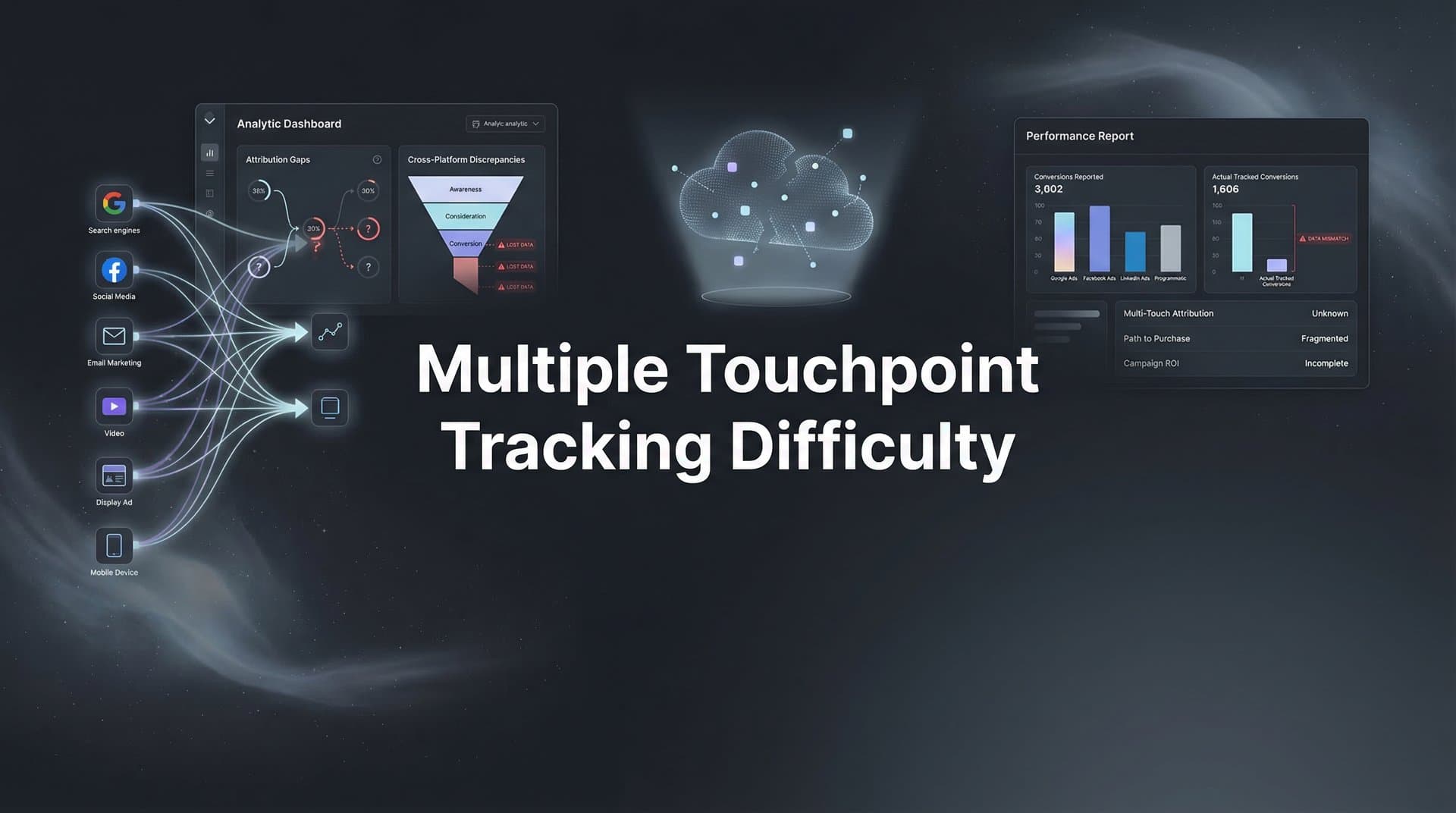
You open your dashboard Monday morning, coffee in hand, ready to review last week's performance. Google Ads reports 47 conversions. Meta claims 52. Your CRM shows 38 closed deals. The numbers don't add up—they never do anymore.
You're not alone in this frustration. Modern customer journeys have evolved into complex webs of interactions spanning 6-8+ touchpoints across devices, platforms, and sessions. What used to be a straightforward path from ad click to purchase has fractured into a maze that traditional tracking systems simply can't navigate.
The result? Conflicting reports, wasted budget, and decisions based on incomplete data. This article breaks down exactly why multiple touchpoint tracking has become so difficult and, more importantly, what you can do to fix it.
The Fragmented Customer Journey: Why Tracking Fell Apart
Think about your own buying behavior. You probably discovered a product on Instagram during your morning scroll, searched for reviews on your laptop at lunch, clicked a Google ad on your tablet that evening, and finally purchased on your desktop three days later.
That's four devices, three platforms, and multiple sessions—all for a single conversion. Now multiply that complexity across thousands of customers, and you begin to see the tracking nightmare marketers face today.
Modern buyers don't follow linear paths anymore. The traditional marketing funnel assumed customers moved predictably from awareness to consideration to purchase. Reality looks nothing like that neat diagram. Buyers jump between channels, devices, and platforms in patterns that seem almost random.
Someone might see your Facebook ad, ignore it, then weeks later search for your brand name after a friend's recommendation. They visit your site on mobile, abandon their cart, receive an email reminder, click through on desktop, and finally convert. Which touchpoint deserves credit for that sale? Understanding multiple touchpoints before conversion is essential for accurate attribution.
The technical infrastructure wasn't built for this complexity. Each platform—Google, Meta, TikTok, LinkedIn—operates in its own silo with proprietary tracking methods that don't communicate with each other. Google has no idea what happened on Meta. Meta can't see your email campaigns. Your CRM doesn't know which ads someone clicked before filling out your contact form.
These platforms were designed when customer journeys were simpler and more contained. A decade ago, most conversions happened on the same device where the ad was clicked, often in the same session. Tracking was straightforward because there were fewer variables to account for.
But as smartphones became ubiquitous and social platforms exploded, customer behavior changed faster than tracking technology could adapt. The shift from linear purchase paths to complex, non-linear journeys has left most marketing teams flying blind, making billion-dollar budget decisions based on incomplete fragments of the actual customer story.
Five Technical Barriers Breaking Your Attribution Data
Privacy Updates Eliminated Massive Chunks of Trackable Data: Apple's App Tracking Transparency framework, rolled out in 2021, fundamentally changed mobile advertising. When users see that tracking permission popup and tap "Ask App Not to Track," advertisers lose visibility into their journey. Many advertisers have reported losing tracking data from cookies and other browser-based methods. Browser manufacturers followed suit, with Safari's Intelligent Tracking Prevention and Firefox's Enhanced Tracking Protection blocking third-party cookies by default. Chrome's planned cookie deprecation adds another layer of complexity.
Cross-Device Tracking Gaps Create Invisible Conversions: Your customer browses on their iPhone during their commute, researches on their work laptop during lunch, and converts on their home desktop that evening. Without a unified identifier connecting those three devices to the same person, your tracking sees three separate users—two who didn't convert and one who appeared out of nowhere. The conversion gets attributed to the last touchpoint visible on desktop, while the mobile and laptop interactions that actually drove the decision remain invisible. Implementing cross-device attribution tracking solves this fragmentation.
Platform Attribution Windows Don't Align: Meta uses a 7-day click and 1-day view attribution window by default. Google Ads defaults to 30 days for search campaigns. LinkedIn offers 30-day windows. Your email platform might use 7 days. When a customer converts 15 days after clicking a Meta ad and 10 days after clicking a Google ad, both platforms claim full credit for the conversion. Your reports show more conversions than you actually received, and you have no clear picture of which channel truly drove the sale.
Browser-Based Tracking Has Become Unreliable: Traditional pixel-based tracking relies on JavaScript code firing in the user's browser and setting cookies to track their behavior. This method breaks down when users clear cookies, use private browsing modes, employ ad blockers, or switch devices. iOS restrictions prevent Meta's pixel from tracking conversions that happen more than 24 hours after an ad click. The data you're basing decisions on represents an incomplete picture of what's actually happening.
Server-Side Implementation Requires Technical Expertise: The solution to browser-based tracking limitations is server-side tracking, which sends conversion data directly from your servers to ad platforms without relying on browser cookies. This captures conversions that browser-based methods miss and provides more reliable data. But implementing server-side tracking requires technical knowledge that many marketing teams lack. You need to set up server infrastructure, configure APIs, handle data formatting, and maintain the system over time. The complexity creates a barrier that leaves many teams stuck with outdated tracking methods.
The Real Cost of Inaccurate Touchpoint Data
When your tracking only captures fragments of the customer journey, the consequences extend far beyond confusing reports. Your entire marketing strategy becomes compromised.
Budget Flows to the Wrong Channels: Last-click attribution gives full credit to whichever touchpoint happened right before conversion. A customer might discover your brand through a LinkedIn ad, research you via organic search, compare options after seeing a display retargeting ad, and finally convert after clicking a branded Google search ad. Last-click attribution credits that final branded search click, which costs you pennies. Meanwhile, the LinkedIn ad that actually introduced your brand to the customer shows zero conversions and looks like wasted spend. You cut budget from the channel that's driving awareness and pour more money into branded search that's just capturing demand you already created.
Ad Platform Algorithms Degrade Over Time: Meta, Google, and other platforms use machine learning to optimize ad delivery toward people most likely to convert. These algorithms need accurate conversion signals to learn effectively. When your tracking only captures partial conversion data—missing cross-device conversions, iOS conversions, and delayed conversions outside attribution windows—the algorithms receive incomplete feedback. They can't distinguish which audiences, creatives, and placements actually drive results. Over time, their targeting becomes less precise, your cost per acquisition rises, and campaign performance degrades. This is one of the most common multiple ad platforms tracking issues marketers face.
Decision-Making Becomes Guesswork: Marketing teams lose confidence in their data when reports contradict each other and numbers don't align with revenue. When you can't trust your attribution data, you can't make confident scaling decisions. Should you increase budget on that campaign showing strong ROAS? Maybe—but if the tracking is missing conversions, you might already be overspending. That underperforming channel might actually be your best performer if you could see the full journey. Without reliable data, teams revert to gut feelings, copying competitors, or following the loudest voice in the room instead of letting data guide strategy.
Multi-Touch Attribution Models: Choosing the Right Approach
If last-click attribution oversimplifies the customer journey, how should you distribute credit across multiple touchpoints? Multi-touch attribution models offer different approaches to this problem.
Linear Attribution: This model splits credit equally across all touchpoints in the customer journey. If someone interacted with five different ads before converting, each gets 20% credit. Linear attribution acknowledges that multiple touchpoints contributed, but it assumes they all contributed equally—which often isn't true. Your initial awareness ad and your final retargeting ad probably played different roles in the conversion.
Time-Decay Attribution: This approach gives more credit to touchpoints closer to conversion, based on the logic that recent interactions had more influence on the final decision. An ad clicked one day before purchase receives more credit than one clicked three weeks earlier. Time-decay works well for longer sales cycles where recent touchpoints genuinely matter more, but it can undervalue important early-stage interactions that initiated the entire journey.
Position-Based Attribution: Also called U-shaped attribution, this model assigns higher credit to the first and last touchpoints—typically 40% each—while distributing the remaining 20% among middle interactions. The logic is that the first touchpoint created awareness and the last touchpoint drove conversion, while middle touchpoints played supporting roles. This model works well when you want to value both customer acquisition and conversion optimization.
Data-Driven Attribution: Instead of following predetermined rules, data-driven models use machine learning to analyze your actual conversion paths and determine which touchpoints statistically contribute most to conversions. The algorithm compares journeys that converted with similar journeys that didn't, identifying which touchpoints made the difference. This approach requires significant data volume to work effectively, but it provides the most accurate picture of channel contribution based on your specific business.
The best model depends on your situation. Businesses with short sales cycles and few touchpoints might find linear attribution sufficient. Companies with longer B2B sales cycles often prefer time-decay or position-based models that account for the extended consideration period. Organizations with enough conversion volume should explore data-driven attribution for the most accurate insights. Reviewing different attribution tracking methods helps you select the right approach for your business.
Here's the key insight: comparing multiple attribution models side-by-side reveals which channels are consistently undervalued or overvalued. If a channel shows strong performance across all models, you can confidently invest more. If it only looks good in last-click attribution but weak everywhere else, you're probably overspending on bottom-funnel tactics while starving top-of-funnel awareness.
Building a Unified Tracking System That Actually Works
Solving multiple touchpoint tracking difficulty requires moving beyond platform-specific data silos toward a unified system that captures the complete customer journey.
Create a Single Source of Truth: Connect your ad platforms, CRM, website analytics, and any other customer touchpoint systems into one unified platform. This doesn't mean abandoning your existing tools—it means linking them together so data flows between systems. When someone clicks a Meta ad, that interaction should be captured. When they visit your website, that session should connect to the ad click. When they convert in your CRM, that conversion should link back to all previous touchpoints. This complete journey visibility eliminates the conflicting reports problem because you're looking at integrated data instead of comparing isolated platform claims. Proper customer touchpoint tracking makes this integration possible.
Implement Server-Side Tracking: Browser-based tracking limitations aren't going away—they're getting stricter. Server-side tracking captures conversions that browser-based methods miss by sending conversion data directly from your servers to ad platforms. When someone converts on your website, your server immediately notifies Meta, Google, and other platforms about the conversion, including all relevant data. This approach bypasses browser restrictions, captures cross-device conversions more accurately, and provides more reliable data to ad platform algorithms. Understanding the difference between Google Analytics vs server-side tracking helps you make the right implementation choice. Yes, implementation requires technical work, but it's become essential for accurate tracking in the privacy-focused era.
Enrich Your Conversion Data: Basic conversion tracking tells platforms that someone converted. Enriched conversion data tells them who converted, what they purchased, how much they spent, and which previous touchpoints influenced the decision. This additional context dramatically improves ad platform optimization. When Meta's algorithm knows that certain audience segments generate higher-value customers, it can optimize toward those segments. When Google understands which search terms lead to actual revenue instead of just conversions, it can bid more aggressively on profitable queries. Feed your ad platforms the richest possible conversion signals, and their algorithms will deliver better results.
Close the Feedback Loop: The most sophisticated tracking systems don't just capture data—they actively use it to improve campaign performance. When your CRM records a high-value customer, that information should flow back to your ad platforms within hours, not days or weeks. This rapid feedback helps algorithms learn faster and optimize more effectively. The customer who converted yesterday should influence how platforms target similar prospects today. Closing this feedback loop transforms tracking from a passive reporting tool into an active optimization engine.
Your Tracking Improvement Roadmap
Fixing multiple touchpoint tracking doesn't happen overnight, but you can make meaningful progress by following a structured approach.
Audit Your Current Tracking: Start by documenting exactly where your tracking breaks down. Compare conversion numbers across platforms and identify discrepancies. Test your tracking by completing a conversion yourself and checking whether all systems captured it correctly. Look for gaps where customer journey data disappears—device switches, platform transitions, time delays between touchpoint and conversion. Understanding your specific tracking weaknesses helps you prioritize improvements that will have the biggest impact. Many teams discover their attribution tracking not working properly only after conducting a thorough audit.
Prioritize Server-Side Implementation: If you're still relying entirely on browser-based tracking, moving to server-side should be your top priority. The accuracy improvements justify the implementation effort. You don't need to migrate everything at once—start with your most important conversion events and expand from there. Many platforms now offer simplified server-side setup options that reduce technical complexity. A professional attribution tracking setup service can accelerate this process.
Integrate Your Data Sources: Don't settle for manually comparing reports from different platforms. Implement a unified attribution system that automatically connects ad data, website analytics, and CRM conversions. This integration eliminates the conflicting reports problem and gives you confidence in your data. Look for platforms that handle the technical integration work so your team can focus on analysis and optimization rather than data wrangling. Effective ad tracking across multiple platforms requires this unified approach.
Leverage AI for Complex Analysis: When you're tracking dozens of touchpoints across multiple channels for thousands of customers, manual analysis becomes impossible. AI-powered tools can surface patterns and insights from complex multi-touch data that human analysis would miss. These tools can identify which touchpoint combinations drive the highest conversion rates, which channels work best together, and where your attribution model might be misleading you. Use AI to handle the complexity so you can focus on strategic decisions.
Moving Forward with Confidence
Multiple touchpoint tracking difficulty isn't an unsolvable mystery—it's a technical challenge with clear solutions. The fragmentation happened because customer behavior evolved faster than tracking technology could adapt. Privacy restrictions eliminated traditional tracking methods. Platform silos created conflicting reports. But these problems have solutions.
Unified tracking systems that connect all your data sources provide the complete journey visibility you need. Server-side tracking captures conversions that browser-based methods miss. Multi-touch attribution models distribute credit accurately across touchpoints. Enriched conversion data fed back to ad platforms improves their optimization algorithms. AI-powered analysis surfaces insights from complex data.
The marketers winning today aren't the ones with the biggest budgets—they're the ones with the most accurate data. When you can see which touchpoints actually drive revenue, you make smarter budget decisions. When your ad platforms receive complete conversion signals, their algorithms optimize more effectively. When you trust your data, you scale with confidence instead of hesitation.
Take an honest look at your current tracking setup. Are you still relying on last-click attribution and browser-based pixels? Are your platform reports contradicting each other? Are you making budget decisions based on incomplete data? If so, it's time to upgrade your tracking infrastructure.
Ready to elevate your marketing game with precision and confidence? Discover how Cometly's AI-driven recommendations can transform your ad strategy—Get your free demo today and start capturing every touchpoint to maximize your conversions.


