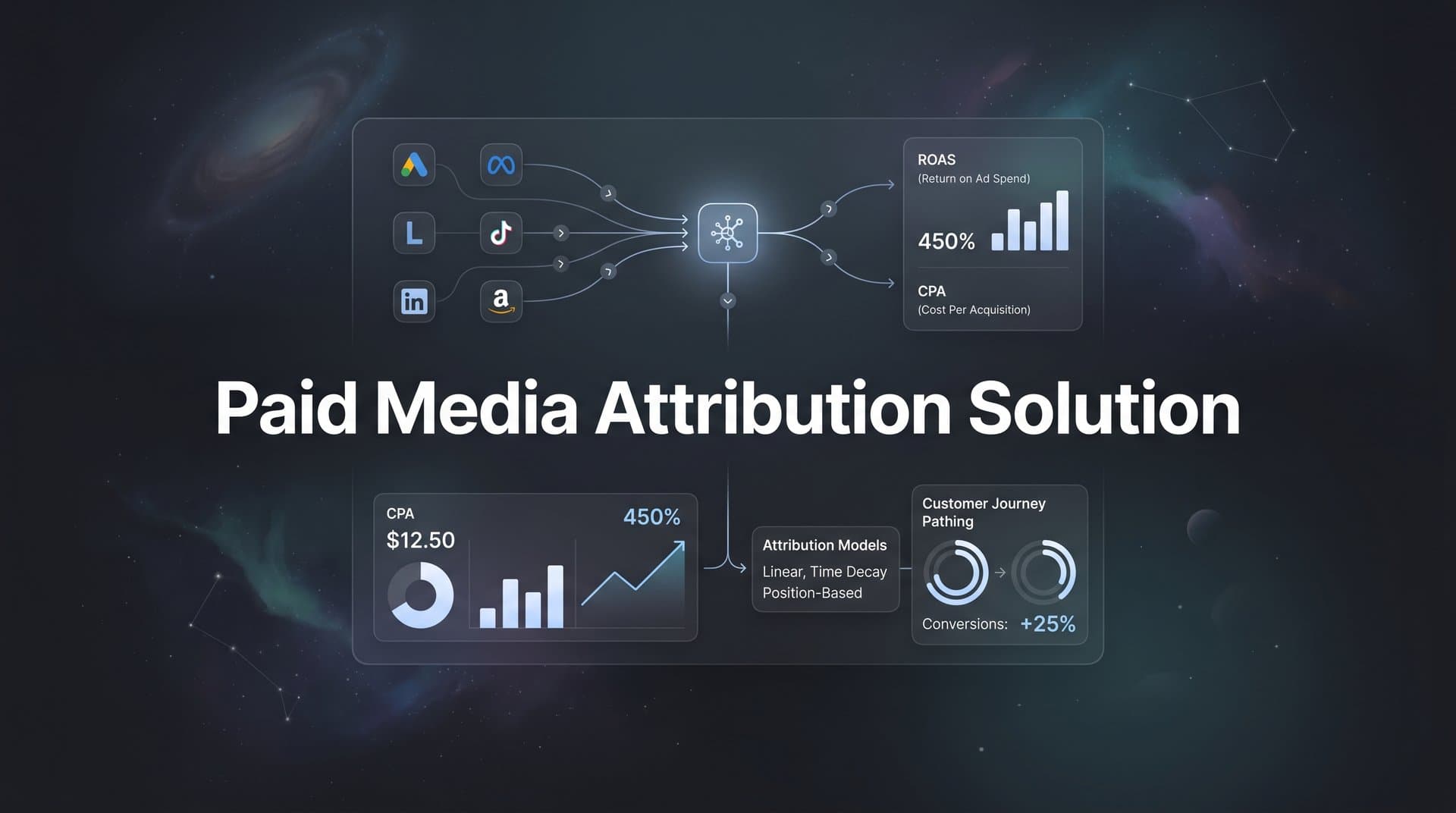
Running paid media across Meta, Google, TikTok, LinkedIn, and more sounds like a growth marketer's dream. But when you can't reliably trace which channel actually drove a conversion, you're essentially flying blind with your budget.
The problem has gotten worse in recent years. iOS App Tracking Transparency, the gradual deprecation of third-party cookies, and increasingly complex cross-device journeys have made native platform reporting less reliable than ever. Each ad platform claims credit for conversions it may not have truly driven, leaving marketers with inflated ROAS numbers and no clear picture of what's actually working.
Independent paid media attribution solutions exist to solve exactly this problem. The tools below were selected based on cross-platform tracking accuracy, multi-touch attribution model flexibility, depth of integrations with ad platforms and CRMs, AI-powered optimization capabilities, and real-time data syncing. Whether you're an ecommerce brand, a B2B lead-gen team, or a mobile app marketer, there's a solution built for your specific needs.
If you want to understand how modern attribution works before diving in, the Cometly attribution overview is a solid starting point. And if you're curious about what a full-featured platform looks like, the Cometly features page breaks it down clearly.
Here are the top paid media attribution solutions worth considering in 2026.
1. Cometly
Best for: AI-powered multi-platform attribution with real-time conversion syncing and ad optimization
Cometly is a marketing attribution and analytics platform that connects your ad platforms, CRM, and website to track the full customer journey, then feeds enriched conversion data back to ad platform algorithms to improve targeting and bidding.
 9 Best Paid Media Attribution Solutions to Track Ad ROI in 2026
Where This Tool Shines
What separates Cometly from many attribution tools is the two-way data flow. It doesn't just tell you what happened after the fact. It actively improves your campaigns by sending enriched, conversion-ready events back to Meta, Google, TikTok, and other platforms through its Conversion Sync feature. This means your ad platform algorithms get better data to work with, which compounds over time into better targeting and lower cost per acquisition.
The AI layer is genuinely useful here. Rather than dumping raw data into a dashboard and leaving you to interpret it, Cometly's AI provides recommendations on which ads and campaigns are performing, where to shift budget, and which touchpoints are contributing most to revenue. The AI Chat feature lets you ask questions in plain language and get answers without needing to build custom reports.
Key Features
AI-Powered Ad Recommendations: Identifies high-performing ads and campaigns across every channel, then suggests budget shifts to maximize ROI.
Server-Side Tracking: Bypasses browser-based limitations and iOS restrictions to capture conversion data that pixel-based tracking misses.
Conversion Sync: Sends enriched conversion events back to Meta, Google, TikTok, and more to improve ad platform algorithm performance.
Multi-Touch Attribution: Supports customizable attribution models so you can analyze the full customer journey rather than relying on last-click defaults.
AI Chat for Data Analysis: Allows natural language queries against your marketing data, making reporting accessible without SQL or custom dashboards.
Best For
Cometly is well-suited for digital marketing teams and agencies managing paid campaigns across multiple platforms who need accurate attribution, AI-driven optimization, and a way to feed better data back to ad platform algorithms. It works for both ecommerce and lead-gen use cases.
Pricing
Custom pricing based on ad spend volume. Request a demo directly on the Cometly website to get details relevant to your account size.
2. Triple Whale
Best for: Ecommerce and DTC brands running paid media through Shopify
Triple Whale is an ecommerce-focused attribution platform built around Shopify, offering first-party pixel tracking, creative analytics, and post-purchase survey data in one dashboard.
 7 Best Funnel.io Alternatives for Marketing Data Analytics in 2026
Where This Tool Shines
Triple Whale has earned a strong following in the DTC space because it understands the Shopify ecosystem deeply. Its first-party pixel captures purchase data more accurately than relying on Meta or Google's native tracking, which is particularly valuable as browser restrictions tighten. The blended ROAS dashboards give a clean, consolidated view of performance across paid channels without needing to toggle between platform accounts.
The creative analytics capability is a standout for brands running high volumes of ad creatives. You can quickly see which creative assets are driving conversions rather than just clicks, which helps creative teams prioritize what to produce next.
Key Features
First-Party Pixel: Accurate Shopify-based attribution that doesn't rely solely on platform-reported data.
Creative Analytics: Performance breakdowns by ad creative to identify what's actually converting, not just getting impressions.
Customer Journey Mapping: Visualizes the touchpoints a customer interacts with before purchasing across paid channels.
Post-Purchase Survey Integration: Captures self-reported attribution data directly from customers at checkout.
Cohort Analysis and Blended ROAS: Dashboards that combine revenue, spend, and LTV data across all channels in one view.
Best For
DTC ecommerce brands on Shopify, particularly those spending heavily on Meta and Google and looking for cleaner attribution data alongside creative performance insights.
Pricing
Plans start around $100 per month for smaller stores, with pricing scaling based on store revenue. Larger brands should expect higher tiers.
3. Northbeam
Best for: Brands combining multi-touch attribution with media mix modeling for budget allocation
Northbeam is a machine learning-powered attribution platform that layers media mix modeling on top of multi-touch attribution to help brands make more confident budget decisions across channels.
 9 Best Attribution Tools for Paid Advertising in 2026
Where This Tool Shines
Northbeam's strength is in combining two measurement methodologies that are typically sold separately. Multi-touch attribution gives you granular, user-level path data, while media mix modeling provides a statistical view of channel contribution at scale. Having both in one platform lets you cross-validate findings and make budget decisions with more confidence than either method alone.
The incrementality-informed attribution modeling is particularly valuable for brands that have grown skeptical of MTA alone. By layering in incrementality signals, Northbeam helps you understand not just which channels get credit, but which channels are actually moving the needle.
Key Features
Customizable Attribution Models: Flexible attribution windows and models to match your sales cycle and business type.
Media Mix Modeling: Statistical channel-level modeling that complements user-level MTA data.
Machine Learning Budget Optimization: Cross-channel budget recommendations informed by ML analysis of your performance data.
Creative Analytics: Performance breakdowns at the creative level to inform ad production decisions.
Incrementality-Informed Attribution: Blends incrementality testing signals into attribution outputs for more accurate channel credit.
Best For
Mid-to-large ecommerce and DTC brands spending significant monthly budgets on paid media who want to move beyond basic MTA into more sophisticated measurement frameworks.
Pricing
Custom pricing; Northbeam is typically positioned for brands spending $50,000 or more per month on paid advertising. Contact them directly for a quote.
4. Rockerbox
Best for: Omnichannel marketers measuring both digital and offline channel performance
Rockerbox is a unified marketing measurement platform that brings multi-touch attribution, media mix modeling, and incrementality testing together, with the added ability to track offline channels like TV, podcasts, and direct mail.
 9 Best Attribution Modeling Software Options by Price in 2026
Where This Tool Shines
Most attribution tools focus exclusively on digital. Rockerbox stands out by extending measurement into offline channels, which is increasingly important as brands diversify beyond Meta and Google into connected TV, podcast sponsorships, and direct mail. Having a single platform that deduplicates conversions across all of these touchpoints gives marketers a much more honest view of what's driving growth.
The new customer versus returning customer attribution is another useful differentiator. Rather than treating all conversions equally, Rockerbox helps you understand which channels are actually acquiring net-new customers versus just converting people who were already in your funnel.
Key Features
Unified Digital and Offline Measurement: Tracks performance across TV, podcast, direct mail, and digital channels in one platform.
MTA, MMM, and Incrementality: Three measurement methodologies available within a single platform.
Deduplicated Conversion Tracking: Eliminates double-counting across platforms for more accurate revenue attribution.
New vs. Returning Customer Attribution: Distinguishes between acquisition and retention performance by channel.
Broad Channel Integrations: Connects to a wide range of ad platforms, CRMs, and offline media sources.
Best For
Brands running diversified marketing programs that span both digital and offline channels, and teams that need to unify measurement across a complex media mix.
Pricing
Custom pricing based on the number of channels and conversion volume. Contact Rockerbox directly for a quote tailored to your program.
5. Hyros
Best for: High-ticket businesses and long sales cycles with complex multi-step funnels
Hyros is an attribution platform built for businesses selling high-ticket products or services, offering extended attribution windows, inbound call tracking, and funnel-level visibility across complex conversion paths.
 7 Best Northbeam Alternatives for Small Business in 2026
Where This Tool Shines
Most attribution tools are optimized for ecommerce with short purchase cycles. Hyros is built for a different kind of business: one where the journey from ad click to closed deal might span weeks or months, involve phone calls, and require multiple touchpoints before a decision is made. The extended attribution windows ensure that early-funnel ad spend gets credit for deals that close long after the initial click.
The inbound call tracking is a genuine differentiator for businesses that rely on phone-based sales. By tying call activity back to the originating ad source, Hyros gives sales teams and marketers a shared view of which campaigns are driving not just leads, but actual conversations with qualified prospects.
Key Features
Long-Window Attribution: Tracks conversions over extended periods to match longer B2C and B2B sales cycles.
Inbound Call Tracking: Connects phone call activity directly to the paid media source that drove it.
AI Ad Optimization: Provides AI-based recommendations for improving ad performance based on your funnel data.
Multi-Step Funnel Attribution: Attributes revenue across complex, multi-stage sales processes.
Ad Platform Data Feedback: Sends conversion data back to major ad platforms to improve algorithm performance.
Best For
Coaches, consultants, agencies, and businesses selling high-ticket offers where the sales process involves multiple touchpoints, phone calls, and extended decision timelines.
Pricing
Plans start around $99 per month, with pricing scaling based on ad spend volume and the features required. Check the Hyros website for current plan details.
6. Ruler Analytics
Best for: B2B lead-gen businesses connecting paid media clicks to CRM revenue
Ruler Analytics is a closed-loop attribution platform that tracks form fills, phone calls, and live chat conversations back to their originating paid media source, then ties that activity to CRM deal revenue.
 8 Best Attribution Tools with Onboarding Support in 2026
Where This Tool Shines
For B2B companies, the gap between a paid media click and a closed deal is where attribution typically breaks down. Ruler Analytics closes that loop by connecting the dots between the first ad interaction, the lead capture event (whether that's a form, a call, or a chat), and the eventual revenue recorded in the CRM. This gives marketing teams a revenue-based view of their paid media performance rather than just a lead volume view.
The offline conversion tracking capability is particularly useful for businesses running Google Ads or Meta campaigns where the goal is lead generation rather than direct purchase. By feeding CRM revenue data back to these platforms, Ruler helps ad algorithms optimize for the leads that actually convert, not just the ones that fill out a form.
Key Features
Closed-Loop Revenue Attribution: Connects paid media clicks to CRM deal revenue across the full sales cycle.
Call, Form, and Chat Tracking: Attributes all lead capture types back to the originating ad source.
Multi-Touch Attribution Models: Supports first click, last click, linear, and other models for flexible analysis.
CRM Integrations: Native connections with HubSpot, Salesforce, and other major CRM platforms.
Offline Conversion Tracking: Sends lead quality and revenue data back to Google Ads and other platforms to improve bidding.
Best For
B2B companies, agencies, and lead-gen businesses that need to connect paid media performance to CRM pipeline and closed revenue, especially where phone and form-based lead capture is central to the funnel.
Pricing
Plans start around $200 per month, with pricing varying based on features, tracked volume, and the number of integrations required.
7. Wicked Reports
Best for: Subscription and recurring revenue brands focused on long-term customer value
Wicked Reports is an LTV-focused attribution platform that uses cohort analysis to show which paid media campaigns drive the highest customer lifetime value, not just first-purchase revenue.
Where This Tool Shines
Most attribution platforms optimize for the initial conversion. Wicked Reports takes a longer view, connecting ad spend to the full revenue a customer generates over their lifetime. This is especially powerful for subscription businesses where the real value of a customer isn't visible at the point of first purchase. A campaign that looks expensive on a cost-per-acquisition basis might actually be your best performer when you factor in average customer LTV.
The email platform integrations are a thoughtful addition. By tracking re-engagement revenue from email campaigns alongside paid media, Wicked Reports gives you a more complete picture of how paid acquisition and email nurturing work together to generate long-term revenue.
Key Features
Cohort-Based LTV Attribution: Ties ad source to customer lifetime value using cohort analysis across acquisition periods.
Subscription Revenue Attribution: Tracks recurring revenue back to the original paid media source over time.
Long-Cycle Multi-Touch Models: Attribution models designed for businesses with extended buying and retention cycles.
Email Platform Integration: Tracks re-engagement revenue from email campaigns alongside paid media attribution.
LTV-Based ROI Reporting: Reports ROI based on total customer value rather than just the initial sale amount.
Best For
Subscription businesses, membership sites, and any brand where customer retention and lifetime value are more meaningful metrics than first-purchase conversion rate.
Pricing
Plans start around $250 per month, scaling based on the volume of revenue tracked. Check the Wicked Reports website for current tier details.
8. AppsFlyer
Best for: Mobile app marketers tracking installs and in-app events across ad networks
AppsFlyer is a mobile-first attribution platform that tracks app installs, in-app events, and deep links back to paid media sources, with built-in fraud detection and support for privacy-first frameworks like SKAdNetwork.
Where This Tool Shines
If your paid media goal is driving app installs or in-app conversions, AppsFlyer is one of the most established platforms in the space. It connects to a wide range of mobile ad networks and provides granular attribution at the install and event level. The fraud protection layer is particularly valuable in mobile advertising, where invalid traffic and click injection are persistent problems that can inflate reported performance.
AppsFlyer has also invested heavily in adapting to privacy changes. Its support for SKAdNetwork (Apple's privacy-preserving attribution framework) and the Privacy Sandbox on Android means it's positioned to continue providing useful attribution data even as mobile privacy restrictions tighten further.
Key Features
Mobile Install and Event Attribution: Tracks app installs and in-app events across a broad range of mobile ad networks.
Deep Linking: Creates seamless user experiences from ad click to specific in-app destination.
Fraud Protection: Filters invalid installs and fraudulent clicks to keep your performance data clean.
SKAdNetwork and Privacy Sandbox Support: Maintains attribution functionality within Apple's and Google's privacy-preserving frameworks.
Audience Segmentation and Retargeting: Builds audiences based on in-app behavior for retargeting campaigns across ad networks.
Best For
Mobile app developers, gaming companies, and any business running paid media campaigns with the primary goal of driving app installs or in-app conversions across iOS and Android.
Pricing
A free tier is available for smaller apps with limited conversion tracking. Paid plans scale based on the number of conversions tracked monthly. Enterprise pricing is available for high-volume accounts.
9. Google Analytics 4 (GA4)
Best for: Teams needing a free attribution baseline with native Google Ads integration
Google Analytics 4 is a free event-based analytics platform with a built-in data-driven attribution model, cross-channel reporting, and native integration with Google Ads and Search Console for basic paid media measurement.
Where This Tool Shines
GA4's biggest advantage is that it's free and already integrated with the Google ecosystem. For teams running Google Ads as their primary paid channel, the native connection between GA4 and Google Ads provides a solid foundation for understanding campaign performance without additional cost. The data-driven attribution model, which uses machine learning to distribute conversion credit across touchpoints, is a meaningful upgrade over the last-click default that many marketers still rely on.
The BigQuery export is worth noting for teams with data engineering resources. Being able to export raw event data into BigQuery opens the door to custom attribution modeling and analysis that goes well beyond what's possible inside the GA4 interface itself.
Key Features
Data-Driven Attribution: Free machine learning-based attribution model that distributes credit across multiple touchpoints.
Event-Based Tracking: Flexible event and conversion definitions that can be customized to match your business goals.
Native Google Ads and Search Console Integration: Direct connection to Google's ad and search platforms for unified reporting.
Cross-Device User Tracking: Attempts to stitch together user journeys across devices using Google's identity graph.
BigQuery Export: Raw data export for custom analysis, modeling, and integration with other data tools.
Best For
Businesses of any size looking for a free attribution baseline, particularly those heavily invested in Google Ads. Also useful as a complementary data source alongside a dedicated paid attribution platform.
Pricing
Standard GA4 is free. GA4 360, the enterprise version with higher data limits and SLAs, starts at approximately $50,000 per year.
Choosing the Right Attribution Solution for Your Team
The right paid media attribution solution depends heavily on your business model, the channels you're running, and what you're ultimately trying to optimize for. Here's a quick breakdown to help you narrow it down.
For AI-powered multi-platform attribution with conversion syncing: Cometly is the strongest choice for teams who want accurate cross-platform attribution, AI-driven budget recommendations, and a way to feed enriched data back to ad platform algorithms to improve targeting over time.
For Shopify ecommerce and DTC brands: Triple Whale's deep Shopify integration and creative analytics make it a natural fit for brands running heavy paid social campaigns and wanting clean, first-party purchase attribution.
For sophisticated budget modeling: Northbeam's combination of MTA and media mix modeling suits larger brands that need more than user-level attribution to make confident channel investment decisions.
For omnichannel programs including offline: Rockerbox is the right call when your media mix extends beyond digital into TV, podcasts, or direct mail and you need unified measurement across all of it.
For high-ticket funnels and long sales cycles: Hyros is purpose-built for businesses where the path from ad click to revenue involves phone calls, long decision windows, and multi-step processes.
For B2B lead-gen tied to CRM revenue: Ruler Analytics excels at closing the loop between paid media and CRM pipeline, making it the go-to for teams where lead quality matters more than lead volume.
For subscription and LTV-focused brands: Wicked Reports is the right tool when first-purchase attribution misses the point and you need to understand which campaigns are actually building long-term customer value.
For mobile app campaigns: AppsFlyer's depth of mobile ad network integrations, fraud protection, and privacy framework support makes it the standard choice for app-first businesses.
As a free baseline: GA4 is worth having regardless of what else you use. It's free, integrates natively with Google Ads, and provides a useful reference point for cross-channel performance.
If you're managing paid campaigns across multiple platforms and want attribution that goes beyond reporting to actually improve your ad performance, Cometly is worth a closer look. Its combination of server-side tracking, multi-touch attribution, AI recommendations, and Conversion Sync creates a feedback loop that gets smarter over time. Get your free demo and see how accurate attribution and AI-driven optimization can change how you allocate your paid media budget.