

Programmatic advertising promises something remarkable: the ability to reach your ideal buyers across dozens of channels, exchanges, and environments simultaneously, all without manually managing each placement. For B2B SaaS marketing teams trying to scale pipeline, that kind of reach is genuinely powerful. The problem is that reach without measurement is just spending.
Here is the tension most marketers know too well. Your programmatic campaigns are running across display, video, native, and connected TV. Impressions are accumulating. Some leads are coming in. But when your VP of Revenue asks which campaigns are actually contributing to pipeline, you find yourself pointing at platform-reported metrics that do not match your CRM, attribution windows that vary by DSP, and a customer journey that spans weeks or months before anyone signs a contract.
This measurement gap is especially costly for B2B SaaS companies. When a sales cycle stretches from first impression to closed-won revenue over several months, the distance between an ad exposure and a conversion event is enormous. Standard attribution approaches were not built for that complexity. Programmatic advertising attribution requires a different way of thinking about how you connect ad spend to business outcomes, and this guide walks you through exactly how to do it.
Why Programmatic Creates a Measurement Problem Unlike Any Other Channel
When you run a campaign on a single paid channel, the data flow is relatively straightforward. One platform, one pixel, one set of reporting metrics. Attribution is still imperfect, but at least the data lives in one place. Programmatic advertising breaks that model entirely.
Programmatic ad buying works by purchasing inventory in real time across multiple ad exchanges and demand-side platforms simultaneously. A single campaign might serve impressions on a news site, a business podcast player, a connected TV app, and a trade publication all within the same hour. Each of those environments has different tracking capabilities, different data return rates, and different definitions of what counts as a viewable impression.
This fragmentation means your impression data is scattered across multiple systems that were not designed to talk to each other. Reconciling that data with your downstream conversion events requires a matching layer that most teams do not have in place. Without it, you are left with a collection of disconnected metrics rather than a coherent picture of what is working.
The automated nature of programmatic compounds this problem. Because the buying happens algorithmically in real time, there is no human decision at the moment of placement to create a clean record of intent. The DSP is optimizing toward its own signals, which may or may not align with the conversion events that actually matter to your business.
For B2B SaaS companies specifically, the timing problem is particularly acute. A programmatic display ad might create the first brand awareness for a prospect who does not actively research your product for another six weeks. By the time they submit a demo request, that initial impression is long outside most attribution windows. Last-click models will credit the paid search ad they clicked right before converting, completely ignoring the programmatic exposure that started the journey. This is not a minor reporting quirk. It leads to systematic misallocation of budget away from channels that are genuinely building pipeline. Understanding the common attribution challenges in marketing helps teams recognize why these gaps exist and how to address them systematically.
The result is that many B2B SaaS teams either undervalue programmatic because they cannot see its contribution, or they over-rely on platform-reported metrics that inflate performance by crediting impressions that had no real influence. Neither outcome helps you make smarter decisions.
The Mechanics Behind Programmatic Attribution
Understanding how programmatic attribution actually works starts with understanding the data pipeline. When a programmatic ad is served, the DSP generates an impression log: a record that this user, identified by a cookie or device ID, was served this creative at this time. That log sits on the DSP side. Separately, your website or CRM records conversion events when a user takes a meaningful action. Attribution is the process of connecting those two data sets.
The connection happens through user identifiers. In a traditional pixel-based setup, when a user sees an ad, a cookie is dropped. When that same user later converts on your site, the pixel fires and attempts to match the conversion back to the earlier ad exposure using that cookie. When the match succeeds, the DSP can credit that impression or click for the conversion.
This is where click-through attribution and view-through attribution diverge in an important way. Click-through attribution only credits ad exposures that resulted in a direct click to your site. View-through attribution credits an impression even when the user did not click, as long as they converted within a specified window after seeing the ad. View-through attribution is particularly relevant for programmatic because display and video ads often influence buyers without generating a direct click, especially at the top of the funnel.
The challenge with view-through attribution is that it can easily overstate programmatic's contribution if the attribution window is too wide. If you set a 30-day view-through window and your programmatic campaign is reaching a broad audience, almost anyone who converts within that period may have technically seen one of your ads. That does not mean the impression drove the conversion. Managing view-through windows carefully and comparing them against control groups or incrementality tests is important for keeping the data honest.
The data pipeline for accurate programmatic attribution typically involves three components working together. First, impression logs from the DSP that record when and where ads were served and to whom. Second, conversion data from your website, CRM, or attribution platform that captures what happened after the impression. Third, a matching layer that ties user identifiers across these sources so you can connect ad exposure to downstream outcomes. When server-side tracking is involved, that matching layer becomes more reliable because it is not dependent on browser cookies that may be blocked or expired.
For B2B SaaS teams, the conversion events that matter most are not just page views or form fills. They include qualified leads, demo requests, opportunities created in the CRM, and ultimately closed-won revenue. Building that full data pipeline requires connecting your digital marketing attribution software to your CRM, not just your website analytics.
Choosing Attribution Models That Reflect How Programmatic Actually Contributes
The attribution model you choose determines how credit is distributed across the touchpoints in a buyer's journey. For programmatic advertising, this choice has significant consequences for how you interpret performance and where you invest budget.
Last-click attribution is the default for many teams because it is simple and easy to explain. The problem is that it systematically undercounts programmatic's role. Programmatic campaigns typically operate at the top and middle of the funnel, building awareness and nurturing interest over time. The final conversion click often comes from a branded search or a direct visit, not from the programmatic ad that introduced the buyer to your product weeks earlier. If you are measuring programmatic on last-click, you will consistently undervalue it and eventually cut spend that was actually doing important work.
Multi-touch attribution models are better suited to programmatic because they distribute credit across all the touchpoints a buyer encounters before converting. A linear model gives equal credit to every touchpoint in the journey, which is a reasonable starting point. A time-decay model gives more credit to touchpoints that occurred closer to the conversion, which can be useful if you believe recency is a meaningful signal in your sales cycle. A position-based model, sometimes called U-shaped attribution, gives the most credit to the first touch and the last touch, with the remaining credit distributed across the middle. This can work well for B2B SaaS teams who want to recognize both the initial awareness-driving impression and the final conversion touchpoint. Exploring multi-touch attribution models for data in depth can help you select the right approach for your specific sales cycle.
Data-driven attribution is the most sophisticated option. It uses statistical modeling to assign credit based on how much each touchpoint actually influenced conversion probability, rather than applying a fixed rule. For teams with enough conversion volume to generate statistically meaningful patterns, data-driven attribution tends to produce the most accurate picture of programmatic's contribution.
The practical recommendation for most B2B SaaS teams is to move away from last-click as the primary model for evaluating programmatic and adopt at least a linear or position-based approach. Run both in parallel initially so you can see how the credit distribution changes and understand what that means for budget decisions. The goal is not to maximize the credit attributed to programmatic but to understand its actual role in your buyers' journeys so you can invest accordingly.
The Tracking Gaps That Quietly Break Your Attribution Data
Even if you have the right attribution model in place, your data is only as reliable as your tracking infrastructure. Several forces are actively working against accurate programmatic attribution right now, and understanding them is essential for building a framework that holds up.
The shift away from third-party cookies has had a significant impact on pixel-based attribution for programmatic. When a user's browser blocks or expires third-party cookies, the matching process between ad exposure and conversion breaks down. The impression was served, the conversion happened, but the connection between them is lost. This creates what looks like a gap in your attribution data but is actually a gap in your tracking infrastructure. Teams that have not addressed this problem will find it increasingly difficult to get accurate programmatic attribution as browser restrictions continue to tighten, and fixing attribution discrepancies in data requires a systematic approach to rebuilding that tracking foundation.
Cross-device journeys make this problem worse in B2B contexts. A prospect might see a programmatic video ad on their phone during a commute, then research your product on their work laptop, then join a demo call that was booked through a direct sales outreach. Standard pixel tracking cannot reliably connect these touchpoints because the user identifiers are different across devices and environments. The result is a fragmented view of the customer journey that makes it look like programmatic had no role when it may have been the starting point.
Browser-level privacy features from major browsers have also reduced the accuracy of impression-to-conversion matching. Even users who have not explicitly opted out of tracking may be affected by intelligent tracking prevention features that limit how long cookies persist or how they can be used across domains.
Server-side tracking addresses many of these limitations by moving the data collection process off the browser and onto your server. Instead of relying on a pixel firing in the user's browser, server-side tracking sends conversion events directly from your server to your attribution platform and ad platforms. This approach is not affected by browser restrictions, ad blockers, or cookie expiration. Conversion API integrations with platforms like Meta and Google work on the same principle: they send enriched, first-party conversion data directly from your server, bypassing the browser entirely.
For B2B SaaS teams, first-party data strategies are increasingly important as a complement to server-side tracking. When users authenticate, fill out forms, or engage with your product, you collect first-party identifiers that can be used to stitch together cross-device journeys and maintain attribution accuracy over longer time horizons. Building this infrastructure is an investment, but it is the foundation of reliable programmatic attribution in an environment where browser-based tracking continues to degrade.
Building a Programmatic Attribution Framework That Actually Holds Up
A reliable programmatic attribution framework starts with clarity about what you are actually trying to measure. Many teams default to tracking clicks and form fills because those are easy to instrument, but for B2B SaaS companies, the conversion events that matter are further down the funnel: demo requests, qualified leads, opportunities created, and closed-won revenue. If your attribution framework only captures top-of-funnel events, you will never be able to connect programmatic spend to actual business outcomes.
Start by mapping your funnel and defining the specific events you want to track at each stage. Work with your sales and revenue operations teams to understand which CRM stages correspond to meaningful milestones in the buying process. Then instrument those events so they flow into your attribution platform alongside your ad data. This is not just a marketing analytics task; it requires coordination across marketing, sales, and engineering to get right.
UTM parameter consistency is one of the most practical and often overlooked elements of programmatic attribution. Every programmatic placement should carry UTM parameters that identify the campaign, channel, creative, and audience segment. When a user clicks through to your site, those parameters are captured in your analytics and attribution platform, creating a clean record of where the traffic originated. Without consistent UTM tagging, your programmatic traffic often gets bucketed into direct or unknown, making it impossible to evaluate performance at the placement level.
A centralized marketing campaign attribution platform that can ingest data from your DSPs, ad platforms, website analytics, and CRM is essential for making sense of programmatic performance. Without a single place where all of this data is reconciled, you are left comparing metrics across systems that define conversions differently and use different attribution windows. Centralization is what allows you to see programmatic's contribution in the context of the full customer journey rather than in isolation.
Implementing server-side event tracking or a Conversion API integration ensures that your conversion data reaches your attribution platform accurately, even when browser-based tracking fails. This is particularly important for programmatic because the gap between impression and conversion is often wide enough that cookie-based matching breaks down entirely. Server-side tracking closes that gap by sending clean, first-party event data directly, giving your attribution platform the signal it needs to connect ad exposure to downstream outcomes.
Platforms like Cometly are built specifically to handle this kind of complexity. By connecting your ad platforms, CRM, and website into a single attribution layer, Cometly gives B2B SaaS teams a complete view of every customer journey from first programmatic impression to closed-won revenue, with the server-side tracking infrastructure needed to maintain accuracy as browser restrictions tighten.
Using Attribution Data to Make Smarter Programmatic Decisions
Getting accurate programmatic attribution data is not the end goal. The goal is using that data to make better decisions about where to invest, what to scale, and what to cut. Once your attribution framework is in place, the data becomes a strategic asset.
The first thing accurate attribution reveals is which programmatic placements and audience segments are genuinely contributing to pipeline. This is often different from what platform-reported metrics suggest. Some placements generate high impression volume and low CPMs but never produce a qualified lead. Others may look expensive on a cost-per-click basis but consistently appear in the journeys of buyers who eventually convert to closed-won revenue. Without attribution data that connects to your CRM, you cannot see this distinction. The best marketing attribution tools for B2B SaaS companies are specifically designed to surface these insights by connecting ad exposure data to CRM outcomes.
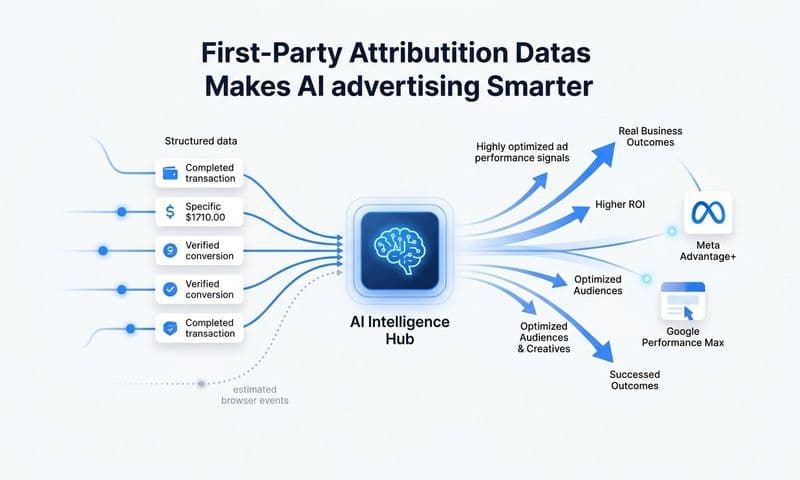
Feeding enriched, first-party conversion data back into your DSP and ad platforms is one of the highest-leverage things you can do with your attribution infrastructure. When your DSP receives accurate conversion signals that reflect actual pipeline and revenue rather than generic pixel fires, its optimization algorithm has better data to work with. It can shift spend toward the audiences and contexts most likely to produce real outcomes rather than optimizing toward proxy metrics that may not correlate with revenue. Better attribution data flowing back into the platform means the platform's AI gets smarter about who to target and when.
Attribution reporting also enables more honest budget allocation conversations. When you can show how programmatic contributes to pipeline alongside paid search, content, and other channels on a consistent attribution basis, budget decisions become data-driven rather than political. You can make the case for programmatic spend not by pointing at impression volume but by showing its role in the journeys of buyers who actually converted to revenue.
Comparing programmatic performance against other paid channels using a consistent attribution model is important for avoiding the trap of evaluating channels in isolation. Programmatic often looks weaker than direct-response channels when measured on last-click, but looks significantly more valuable when measured on a multi-touch basis that captures its awareness and nurturing role. Using the same cross-channel attribution model across all channels creates a level playing field for budget allocation decisions.
Closing the Measurement Gap on Programmatic
Programmatic advertising attribution is not something you configure once and forget. It is an ongoing discipline that requires the right tracking infrastructure, the right attribution model, and a reporting framework that connects ad spend to actual revenue. The good news is that teams who invest in getting this right gain a genuine competitive advantage.
When you can see which programmatic placements are contributing to pipeline, you can scale what is working and cut what is not, without guessing. When you feed enriched conversion data back into your ad platforms, their optimization algorithms get smarter and your campaigns become more efficient over time. When you can compare programmatic performance against other channels on a consistent basis, your budget allocation decisions are grounded in reality rather than platform-reported metrics that may not reflect what is actually driving revenue.
For B2B SaaS teams navigating long sales cycles and complex buying committees, this level of measurement clarity is not a nice-to-have. It is what separates teams that scale efficiently from teams that spend more and wonder why results are not improving.
If you are ready to close the measurement gap and connect every programmatic touchpoint to the pipeline and revenue it actually drives, Get your free demo of Cometly today and see how a purpose-built attribution platform handles the complexity of modern programmatic measurement from first impression to closed-won revenue.