
Most B2B SaaS marketing teams have acquisition attribution figured out. They know which ads drove trial signups, which channels produced the most demo requests, and which campaigns delivered the lowest cost per lead. That part of the measurement story is well understood.
But here is the uncomfortable truth: in subscription businesses, acquisition is just the beginning. The real revenue lives in renewals, expansions, and upsells that happen months or years after the initial conversion. And for most teams, the marketing efforts that influence those outcomes are completely invisible in their attribution data.
Retention marketing attribution closes that gap. It extends your measurement framework beyond the first sale and connects post-sale marketing touchpoints to the revenue events that actually determine whether your business grows or stalls. This guide breaks down what retention attribution is, why it matters more than most SaaS teams realize, and how to build a framework that gives you a complete picture of what keeps customers coming back.
Why Acquisition Attribution Is Only Half the Story
Think about how SaaS revenue actually works. A customer signs a contract, and that initial deal represents a fraction of the total revenue they could generate over their lifetime. The bulk of the value comes from renewals, seat expansions, plan upgrades, and cross-sells that accumulate over months and years. Acquisition attribution captures the first transaction. Everything after that is typically unmeasured from a marketing perspective.
This creates a serious blind spot. Your marketing team is running onboarding email sequences, re-engagement campaigns for dormant users, product education content, and loyalty-focused offers. Each of these touchpoints influences whether a customer deepens their engagement or quietly starts evaluating alternatives. But if your attribution model stops at the initial conversion, none of that post-sale activity gets credited to marketing outcomes.
The downstream consequence is a budget allocation problem. Without retention attribution, teams tend to over-invest in top-of-funnel acquisition channels because those are the channels that show up in the data. Meanwhile, post-sale programs that protect and grow recurring revenue get underfunded because their impact is invisible. The numbers look fine on the acquisition side while churn quietly erodes the revenue base underneath.
There is also a quality dimension that acquisition-only attribution misses entirely. Not all customers acquired through the same channel behave the same way after signup. Some cohorts renew at high rates and expand aggressively. Others churn within the first contract period. Without connecting post-sale outcomes back to acquisition source and marketing touchpoints, you have no way to distinguish between channels that bring in high-LTV customers and channels that fill the top of the funnel with customers who will not stick around.
The result is a marketing strategy that optimizes confidently for the wrong outcome. Acquisition metrics look strong. LTV quietly suffers. And the marketing programs for B2B SaaS that could have changed that outcome never get the investment they deserve.
Defining Retention Marketing Attribution
Retention marketing attribution is the practice of identifying and crediting the specific marketing touchpoints, campaigns, and channels that influence a customer to renew, expand, or remain active beyond their initial conversion. It treats the post-sale customer relationship as a measurable marketing journey with its own conversion events and attribution logic.
The mechanics are similar to acquisition attribution in structure but different in scope. Instead of tracking the path from first ad impression to demo booking, retention attribution tracks the path from initial onboarding through renewal, expansion, or churn. The touchpoints include onboarding email sequences, nurture campaigns, retargeting ads served to existing customers, customer success outreach, educational content, and any other marketing interaction that occurs after the sale.
The conversion events are also different. In acquisition attribution, the conversion is a trial signup, demo request, or closed-won deal. In retention attribution, the conversion events are renewal, upsell transaction, plan upgrade, cross-sell, or a meaningful engagement milestone that predicts renewal likelihood. Defining these events precisely is one of the foundational steps in building a retention attribution framework.
It is also worth noting the account-level complexity that B2B SaaS introduces. In enterprise and mid-market accounts, multiple stakeholders interact with marketing touchpoints before a renewal decision is made. A VP of Marketing might engage with a product education webinar. An end user might click through a feature announcement email. A procurement lead might respond to a direct outreach sequence. All of these interactions contribute to the renewal outcome, and accurate attribution needs to account for them at the account level, not just the individual user level. This is precisely where account based marketing attribution becomes an essential methodology.
This is where retention attribution becomes genuinely powerful. It does not just tell you whether a customer renewed. It tells you which specific marketing efforts influenced that renewal, which gives you the information you need to replicate those efforts at scale.
The Touchpoints That Drive Retention and How to Track Them
Retention touchpoints span a wide range of channels and formats. Email nurture sequences that guide customers through product features, paid retargeting campaigns that remind existing users of underutilized capabilities, in-app messaging that surfaces relevant content at the right moment, customer success outreach that responds to usage signals, and educational content that helps customers achieve outcomes with the product. Each of these influences retention in measurable ways, but only if you have the tracking infrastructure in place to connect them to renewal events.
The tracking challenge for retention attribution is more complex than acquisition tracking for a specific reason: time. Post-sale customer journeys span months or years, involve multiple devices, and cross multiple channels. Browser-based pixel tracking degrades significantly over these longer windows. Cookie expiration, Intelligent Tracking Prevention restrictions, and cross-device behavior all create gaps in the data that compound over time. A customer who clicked a retargeting ad six months before their renewal date will often not be connected to that renewal event if you are relying on browser cookies to do the work.
Server-side tracking solves this problem. By passing conversion events directly from your server rather than relying on the browser, you maintain a reliable, persistent connection between customer identifiers and marketing touchpoints regardless of how much time has passed or how many devices were involved. For retention attribution specifically, server-side tracking is not optional. It is the foundation that makes accurate measurement possible.
First-party data is equally critical. Your CRM holds renewal dates, contract values, expansion history, and account health data. Your product analytics platform holds usage patterns that predict retention likelihood. Your ad platforms hold campaign and touchpoint data. Retention attribution requires connecting all three into a single attribution layer where you can see which marketing touchpoints correlate with customers who renew versus those who churn.
Platforms like Cometly are built specifically for this kind of integration. By connecting ad platform data, CRM events, and website behavior into a unified view, Cometly gives marketing teams the infrastructure to track the full customer journey from first ad click through renewal and expansion, without the data gaps that come from pixel-only tracking.
Attribution Models That Work for Retention Campaigns
The attribution model you use matters as much as the data you collect. Standard last-click and first-touch models were designed for short, linear purchase journeys where a single touchpoint can reasonably claim credit for a conversion. Retention journeys are neither short nor linear, and collapsing months of marketing interactions into a single touchpoint produces a distorted picture of what is actually driving renewals.
Last-click attribution for a renewal event would credit the email campaign that landed in the customer's inbox the week before their contract came up for renewal. But that email did not create the conditions for renewal on its own. The onboarding sequence that helped the customer achieve initial value, the feature education content that expanded their use case, and the re-engagement campaign that brought them back when usage dropped all contributed to the outcome. Last-click ignores all of it.
Multi-touch attribution models are far better suited for retention measurement. Linear attribution distributes credit equally across all touchpoints in the retention journey, which at minimum acknowledges that multiple interactions contributed to the renewal. Time-decay attribution gives more credit to touchpoints that occurred closer to the renewal event, which reflects the intuition that recent interactions are more influential than older ones. Both are meaningful improvements over single-touch models for post-sale journeys. Understanding the full range of types of marketing attribution models helps teams choose the right fit for their renewal cycles.
Data-driven attribution goes further by using actual conversion patterns across your customer base to assign credit dynamically. Rather than applying a fixed formula, data-driven models analyze which touchpoints and sequences actually correlate with renewal outcomes in your specific data. This makes it especially valuable for retention programs where the path to renewal varies significantly across customer segments, product tiers, and acquisition cohorts. Teams exploring this approach can benefit from understanding how machine learning is used in marketing attribution to assign credit more accurately.
The practical implication is that choosing the right attribution model for retention is not a one-size-fits-all decision. Teams should consider the length of their typical renewal cycle, the number of meaningful touchpoints in the post-sale journey, and the degree to which renewal behavior varies across segments. Starting with a multi-touch model and moving toward data-driven attribution as data volume increases is a reasonable progression for most B2B SaaS teams.
Building a Retention Attribution Framework for B2B SaaS
A retention attribution framework starts with defining the conversion events that matter most for your business. These are the specific outcomes you want to attribute marketing influence to, and they need to be instrumented and tracked before any attribution analysis is possible. Common retention conversion events include contract renewal, seat expansion, plan upgrade, cross-sell transaction, and engagement milestones that your data identifies as predictive of renewal likelihood.
Each of these events needs to be passed back to your attribution platform with the right metadata: account ID, contract value, product tier, and acquisition source. This is what allows you to connect the marketing touchpoints that preceded the event to the revenue outcome it represents. Without this data flowing cleanly into your attribution layer, your framework has nothing to analyze.
Segmentation is the next layer. Retention attribution becomes significantly more actionable when you can analyze it by cohort, acquisition source, and product tier. The goal is not just to understand which campaigns influence retention overall, but which campaigns work best for specific customer segments. A re-engagement email sequence might be highly effective at retaining customers acquired through organic search but have minimal impact on customers acquired through paid social. That distinction only becomes visible when you segment your attribution analysis. Learning how to measure marketing attribution at the segment level is what separates actionable insights from surface-level reporting.
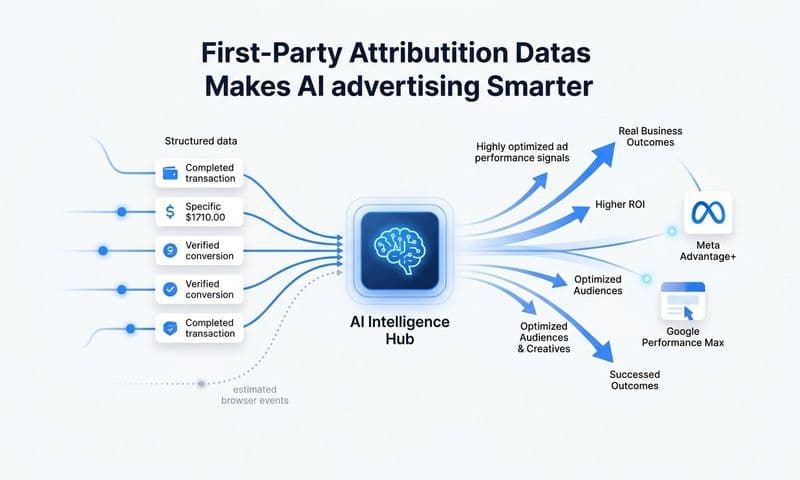
The third component is the feedback loop back to your ad platforms. This is where retention attribution creates compounding value. When you send enriched retention conversion events, such as renewals and upsells, back to Meta's Conversion API, Google's Enhanced Conversions, and other ad platform signals, you are training those platforms' algorithms to optimize toward customers who are likely to retain, not just customers who are likely to convert initially.
Ad platforms optimize toward the conversion signals they receive. If you only send acquisition events, the algorithm learns to find users who sign up. If you send renewal and expansion events, the algorithm learns to find users who become long-term, high-value customers. Cometly's Conversion API integration makes this feedback loop straightforward to implement, passing enriched first-party conversion data back to ad platforms in a format their optimization engines can act on immediately.
Bringing these three components together, defined conversion events, segmented attribution analysis, and ad platform feedback loops, creates a retention attribution framework that improves both your understanding of what drives retention and your ability to scale the campaigns that produce it.
Turning Retention Attribution Data Into Smarter Marketing Decisions
Once retention attribution is in place, the quality of marketing decisions improves significantly. The most immediate benefit is the ability to calculate true LTV by channel. Instead of comparing acquisition channels only on cost per lead or cost per acquisition, you can compare them on the long-term revenue generated by the customers they bring in. A channel with a higher cost per acquisition might consistently deliver customers who renew at higher rates and expand more aggressively, making it the better investment when LTV is part of the equation.
Retention attribution data also reveals which campaigns are genuinely reducing churn versus which ones are reaching customers who would have renewed regardless. This distinction matters because not all retention marketing spend is equally effective. Some campaigns intercept customers at genuine risk of churning and influence them to stay. Others are served to customers who were never at risk in the first place. Without attribution data from the right tools, you cannot tell the difference, and you end up maintaining spend on programs that feel productive but are not actually moving the needle.
There is also a cross-functional dimension to the value of retention attribution. When marketing teams share attribution insights with sales, customer success, and product teams, the organization gains a unified view of the customer journey that improves handoffs and surfaces at-risk accounts earlier. Customer success teams can see which marketing touchpoints a customer has engaged with before a renewal conversation. Sales teams can identify expansion opportunities based on which campaigns are correlating with upsell behavior. Product teams can understand which educational content is driving deeper feature adoption.
Cometly is built to support this kind of cross-functional visibility. Its customer journey analytics connect every touchpoint to revenue outcomes in a single dashboard, giving every team that touches the customer relationship access to the same accurate, real-time data. That shared view is what allows organizations to move from siloed retention tactics to a coordinated strategy that protects and grows recurring revenue at scale.
The Bottom Line on Retention Attribution
Retention marketing attribution closes the gap between acquisition metrics and long-term revenue growth. B2B SaaS companies that measure only acquisition are operating with incomplete data, and the budget decisions that follow from that incomplete data often quietly damage LTV without anyone realizing it.
The path forward is clear: define your retention conversion events, instrument them with server-side tracking, connect your CRM and ad platform data into a unified attribution layer, choose attribution models suited to long post-sale journeys, and create feedback loops that train your ad platforms to optimize for retention, not just initial conversion.
Cometly is the platform that makes this possible. It connects every touchpoint across the full customer lifecycle, from first ad click to closed-won revenue and beyond, giving marketing teams the single source of truth they need to optimize for retention as confidently as they optimize for acquisition. With multi-touch attribution, Conversion API integration, AI-driven recommendations, and 70+ native integrations, Cometly gives you the infrastructure to measure what actually keeps customers coming back and scale the campaigns that drive it.
If you are ready to move beyond acquisition attribution and start measuring the full revenue impact of your marketing efforts, Get your free demo today and see how Cometly connects every touchpoint to the outcomes that matter most.