
You've built the campaigns, set the budgets, and watched the leads roll in. But the moment a prospect enters your sales pipeline, visibility disappears. Marketing sees a form fill. Sales sees a new contact. And nobody can tell you which ad, which channel, or which campaign actually started the conversation that eventually became a closed deal.
This is the reality for most B2B SaaS marketing teams. You're spending real budget across paid search, paid social, content, and email, and your reporting shows clicks, impressions, and cost-per-lead. But when the CFO asks which channels are actually driving revenue, the honest answer is often: we're not sure.
Full funnel attribution changes that. It's the practice of connecting every marketing touchpoint across the entire customer journey, from the first ad impression to the moment a deal closes in your CRM, so you can see exactly what's driving revenue and what's just generating noise. For SaaS teams operating with long sales cycles and multiple channels in play, it's not a reporting luxury. It's the foundation of every smart budget decision you'll ever make. This article breaks down how it works, what infrastructure it requires, and how to put it into practice.
Why SaaS Marketing Breaks Without Full Funnel Visibility
Here's the structural problem: ad platforms and CRMs speak completely different languages, and most SaaS teams never build a translator between them.
Your ad platforms, whether that's Google, Meta, or LinkedIn, report on clicks, impressions, and their own attributed conversions. Your CRM tracks leads, pipeline stages, and closed deals. These two systems contain the most important data in your marketing operation, and in most SaaS companies, they never actually talk to each other. Marketing optimizes based on what the ad platform reports. Sales works from what the CRM shows. And leadership tries to reconcile two datasets that don't connect.
The result is what you might call the attribution gap: a blind spot that sits between the moment someone clicks an ad and the moment they sign a contract. Inside that gap, you have no reliable way to trace which early marketing activity actually contributed to revenue.
This gap produces a predictable and costly mistake: budget misallocation driven by the wrong metrics. Teams cut channels with a high cost-per-lead, assuming they're inefficient, while scaling channels with a low cost-per-lead, assuming they're working. But CPL tells you nothing about what happens after the lead is created. A channel that generates cheap leads might be filling your pipeline with prospects who never close. A channel with a higher CPL might be consistently producing your best enterprise accounts. Without full funnel data, these distinctions are invisible, and you're optimizing for the wrong outcome.
The compounding effect is especially damaging in B2B SaaS, where sales cycles are long and multi-touch by nature. A prospect might encounter a LinkedIn ad, read a blog post, attend a webinar, click a branded search ad, and join a product demo before ever talking to sales. That's a journey that spans weeks or months and crosses eight to twelve touchpoints. Single-touch attribution models collapse that entire journey into a single moment, crediting either the first interaction or the last click and ignoring everything in between.
The cost of those blind spots compounds over time. Every budget cycle where you're working from incomplete data is another cycle where high-performing channels get underfunded and low-performing channels consume budget they haven't earned. Full funnel visibility is what closes the loop and lets you make decisions based on what's actually driving revenue.
What Full Funnel Attribution Actually Means in a SaaS Context
Full funnel attribution is the practice of tracking and assigning credit to every marketing touchpoint a prospect encounters across the entire customer journey, from the first ad impression through lead creation, qualification, opportunity, and finally closed-won revenue.
That definition sounds straightforward, but in practice it requires connecting systems that most SaaS companies keep siloed. It means your ad platform data, your website analytics, your marketing automation, and your CRM all need to be part of a single attribution layer that can trace a deal back to its original source.
To understand why this matters, consider what single-touch models miss. First-touch attribution credits the very first interaction a prospect had with your brand. It's useful for understanding which channels create awareness, but it completely ignores the nurture sequence, the retargeting campaign, and the bottom-of-funnel content that actually moved the prospect toward a decision. Last-click attribution does the opposite: it credits the final touchpoint before conversion, which tends to over-reward branded search and direct traffic while undercounting the awareness channels that started the journey.
Neither model reflects the reality of how B2B SaaS buyers actually behave. They research slowly, compare alternatives, involve multiple stakeholders, and return to your brand multiple times before committing. Crediting a single moment in that process produces a distorted picture of channel contribution.
Full funnel attribution addresses this by operating across three distinct layers of the customer journey.
Top-of-funnel awareness tracking captures the first interactions: paid ads, organic content, social media, and any other channels that introduce prospects to your brand. This layer tells you how people are finding you and which channels are building your pipeline from scratch.
Mid-funnel lead and pipeline tracking follows the prospect through lead creation, MQL qualification, and sales development activity. This is where you start connecting marketing touchpoints to pipeline stages, understanding which channels produce leads that actually advance through the funnel rather than stalling at the first stage.
Bottom-of-funnel revenue attribution is where full funnel thinking delivers its most valuable insight. By connecting ad-level data to closed deals in your CRM, you can trace every dollar of revenue back to the specific campaigns and channels that contributed to it. This is the layer that transforms attribution from a reporting exercise into a budget strategy.
Together, these three layers give SaaS marketing teams a complete picture of what's driving growth, not just what's generating clicks.
The Attribution Models That Power Full Funnel Analysis
Choosing an attribution model is really about choosing which version of the truth you want to work with. Each model distributes credit differently, and the model you choose will directly influence which channels appear to be performing and which ones look like underperformers.
Here's a clear breakdown of the main models used in full funnel analysis and when each makes sense for SaaS teams.
Linear attribution distributes credit equally across every touchpoint in the customer journey. If a prospect touched six channels before converting, each gets one-sixth of the credit. It's simple, fair, and avoids the distortions of single-touch models. The limitation is that it treats every touchpoint as equally important, which may not reflect reality.
Time decay attribution gives more credit to touchpoints that occurred closer to the conversion event. The logic is that the interactions that happened right before a deal closed had more influence on the final decision. This model works well for shorter sales cycles where recency genuinely correlates with influence.
Position-based attribution comes in two common variants. U-shaped attribution gives the most credit to the first touch and the last touch, with the remaining credit distributed across the middle touchpoints. This reflects the idea that the channel that introduced the prospect and the channel that closed the loop both deserve significant recognition. W-shaped attribution adds a third peak at the lead creation touchpoint, making it particularly useful for SaaS teams that want to credit the moment a prospect became a known contact in addition to the first and last interactions.
Data-driven attribution uses machine learning to assign credit based on actual conversion path data from your account. Rather than applying a fixed rule, it analyzes which touchpoint combinations are most likely to produce conversions and weights accordingly. It's generally considered the most accurate model, but it requires sufficient data volume to produce reliable results.
The foundation of full funnel thinking is multi-touch attribution: any model that distributes credit across multiple touchpoints rather than collapsing the journey into a single moment. For B2B SaaS companies with long sales cycles, this is the minimum viable approach. Crediting only one touchpoint in a journey that spans months and dozens of interactions is structurally guaranteed to produce misleading conclusions.
The practical question is which multi-touch model to start with. For most SaaS teams early in their attribution journey, position-based models offer a good balance of simplicity and accuracy. As your data volume grows and your attribution infrastructure matures, moving toward data-driven attribution gives you the most nuanced view of how your channels actually work together.
The Technical Infrastructure Behind Accurate Full Funnel Tracking
Even the best attribution model produces unreliable results if the underlying tracking is broken. And for most SaaS teams relying on browser-based pixels, the tracking is more broken than they realize.
Browser-based tracking works by placing a small piece of JavaScript on your website that fires when a user completes a conversion action. The problem is that this approach depends entirely on the browser cooperating, and increasingly, browsers don't. Ad blockers prevent pixels from loading. Safari's Intelligent Tracking Prevention and Firefox's Enhanced Tracking Protection limit how long cookies can persist. Apple's App Tracking Transparency changes reduced the signal that ad platforms receive from iOS users. The cumulative effect is significant signal loss, meaning a meaningful portion of your actual conversions are never recorded by your ad platform's pixel.
When your conversion data is incomplete, your attribution is incomplete. You're making budget decisions based on a partial picture of what's actually happening.
Server-side tracking and Conversion API integrations solve this problem by bypassing the browser entirely. Instead of relying on a pixel in the user's browser to fire and report back, server-side tracking sends conversion data directly from your server to the ad platform's API. Meta's Conversions API and Google's Enhanced Conversions are the two most important implementations of this approach. Because the data travels server-to-server rather than through the browser, it's not affected by ad blockers, browser privacy settings, or iOS restrictions. The result is a more complete and accurate conversion signal that reflects what's actually happening in your funnel.
This is now considered a best practice for any SaaS team running paid advertising at scale. Without it, you're systematically underreporting conversions to the platforms that use that data to optimize your campaigns.
The other critical piece of technical infrastructure is CRM integration. For B2B SaaS, the conversion that matters most is not a form fill. It's a closed deal. That means your attribution layer needs to reach beyond your marketing automation tools and into your CRM, where pipeline stages and revenue data actually live.
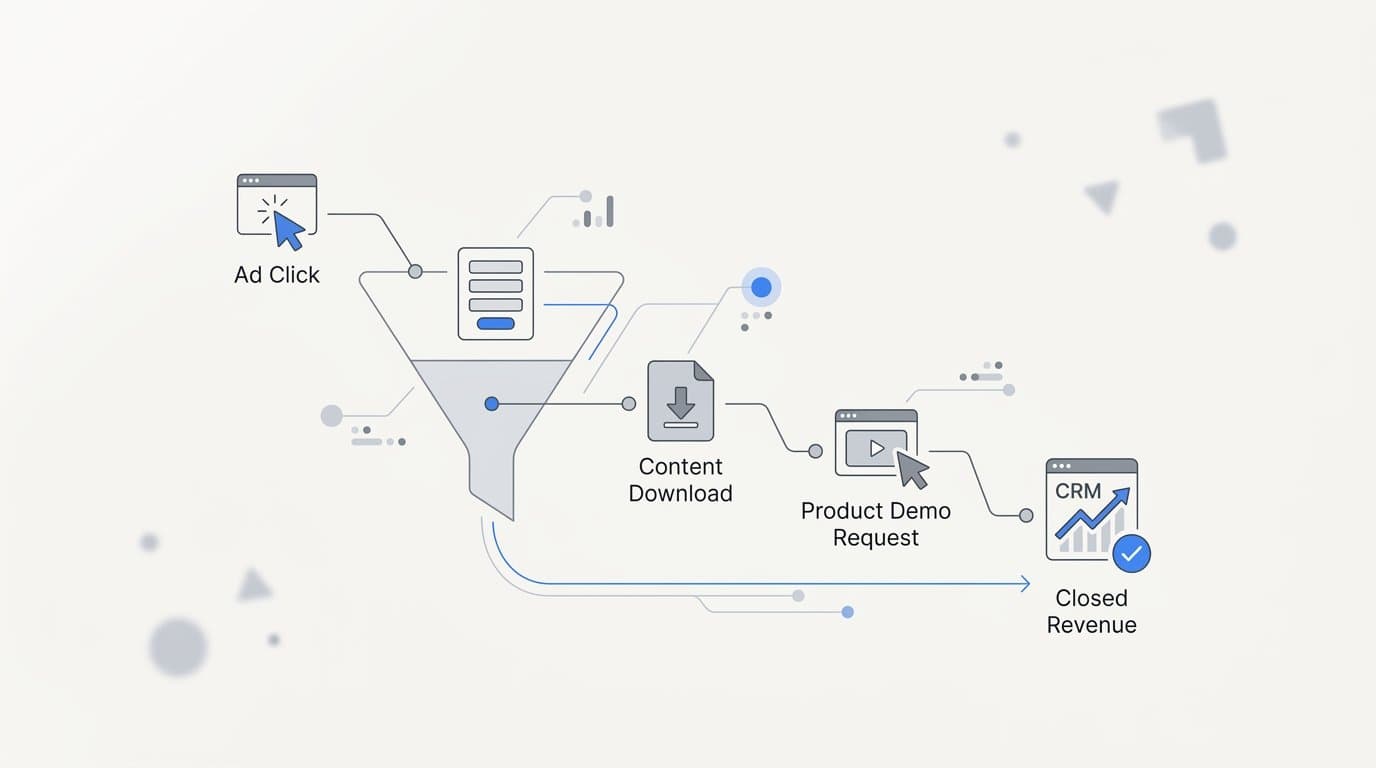
When your CRM is connected to your attribution platform, you can associate ad-level data with specific contacts and deals as they move through the pipeline. You can see which campaigns generated opportunities, which ones produced closed-won revenue, and which ones filled your pipeline with prospects who stalled at the demo stage. This is the connection that turns lead attribution into true revenue attribution, and it's what makes full funnel tracking genuinely actionable for SaaS marketing teams.
How to Build a Full Funnel Attribution Strategy for Your SaaS Business
Building a full funnel attribution strategy doesn't require a data engineering team. It requires a clear process and the right tools. Here's how to approach it in three concrete steps.
Step one: define your funnel stages explicitly. Before you can track attribution across the funnel, you need to agree on what the funnel actually looks like. Map each stage from visitor through lead, MQL, SQL, opportunity, and customer to a specific, trackable conversion event. This gives your attribution system clear milestones to measure against. Without this mapping, you end up with attribution data that doesn't align with how your sales team thinks about pipeline, which makes it harder to act on.
Be specific here. An MQL might be defined as a lead who has visited your pricing page and downloaded a resource. An SQL might be a lead that sales has contacted and qualified. The more precisely you define these stages, the more accurately your attribution data will reflect what's actually happening in your funnel.
Step two: unify your data sources. Connect your ad platforms, website analytics, and CRM into a single attribution layer. Every touchpoint needs to be captured and associated with the correct contact and deal. This is where many SaaS teams run into friction, because their tools weren't designed to talk to each other natively. An attribution platform that integrates across your entire stack is what makes this practical without building custom data pipelines.
The goal is a single source of truth where you can see every touchpoint in a prospect's journey, from the first ad click to the closed deal, in one place. When that data is unified, the attribution model you apply to it produces results you can actually trust.
Step three: select your attribution model and act on the data. Choose the model that matches your sales cycle length and apply it consistently so you can compare channel performance over time. Then layer in AI-driven analysis to identify which campaigns are producing pipeline and revenue, not just leads. The goal is to move from reporting what happened to understanding why it happened and what to do next.
Turning Attribution Data into Budget Decisions That Drive Growth
Full funnel attribution is only valuable if it changes how you allocate budget. The data is the input; the decision is the output. Here's how to read attribution reports in a way that produces better decisions.
Start by identifying which channels and campaigns are driving high-quality pipeline versus which ones are inflating lead volume without contributing to revenue. These are often different channels. A campaign that generates a high volume of leads at a low cost-per-lead might look excellent in a top-of-funnel report, but if those leads consistently stall before reaching the SQL stage or close at a low rate, the channel is consuming budget without producing business outcomes.
This is why shifting from cost-per-lead to cost-per-pipeline and cost-per-acquisition changes everything. When you're optimizing for CPL, you reward channels that generate cheap contacts. When you're optimizing for cost-per-pipeline and cost-per-acquisition, you reward channels that generate contacts who actually become customers. Those are fundamentally different optimization targets, and they produce fundamentally different budget allocation decisions.
A channel with a high CPL might be consistently producing your best enterprise accounts. A channel with a low CPL might be generating churned customers. Without full funnel data connecting ad spend to revenue outcomes, you can't see the difference.
The third dimension of this is feeding better data back to your ad platforms. When you send enriched conversion events to Meta via the Conversions API or to Google via Enhanced Conversions, and those events include downstream revenue signals rather than just form submissions, the ad platform's optimization algorithm gets smarter. It starts targeting audiences that resemble your actual paying customers, not just people who fill out forms.
This creates a compounding effect over time. Better conversion signals produce better targeting, which produces higher-quality leads, which produces more revenue from the same budget. Full funnel attribution is what makes this feedback loop possible, because it's the mechanism that connects downstream revenue data back to the ad platforms that need it.
Putting Full Funnel Attribution Into Practice with Cometly
Everything described in this article, connecting ad platforms to CRM data, tracking every touchpoint across the funnel, applying multi-touch attribution models, and feeding enriched signals back to ad platforms, is exactly what Cometly is built to do.
Cometly connects your ad platforms, website, and CRM into a single attribution layer that gives your team a real-time view of every touchpoint from first ad click to closed-won revenue. Instead of toggling between your ad platform dashboards and your CRM trying to manually reconcile data, you get a unified picture of the entire customer journey in one place.
The practical outcomes are significant. You can see which campaigns are driving actual revenue, not just leads. You can use AI-powered recommendations to identify high-performing ads and scale them with confidence, rather than relying on gut instinct or incomplete platform data. And you can send enriched, conversion-ready events back to Meta, Google, and other ad platforms so their targeting algorithms optimize toward your actual paying customers rather than top-of-funnel form fillers.
Cometly's server-side tracking and Conversion API integrations ensure that your conversion data is accurate even in a privacy-first browser environment, so the attribution picture you're working from reflects reality rather than a degraded subset of your actual conversions. With 70+ native integrations, connecting your existing stack is straightforward, and you don't need a data engineering team to make it work.
For B2B SaaS marketing teams that are tired of making budget decisions based on incomplete data, Cometly provides the infrastructure, the attribution models, and the AI-driven analysis to move from guessing to knowing.
Get your free demo today and see what full funnel attribution looks like when all your data is finally in one place.