
Every SaaS marketing team eventually faces the same uncomfortable question: which channel actually started the customer relationship? You can see who converted, you can see what they bought, but tracing the very beginning of that journey is where things get murky. Was it the paid search ad they clicked three months ago? The LinkedIn post a colleague shared? The organic blog article they found while researching a competitor?
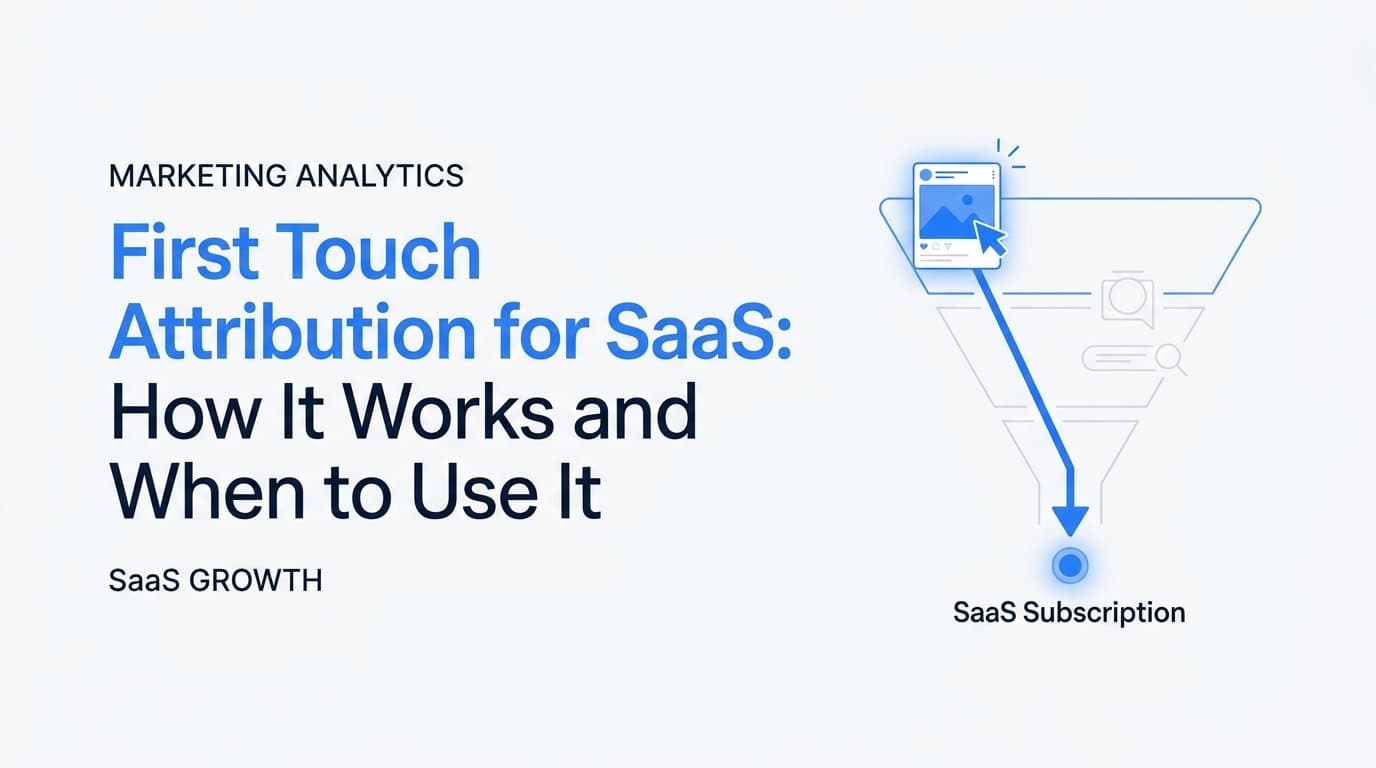
First touch attribution is the model built to answer exactly that question. It works on a straightforward principle: whichever channel or campaign a prospect first interacted with receives 100% of the credit for any conversion that eventually follows. No splitting credit, no weighting by recency. The first interaction wins.
For SaaS companies specifically, this matters more than it might for other business models. Customer acquisition costs are high, sales cycles stretch over weeks or months, and the top of the funnel is often the most competitive and expensive part of growth. Knowing which channels consistently generate net-new awareness is not just a nice-to-have metric. It is a strategic input that shapes where you put your budget and how you build your pipeline.
That said, first touch attribution is one model among several, and each model answers a different question. This article will give you a clear understanding of how first touch attribution works, where it genuinely excels for SaaS teams, where it creates blind spots, and how to use it intelligently alongside other attribution approaches. By the end, you will know exactly when to lean on first touch data and when to look further down the funnel.
The Logic Behind First Touch: Why the First Click Matters
At its core, first touch attribution is about ownership. When a prospect enters your funnel, some channel, campaign, or piece of content was responsible for introducing them to your brand. First touch attribution assigns 100% of the conversion credit to that originating interaction, whether it was a paid search ad, an organic Google result, a social media post, a referral link from a partner, or a cold email that sparked curiosity.
The business logic behind this model is grounded in a simple economic reality: in SaaS, acquiring a new lead is often the most expensive step in the entire customer lifecycle. Before anyone can be nurtured, before any demo can be booked, before any trial can be started, someone has to discover you exist. First touch attribution puts a lens on that discovery moment and helps you understand which channels are best at generating net-new awareness from cold audiences who had no prior relationship with your brand.
Think of it like this: if your sales cycle is six months long and a customer converts in December, last touch attribution might credit the email sequence that nudged them over the line. But first touch attribution credits the LinkedIn ad they clicked in June that introduced them to your product for the first time. Both pieces of information are valuable. They just answer different questions.
This is the conceptual distinction that matters most when evaluating attribution models. Last touch attribution answers: what closed the deal? First touch attribution answers: where did this customer come from originally? Neither model is universally correct. They are diagnostic tools, each designed to illuminate a different part of the customer journey.
For SaaS teams managing multiple acquisition channels simultaneously, first touch data creates a clear signal about which channels are seeding the pipeline. If your paid search campaigns consistently generate first touches from prospects who eventually convert, that is a meaningful signal about the channel's role in demand generation, even if paid search never gets credit in a last-touch model because the final conversion happened through a retargeting ad or a direct visit.
Understanding this distinction is the foundation for using first touch attribution intelligently rather than treating it as the only truth about your marketing performance.
Where First Touch Attribution Excels for SaaS Companies
First touch attribution is not the right tool for every situation, but there are specific scenarios where it delivers genuinely actionable insight for SaaS marketing teams.
Top-of-funnel budget decisions: When you are deciding where to invest in brand awareness, content marketing, paid search, or cold outbound campaigns, first touch data is highly relevant. These are channels whose primary job is to generate initial interest from people who have never heard of your product. First touch attribution measures exactly that job. If you are allocating budget across awareness channels, first touch gives you a direct read on which ones are actually generating new pipeline entries.
Identifying high-performing acquisition channels during growth phases: When a SaaS company is in active growth mode and testing multiple channels at once, first touch attribution quickly surfaces which channels consistently bring in new prospects. You might be running paid social, content SEO, a podcast sponsorship, and a co-marketing partnership simultaneously. First touch data tells you which of those channels is winning the initial attention of your target audience, giving you a basis for doubling down or pulling back before you have spent months of budget on underperforming channels.
Long sales cycles where the first interaction is distant from conversion: This is where first touch attribution has a particular advantage over last touch models in B2B SaaS. When the gap between a prospect's first interaction and their eventual conversion spans weeks or months, last touch attribution can make it look like your bottom-funnel retargeting ads are doing all the heavy lifting. First touch attribution corrects for this by anchoring the credit to the channel that actually initiated the relationship, giving demand generation teams visibility into the long-term payoff of their top-of-funnel investments.
Evaluating content and organic search performance: Many SaaS companies invest heavily in content marketing and SEO, but these channels often struggle to show ROI in last-touch models because prospects who discover you through a blog post typically do not convert on their first visit. First touch attribution gives organic content its fair credit by recognizing that a well-ranked article was the entry point for a prospect who later became a paying customer after several more interactions.
The common thread across all of these use cases is that first touch attribution is most powerful when your primary question is about the origin of demand, not the mechanics of closing it. If you want to understand which channels are building your pipeline from scratch, first touch is the right lens.
The Blind Spots: What First Touch Attribution Misses
For all its strengths, first touch attribution has real limitations that SaaS marketing teams need to understand before making budget decisions based on it alone.
It ignores the nurture journey entirely: SaaS buyers rarely convert after a single touchpoint. A prospect might discover your product through a paid search ad, then read three blog posts, attend a webinar, receive a five-email nurture sequence, click a retargeting ad, and finally book a demo after a personalized outreach from a sales rep. First touch attribution credits the paid search ad with 100% of the conversion and gives zero credit to everything that happened in between. Those nurture touchpoints are not free. They represent real investment in content, email infrastructure, retargeting spend, and sales time. Ignoring their contribution creates a distorted view of what actually drove the conversion.
It can distort budget allocation: When first touch data drives all budget decisions, the natural tendency is to over-invest in awareness channels and under-invest in mid-funnel and bottom-funnel activities. This creates a situation where you are great at generating new pipeline entries but poor at moving prospects through to closed revenue. Pipeline velocity suffers. Conversion rates from lead to opportunity to closed-won decline. The irony is that first touch attribution, used in isolation, can make your top-of-funnel look like it is working while obscuring the fact that your nurture and closing activities are underfunded and underperforming.
It creates a misleading picture of revenue attribution in B2B contexts: B2B SaaS purchases often involve multiple stakeholders. A product manager might discover your tool through an organic search result, share it with a VP of Engineering who watches a demo, and then a CFO gets involved who was reached through a LinkedIn ad. First touch attribution would credit the organic search result with the entire deal, even though the LinkedIn ad played a critical role in bringing in the economic buyer. In multi-stakeholder sales environments, single-touch models of any kind struggle to reflect the complexity of how decisions actually get made.
The takeaway here is not that first touch attribution is flawed beyond usefulness. It is that it is a partial view. Used alongside other models, it is genuinely valuable. Used alone as the primary basis for revenue attribution, it will lead you toward conclusions that do not hold up when you look at the full customer journey.
First Touch vs. Other Attribution Models: Choosing the Right Lens
Attribution models are not competitors where one wins and the others lose. They are different lenses, each designed to answer a specific question about your marketing performance. Understanding what each model tells you is the key to using them intelligently.
Last touch attribution credits 100% of the conversion to the final interaction before a prospect converted. It answers the question: what closed the deal? This model is useful for evaluating bottom-funnel tactics like retargeting campaigns, demo request pages, or direct sales outreach. Its weakness is the same as first touch but in reverse: it ignores everything that happened before the final interaction.
Linear attribution distributes credit equally across every touchpoint in the customer journey. If a prospect had five interactions before converting, each one gets 20% of the credit. This model is more balanced than single-touch models, but it treats a brand awareness blog post and a demo invitation email as equally valuable, which is rarely an accurate reflection of how different touchpoints actually influence decisions.
Time decay attribution gives more credit to touchpoints that occurred closer to the conversion event. This model is intuitive for shorter sales cycles where the most recent interactions are genuinely the most influential. For longer B2B SaaS sales cycles, it can undervalue the early-stage awareness activities that seeded the opportunity in the first place.
Data-driven attribution uses machine learning to assign credit based on the actual patterns in your conversion data, rather than applying a fixed rule. It is the most sophisticated approach, but it requires significant data volume to produce reliable results and can be difficult to interpret without strong analytics capabilities.
The practical implication for SaaS marketing teams is that first touch attribution should not be used in isolation. It is most powerful when used alongside last touch and multi-touch models as part of a diagnostic toolkit. When you compare first touch data with last touch data for the same set of conversions, the gaps between them reveal where the real nurture work is happening. When you layer in a linear or time decay model, you start to see the full shape of your customer journey.
Multi-touch attribution represents the natural evolution beyond single-touch models. Rather than forcing you to choose between first touch and last touch, multi-touch attribution distributes credit across the full journey in a way that reflects the actual contribution of each channel. First touch becomes one data point within a richer picture rather than the only signal you are acting on.
Setting Up First Touch Attribution Tracking That Actually Works
Understanding first touch attribution conceptually is one thing. Getting reliable first touch data from your actual marketing stack is another challenge entirely, and many SaaS teams discover their data is less trustworthy than they assumed.
UTM parameters are the foundation: Every paid campaign, email link, and social post that could serve as a first touch needs to be tagged with consistent UTM parameters. If your UTM naming conventions are inconsistent across campaigns or channels, your attribution data will be fragmented and unreliable. A prospect who clicked a LinkedIn ad tagged as "linkedin-ads" in one campaign and "LinkedIn_Ads" in another will appear as two different sources in your analytics, obscuring the true picture of that channel's performance.
First-party cookies and their limitations: Traditional first touch tracking relies on browser cookies to remember the first interaction a visitor had with your site. The problem is that cookies expire, get deleted, or are blocked entirely by privacy-focused browsers and ad blockers. A prospect who first visited your site six months ago on a work computer might return on a personal laptop and appear as a brand-new visitor with no attribution history. In this scenario, the recorded first touch is not actually the first touch at all.
Server-side tracking and Conversion APIs: These limitations are why server-side tracking has become increasingly important for SaaS companies that need accurate attribution data. Unlike browser-based pixels that can be blocked or lost, server-side tracking sends event data directly from your server to ad platforms, bypassing the browser entirely. Conversion APIs from platforms like Meta and Google work on this principle, ensuring that first touch events are captured even when traditional pixel tracking fails due to ad blockers or cookie restrictions.
Cross-device journeys create additional complexity: A prospect who first encounters your brand on a mobile device during their commute and then researches your product on a desktop at work represents a cross-device journey that browser-based tracking typically cannot stitch together. Without a unified identity layer that connects these sessions, you end up with fragmented data where the recorded first touch may be the desktop visit rather than the actual mobile first interaction.
Connecting ad platforms, CRM, and website behavior: The most reliable first touch data comes from systems that integrate ad platform data, CRM records, and website behavior into a single unified view. When these data sources are connected, you can verify that the first touch recorded in your analytics actually corresponds to the first meaningful interaction in your CRM, creating a coherent picture of how prospects entered your funnel and what happened next. Without this integration, first touch data often reflects the first cookie set rather than the first genuine interaction.
Turning First Touch Data Into Smarter SaaS Growth Decisions
Collecting first touch data is only valuable if it informs decisions. Here is how SaaS marketing teams can translate first touch insights into concrete strategy.
Channel investment strategy: If a specific ad campaign or content piece consistently generates first touches that eventually convert to paying customers, that signal should directly influence your budget allocation. The key word is "eventually." First touch attribution requires patience: you need to allow enough time for prospects who entered your funnel through a given channel to complete their buying journey before you can assess whether that channel's first touches are high-quality. Looking at first touch data in isolation over a short window will not give you an accurate picture. But when you look at cohorts of first touches over a longer period and track what percentage of them converted to revenue, you get a powerful signal about channel quality.
Pairing first touch with pipeline and revenue data: First touch data becomes significantly more actionable when it is connected to downstream pipeline and revenue metrics. Knowing that a particular campaign generated a large number of first touches is interesting. Knowing that those first touches generated a specific amount of pipeline and a measurable amount of closed-won revenue is genuinely strategic. This connection between top-of-funnel acquisition and actual revenue is what separates attribution as a reporting exercise from attribution as a growth tool.
Using first touch alongside AI-driven recommendations: Modern attribution platforms can analyze patterns across your first touch data and surface insights that would be difficult to identify manually. Which first touch channels are producing prospects with the shortest time-to-close? Which channels generate first touches that consistently stall at the demo stage? Which campaigns are bringing in prospects from your ideal customer profile versus prospects who churn quickly? These are the questions that AI-driven analysis can answer when it has access to complete, accurate attribution data.
This is where a platform like Cometly becomes directly relevant for SaaS marketing teams. Cometly captures every touchpoint from the first ad click through to closed-won revenue, connecting ad platform data, CRM events, and website behavior into a unified view of the customer journey. With Cometly, you can analyze first touch attribution alongside multi-touch models, compare how different attribution lenses change your understanding of channel performance, and get AI-driven recommendations that identify which campaigns and channels are actually driving revenue. The Stripe integration means that first touch data is connected directly to real revenue numbers, not just lead counts or pipeline estimates. That connection from first click to closed deal is what makes attribution data genuinely useful for making confident budget decisions.
Putting It All Together
First touch attribution is a powerful and underutilized lens for understanding which channels generate awareness and bring new prospects into your funnel. For SaaS companies navigating long sales cycles and competitive acquisition environments, knowing where customers come from originally is genuinely strategic information.
But the core takeaway is this: first touch attribution works best as part of a broader attribution strategy, not as a standalone model. SaaS marketing teams who rely solely on first touch risk misallocating budget by over-investing in awareness channels while neglecting the nurture and closing activities that drive pipeline velocity and revenue. The full customer journey matters, and understanding it requires looking at multiple attribution models together.
The most effective SaaS marketing teams treat attribution as a diagnostic toolkit. They use first touch to understand demand generation, last touch to evaluate closing tactics, and multi-touch models to see the full shape of the customer journey. When those models are powered by accurate, server-side tracking and connected to real revenue data, they stop being reporting tools and start being growth levers.
If you are ready to move beyond guesswork and understand exactly which channels are driving your pipeline from first click to closed revenue, explore what Cometly can do for your team. Get your free demo today and start capturing every touchpoint so you can make confident, data-driven decisions about where to invest your ad spend.