Running paid ads for a subscription business is a fundamentally different game than selling one-time products. When someone buys a pair of shoes, the transaction is complete. When someone subscribes to your SaaS platform, that first payment is just the beginning of a relationship that could last years and generate many times the value of the initial conversion.
The challenge is that most attribution tools were not built with this reality in mind. They track clicks, measure conversions, and report back to your ad platforms as if every customer journey ends at signup. For subscription businesses, that is where the journey actually starts.
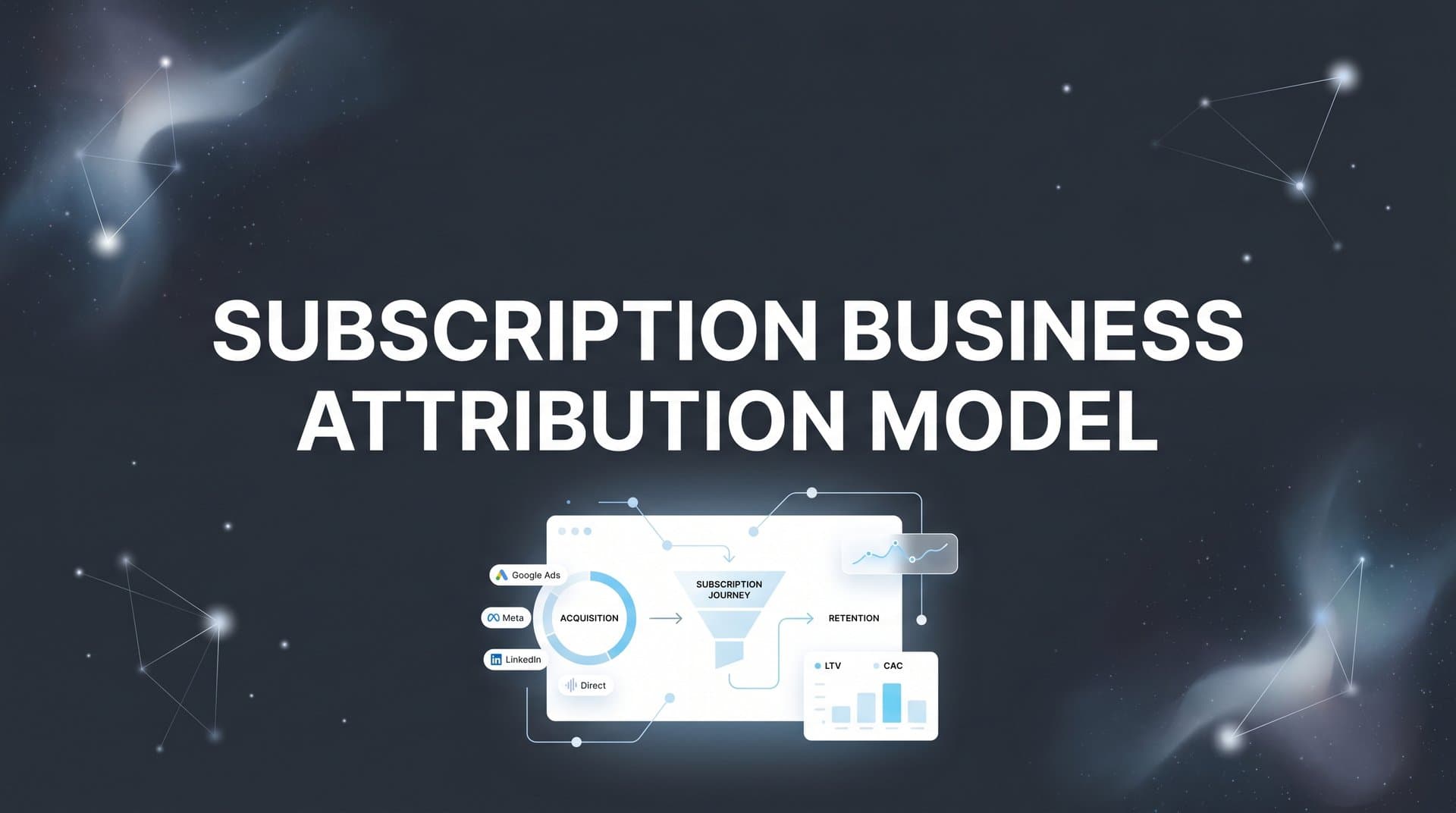
A subscription business attribution model is the framework that connects your marketing efforts not just to initial signups, but to the recurring revenue those customers generate over time. It accounts for free trials, plan upgrades, renewals, and even churn, giving you a complete picture of which channels and campaigns are actually building your business. As subscription-based companies scale across multiple ad platforms and increasingly complex customer journeys, getting this right has become one of the most important capabilities a marketing team can develop.
Why Traditional Attribution Falls Short for Recurring Revenue
Last-click attribution made sense in a world where customers saw one ad, clicked it, and bought something immediately. That world still exists for some businesses. For subscription companies, it is largely a fiction.
Think about how a typical subscriber actually finds you. They might see a display ad, then search your brand name a week later, read a comparison article, sign up for a free trial after clicking a retargeting ad, and finally convert to a paid plan after receiving an onboarding email sequence. A last-click model gives all the credit to that final email or retargeting ad and ignores every touchpoint that built the relationship leading up to it.
First-click attribution has the opposite problem. It credits the very first interaction and ignores everything that actually pushed the prospect over the line. Neither model reflects reality for a business where nurturing prospects into loyal subscribers is the entire point of the marketing operation.
The deeper issue is what these models measure. Standard attribution is built around the conversion event, typically a signup or a purchase. For a subscription business, that event is not where value is created. Value is created over months and years through renewals, upsells, and compounding lifetime value. A channel that drives a high volume of free trial signups might look exceptional in a last-click model while actually producing customers who churn within the first billing cycle. Another channel might generate fewer signups but consistently attract customers who stay for years and upgrade to higher tiers.
When you optimize for the metric your attribution model measures, you optimize for what that model values. If your model only values the initial conversion, you will allocate budget toward channels that drive cheap signups, regardless of whether those customers ever generate meaningful revenue. This is one of the most common and costly mistakes subscription businesses make, and it flows directly from using attribution tools designed for digital marketing that were never built for recurring revenue models.
The subscription lifecycle includes trials, activations, renewals, upgrades, and eventual churn. Each of these stages involves marketing touchpoints, and each one carries information about which channels are actually building sustainable revenue. Traditional attribution models capture almost none of this, which is why subscription businesses need a different approach entirely.
Breaking Down Attribution Models Through a Subscription Lens
Not all attribution models are equally suited to subscription funnels. Understanding how each one handles the unique events in a subscription lifecycle helps you choose the right framework for your business.
First-Touch Attribution: Credits the very first interaction a subscriber had with your brand. This is useful for understanding which channels are best at creating awareness and bringing new prospects into your funnel, but it ignores everything that happens between that first touch and the moment someone becomes a paying customer.
Last-Touch Attribution: Credits the final interaction before conversion. For subscription businesses, this often means retargeting ads or email sequences get all the credit, even though they only work because earlier touchpoints built awareness and intent. It is simple to implement but deeply misleading for budget allocation.
Linear Attribution: Distributes credit equally across every touchpoint in the customer journey. This is a more honest representation of how multi-step funnels work, though it treats a brand awareness impression the same as a high-intent comparison page visit, which may not reflect the actual influence of each touchpoint.
Time-Decay Attribution: Gives more credit to touchpoints that occurred closer to the conversion. This can make sense for shorter sales cycles but tends to undervalue top-of-funnel channels that introduce prospects to your brand, which are especially important for subscription businesses with longer consideration periods.
Position-Based Attribution: Typically splits credit with a larger share going to the first and last touchpoints and the remainder distributed among the middle interactions. This acknowledges both acquisition and conversion while still recognizing the journey in between.
Data-Driven Attribution: Uses machine learning to analyze your actual conversion data and assign credit based on which touchpoints statistically correlate with successful outcomes. For subscription businesses with enough data, this is the most powerful option because it can identify patterns that human-designed models miss. It can detect, for example, that customers who engage with a specific piece of content during their trial period have significantly higher retention rates, and weight that touchpoint accordingly.
For most subscription businesses, multi-touch attribution is the right starting point because it distributes credit across the full journey rather than collapsing it into a single interaction. The specific model you choose within that framework depends on your funnel length, data volume, and the questions you most need to answer. Exploring a detailed comparison of attribution models can help you evaluate which approach best fits your subscription funnel.
The key principle is that your attribution model should be able to track events beyond the initial signup, including trial-to-paid conversions, plan upgrades, and renewal milestones. If your model stops at the signup event, you are missing the majority of the story.
Mapping the Subscription Customer Journey for Accurate Attribution
Before you can attribute revenue accurately, you need a clear map of the journey you are trying to track. Subscription funnels have more stages than most attribution setups account for, and each stage involves different channels, messages, and conversion events.
The journey typically moves through awareness, consideration, trial or signup, activation, retention, and expansion. In the awareness stage, prospects encounter your brand through paid ads, organic search, social content, or referrals. In consideration, they research options, visit your pricing page, read reviews, and compare alternatives. The trial or signup stage is where most attribution models stop, but for subscription businesses, it is really just the midpoint.
Activation is the moment a new subscriber actually experiences the value of your product for the first time. Retention is the ongoing relationship that generates recurring revenue. Expansion is when customers upgrade to higher tiers or add additional seats or features. Each of these stages involves marketing touchpoints, whether that is onboarding emails, in-app messaging, retargeting campaigns, or customer success outreach.
To attribute revenue accurately across this entire journey, you need to connect data from multiple systems. Your ad platforms capture click and impression data. Your CRM captures lead and customer behavior. Your billing system captures actual revenue events, including renewals and upgrades. When these systems operate in silos, you can only see fragments of the journey. When they are connected through a unified marketing attribution platform, you can trace a customer from their first ad interaction all the way through years of subscription revenue.
This is where server-side tracking becomes critical. Browser-based tracking has become increasingly unreliable due to iOS App Tracking Transparency restrictions, the phasing out of third-party cookies, and ad blockers that prevent client-side scripts from firing. Server-side tracking sends conversion data directly from your server to ad platforms and attribution tools, bypassing the browser entirely. This means you capture touchpoints that would otherwise be invisible, which is especially important for subscription businesses where missing even a portion of conversion data can significantly distort your attribution results.
The practical implication is that your attribution tracking setup needs to be built for the full subscription lifecycle, not just the acquisition phase. Every stage of the journey should generate trackable events that feed into your attribution model and connect back to actual revenue outcomes.
Key Metrics That Subscription Attribution Must Capture
Getting your attribution model right means measuring the right things. For subscription businesses, the metrics that matter most are fundamentally different from what standard ad platform dashboards show you.
LTV by Channel: Which acquisition channels produce customers with the highest lifetime value? This is the most important question in subscription marketing, and it is one that platform-native attribution almost never answers. A channel that looks expensive on a cost-per-signup basis might actually be your most efficient channel when you measure revenue over 12 or 24 months.
CPA Relative to LTV: Cost per acquisition only makes sense in the context of what you actually earn from those customers. A CPA of $200 is excellent if your average customer generates $2,000 in lifetime revenue. It is a disaster if they churn after one month. Attribution that connects acquisition cost to downstream revenue gives you the ratio that actually drives budget decisions. Understanding performance marketing attribution helps you connect these cost and revenue signals effectively.
Trial-to-Paid Conversion Rate by Source: Not all trial signups are equal. Customers from different channels, campaigns, and ad creatives convert from trial to paid at very different rates. Tracking this by acquisition source reveals which channels are bringing in genuinely interested prospects versus those who sign up out of curiosity and never activate.
Churn Rate by Acquisition Channel: Some channels consistently produce customers who stay. Others produce customers who leave quickly. Understanding churn by source allows you to reallocate budget away from channels that generate high-volume, low-retention customers and toward channels that bring in subscribers who stick around.
Expansion Revenue by Touchpoint: Which marketing interactions correlate with customers who eventually upgrade or expand their usage? This connects your marketing activity to upsell revenue, which can be a significant portion of total revenue for many subscription businesses.
One of the most impactful things you can do with this data is feed it back to your ad platforms. When you send enriched conversion events to Meta and Google that include not just signup events but actual paid conversion signals and revenue values, their algorithms learn to find more customers who look like your best subscribers. This creates a compounding effect: better data leads to better targeting, which leads to better customers, which generates better data. Platforms like Cometly are built specifically to facilitate this kind of conversion syncing, connecting your CRM and billing data to ad platform signals so the algorithms optimize toward marketing revenue attribution rather than raw signups.
Building Your Subscription Attribution Stack
Knowing what you need to measure is one thing. Building the infrastructure to measure it is another. Here is how to think about assembling the right attribution stack for a subscription business.
The foundation is an attribution platform that supports multi-touch models and can ingest data from multiple sources. You need something that goes beyond ad platform reporting, which is inherently biased toward making each platform look as effective as possible. An independent attribution layer gives you a neutral view of how channels interact and contribute across the full customer journey. Reviewing the best multi-touch attribution software options is a good starting point for evaluating what fits your needs.
CRM integration is non-negotiable. Your CRM is where post-conversion customer behavior lives: activation milestones, support interactions, renewal events, and churn signals. Without connecting your attribution platform to your CRM, your attribution model stops at the signup event and misses everything that determines whether a customer actually becomes valuable.
Server-side tracking, as discussed earlier, is essential for data accuracy. Set this up before you worry about model selection, because a sophisticated attribution model built on incomplete data will produce misleading results. Accurate data collection is the prerequisite for everything else.
Conversion syncing closes the loop by sending enriched conversion data back to your ad platforms. When Meta and Google receive signals that include not just clicks and signups but actual paid conversions and revenue values, their optimization algorithms become significantly more effective at finding high-quality prospects.
AI-powered attribution tools add another layer of value by analyzing patterns across your entire dataset and surfacing recommendations that would be difficult to identify manually. For B2B SaaS companies in particular, exploring the best marketing attribution tools for B2B SaaS can help you find platforms purpose-built for longer sales cycles and recurring revenue.
To get started practically, work through these steps:
1. Connect your ad accounts to your attribution platform so all click and impression data flows into a single system.
2. Integrate your CRM and billing system to extend tracking beyond the initial signup to include trial conversions, renewals, upgrades, and churn events.
3. Implement server-side tracking to ensure you are capturing touchpoints accurately regardless of browser restrictions or ad blockers.
4. Choose an attribution model that fits your funnel length and data volume, starting with multi-touch and moving toward data-driven attribution as your dataset grows.
5. Set up conversion events that reflect the full subscription lifecycle, not just the signup, so your attribution model has the events it needs to distribute credit accurately.
Common Pitfalls and How to Avoid Them
Even with the right tools in place, subscription businesses frequently make attribution mistakes that lead to poor budget decisions. These are the most common ones to watch for.
Optimizing for Trial Signups Instead of Paid Conversions: This is the most widespread mistake in subscription marketing. When your attribution model and your ad platform optimization goals are both set to maximize trial signups, you will find channels that are very good at generating trials, but those trials may convert to paid plans at a low rate. The result is impressive acquisition numbers and disappointing revenue. The fix is to pass paid conversion events and revenue signals back to your ad platforms and attribution model so optimization is happening against the metric that actually matters.
Relying Solely on Platform-Reported Data: Meta, Google, and other ad platforms each measure conversions using their own methodologies, and they all have a natural incentive to show their own performance in the best possible light. When you rely exclusively on platform dashboards without an independent attribution layer, you will typically see more conversions than actually occurred because multiple platforms claim credit for the same customer. Investing in cross-platform analytics resolves this by providing a single source of truth across all channels.
Failing to Update Your Attribution Model as Your Business Evolves: Your attribution setup should not be a one-time configuration. As you add new pricing tiers, launch new products, enter new markets, or shift your channel mix, your attribution model needs to evolve accordingly. A model calibrated for a simple two-tier subscription product may produce misleading results after you add an enterprise tier with a longer sales cycle. Learning how to build a marketing attribution model with flexibility in mind ensures your framework stays aligned with how your business actually works.
Putting It All Together
Subscription businesses operate in a fundamentally different revenue reality than one-time purchase models, and their attribution frameworks need to reflect that. The goal is not to measure which channel drove the most signups. The goal is to understand which channels, campaigns, and touchpoints are building recurring revenue over the long term.
A well-designed subscription business attribution model connects every stage of the customer journey, from the first ad impression through years of renewals and upgrades, to actual revenue outcomes. It uses multi-touch models to distribute credit fairly across a complex funnel, server-side tracking to capture touchpoints accurately in a privacy-first environment, and conversion syncing to feed enriched data back to ad platforms so their algorithms improve over time.
The marketers who get this right gain a decisive advantage: they know which channels produce their best customers, they allocate budget toward long-term revenue rather than cheap signups, and they continuously improve their acquisition efficiency by feeding better signals into the platforms they use every day.
Cometly is built for exactly this kind of attribution work. It captures every touchpoint from ad click to CRM event, connects your ad platform data to downstream revenue, and feeds enriched conversion signals back to Meta, Google, and other platforms to improve targeting and optimization. Whether you are trying to understand why certain channels produce better subscribers or looking to scale the campaigns that drive the highest LTV, Cometly gives you the clarity to act with confidence.
Ready to elevate your marketing game with precision and confidence? Discover how Cometly's AI-driven recommendations can transform your ad strategy. Get your free demo today and start capturing every touchpoint to maximize your conversions.