You've been running ads for months. A prospect sees your display ad on Monday, clicks your email on Wednesday, searches your brand name and visits your site on Friday, then finally converts after clicking a retargeting ad on Sunday. When you look at your analytics, the retargeting ad gets 100% of the credit. But that doesn't feel right, does it?
Every marketer faces this puzzle: how do you fairly credit the touchpoints that led to a conversion? If you only look at the last click, you're ignoring all the work your awareness campaigns did to get that prospect interested in the first place. But if you credit everything equally, you're treating a casual impression the same as the ad that actually closed the deal.
This is where time decay attribution enters the picture. It's a multi-touch model that answers a simple question: what if we gave more credit to touchpoints that happened closer to the conversion? The logic is straightforward—the interactions that happened right before someone converted probably had more influence on that decision than something they saw three weeks ago.
Why Recency Matters in Attribution
Time decay attribution is built on a premise that matches how most of us actually make purchase decisions. Think about the last time you bought something significant. You probably researched options over days or weeks, but the final push to convert often came from something recent—a limited-time discount, a retargeting ad that reminded you at the right moment, or an email that answered your last question.
The model works by assigning increasing credit to each touchpoint as you move closer to the conversion event. It uses an exponential decay function, which sounds complex but follows intuitive logic. Imagine credit as a spotlight that gets brighter the closer you get to the moment of conversion. The final touchpoint gets the most light, the one before it gets a bit less, and so on backward through the journey.
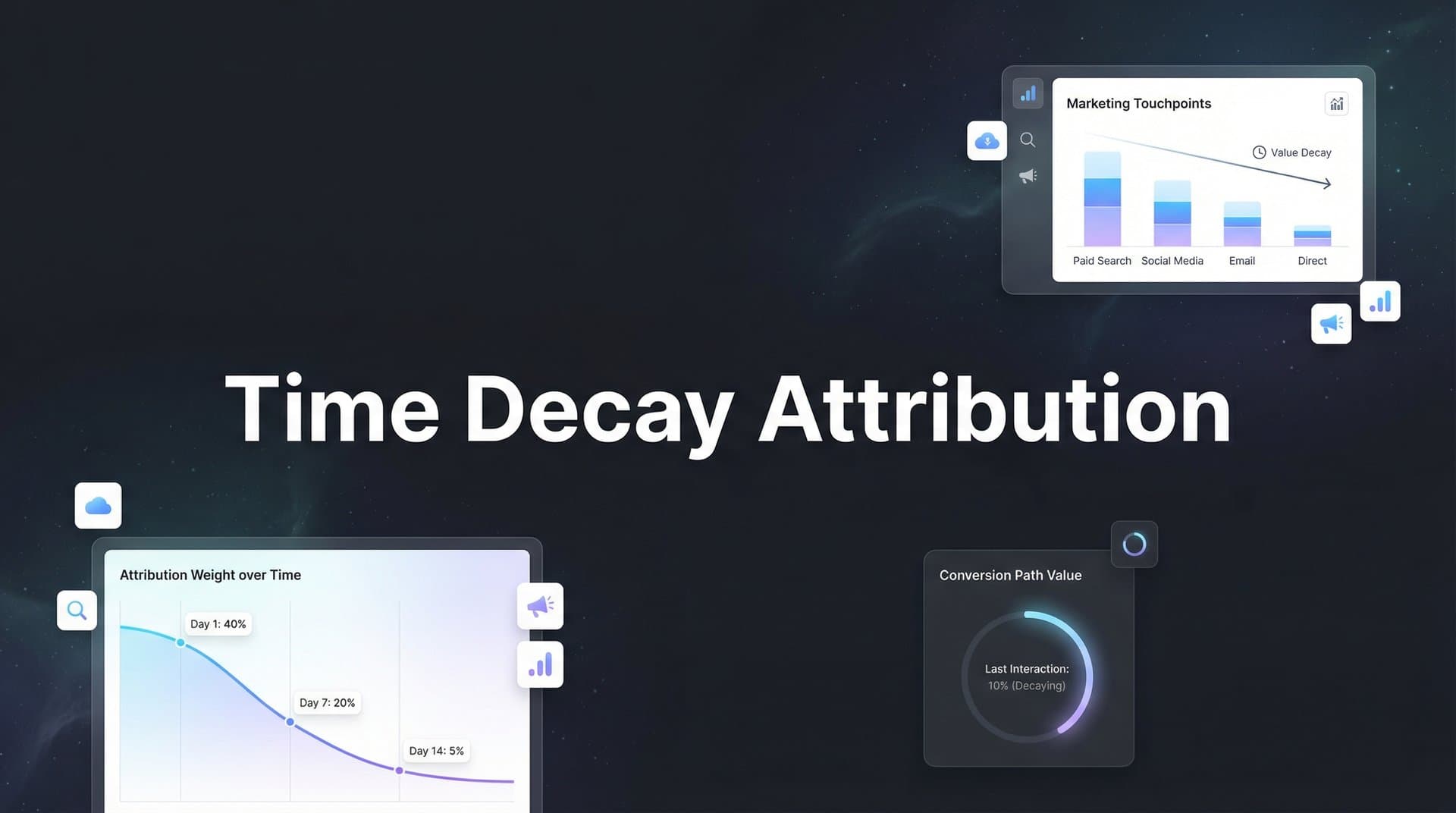
At the heart of this model is the concept of half-life. In time decay attribution, half-life determines how quickly credit diminishes as you move backward from the conversion. Google Analytics, for example, uses a default 7-day half-life. This means a touchpoint that occurred 7 days before conversion receives half the credit of the final touchpoint. A touchpoint 14 days before conversion gets 25% of that final touchpoint's credit, and so on.
Here's where time decay stands apart from simpler models. First-touch attribution gives all credit to the initial interaction—great for understanding what brings people in the door, but it completely ignores what actually convinced them to convert. Last-touch attribution does the opposite, crediting only the final click and treating all previous touchpoints as irrelevant. Understanding the difference between single source attribution and multi-touch attribution models helps clarify why time decay offers a more nuanced approach.
Time decay offers a middle path. It acknowledges that multiple touchpoints matter, but it weights them based on when they occurred. This makes intuitive sense for many marketing scenarios. If someone saw your brand awareness ad a month ago but forgot about you until a retargeting ad brought you back to mind last week, that retargeting ad probably deserves more credit for the conversion.
The model also respects the reality that marketing messages have a shelf life. A prospect who clicked your ad three weeks ago might have completely forgotten that interaction by the time they convert. The touchpoints that happened in the days immediately before conversion are more likely to be fresh in their mind and actively influencing their decision.
Matching Attribution Models to Your Sales Reality
Time decay attribution isn't a universal solution—it shines in specific scenarios where recency genuinely drives conversion decisions. Understanding when to use it versus other models can dramatically improve how you interpret your marketing data.
The model works best for short-to-medium sales cycles where purchases happen within days or weeks rather than months. E-commerce brands running flash sales or limited-time promotions see particularly strong results with time decay. When you're creating urgency with a 72-hour discount, the touchpoints that happened in those final three days absolutely matter more than an awareness campaign from last month. Businesses focused on ecommerce attribution tracking often find this model aligns well with their customer behavior patterns.
SaaS companies with trial-to-paid conversion funnels often find time decay valuable. A prospect might sign up for a free trial after seeing an initial ad, but the emails and retargeting ads they receive during the trial period are what actually convince them to pull out their credit card. Time decay properly credits these closing touchpoints while still acknowledging the role of that first interaction.
Event registrations and webinar signups follow similar patterns. Someone might become aware of your event through organic social media, but the email reminder you send three days before registration closes is probably what finally gets them to commit. Time decay captures this reality better than models that would credit the social post and the email equally.
Industries where purchase decisions are heavily influenced by recent triggers—seasonal retail, travel booking during promotional periods, or subscription renewals—see the most benefit from time decay models. These are scenarios where timing genuinely matters and where the final push often comes from recent marketing touchpoints.
But here's where you need to be careful. Time decay can mislead you in long, complex B2B sales cycles. When a prospect spends six months researching enterprise software, attending webinars, downloading whitepapers, and meeting with sales reps, those early touchpoints aren't just awareness—they're critical nurturing steps that build trust and educate the buyer.
In these longer cycles, a time decay model might drastically undervalue the content marketing piece that first attracted the prospect or the case study they read in month two that convinced them your solution could work for their company. The demo request that finally converts them gets heavy credit, but that demo never would have happened without all those earlier touchpoints.
The key is matching the model to your actual customer behavior. If most conversions happen within 14 days of first interaction, time decay makes strategic sense. If your average sales cycle is 90 days with multiple critical touchpoints throughout, you'll want to combine time decay with other models to get the full picture.
Breaking Down the Math Behind Time Decay
Understanding how credit actually gets distributed in time decay attribution helps you interpret your data correctly and avoid common misreading of results. Let's walk through a concrete example that shows how the math works in practice.
Imagine a customer journey with five touchpoints leading to a $1,000 purchase. The timeline looks like this: Display ad impression 21 days before conversion, email click 14 days before conversion, organic search visit 7 days before conversion, social media click 3 days before conversion, and finally a retargeting ad click that leads directly to conversion.
Using a standard 7-day half-life, here's how credit gets distributed. The final touchpoint (retargeting ad) serves as the baseline. The social media click 3 days earlier receives roughly 76% of the retargeting ad's credit. The organic search visit 7 days out gets 50% of the final touchpoint's credit. The email click 14 days before gets 25%, and the initial display ad 21 days out receives about 12.5%.
When you normalize these percentages to total 100%, the retargeting ad might receive around 38% of the credit, social media gets 29%, organic search gets 19%, email gets 10%, and the display ad gets 4%. This distribution reflects the exponential decay—each step backward in time receives roughly half the credit of the previous touchpoint.
Now here's where half-life settings change everything. If you switch to a 14-day half-life, the credit distribution flattens out. That initial display ad 21 days before conversion now receives significantly more credit because the decay happens more slowly. The final touchpoints still get more credit than earlier ones, but the gap narrows.
A shorter half-life (say, 3 days) would create an even steeper curve, with the final few touchpoints dominating credit allocation and earlier interactions barely registering. This might be appropriate for flash sale campaigns where purchase decisions truly happen in a compressed timeframe.
The half-life you choose should reflect your actual customer behavior. If you know from your data that most conversions happen within 10 days of first interaction, a 7-day half-life makes sense. If your typical consideration period is three weeks, you might want a 14-day half-life to avoid undervaluing those early touchpoints. Proper attribution data analysis can help you determine the optimal settings for your specific business.
Here's the critical insight many marketers miss: time decay can create a self-fulfilling prophecy if you're not careful. When you see retargeting ads getting heavy credit in your time decay model, it's tempting to shift more budget there. But retargeting only works if you've built an audience through awareness campaigns. If you cut those awareness channels because they show low credit in time decay, your retargeting pool shrinks and performance drops.
This is why experienced marketers never rely on a single attribution model. They use time decay to understand which touchpoints are effectively closing deals, but they also look at first-touch attribution to see what's bringing new prospects into the funnel and linear attribution to understand the full journey without recency bias.
Building the Infrastructure for Accurate Time Decay Analysis
Time decay attribution is only as good as the data feeding it. If you're missing touchpoints or your timestamps are unreliable, the entire model falls apart. Setting up proper tracking infrastructure is the unglamorous but essential foundation for any attribution analysis.
The first requirement is complete touchpoint capture across every channel where prospects interact with your brand. This means tracking not just ad clicks but also impressions, email opens, website visits, social media engagements, and any offline interactions like phone calls or in-store visits. Each of these touchpoints needs an accurate timestamp and must be tied to the same customer identity. Comprehensive customer attribution tracking ensures no interaction goes unrecorded.
This is where many marketing teams hit their first major obstacle. Modern privacy changes—particularly iOS tracking limitations and cookie deprecation—have created significant gaps in touchpoint data. When a prospect clicks your ad on their iPhone but converts later on their laptop, traditional client-side tracking often fails to connect those two events to the same person.
Server-side tracking has become essential for solving these gaps. Instead of relying on browser cookies that get blocked or deleted, server-side tracking captures events directly from your website backend and sends them to your analytics platform. This creates more reliable data that isn't subject to ad blockers or privacy settings. Many marketers are now exploring cookieless attribution tracking solutions to maintain data accuracy in this new privacy landscape.
Cross-device attribution adds another layer of complexity. A prospect might discover you on mobile, research on a tablet, and convert on desktop. Without proper identity resolution, these look like three different people in your analytics. Time decay attribution becomes meaningless if you're treating one customer's journey as three separate journeys.
CRM integration is critical for connecting online touchpoints to offline conversions. If someone fills out a lead form, receives follow-up emails, takes a sales call, and then converts offline, you need all those touchpoints in your attribution system. Many marketers only track the journey up to lead submission and miss everything that happens in the sales process. For businesses relying heavily on phone interactions, marketing attribution for phone calls becomes an essential capability.
Data quality issues can completely skew time decay results. Inaccurate timestamps make the model assign credit to the wrong touchpoints. Missing data creates artificial gaps in the customer journey. Duplicate events inflate the importance of certain channels. Before you trust any attribution model, audit your data collection to ensure it's capturing complete, accurate customer journeys.
Another common challenge is handling assisted conversions that don't fit neatly into digital tracking. Phone calls, in-person consultations, or conversions that happen through partner channels need to be manually integrated into your attribution data. If these aren't captured, your time decay model will systematically undervalue the channels that drive these types of conversions.
The technical setup also needs to handle lookback windows appropriately. If you're analyzing time decay attribution with a 30-day lookback window but your actual sales cycle is 60 days, you're missing half the journey. Set your lookback window to match or exceed your typical customer journey length.
Translating Attribution Data Into Smarter Budget Allocation
Understanding time decay attribution is one thing. Using it to make better marketing decisions is where the real value lives. The goal isn't just to see which touchpoints get credit—it's to use that information to allocate budget more effectively and improve overall marketing performance.
Start by identifying which channels are playing closing roles versus assisting roles in your customer journeys. Time decay attribution will naturally show you which channels are present at the end of the funnel and getting heavy credit for conversions. These are your closers—retargeting ads, branded search, email nurture sequences, and bottom-funnel content.
But here's the trap: these channels only work because other channels built the audience and generated initial interest. If you see retargeting getting 40% credit in your time decay model and decide to pour all your budget there, you'll quickly discover that retargeting performance drops when you stop feeding it new prospects through awareness campaigns.
The smart approach is using time decay data to understand the relationship between channels rather than just their individual performance. Look at which top-funnel channels consistently lead to journeys that end with high-credit bottom-funnel conversions. A display campaign might show low credit in time decay, but if prospects who see those display ads are more likely to convert through retargeting later, that display campaign is valuable even if it doesn't get direct credit. Understanding channel attribution in digital marketing revenue tracking helps you see these relationships clearly.
Many marketing teams use time decay attribution to optimize within channel categories rather than across them. For example, if you're running multiple retargeting campaigns, time decay can help you identify which creative or audience segments are most effective at closing deals. Similarly, you can use it to compare different email nurture sequences and see which ones drive conversions most effectively.
Budget allocation should balance what time decay tells you about conversion influence with what other models tell you about customer acquisition and journey initiation. A healthy marketing mix includes channels that introduce your brand to new audiences (even if they show low time decay credit), channels that nurture and educate prospects through the consideration phase, and channels that provide that final push to conversion.
One practical approach is setting budget floors for top-funnel activities regardless of their time decay credit. You might decide that at least 30% of your budget goes to awareness and consideration channels, even if time decay suggests they're less valuable. This prevents the model from leading you to over-optimize for bottom-funnel tactics at the expense of building your audience.
Combining time decay with other multi-touch attribution models gives you a more complete picture. Run the same data through first-touch attribution to see which channels are best at bringing new prospects into your funnel. Use linear attribution to understand the full journey without recency bias. Compare data-driven attribution (if you have enough volume) to see how machine learning weights your touchpoints differently.
When these models tell different stories, that's valuable information. If a channel scores high in first-touch but low in time decay, it's an awareness channel that introduces prospects but doesn't close them. If a channel scores high in time decay but low in first-touch, it's a closing channel that needs audience from elsewhere. Understanding these roles helps you build a balanced marketing strategy.
Choosing the Right Attribution Lens for Your Marketing
Time decay attribution isn't about finding the one true answer to how credit should be distributed. It's about choosing a perspective that matches your business reality and marketing goals. The model works best when you understand both its strengths and its blind spots.
For businesses with short sales cycles and clear recency effects, time decay provides actionable insights that other models miss. It helps you identify which touchpoints are actually closing deals and which are playing supporting roles. This clarity can guide budget decisions and help you optimize campaigns for conversion rather than just engagement.
But the model has limitations you need to respect. It systematically undervalues brand-building activities and top-funnel touchpoints that plant seeds for later conversions. It can't account for offline influences or word-of-mouth that don't leave digital traces. And it assumes that recency equals influence, which isn't always true for considered purchases. These are among the common attribution challenges in marketing analytics that every team must navigate.
The best approach is treating attribution models as different lenses for viewing the same data rather than competing theories about the truth. Time decay shows you one perspective—how recency correlates with conversion. Other models show different perspectives. Together, they give you a more complete understanding of how your marketing actually works.
Start by mapping your typical customer journey. How long does it usually take from first interaction to conversion? How many touchpoints are involved? Are there clear patterns where certain channels tend to appear at specific stages? This understanding helps you choose appropriate half-life settings and interpret time decay results in context.
Test time decay alongside other models for at least a full sales cycle before making major budget changes. Look for patterns and differences in how models credit your channels. If time decay and linear attribution tell wildly different stories, dig into why. Understanding these differences often reveals insights about channel roles that aren't obvious from any single model. Exploring the best marketing attribution analytics tools can help you run these comparisons effectively.
Remember that attribution models are tools for understanding, not rules for decision-making. They inform your strategy but shouldn't dictate it mechanically. Use time decay insights combined with your knowledge of your customers, your competitive landscape, and your business goals to make smarter marketing investments.
The real power of comprehensive attribution tracking isn't in any single model—it's in having complete, accurate data about customer journeys that you can analyze from multiple angles. When you can trust your data and view it through different attribution lenses, you gain the clarity needed to make confident marketing decisions and scale what's actually working.
Ready to elevate your marketing game with precision and confidence? Discover how Cometly's AI-driven recommendations can transform your ad strategy—Get your free demo today and start capturing every touchpoint to maximize your conversions.