Most B2B SaaS marketers are making budget decisions based on incomplete data, and they know it. A prospect clicks a LinkedIn ad on a Tuesday, reads three blog posts over the following week, attends a webinar, and then converts two months later after clicking a branded Google search ad. Without touchpoint attribution, that entire journey collapses into a single data point: the Google search click gets all the credit, and LinkedIn gets none.
This is not a minor reporting inconvenience. It is a structural problem that shapes how budgets get allocated, which campaigns get scaled, and which channels get cut. When credit flows only to the last interaction, teams systematically undervalue the channels that build awareness, generate intent, and nurture prospects through long sales cycles.
Touchpoint attribution is the discipline that fixes this blind spot. It is the process of capturing, connecting, and crediting every interaction a prospect has with your brand, from the first ad impression to the moment a deal closes in your CRM. For B2B SaaS companies specifically, where buying cycles stretch across weeks or months, involve multiple stakeholders, and span paid search, social, organic content, email, and direct outreach, touchpoint attribution is not a nice-to-have. It is the foundation of any serious revenue strategy.
This article covers what touchpoint attribution is, how it works technically, which attribution models matter and why, how to connect touchpoint data to actual pipeline and revenue, and what to look for in a platform that makes all of this actionable.
Why a Single Click Never Tells the Full Story
Think about how your best customers actually found you. Not the sanitized version where someone Googled your product and signed up. The real version, where they saw a LinkedIn post, ignored it, then saw a retargeting ad, clicked through, read a comparison article, subscribed to your newsletter, attended a webinar three weeks later, and finally booked a demo after a colleague mentioned your name in a Slack message.
That is a B2B buyer journey. And it is far more common than the clean, single-session conversion that most attribution tools are built to measure.
In marketing attribution, a touchpoint is any interaction a prospect has with your brand that can be recorded and connected to their identity or session. This includes ad clicks, organic search visits, email opens and clicks, form submissions, demo requests, webinar registrations, direct website visits, and CRM events like sales calls and follow-up sequences. Each of these interactions represents a moment where your brand influenced the prospect's thinking, even if they did not convert on the spot.
The problem with single-touch attribution, whether that is first-click or last-click, is that it treats the buyer journey as a single moment rather than a sequence of influences. Last-click attribution, which remains the default in many ad platforms, assigns full conversion credit to whichever channel the prospect interacted with immediately before converting. This creates a predictable distortion: closing channels like branded search and direct traffic look highly efficient, while awareness and nurture channels like paid social, content, and email appear to generate little measurable return.
Budget decisions made on this data are structurally flawed. Teams cut the LinkedIn campaigns that were building pipeline for months because the last-click data shows zero conversions. They pour more money into branded search, which is capturing demand that other channels already created. Over time, the pipeline dries up because the top-of-funnel investment has been quietly defunded.
Touchpoint attribution solves this by preserving the full sequence of interactions and distributing credit across all the channels that contributed to a conversion. Instead of asking "which channel closed this deal," it asks "which channels shaped this deal." That is a fundamentally different question, and it leads to fundamentally different budget decisions.
The Mechanics Behind Credit Assignment
Touchpoint attribution is the process of assigning credit to each marketing interaction along a buyer's path to conversion, so teams can understand which channels and campaigns actually contributed to revenue, not just which one happened to be last.
It is worth distinguishing this from basic conversion tracking, because the two are often conflated. Conversion tracking tells you that a conversion happened. It records the event: a form was submitted, a trial was started, a deal was marked closed-won. Touchpoint attribution tells you which interactions caused that conversion to happen. It maps the sequence of influences that led to the event, not just the event itself.
This distinction matters enormously for budget decisions. Conversion tracking answers the question "are we getting conversions?" Touchpoint attribution answers the question "why are we getting conversions, and which investments are responsible?"
Central to touchpoint attribution is the concept of an attribution model. The model is the rule set that determines how credit gets distributed across the touchpoints in a conversion path. If a prospect interacted with five channels before converting, the attribution model decides how much of the conversion credit each of those five interactions receives.
Different models make different assumptions about which interactions matter most. Some weight the first interaction heavily, operating on the assumption that awareness is the most valuable contribution. Others weight the last interaction, assuming the closing channel deserves the most credit. Still others distribute credit evenly or use algorithmic weighting based on actual conversion data.
The model you choose shapes everything downstream: which campaigns look effective, which channels appear to drive ROI, and where budget gets allocated next quarter. This is why choosing the right model, or using multiple models for different decisions, is one of the most consequential choices in your attribution setup. The next section breaks down exactly what each model does and where each one falls short.
The Attribution Models That Shape How Credit Gets Assigned
No attribution model is universally correct. Each one makes a deliberate trade-off about which part of the buyer journey to prioritize, and understanding those trade-offs is what allows you to use them intelligently rather than blindly.
First-Touch Attribution: This model gives 100% of the conversion credit to the very first interaction a prospect had with your brand. It is useful for measuring which channels are best at generating initial awareness and bringing new prospects into the funnel. For B2B SaaS teams trying to understand which top-of-funnel investments are building pipeline, first-touch provides a clear signal. The downside is that it completely ignores everything that happened after that first interaction, including the nurture content, retargeting campaigns, and sales touchpoints that moved the prospect toward a decision.
Last-Touch Attribution: This model assigns all credit to the final interaction before conversion. It is the default in most ad platforms and analytics tools, which means it is also the most widely misused model in B2B marketing. Last-touch is useful for understanding which channels are effective at closing, but it systematically undervalues awareness and nurture investments. In long B2B sales cycles, last-touch attribution often makes branded search and direct traffic look like the primary revenue drivers, when in reality those channels are capturing demand that other channels spent months building.
Linear Attribution: This model distributes credit evenly across all touchpoints in the conversion path. If a prospect had five interactions before converting, each gets 20% of the credit. Linear attribution is more honest than single-touch models because it acknowledges that multiple channels contributed. The limitation is that it treats all interactions as equally valuable, which is rarely true. A webinar that generated a demo request probably had more influence than a display ad impression, but linear attribution would credit them equally.
Time-Decay Attribution: This model weights interactions more heavily as they get closer to the conversion event. Recent touchpoints receive more credit than early ones. For B2B SaaS teams focused on understanding which channels are effective at accelerating deals in the final stages of the funnel, time-decay can be useful. However, it tends to undervalue the awareness and education touchpoints that initiated the buyer journey in the first place.
Data-Driven Attribution: This model uses machine learning to assign fractional credit based on actual patterns in your conversion data. Rather than applying a fixed rule, it analyzes which combinations of touchpoints and sequences are most strongly associated with conversions, and weights credit accordingly. Data-driven attribution avoids the arbitrary assumptions built into rule-based models, making it the most accurate option for teams with sufficient conversion volume to train the algorithm reliably.
For B2B SaaS companies running campaigns across multiple channels with complex, multi-stage sales cycles, multi-touch attribution, and specifically data-driven attribution when the data volume supports it, provides the most complete and actionable picture. It captures the contributions of awareness channels, nurture campaigns, and closing channels simultaneously, giving teams the information they need to optimize across the entire funnel rather than just the bottom of it.
How Touchpoint Data Gets Captured Across Channels
Understanding attribution models is one thing. Actually capturing the touchpoint data that feeds those models is another challenge entirely, and it is one that has become significantly more complex as privacy restrictions and browser limitations have tightened.
The foundation of touchpoint data capture is UTM parameter tracking. When you tag your ad URLs with UTM parameters (source, medium, campaign, content, and term), your analytics platform can identify which campaign drove each session. This is the baseline layer that connects paid traffic to on-site behavior and conversion events. Without consistent UTM tagging across every paid channel, your attribution data will have gaps from the start.
Beyond UTM tracking, pixel-based tracking uses first-party cookies to stitch together sessions across multiple visits from the same user. When a prospect visits your site from a LinkedIn ad, returns directly three days later, and then converts after clicking a Google search ad, a properly implemented tracking setup can connect all three sessions to the same user and record all three touchpoints in the conversion path.
However, browser-based tracking has become increasingly unreliable. Ad blockers, Safari's Intelligent Tracking Prevention, and the broader shift away from third-party cookies mean that a meaningful portion of touchpoints are simply not being captured by pixel-based methods. This is where server-side tracking and Conversion APIs have become essential.
Meta's Conversion API (CAPI) and Google Enhanced Conversions allow you to send conversion event data directly from your server to the ad platform, bypassing the browser entirely. This preserves touchpoint data that would otherwise be lost to ad blockers and cookie restrictions, improving the accuracy and completeness of your attribution record for paid social and paid search campaigns.
CRM integration is the third critical layer, and it is particularly important for B2B SaaS attribution. Many of the highest-value touchpoints in a B2B buyer journey happen offline: a discovery call, a product demo, a follow-up email sequence, a proposal review. These interactions are not captured by ad pixels or UTM parameters. They live in your CRM. Without syncing CRM events into your attribution record, you are building a picture of the buyer journey that is missing some of its most influential moments.
Complete touchpoint attribution requires all three layers working together: UTM and pixel tracking for digital interactions, server-side tracking for data resilience, and CRM integration for offline touchpoints. When these layers are connected, you get a full and accurate view of every interaction that shaped a conversion.
From Lead Attribution to Revenue Attribution
Here is a question worth sitting with: does your attribution data tell you which channels generate leads, or which channels generate revenue?
For many B2B SaaS teams, the honest answer is the former. They can see which campaigns drove form submissions and trial signups. What they cannot see is which of those leads actually closed, what those deals were worth, and which channels consistently influence the opportunities that convert to paying customers.
This gap between lead attribution and revenue attribution leads to a specific and common failure mode: budget gets allocated based on lead volume rather than lead quality. A channel that generates a high volume of leads that rarely close looks efficient in a lead-attribution report. A channel that generates fewer leads that consistently close at high contract values looks inefficient. Teams optimizing on the wrong signal end up scaling the wrong channels.
Pipeline attribution bridges this gap. By connecting touchpoint data to CRM deal stages, teams can see which campaigns and channels are influencing opportunities at each stage of the funnel, not just at the top. You can see which channels are strong at generating initial pipeline, which are effective at accelerating deals through the middle stages, and which consistently appear in the conversion paths of closed-won deals.
The most powerful version of this is connecting ad spend data directly to closed-won revenue. When you can see, for a given campaign or channel, how much you spent and how much closed revenue that investment influenced, you can calculate true return on ad spend. You can compare customer acquisition costs accurately across channels. You can identify which campaigns are generating your best customers, not just your most leads, and scale those investments with confidence.
This is the shift from marketing as a cost center to marketing as a measurable revenue function. It requires touchpoint data that extends all the way through the funnel, connected to CRM outcomes, and tied back to the specific campaigns and channels that influenced each deal. When that data is in place, growth decisions stop being judgment calls and start being data-driven conclusions.
Choosing the Platform That Makes Attribution Actionable
Having a clear understanding of touchpoint attribution is valuable. Having a platform that actually implements it across your channels, models, and CRM is what makes it useful in practice.
When evaluating a touchpoint attribution platform, there are several capabilities that matter most for B2B SaaS teams. Multi-touch model support is essential: you need the ability to compare results across different attribution models so you can understand the full picture rather than being locked into a single perspective. Native integrations with your ad platforms and CRM ensure that data flows automatically without manual exports or reconciliation. Server-side tracking capabilities preserve data quality as browser-based tracking becomes less reliable. And the ability to connect ad spend to closed-won revenue in a single view is what transforms attribution from a reporting exercise into a revenue strategy tool.
Cometly is built specifically to meet these requirements for B2B SaaS companies. It captures every touchpoint from the first ad click through CRM events, connects that data to pipeline and revenue, and uses AI to surface which campaigns and channels are actually driving results. Rather than requiring teams to manually interpret attribution reports, Cometly's AI surfaces recommendations about which ads and campaigns are performing and where budget should shift.
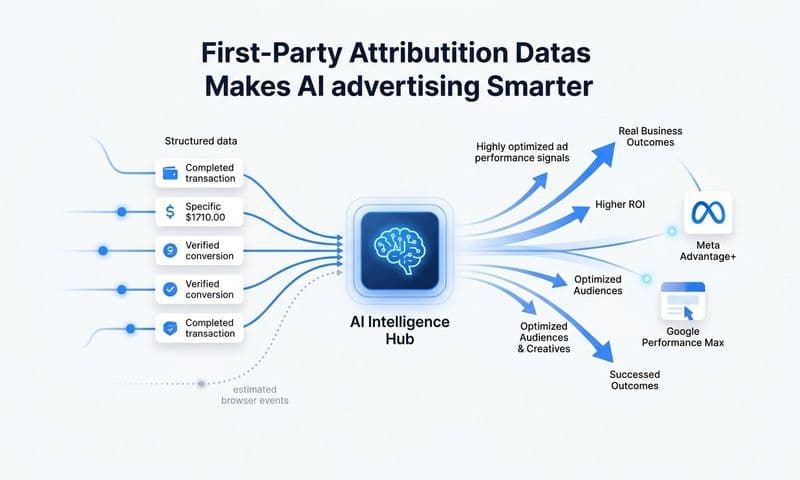
Cometly also closes the feedback loop with ad platforms. By sending enriched, conversion-ready events back to Meta, Google, and other ad platforms, it improves the targeting and optimization algorithms that those platforms use to find your best customers. Better data in means better targeting out, which means lower cost per acquisition over time.
The practical outcome for marketing teams is significant. Instead of debating which channel deserves budget based on incomplete last-click data, teams can see the full contribution of every channel across the entire buyer journey. They can scale what is working, cut what is not, and do both with confidence rather than guesswork.
The Bottom Line on Touchpoint Attribution
Touchpoint attribution is not a reporting exercise. It is a revenue strategy. When B2B SaaS teams can see every interaction that shaped a conversion, from the first LinkedIn ad impression to the demo call that closed the deal, they make better budget decisions, build more effective campaigns, and scale with the kind of confidence that only comes from accurate data.
The alternative is continuing to optimize on incomplete information: crediting the wrong channels, cutting the campaigns that are quietly building pipeline, and scaling the ones that are just capturing demand that other investments already created.
The mechanics are clear. Capture every touchpoint across paid, organic, and offline channels. Connect that data to CRM outcomes and closed revenue. Use attribution models that reflect the complexity of your buyer journey. And use a platform that makes all of this visible in one place, with AI to help you act on what you see.
Ready to stop guessing and start scaling based on what the data actually shows? Get your free demo and see how Cometly makes complete touchpoint attribution actionable for your B2B SaaS marketing team.