

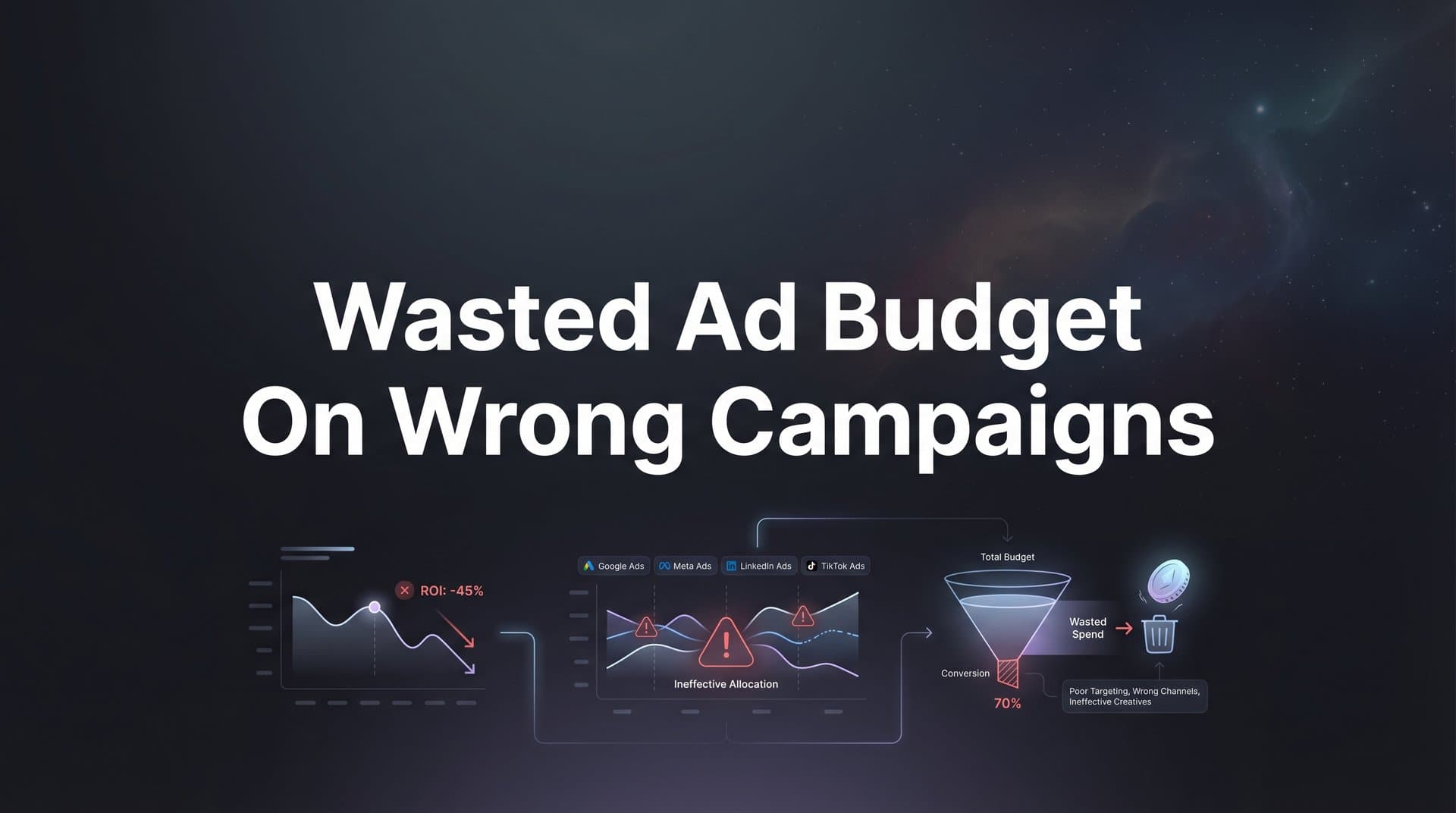
Your Meta Ads dashboard shows a 3.2% click-through rate. Google Ads reports 487 conversions this month. LinkedIn says your campaign reached 52,000 decision-makers. The numbers look solid, so you keep the budget flowing.
Then the sales team sends their monthly report: pipeline is down 18%, and only a handful of those "conversions" actually turned into qualified leads. You're left with a sinking question: where did all that ad spend actually go?
This disconnect between what ad platforms tell you and what actually drives revenue is one of the costliest problems in digital marketing today. Marketers unknowingly pour budget into campaigns that look successful on the surface but contribute little to the bottom line. The issue isn't your creative or targeting—it's that you're making decisions based on incomplete, fragmented data that obscures which campaigns truly matter.
The Hidden Cost of Flying Blind with Ad Data
Platform metrics feel reassuring. You log into your ad account, see green arrows pointing up, and assume you're on the right track. Clicks are climbing. Impressions are strong. The cost per conversion looks reasonable compared to last month.
But here's the problem: those metrics measure activity, not outcomes. A click tells you someone was curious enough to visit your site. An impression confirms your ad appeared on someone's screen. Even a platform-reported conversion only confirms that someone completed an action the platform could track—not that they became a paying customer.
This creates what marketers call the attribution gap. Your ad platforms live in their own data silos, reporting conversions based on their tracking pixels and cookies. Your website analytics tool has its own view of user behavior. Your CRM holds the actual truth about which leads turned into revenue. None of these systems naturally talk to each other, so you're left piecing together fragments of the customer journey like a detective working three separate crime scenes.
The consequences show up in predictable patterns. You might notice campaigns with massive reach but suspiciously low revenue contribution. Or you're scaling a campaign that drives tons of form submissions, only to discover your sales team considers 90% of those leads unqualified. You see strong performance in your ad dashboard but weak results in your revenue reports, and you can't figure out where the disconnect happens.
Think of it like judging a restaurant by how many people walk through the door instead of how many actually order food and pay their bill. Foot traffic matters, but it's not the metric that keeps the lights on. The same principle applies to your ad spend: activity metrics create the illusion of success while your budget quietly drains into campaigns that don't move the needle on revenue.
The frustration compounds when you try to optimize. You pause campaigns with "low engagement" that might actually be driving your highest-value customers. You double down on campaigns with "strong conversion rates" that generate leads your sales team immediately disqualifies. Every budget decision becomes a gamble because you're optimizing for the wrong signals.
This isn't a failure of effort or expertise. It's a structural problem: you're trying to make strategic decisions using tactical metrics that were never designed to show you the complete picture of what drives revenue. Understanding wasted ad budget on wrong attribution is the first step toward fixing this fundamental disconnect.
Why Your Best-Performing Campaigns Might Actually Be Your Worst
Last-click attribution is the default setting in most marketing analytics, and it's quietly sabotaging your budget decisions. Under this model, whichever touchpoint happens right before a conversion gets 100% of the credit. It's simple, clean, and completely misleading for any business with a considered purchase process.
Picture this scenario: A potential customer sees your LinkedIn ad, clicks through to read a blog post, and leaves. Three days later, they see your Facebook retargeting ad and visit your pricing page. A week after that, they Google your brand name directly, click your search ad, and finally convert. Last-click attribution gives all the credit to that branded search ad—the one that captured someone already convinced to buy.
Meanwhile, the LinkedIn campaign that introduced them to your solution gets zero credit. The Facebook retargeting that kept you top-of-mind gets ignored. You look at your reports, see branded search "outperforming" everything else, and naturally shift more budget there. You've just rewarded the campaign that did the least work and defunded the campaigns that actually built awareness and consideration. This is a classic case of revenue attribution to wrong campaigns.
This problem has gotten dramatically worse since Apple's iOS privacy changes limited tracking capabilities. When users opt out of tracking on their iPhones, ad platforms lose visibility into a significant portion of the customer journey. Meta can't see that someone clicked your Instagram ad, then later converted on desktop. Google can't connect mobile research to desktop purchases. The tracking blind spots force platforms to make educated guesses about which ads drove conversions.
Add cookie deprecation to the mix, and browser-based tracking becomes even less reliable. Users clear cookies, browse in incognito mode, or use ad blockers that prevent tracking pixels from firing. Each of these actions creates gaps in your attribution data, making it harder to understand which campaigns actually contribute to conversions.
Here's where platform self-reporting bias enters the picture. Ad platforms have a business incentive to show strong performance. They're not deliberately lying, but their attribution windows and models tend to be generous in crediting conversions to their own ads. Meta might claim a conversion happened because someone saw your ad six days ago, even if they converted through a completely different channel. Google Ads might attribute a sale to a display ad impression that had minimal influence on the actual purchase decision.
When you rely solely on platform-reported data, you're essentially letting each channel grade its own homework. The result is inflated conversion numbers, overlapping attribution claims across platforms, and a distorted view of which campaigns deserve your budget. You might be celebrating a "winning" campaign that's actually riding on the coattails of other marketing efforts you're unknowingly underfunding.
Five Warning Signs You're Bleeding Budget on Wrong Campaigns
Your ad platforms report more conversions than your CRM shows closed deals. This is the clearest red flag. If Meta says you had 200 conversions last month but your CRM only shows 45 new customers, something is fundamentally broken in your attribution. The gap reveals that you're optimizing campaigns based on inflated numbers that don't reflect actual business outcomes. Learning to identify wasted ad budget identification patterns can save you thousands.
Campaigns with stellar engagement metrics contribute almost nothing to your pipeline. You've got a campaign generating thousands of clicks, hundreds of form submissions, and impressive time-on-site numbers. But when you ask your sales team about lead quality from that source, they tell you those leads never respond or aren't a good fit. High engagement without revenue contribution means you're paying to attract the wrong audience.
You can't connect offline conversions back to their original touchpoints. This hits especially hard for businesses with longer sales cycles or offline conversion events. Someone fills out a form, gets nurtured through email, talks to sales for three weeks, and finally signs a contract. By the time the deal closes, you've lost track of which ad campaign started that journey. Without that connection, you can't accurately measure campaign ROI or make informed scaling decisions.
Your attribution reports show impossible overlaps between channels. When you add up all the conversions claimed by each platform, the total exceeds your actual number of customers. Each channel is taking credit for the same conversions, giving you a funhouse mirror view of performance. This makes it nearly impossible to know which channels deserve more budget and which should be scaled back.
Budget decisions feel like guesswork rather than data-driven strategy. You're making choices based on gut feeling, anecdotal feedback from the sales team, or which campaigns "seem" to be working. When you lack confidence in your attribution data, every budget reallocation becomes a gamble. You might be defunding your most valuable campaigns simply because their contribution isn't visible in your current tracking setup.
Building a Complete Picture of Your Customer Journey
The solution to wasted ad budget starts with capturing every touchpoint in your customer's path to purchase. Not just the clicks and conversions that platforms can easily track, but the complete journey from first awareness through closed deal and beyond.
This means tracking more than just ad interactions. You need to capture website visits, content downloads, email opens, demo requests, sales calls, and CRM events. Each of these touchpoints reveals something about how customers discover, evaluate, and ultimately choose your solution. When you connect these dots, patterns emerge that single-channel data could never show. Implementing proper tracking for B2B marketing campaigns is essential for this visibility.
Server-side tracking has become essential for building this complete picture. Instead of relying on browser cookies and tracking pixels that users can block or delete, server-side tracking sends conversion data directly from your servers to ad platforms. When someone converts on your site, your server communicates that event to Meta, Google, and other platforms—regardless of whether the user has cookies enabled or tracking blocked.
This approach solves multiple problems at once. It bypasses browser limitations and ad blockers that create gaps in your data. It provides more accurate conversion tracking even when users switch devices or clear their cookies. And it gives you control over what data gets sent to each platform, allowing you to share enriched conversion information that includes revenue values, customer lifetime value predictions, and other business-critical metrics.
The real power comes from connecting your ad platforms with your CRM data. This integration closes the loop between marketing activity and actual revenue. When a lead from a Facebook ad eventually becomes a customer in your CRM, that connection gets tracked and attributed back to the original campaign. You can finally see which campaigns drive not just leads, but qualified leads that turn into paying customers.
Consider how this transforms your understanding of campaign performance. Instead of seeing "Campaign A generated 150 conversions at $45 each," you see "Campaign A generated 150 conversions, 23 became qualified leads, 8 closed as customers, generating $47,000 in revenue." That level of visibility changes everything about how you allocate budget.
For businesses with longer sales cycles, this connection becomes even more critical. When deals take weeks or months to close, you need tracking that persists across that entire timeline. You need to know that the customer who signed a contract today first clicked your LinkedIn ad 47 days ago, then attended a webinar, downloaded a guide, and had three sales calls. Without that complete journey mapped out, you're making budget decisions based on fragments of the story.
The goal is to create a single source of truth for your marketing data. Instead of juggling conflicting reports from different platforms, you have one unified view that shows how all your marketing touchpoints work together to drive conversions. This doesn't mean you ignore platform data—it means you enhance it with the context needed to make smart decisions about where your budget should go.
Making Smarter Budget Decisions with Multi-Touch Attribution
Once you're capturing the complete customer journey, multi-touch attribution models help you understand which campaigns deserve credit for conversions. Unlike single-touch models that assign 100% credit to one interaction, multi-touch attribution distributes credit across all the touchpoints that contributed to a sale.
Different attribution models serve different purposes. Linear attribution gives equal credit to every touchpoint in the journey—useful for understanding the full scope of channels involved but potentially over-crediting minor interactions. Time-decay attribution gives more credit to touchpoints closer to the conversion, recognizing that recent interactions often have more influence on the final decision. Position-based attribution credits both the first touchpoint that created awareness and the last touchpoint that drove conversion, acknowledging that introduction and closing both matter. Understanding what attribution model is best for optimizing ad campaigns depends on your specific business model.
The key is comparing multiple attribution models to understand how your customer journey actually works. If linear and last-click attribution show vastly different results, that tells you something important about your marketing mix. Maybe your awareness campaigns are doing heavy lifting that last-click attribution completely misses. Or perhaps your retargeting is more influential than a linear model suggests.
For businesses with complex B2B sales cycles, custom attribution models often work best. You might assign more weight to demo requests and sales calls because you know those interactions strongly predict eventual purchases. Or you might give extra credit to campaigns that drive high-value enterprise leads versus small business prospects. The flexibility to define what matters for your specific business model makes attribution truly actionable.
Here's where attribution data becomes a competitive advantage: you can send enriched conversion signals back to ad platform algorithms. Instead of just telling Meta that someone converted, you can send data about conversion value, customer quality, and likelihood to become a long-term customer. This feeds the platform's machine learning systems with the information they need to optimize for outcomes you actually care about, not just any conversion.
When Google's algorithm knows that conversions from certain campaigns tend to generate 3x more revenue than others, it can optimize bidding and targeting to find more of those high-value customers. When Meta understands which conversions lead to qualified sales opportunities versus dead-end leads, its targeting improves. You're essentially training the ad platforms to hunt for the customers who matter most to your business.
This creates a virtuous cycle: better attribution data leads to smarter budget allocation, which improves campaign performance, which generates more revenue, which provides even better data for future optimization. You move from reactive budget management to proactive scaling of what actually works.
Putting Your Ad Budget to Work: A Practical Action Plan
Start by auditing your current campaign performance against actual revenue data. Pull reports from each ad platform showing conversions and spend. Then compare those numbers to your CRM data showing which campaigns actually generated qualified leads and closed deals. The gaps between these reports reveal where you're likely wasting budget on campaigns that look good on paper but underperform in reality. A thorough wasted ad budget diagnosis is the foundation for improvement.
Next, identify which campaigns have the strongest correlation between ad spend and revenue generation. Look beyond surface metrics like clicks and impressions. Focus on campaigns that consistently drive leads your sales team wants to talk to, that progress through your pipeline at healthy rates, and that close into customers at acceptable costs. These are your foundation campaigns that deserve stable or increased budget.
For campaigns showing weak revenue correlation despite strong platform metrics, don't immediately pause them. Dig deeper to understand why the disconnect exists. Sometimes the issue is lead quality problems that better targeting can fix. Other times you're attracting the right audience but your landing page or offer isn't converting them effectively. Occasionally you discover that a campaign drives valuable awareness that contributes to conversions credited elsewhere. Understanding the "why" prevents you from making hasty cuts that hurt overall performance.
Implement tracking that connects your entire funnel from ad click through closed deal. This might mean setting up server-side tracking, integrating your CRM with your ad platforms, or deploying attribution software that unifies data across channels. The initial setup requires effort, but the visibility you gain transforms how confidently you can allocate budget. Explore marketing budget allocation based on data to make every dollar count.
Create a regular cadence for reviewing attribution data and adjusting budget allocation. Monthly reviews work well for most businesses, giving you enough data to spot trends without reacting to daily noise. Look for campaigns that consistently drive high-quality conversions and gradually shift budget toward them. Identify underperformers and either optimize them or redirect that spend to proven winners.
Set up alerts for the warning signs discussed earlier: conversion discrepancies between platforms and CRM, campaigns with high spend but low pipeline contribution, or attribution overlaps that suggest data quality issues. Catching these problems early prevents budget waste from compounding over time.
Turning Data Into Your Competitive Edge
Wasted ad budget on wrong campaigns isn't a creative problem or a targeting failure. It's a visibility problem. When you're making decisions based on fragmented data that shows activity instead of outcomes, budget waste becomes inevitable. You reward campaigns that happen to be last in line, defund the campaigns doing the hard work of building awareness, and scale based on metrics that don't correlate with revenue.
The marketers who win aren't necessarily the ones with bigger budgets or better creative. They're the ones who can see their entire customer journey clearly, understand which touchpoints actually drive conversions, and ruthlessly allocate budget to what works. They don't guess which campaigns deserve more spend—they know, because they've connected their ad platforms to their CRM and built attribution systems that reveal the truth about campaign performance.
This clarity compounds over time. Every month of accurate attribution data makes your next budget decision smarter. Every optimization based on real revenue data improves your overall marketing efficiency. You stop wasting money on campaigns that look successful but contribute little, and you confidently scale the campaigns that actually drive growth.
The question isn't whether you're wasting some portion of your ad budget on the wrong campaigns. If you're relying on platform-reported data without connecting it to actual revenue, you almost certainly are. The question is how much longer you'll operate with that blind spot before taking action to fix it.
Ready to elevate your marketing game with precision and confidence? Discover how Cometly's AI-driven recommendations can transform your ad strategy. Get your free demo today and start capturing every touchpoint to maximize your conversions.



