You've just scaled your best-performing campaign. The dashboard looks incredible—CTR is up, CPAs are down, and the conversion count keeps climbing. You confidently increase the budget, expecting revenue to follow the same upward trajectory.
Two weeks later, you're staring at your bank account with a sinking feeling. The money went out. The conversions supposedly came in. But the revenue? It's nowhere near what the platform promised.
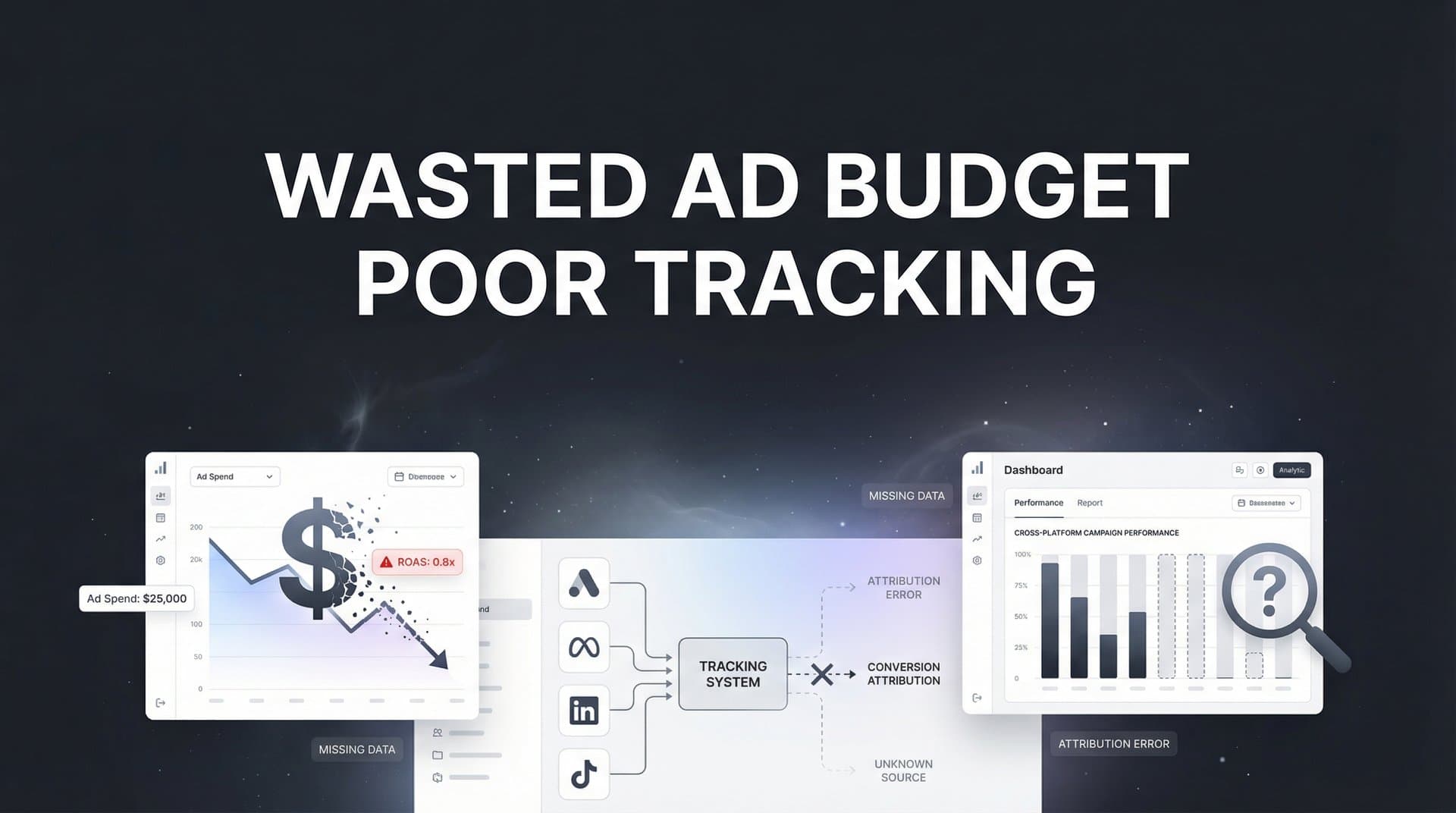
This isn't a story about bad luck or market conditions. It's about something far more insidious: poor tracking creating blind spots in your attribution data. Every time your tracking infrastructure fails to capture a conversion, misattributes a sale, or feeds incomplete data back to your ad platforms, you're making decisions in the dark. And in the dark, it's remarkably easy to throw money at campaigns that look like winners but are actually draining your budget.
The stakes have never been higher. In today's privacy-first advertising landscape, the gap between what your ad platforms report and what actually drives revenue has become a chasm. This article will show you exactly how tracking gaps lead to wasted ad spend—and more importantly, what you can do to stop the bleeding.
The Hidden Cost of Flying Blind on Ad Performance
When marketers talk about "poor tracking" in 2026, they're describing a perfect storm of technical challenges that have fundamentally broken traditional measurement approaches.
Let's start with the elephant in the room: iOS privacy changes. Since Apple introduced App Tracking Transparency, a significant portion of your mobile traffic has become essentially invisible to traditional tracking methods. Users who decline tracking permission disappear from your attribution funnel, creating gaps in your customer journey data that you might not even realize exist.
But iOS is just the beginning. Google's ongoing deprecation of third-party cookies in Chrome has eliminated another pillar of traditional tracking infrastructure. Cross-device fragmentation means a customer might see your ad on mobile, research on tablet, and convert on desktop—with each touchpoint appearing as a different "user" in your analytics. Understanding cross-device user tracking challenges is essential for modern marketers facing this reality.
Then there's the data disconnection problem. Your ad platforms live in one silo. Your CRM holds different information. Your website analytics tell yet another story. Without a unified view, you're essentially trying to solve a puzzle with pieces from three different boxes.
Here's where it gets expensive: inaccurate data doesn't just create confusion—it triggers a cascade of wrong decisions that compounds waste over time.
Think about how optimization actually works. You look at your campaign data, identify what appears to be working, and allocate more budget there. You cut spending on what looks like it's underperforming. This seems logical, except when your data is fundamentally wrong.
When tracking gaps make Campaign A look like a superstar while hiding the true value of Campaign B, you'll naturally shift budget toward A. Over weeks and months, this misallocation compounds. You're not just wasting the budget on the overvalued campaign—you're also missing out on the revenue you could have generated from the undervalued one.
The self-reporting bias of ad platforms makes this even worse. Platform-reported metrics often overstate performance because of how attribution windows work and what conversions they choose to count. Facebook might claim credit for a conversion that happened within 7 days of someone seeing your ad—even if that person also clicked a Google ad, received an email, and searched your brand name before converting.
Each platform wants to prove its value, so their attribution models are designed to be generous to themselves. This isn't necessarily malicious—it's just the nature of self-reported data. But when you're making budget decisions based on these inflated numbers, you're optimizing for the wrong outcomes.
The truly insidious part? Poor tracking creates a feedback loop that makes the problem worse over time. Bad data leads to bad optimization decisions. Bad optimization decisions lead to worse performance. Worse performance generates even more confusing data. Before you know it, you're stuck in a cycle where you can't trust your metrics enough to make confident changes, but you can't afford to keep doing what you're doing.
Five Warning Signs Your Tracking Is Leaking Budget
The Phantom Conversion Problem: You're seeing a growing gap between what your ad platforms report and what actually shows up in your CRM or bank account. Meta says you got 100 conversions this week. Your CRM shows 60 new customers. Your payment processor confirms 45 actual sales.
This discrepancy isn't just an accounting annoyance—it's a fundamental signal that your tracking infrastructure is broken. When platforms report conversions that don't correspond to real revenue, they're essentially giving you permission to waste money on campaigns that look successful but aren't.
The danger multiplies when you use these phantom conversions to calculate metrics like ROAS or CAC. If your platform says you spent $5,000 to generate 100 conversions, you might think you're paying $50 per customer. But if only 45 of those conversions were real, your actual cost per customer is $111. That's not a rounding error—it's the difference between a profitable campaign and one that's slowly bankrupting your marketing efforts. Learning best practices for tracking conversions accurately can help you eliminate these phantom conversion issues.
The Cross-Device Black Hole: Your analytics show that most conversions happen on desktop, so you've been cutting mobile ad spend. But when you actually talk to customers, many of them mention seeing your ads on their phones before converting on their laptops.
This is the cross-device attribution problem in action. Traditional tracking can't follow a customer across devices, so it attributes the conversion to whatever device completed the purchase. This makes mobile look like it doesn't work, when in reality it might be your most effective awareness channel.
Marketers who can't track cross-device journeys often make catastrophic budget decisions. They cut spending on channels that introduce customers to their brand because those channels don't get credit for the final conversion. Meanwhile, they over-invest in bottom-funnel channels that capture demand created elsewhere.
The Last-Click Attribution Trap: You're giving all the credit to the last touchpoint before conversion, which means you're systematically undervaluing every other channel in your marketing mix.
Let's say a customer sees your Facebook ad, clicks a Google search ad, receives an email, and then converts through organic search. Last-click attribution gives 100% of the credit to that organic search visit. Facebook gets nothing. Google gets nothing. Email gets nothing.
Based on this data, you might conclude that organic search is your best channel and cut spending on paid social and search. But without those earlier touchpoints, that customer probably never would have searched for your brand in the first place. Exploring different attribution tracking methods can help you move beyond the limitations of last-click models.
This isn't a theoretical problem. Many marketers are actively defunding their most effective awareness and consideration channels because last-click attribution makes them invisible.
The Algorithm Optimization Mismatch: Your ad platform algorithms are optimizing for conversions, but the conversion signals they're receiving don't actually correlate with revenue.
This happens when your tracking only captures surface-level conversion events without feeding back the actual value of those conversions. The algorithm learns to find more people who take the tracked action, but it has no idea whether those people become valuable customers or one-time buyers who never return.
You might be feeding your Meta campaigns a "Purchase" event, but if you're not also sending back the order value, customer lifetime value, or whether the purchase was later refunded, the algorithm is optimizing blind. It'll happily find you more converters, even if those converters are low-value or problematic customers.
The Vanity Metrics Scaling Trap: You're making budget decisions based on engagement metrics, traffic numbers, or even conversion counts rather than actual revenue impact.
This is the most common warning sign of all. A campaign generates lots of clicks, so you scale it. An ad has high engagement, so you increase its budget. A channel drives tons of traffic, so you invest more there.
But clicks, engagement, and traffic aren't the goal—revenue is. When your tracking infrastructure can't connect marketing activities to actual business outcomes, you're forced to optimize for proxy metrics. And proxy metrics are notoriously unreliable guides to profitability.
Why Ad Platform Algorithms Suffer Without Clean Data
Modern advertising platforms are remarkably sophisticated. Meta's Advantage+ campaigns, Google's Smart Bidding, TikTok's automated targeting—these systems use machine learning to optimize thousands of variables in real time.
But here's the catch: these algorithms are only as good as the data you feed them.
Think of ad platform algorithms like a highly skilled assistant who's trying to help you find customers. You tell this assistant what a successful outcome looks like, and they go out and find more people who match that pattern. The more accurate your definition of success, the better they perform.
When you send complete, accurate conversion data back to your ad platforms, you're giving the algorithm clear instructions: "This is what a valuable customer looks like. Find me more people like this."
The algorithm analyzes the characteristics of people who convert—their demographics, interests, behaviors, device usage, time of day they're active, and thousands of other signals. It then uses this pattern recognition to identify similar people who are likely to convert and shows them your ads.
This is why conversion tracking isn't just about measurement—it's the primary training mechanism for algorithmic optimization.
Now imagine what happens when your conversion data is incomplete or inaccurate. You're essentially training the algorithm on false information.
If your tracking only captures 60% of actual conversions because of iOS privacy restrictions, the algorithm is learning from an incomplete picture. It might conclude that certain audience segments don't convert when they actually do—their conversions just aren't being tracked. So it stops showing ads to those segments, and you miss out on potential customers.
Delayed conversion signals create another problem. Many tracking setups don't send conversion events to ad platforms until hours or even days after they occur. By that time, the algorithm has already made thousands of optimization decisions based on incomplete information. Implementing real-time data tracking ensures your algorithms receive conversion signals when they matter most.
It's like trying to teach someone to play basketball by only telling them whether their shots went in three days after they took them. The feedback loop is so slow that learning becomes nearly impossible.
The feedback loop problem compounds over time. Poor conversion data causes the algorithm to target the wrong audiences. Targeting the wrong audiences generates fewer real conversions. Fewer conversions means even less data for the algorithm to learn from. The algorithm's performance degrades further, and the cycle continues.
This is why two advertisers in the same industry with similar budgets can see wildly different results. The one with clean, complete conversion tracking is training their algorithms effectively. The one with poor tracking is essentially asking their algorithms to optimize while blindfolded.
The most insidious aspect? You often can't tell this is happening just by looking at platform metrics. The algorithm will continue to optimize for whatever signals it receives. If those signals are wrong, it'll confidently optimize in the wrong direction while reporting that everything looks great.
The Server-Side Tracking Advantage
For years, marketers relied on browser-based tracking—little pieces of code that run in a user's web browser to capture conversions and send them to analytics platforms. This approach worked well enough in the pre-privacy era.
But in 2026, browser-based tracking is fundamentally broken.
When a user blocks cookies, uses an ad blocker, or declines tracking permission on iOS, browser-based tracking simply stops working. The conversion happens, but your tracking code never fires. From your analytics perspective, that customer doesn't exist.
This is where server-side tracking changes everything.
Instead of relying on code that runs in the user's browser, server-side tracking sends conversion data directly from your servers to ad platforms and analytics tools. This happens completely independently of what's happening in the user's browser. A comprehensive server-side tracking implementation guide can walk you through the technical setup process.
Think of it like the difference between asking someone to deliver a message for you versus delivering it yourself. Browser-based tracking is asking the user's browser to deliver your conversion data—and increasingly, browsers are refusing. Server-side tracking delivers the message directly, bypassing the browser entirely.
The immediate benefit is capturing conversions that would otherwise be lost. When someone converts on your site after blocking cookies or declining tracking, server-side tracking still captures that conversion because it doesn't depend on browser cooperation.
But the real power of server-side tracking goes deeper than just capturing more conversions. It allows you to enrich conversion events with data that only exists on your servers.
Your CRM knows whether a customer is a first-time buyer or a repeat purchaser. It knows their lifetime value, their purchase frequency, and whether they've ever requested a refund. Your server-side tracking can include all of this rich context when sending conversion events back to ad platforms.
This transforms how ad platform algorithms optimize. Instead of just knowing that someone converted, they know that someone became a high-value repeat customer. The algorithm can then find more people who match that valuable customer profile, rather than just finding more people who convert once.
Server-side tracking also solves the delayed signal problem. Because you control when conversion events are sent, you can ensure they're transmitted in real time rather than waiting for browser-based code to fire on the next page load.
The technical implementation requires connecting your server infrastructure to ad platform APIs, but the payoff is substantial. Marketers who implement server-side tracking typically see immediate improvements in conversion tracking accuracy, which then compounds into better algorithmic performance over the following weeks.
Building a Tracking Infrastructure That Protects Your Budget
Solving the tracking problem isn't about implementing one tool or fixing one issue. It's about building a complete infrastructure that connects every piece of your marketing data ecosystem.
Start by connecting your ad platforms, CRM, and website data into a unified view. This sounds obvious, but most marketers are still working with fragmented data sources that never talk to each other.
Your ad platforms know what ads people clicked. Your website analytics know what pages they visited. Your CRM knows whether they became customers and how much they spent. When these three data sources remain separate, you're missing the complete picture of what actually drives revenue. Using customer journey tracking tools can help you connect these disparate data sources into a cohesive view.
A unified tracking infrastructure captures the entire customer journey—from the first ad impression through every touchpoint to the final conversion and beyond. This complete view is what allows you to make confident optimization decisions.
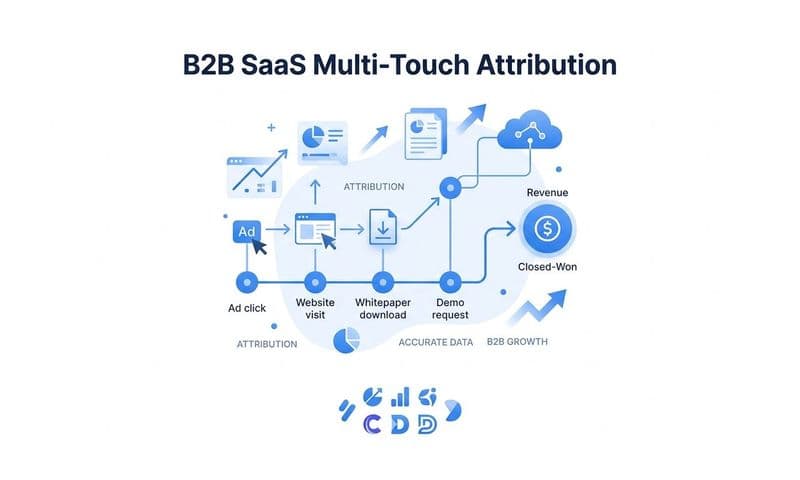
Multi-touch attribution is the next critical piece. Instead of giving all credit to one touchpoint, multi-touch attribution distributes credit across the entire customer journey based on each touchpoint's contribution.
Different attribution models weight touchpoints differently. First-touch attribution gives credit to the initial interaction. Linear attribution spreads credit evenly across all touchpoints. Time-decay attribution gives more credit to recent interactions. U-shaped attribution emphasizes both the first and last touchpoints.
The specific model matters less than the principle: understanding that customer journeys involve multiple touchpoints and that each touchpoint plays a role in driving conversions. When you can see the full journey, you stop making the mistake of cutting channels that create awareness just because they don't get last-click credit. Implementing proper touchpoint tracking analytics gives you visibility into every interaction that influences a conversion.
Real-time analytics capabilities are equally important. The faster you can identify tracking issues, the less budget you'll waste before fixing them.
Set up monitoring that alerts you when conversion discrepancies appear, when tracking pixels stop firing, or when key metrics deviate significantly from expected patterns. Catching a tracking problem after one day of wasted spend is infinitely better than discovering it after a month.
Regular attribution audits should become part of your routine. At least monthly, compare what your ad platforms report against what your CRM and payment processor confirm. Investigate any significant discrepancies immediately.
The goal isn't perfection—some level of discrepancy is normal due to attribution window differences and legitimate measurement challenges. But large or growing gaps signal that your tracking infrastructure needs attention.
Turning Accurate Attribution Into Confident Scaling
When you finally have accurate attribution data, something remarkable happens: you can make scaling decisions with actual confidence.
Instead of wondering whether a campaign's reported performance is real, you know exactly which ads drive revenue. You can see which channels contribute to the customer journey even if they don't get last-click credit. You understand the true cost of acquiring valuable customers across your entire marketing mix.
This clarity transforms budget allocation from guesswork into science. You're no longer flying blind, hoping that the campaigns you're scaling will actually deliver revenue. You're making decisions based on verified connections between marketing spend and business outcomes. Discover how ad tracking tools can help you scale ads using accurate data rather than platform-inflated metrics.
AI-powered recommendations become exponentially more valuable when they're working with clean data. Modern attribution platforms can analyze performance patterns across all your channels simultaneously, identifying opportunities that would be impossible to spot manually.
These systems can tell you which combinations of channels work best together, which audience segments drive the highest lifetime value, and which creative elements correlate with better conversion rates. But only if the underlying data is accurate.
The compound effect of better tracking creates a virtuous cycle that accelerates over time. Better data leads to better optimization decisions. Better optimization improves campaign performance. Better performance generates more conversions, which provides even more data for the algorithm to learn from.
Your ad platform algorithms get smarter because you're feeding them accurate conversion signals. Your budget allocation gets more efficient because you're investing in channels that actually drive revenue. Your overall marketing ROI improves because you're eliminating waste at every level.
This compounding advantage is why marketers who solve their tracking challenges often see dramatic improvements that continue to build month after month. They're not just fixing a technical problem—they're removing the fundamental constraint that was limiting their ability to scale profitably.
Reclaiming Control of Your Marketing Investment
Poor tracking isn't just a technical inconvenience that makes reporting harder. It's an active drain on your marketing budget that compounds every single day you let it continue.
Every misattributed conversion leads to a wrong optimization decision. Every tracking gap creates a blind spot where budget disappears without accountability. Every delayed conversion signal trains your ad algorithms in the wrong direction.
The privacy-first advertising landscape has made these problems more severe, but it's also created a significant competitive advantage for marketers who solve them. While your competitors struggle with phantom conversions and fragmented data, you can be making confident scaling decisions based on accurate attribution.
The gap between what ad platforms report and actual business outcomes will only widen as privacy restrictions continue to evolve. Marketers who build robust tracking infrastructure now will be positioned to thrive while others struggle with increasingly unreliable data.
Start by auditing your current tracking setup. Compare platform-reported conversions against CRM data and actual revenue. Identify where the gaps are largest and which tracking issues are costing you the most money. If you're unsure where to begin, reviewing a complete attribution marketing tracking guide can provide a solid foundation.
Then systematically address each gap—implementing server-side tracking to capture lost conversions, connecting your data sources for complete journey visibility, and adopting multi-touch attribution to understand true channel contribution.
The investment in better tracking infrastructure pays for itself remarkably quickly. When you stop wasting budget on campaigns that only look successful and start scaling the ones that actually drive revenue, the ROI improvement is immediate and substantial.
Ready to elevate your marketing game with precision and confidence? Discover how Cometly's AI-driven recommendations can transform your ad strategy—Get your free demo today and start capturing every touchpoint to maximize your conversions.