You're staring at three different dashboards, and they're telling you three completely different stories. Google Analytics says you got 47 conversions last week. Meta Ads Manager claims 63. Your CRM shows 38 closed deals. Same time period. Same campaigns. Different numbers.
This isn't just confusing—it's expensive. When you can't tell which marketing channels actually drive revenue, you end up throwing money at the ones that look good on paper while starving the ones that quietly deliver your best customers. You might be doubling down on Facebook ads because they show impressive conversion numbers, not realizing that most of those "conversions" started with a Google search two weeks earlier.
Attribution in digital marketing solves this puzzle by connecting the dots between every touchpoint in your customer's journey and the revenue that eventually lands in your account. It's the difference between guessing where your next dollar should go and knowing with confidence which channels deserve more budget because they actually drive results. Let's break down exactly what attribution is, why it matters more than ever in today's privacy-focused landscape, and how to build an attribution strategy that turns data into smarter decisions.
The Simple Truth Behind Marketing Attribution
Marketing attribution is the process of identifying which marketing touchpoints contribute to conversions and revenue. Think of it as detective work for your marketing dollars—tracing backward from each sale to understand which ads, emails, social posts, and content pieces played a role in making that customer say yes.
Here's the reality: your customers don't see an ad and immediately buy. They might click a Facebook ad on Monday, visit your website directly on Wednesday after thinking about it, receive your email newsletter on Friday, and finally convert through a Google search the following Tuesday. That's four different touchpoints, and each one influenced their decision in some way.
Without attribution, you're flying blind. You might look at last-click data and conclude that Google search is your hero channel, completely missing the fact that Facebook introduced those customers to your brand in the first place. Or you might keep pumping budget into display ads because they generate clicks, not realizing that those clickers rarely convert into actual customers. Understanding why attribution is important in digital marketing helps you avoid these costly blind spots.
The stakes get higher as your marketing gets more sophisticated. When you're running campaigns across Meta, Google, TikTok, email, and content marketing, the customer journey becomes a web of interconnected touchpoints. Attribution is what turns that tangled web into a clear map showing you exactly which paths lead to revenue.
This matters because marketing budgets aren't infinite. Every dollar you spend on a channel that looks good but doesn't actually drive conversions is a dollar you're not investing in the channels that do. Attribution gives you the confidence to shift spend toward what works and cut what doesn't—not based on vanity metrics like impressions or clicks, but based on actual revenue contribution.
How Attribution Models Assign Credit to Your Channels
Attribution models are the rules that determine how credit gets distributed across the touchpoints in a customer's journey. Different models tell different stories about which channels deserve recognition, and choosing the right one depends on understanding how your customers actually buy.
First-Click Attribution: This model gives 100% of the credit to whatever brought the customer into your world initially. If someone clicked a Facebook ad three weeks before converting through a Google search, Facebook gets all the credit. This model makes sense when you're primarily focused on awareness and top-of-funnel performance, but it completely ignores everything that happened after that first interaction.
Last-Click Attribution: The opposite approach—whoever touched the customer last gets all the glory. This is the default setting in most ad platforms, which is convenient for the platforms but often misleading for you. Last-click makes retargeting and branded search look like heroes while ignoring the channels that actually introduced customers to your brand. It's like crediting the closer in sales while forgetting about everyone who nurtured the lead.
Linear Attribution: This model takes a more democratic approach by distributing credit equally across every touchpoint. If a customer interacted with five different marketing activities before converting, each one gets 20% of the credit. Linear attribution acknowledges that the entire journey matters, though it doesn't account for the reality that some touchpoints probably influenced the decision more than others.
Time-Decay Attribution: Here's where things get more sophisticated. Time-decay gives more credit to touchpoints that happened closer to the conversion, based on the logic that recent interactions have more influence on the final decision. If someone saw your ad a month ago and then clicked an email yesterday before converting, the email gets weighted more heavily. This model works well for longer sales cycles where nurturing matters.
Position-Based Attribution: Also called U-shaped attribution, this model recognizes that first and last touches are typically most important while still acknowledging the middle of the journey. A common setup gives 40% credit to the first touch, 40% to the last touch, and distributes the remaining 20% across everything in between. This balances awareness and conversion while not completely ignoring the nurturing phase.
Data-Driven Attribution: This is where machine learning enters the picture. Instead of using predetermined rules, data-driven models analyze your actual conversion paths to understand which touchpoints statistically correlate with higher conversion rates. The algorithm identifies patterns—maybe customers who interact with both paid search and organic content convert at twice the rate of those who only see paid ads—and assigns credit accordingly.
The model you choose shapes how you understand your marketing performance. A channel that looks like a star performer under last-click might barely register under first-click. The key is matching your marketing attribution model to your actual sales cycle and customer behavior, not just picking what makes your favorite channel look best.
Why Traditional Tracking Falls Short in Today's Privacy Landscape
The tracking methods that worked perfectly well five years ago are crumbling. Privacy regulations and platform changes have fundamentally altered what data you can collect and how reliably you can track customer journeys across devices and platforms.
Apple's App Tracking Transparency framework, introduced with iOS 14.5, gave iPhone users the power to opt out of tracking. Most did. Suddenly, the Facebook pixel that used to capture nearly every conversion started missing significant chunks of your customer journey. When someone opts out of tracking, their path from ad click to purchase becomes invisible to traditional cookie-based tracking.
Browser restrictions have compounded the problem. Safari's Intelligent Tracking Prevention and Firefox's Enhanced Tracking Protection actively block third-party cookies and limit the lifespan of first-party cookies. Even Google Chrome, which has delayed its cookie deprecation timeline multiple times, is moving toward a cookieless future. The client-side tracking pixels that marketers relied on for years are becoming less and less reliable.
Here's where it gets expensive: platform-reported conversions often inflate your results because each platform operates in its own silo. Meta sees someone click your ad and convert within their attribution window, so they count it as a Meta conversion. Google sees the same person search your brand name and convert, so they count it too. Your CRM shows one actual customer, but your ad platforms are claiming two conversions. When you add up platform-reported numbers, you might see 150 conversions when you actually closed 80 deals. This is the core digital marketing attribution problem that plagues most businesses.
This over-counting problem makes it nearly impossible to accurately calculate return on ad spend or compare channel performance. You can't make smart budget decisions when your data is fundamentally unreliable.
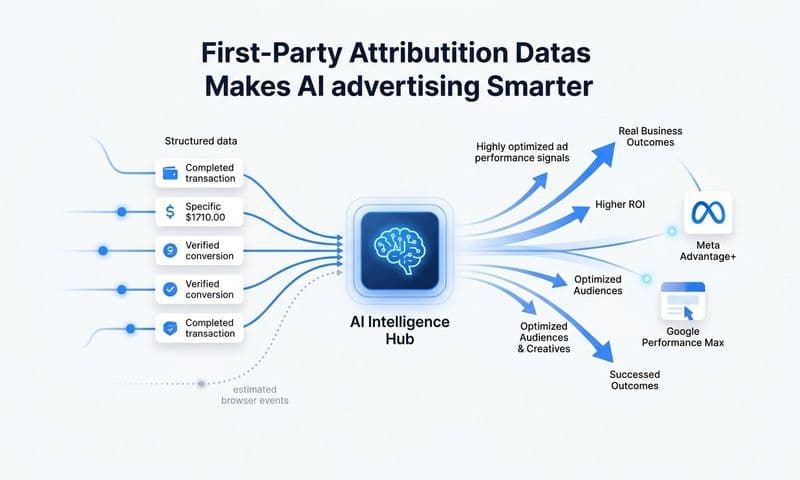
Server-side tracking has emerged as the solution to these challenges. Instead of relying on browser-based pixels that can be blocked or restricted, server-side tracking sends conversion data directly from your server to ad platforms. This approach captures events that client-side pixels miss, operates independently of cookie restrictions, and provides more accurate data for both your own analysis and for feeding back to platform algorithms.
The privacy landscape isn't going back to how it was. Marketers who continue relying solely on traditional client-side tracking will find their data getting less accurate over time, while those who adopt server-side approaches will maintain visibility into the customer journey even as restrictions tighten.
Building Your Attribution Strategy: A Practical Framework
Understanding attribution theory is one thing. Actually implementing it in a way that improves your marketing decisions is another. Here's a practical framework for building an attribution strategy that works in the real world.
Step 1: Connect Your Data Sources
Attribution only works when your marketing data can talk to each other. Your ad platforms need to connect to your website tracking, which needs to connect to your CRM, which needs to connect back to your ad platforms. This creates a closed loop where you can see the complete customer journey from first ad impression to closed deal.
Start by implementing tracking that captures user behavior across your entire funnel. Your website needs to track not just conversions but also the touchpoints leading up to them. Your CRM needs to record which marketing source brought in each lead. Your ad platforms need accurate conversion data fed back to them so their algorithms can optimize effectively. Proper attribution marketing tracking is essential for connecting these dots.
Many businesses discover gaps in this process. Maybe your sales team closes deals in the CRM but doesn't consistently tag which marketing campaign generated each lead. Or your website tracks conversions but doesn't pass that data back to your ad platforms. These gaps break your attribution chain and force you to make decisions based on incomplete information.
Step 2: Choose Attribution Models That Match Your Reality
Your attribution model should reflect how your customers actually buy, not just what's easiest to implement. If you sell a simple product with a short sales cycle—someone sees an ad and buys within hours—last-click attribution might be perfectly adequate. But if you're selling complex B2B software with a three-month sales cycle involving multiple decision-makers, you need multi-touch attribution to understand which touchpoints move deals forward.
Consider running multiple attribution models in parallel, at least initially. Compare what last-click attribution tells you versus what linear or position-based models reveal. The differences often highlight channels that are undervalued in simple models but actually play crucial roles in your customer journey.
Sales cycle length matters enormously here. Longer cycles with more touchpoints benefit from models that acknowledge the entire journey. Shorter cycles where customers make quick decisions might not need the complexity of multi-touch attribution.
Step 3: Use Insights to Reallocate Budget Toward Revenue Drivers
Attribution data is worthless if it doesn't change how you spend money. The point isn't to generate prettier reports—it's to identify which channels actually drive revenue so you can invest more there and cut budget from channels that look good on surface metrics but don't deliver results.
Look for channels that consistently appear in the conversion paths of your highest-value customers. Maybe your attribution data reveals that customers who interact with both paid search and organic content convert at higher rates and spend more than customers who only see paid ads. That insight should inform not just budget allocation but also content strategy.
Watch for channels that generate lots of activity but rarely contribute to actual conversions. Display advertising might deliver impressive impression numbers and decent click-through rates, but if those clicks rarely turn into customers, your attribution data is telling you to shift that budget elsewhere.
The goal is confident decision-making. When you know which channels drive revenue, you can scale winning campaigns aggressively instead of timidly testing with small budget increases. You can cut underperforming channels without second-guessing yourself. Attribution transforms marketing from educated guessing into data-driven strategy.
Turning Attribution Data Into Smarter Ad Spend
Attribution isn't just about understanding the past—it's about making your future marketing more effective. The real power comes from using attribution insights to improve how your campaigns perform and how efficiently your ad platforms optimize.
Feed Better Data to Ad Platform Algorithms
Modern ad platforms rely heavily on machine learning to optimize your campaigns. Facebook's algorithm, Google's Smart Bidding, TikTok's automated targeting—they all work by learning which users are most likely to convert based on the conversion data you send back. When that data is incomplete or inaccurate because of tracking limitations, the algorithms optimize toward the wrong signals.
Server-side tracking and proper attribution let you send complete, accurate conversion data back to ad platforms. This means their algorithms can learn from your actual customer behavior rather than the incomplete picture that client-side pixels provide. The result is better targeting, more efficient bidding, and lower cost per acquisition. Leveraging data analytics for digital marketing ensures you're maximizing every dollar spent.
This creates a virtuous cycle: better data leads to better optimization, which leads to more conversions, which generates more data to learn from. Marketers who feed accurate attribution data back to their ad platforms consistently see performance improvements even without changing their creative or targeting strategy.
Identify Quality Over Volume
Not all conversions are created equal. A channel might generate tons of leads while another generates fewer leads that convert to customers at twice the rate. Attribution data that connects marketing touchpoints to actual revenue helps you distinguish between channels that drive volume and channels that drive value. Understanding channel attribution and revenue tracking is critical for this analysis.
Look at metrics beyond just conversion count. What's the average customer lifetime value from each channel? Which channels bring in customers who stick around versus those who churn quickly? Which campaigns generate leads that your sales team can actually close versus leads that waste their time?
This quality analysis often reveals surprising insights. That expensive LinkedIn campaign might generate fewer leads than Facebook, but if those LinkedIn leads convert to customers at three times the rate and spend twice as much, it's actually your most valuable channel. You'd never discover that looking only at cost per lead.
Understand Channel Synergies
Attribution data reveals how your channels work together rather than in isolation. You might discover that customers who see both paid social ads and paid search convert at significantly higher rates than those who only see one or the other. Or that email marketing rarely drives direct conversions but consistently appears early in the journey of your best customers. This is where multi-channel attribution becomes invaluable.
These cross-channel insights change how you structure your entire marketing strategy. Instead of managing each channel independently and competing for budget, you start thinking about channel combinations that work together to move customers through the journey.
Maybe your data shows that content marketing rarely gets last-click credit but frequently appears in the conversion paths of high-value customers. That's a signal to maintain or increase content investment even though it doesn't show strong performance in last-click reporting. The channel is doing important work that simpler attribution models miss.
Attribution also helps you identify diminishing returns. Perhaps the first $10,000 you spend on Facebook each month drives great results, but every dollar beyond that shows declining efficiency. That's your signal to cap Facebook spend and redirect the excess to channels with more room to scale.
Putting It All Together
Attribution isn't just another analytics exercise to add to your already-full plate. It's the foundation that makes every other marketing decision more confident and more profitable. When you understand which touchpoints actually contribute to revenue, you stop wasting budget on channels that look good in platform dashboards but don't drive real business results.
The marketers who thrive in today's privacy-focused, multi-channel landscape are the ones who can see the complete customer journey. They know which ads introduce customers to their brand, which content nurtures interest, and which touchpoints push prospects over the conversion line. That visibility lets them scale what works and cut what doesn't with certainty rather than hope.
Start by evaluating your current attribution setup honestly. Are you relying on last-click data from individual platforms, each claiming credit for the same conversions? Are you missing significant portions of the customer journey because of tracking limitations? Can you connect marketing touchpoints all the way through to closed revenue, or does your visibility end at the lead form? Reviewing your digital marketing attribution report can help identify these gaps.
The gaps you identify aren't failures—they're opportunities to build a more accurate understanding of what drives your business. Modern attribution tools can capture every touchpoint across your entire marketing ecosystem, from the first ad impression through to CRM events and closed deals. They use server-side tracking to maintain accuracy despite privacy restrictions, and they feed enriched conversion data back to your ad platforms to improve optimization.
Ready to elevate your marketing game with precision and confidence? Discover how Cometly's AI-driven recommendations can transform your ad strategy—Get your free demo today and start capturing every touchpoint to maximize your conversions.