
If you were running paid ads when Apple's iOS privacy changes rolled out, you probably remember the moment your dashboard seemed to fall apart. Reported conversions dropped. Cost per acquisition climbed. Campaigns that had been performing well suddenly looked like they were failing. Your first instinct may have been to cut budgets or pause campaigns, which is exactly the wrong move, and exactly what the data was pushing you toward.
Here is the important thing to understand: the conversions did not disappear. The tracking did. Your ads were still reaching people. Leads were still coming in. Deals were still closing. But the infrastructure that connected ad clicks to downstream outcomes had been fundamentally disrupted, and most tracking setups were not built to survive that disruption.
This article breaks down exactly what happened, why it happened at a technical level, and what modern marketing teams are doing to rebuild accurate measurement. Whether you are running paid social for a B2B SaaS company, managing performance campaigns for clients, or trying to make sense of why your attribution numbers no longer match your CRM, this guide will give you a clear picture of the problem and a practical path forward.
Why iOS Privacy Changes Shattered Traditional Ad Tracking
Apple's App Tracking Transparency framework, introduced with iOS 14.5, changed the rules of the game in a fundamental way. Before ATT, ad platforms like Meta and Google could use a device-level identifier called the IDFA (Identifier for Advertisers) to connect the dots between a user who saw or clicked an ad and a user who later converted. This happened largely in the background, without users being aware of it.
ATT required apps to ask users for explicit permission before accessing the IDFA. The prompt was simple: allow tracking or ask the app not to track. The majority of users, when given the choice, chose not to be tracked. That single behavioral shift removed the primary matching mechanism that ad platforms had relied on for years.
Without the IDFA, Meta and Google lost the ability to match ad exposures to conversions for a significant portion of their iOS user base. The result was not that those conversions stopped happening. It was that the platforms could no longer see them, so they could not report them, and they could not use them to optimize future delivery.
Browser-side tracking faced a parallel problem through Safari's Intelligent Tracking Prevention. ITP progressively shortened the lifespan of cookies set by third-party scripts, in some cases limiting them to as little as 24 hours. A B2B buyer who clicks a LinkedIn ad on Monday and converts on Thursday was already a challenge for last-click attribution. Post-ITP, the cookie that would have connected those two events may have expired before the conversion even happened.
The compounding effect is what made this so damaging for marketers. Both the app-level tracking mechanism and the browser-level tracking mechanism were weakened at the same time, affecting the same large pool of iOS users. To understand the full scope of how these changes reshaped digital advertising, the iOS 14 impact on digital advertising goes deeper into the platform-level consequences. Ad platforms saw their reported conversion numbers drop sharply, while actual business results, measured through CRM data, revenue reports, and pipeline activity, often remained stable or continued growing.
This created a dangerous gap between perceived performance and real performance. Marketers were looking at dashboards that told one story while their sales teams were living a completely different reality. That gap is where bad decisions get made.
The Hidden Cost of Broken Attribution: Bad Decisions, Not Just Bad Data
Broken attribution is not just an analytics problem. It is a business risk. When your reported data no longer reflects reality, every budget decision you make is based on a distorted picture, and the distortion tends to punish your best-performing channels while rewarding the ones that are easiest to track.
Think about what typically happens when a marketer sees conversion numbers drop on a campaign. The natural response is to reduce spend or pause it entirely. But if the drop is caused by tracking loss rather than actual performance decline, you have just cut a channel that was driving real revenue. Meanwhile, campaigns running on channels with stronger cookie persistence or non-iOS audiences may look comparatively healthy, leading you to scale them. You end up investing more in the channels that are easy to measure and less in the channels that are actually working.
The downstream impact on ad platform algorithms makes this worse. Meta's Advantage+ and Google's Smart Bidding both rely on conversion signals to determine which users to target and how to allocate spend. When the volume of reported conversions drops, the algorithms have less data to work with. Less data means less precise targeting. Less precise targeting means higher cost per acquisition. It becomes a self-reinforcing cycle: tracking loss leads to weaker optimization, which leads to genuinely worse performance, which makes it even harder to distinguish real performance problems from measurement problems.
For B2B SaaS teams, this problem is amplified by the nature of the sales cycle. A B2B buyer might click a paid search ad in week one, read a blog post in week two, attend a webinar in week three, and finally request a demo in week four. Each of those touchpoints matters. Understanding attribution challenges in marketing analytics helps explain why capturing every touchpoint has become so critical for accurate measurement. But in a post-iOS world, the early touchpoints, especially those on mobile devices running iOS, are the least likely to be captured by traditional pixel-based tracking.
Last-click attribution was already a poor fit for B2B before iOS. It systematically under-credited the channels that introduce buyers to your brand and over-credited the final touchpoint before conversion. Post-iOS, the problem is more severe because many of those early touchpoints are now invisible to your tracking setup entirely. The result is a measurement model that misrepresents the actual customer journey and leads teams to make budget decisions that do not reflect how their buyers actually behave.
Client-Side vs. Server-Side Tracking: The Technical Fork in the Road
To understand why iOS changes broke so much tracking and what it takes to fix it, you need to understand the difference between client-side and server-side tracking. This is the technical fork in the road that determines whether your attribution survives in a privacy-first world.
Client-side tracking fires from the user's device. When someone visits your website, a pixel script loads in their browser, detects the conversion event, and sends that data back to the ad platform. This is how the Meta Pixel and Google Tag have traditionally worked. The problem is that this entire process happens on the user's device, which means it is subject to every restriction the device or browser can impose.
On iOS, if a user has opted out of tracking, the app cannot access the IDFA. In Safari, ITP may have already deleted the cookie that would have identified the user. Ad blockers can prevent the pixel from firing at all. Each of these layers can independently break the tracking chain, and they often stack on top of each other, meaning a single iOS Safari user with an ad blocker represents a complete blind spot for client-side tracking.
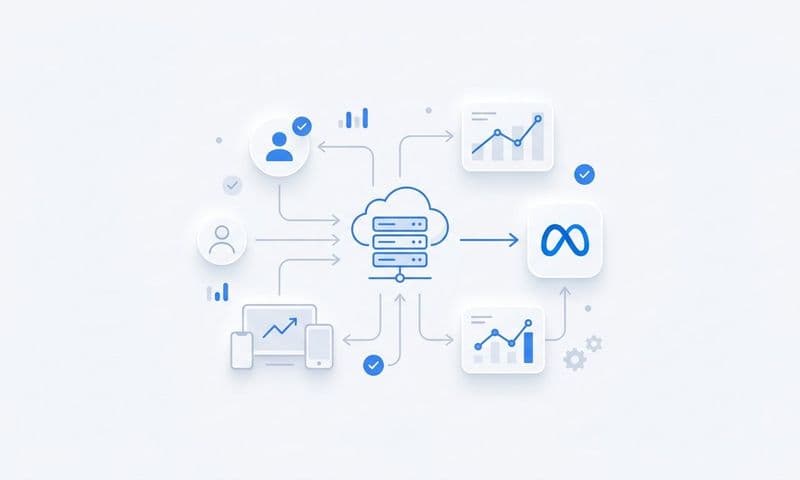
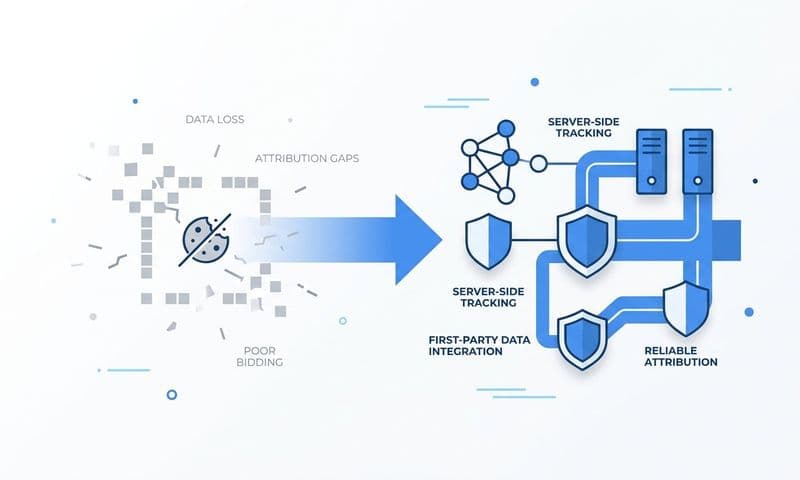
Server-side tracking works differently. Instead of firing from the user's browser, the conversion event is captured by your web server or a middleware layer and sent directly to the ad platform from there. The user's device is not involved in the transmission. iOS opt-out decisions, Safari's ITP, and browser-based ad blockers cannot intercept a signal that never passes through the browser.
This is why the Conversion API (Meta CAPI) and Google Enhanced Conversions have become central to modern tracking setups. Both are server-side solutions provided by the ad platforms themselves. They allow you to send conversion data directly from your server to Meta or Google, bypassing the device-level restrictions that broke client-side tracking. For teams managing Facebook ads attribution, implementing CAPI has become one of the most important steps toward recovering lost conversion visibility.
The catch is that server-side tracking requires first-party data to work well. To match a server-side conversion event back to the right user and the right ad, the platforms need an identifier that they can recognize. Hashed emails and phone numbers are the most common inputs. If a user submits a form with their email address, you can hash that email and send it to Meta or Google alongside the conversion event, allowing the platform to match the conversion to the user who clicked your ad.
This is why first-party data collection has become so strategically important. The teams with robust first-party data, collected with consent at sign-up, purchase, or form submission, have the most resilient tracking setups. They can match server-side events back to users even when device identifiers are unavailable, which keeps their optimization signals strong and their attribution accurate.
Rebuilding Attribution: The Modern Stack for Post-iOS Measurement
Rebuilding accurate attribution after iOS changes is not about finding a single fix. It is about constructing a measurement stack that does not depend on any single point of failure. The marketers who have adapted most successfully have shifted their approach across three interconnected layers: data collection, attribution modeling, and platform integration.
First-party data as the foundation: The starting point is capturing identifiers at the moment of interaction. When a user submits a form, logs into your product, or completes a purchase, you have a moment where they are providing information directly to you. That information, typically an email address or phone number, becomes the anchor for server-side matching. Building this collection into your product and marketing flows is not optional in a post-iOS environment. It is the foundation everything else rests on.
Multi-touch attribution across the full journey: Last-click attribution was never a good fit for B2B, and post-iOS it is actively misleading. Multi-touch models that distribute credit across the customer journey, whether linear, time-decay, or data-driven, give a more accurate picture of which channels are introducing buyers to your brand and which are closing them. But multi-touch models only work if you have a unified data layer that captures all the touchpoints. If your early iOS-affected touches are invisible, even a multi-touch model will give you a distorted picture.
Combining platform data with independent attribution: Ad platforms report conversions from their own perspective, which means each platform tends to claim credit for conversions that other platforms also claim. Running Meta and Google simultaneously and adding up their reported conversions will almost always give you a number that exceeds your actual conversions. An independent marketing attribution platform for B2B SaaS that pulls data from all your ad channels, your CRM, and your website can deduplicate those conversions and give you a unified view of what actually happened.
This unified view is particularly important for B2B SaaS teams where the journey from first touch to closed revenue can span weeks or months. You need a system that can connect a paid social click from six weeks ago to a demo request from last week and a closed deal from yesterday, and attribute credit appropriately across all the touchpoints in between. That kind of end-to-end visibility is what separates teams that make confident budget decisions from teams that are essentially guessing.
How Cometly Closes the Attribution Gap Left by iOS
Cometly was built specifically for the measurement challenges that B2B SaaS marketing teams face, and the post-iOS tracking problem sits at the center of what the platform addresses.
At the infrastructure level, Cometly uses server-side event tracking and Conversion API integration to capture conversion data at the server level. Instead of relying on browser pixels that are vulnerable to iOS restrictions and Safari's ITP, Cometly sends enriched, first-party signals directly to Meta and Google. This means the ad platforms receive the conversion data they need to optimize delivery even when device-level tracking is unavailable. The result is stronger optimization signals, more efficient ad delivery, and a more accurate picture of what your campaigns are actually producing.
Beyond the tracking infrastructure, Cometly connects ad spend data directly to CRM events and pipeline activity. For a B2B SaaS team, this means you can trace a lead from the original ad click, through every subsequent touchpoint, all the way to closed-won revenue. You are not looking at platform-reported conversions in isolation. You are looking at the full journey, with revenue data attached, so you can see which campaigns are actually contributing to pipeline and which are generating activity that never converts to revenue. Teams exploring B2B revenue attribution software will find that this kind of CRM-connected visibility is what makes the difference between guessing and knowing.
The AI-powered recommendations layer surfaces which ads and channels are driving the most valuable conversions, not just the most visible ones. This is particularly valuable in a post-iOS environment where platform-reported data is incomplete. Instead of scaling campaigns based on what Meta or Google tells you is working, you can scale based on what your own first-party data and CRM show is actually closing deals.
Cometly also supports more than 70 native integrations, connecting your ad platforms, CRM, and website into a single source of truth. For teams that have been managing attribution across disconnected tools, this unified view is often where the biggest insights emerge. Seeing all your data in one place, deduplicated and connected to revenue, makes it possible to make budget decisions with genuine confidence rather than educated guesses.
Practical Steps to Restore Accurate Ad Measurement
If your attribution is still broken or incomplete, the path forward starts with an honest audit of your current setup. Here are the concrete steps that will move you from a pixel-dependent, iOS-vulnerable tracking setup to a more resilient measurement foundation.
Audit your tracking for client-side dependencies: Identify every conversion event you are currently tracking and determine whether it is firing from a browser pixel or from your server. Any conversion that relies solely on a client-side pixel is a vulnerability. Prioritize implementing server-side alternatives for your most important events, starting with form submissions, demo requests, and purchase completions.
Implement UTM parameters consistently: URL-level tracking parameters are not affected by iOS restrictions because they are captured at the server level when a user lands on your page. If your UTM parameters are inconsistent or missing across campaigns, you are losing a reliable fallback layer that would otherwise give you source and campaign data regardless of what happens at the device level. Audit your campaign URLs and establish a consistent naming convention across all channels.
Evaluate your attribution model: If you are still defaulting to last-click attribution, you are working with a model that was already misleading for B2B before iOS and is now significantly more distorted. Consider moving to a multi-touch model that reflects your buyer's journey rather than relying on any single platform's self-reported numbers. This requires a platform that can unify data across your ad channels, CRM, and website.
Invest in first-party data collection: Review every point in your marketing and product flows where users provide contact information. Make sure those identifiers are being captured, stored, and used to power server-side matching. This is the long-term foundation for resilient tracking in a world where device-level identifiers continue to become less available.
The Bottom Line on Post-iOS Attribution
Broken ad attribution after iOS updates is not a permanent condition. It is a solvable infrastructure problem, and the solution is well understood. The marketers who have adapted by moving to server-side tracking, building first-party data strategies, and adopting multi-touch attribution models are operating with a meaningful advantage over those still relying on pixel-only measurement.
The gap between what your ad platforms report and what is actually happening in your pipeline is not something you have to accept. It is something you can close with the right tools and the right approach to data collection.
Ready to stop making budget decisions based on incomplete data? Get your free demo and see how Cometly can help you rebuild accurate attribution, capture every touchpoint from first ad click to closed revenue, and make confident, data-driven decisions about where to invest your ad spend.