

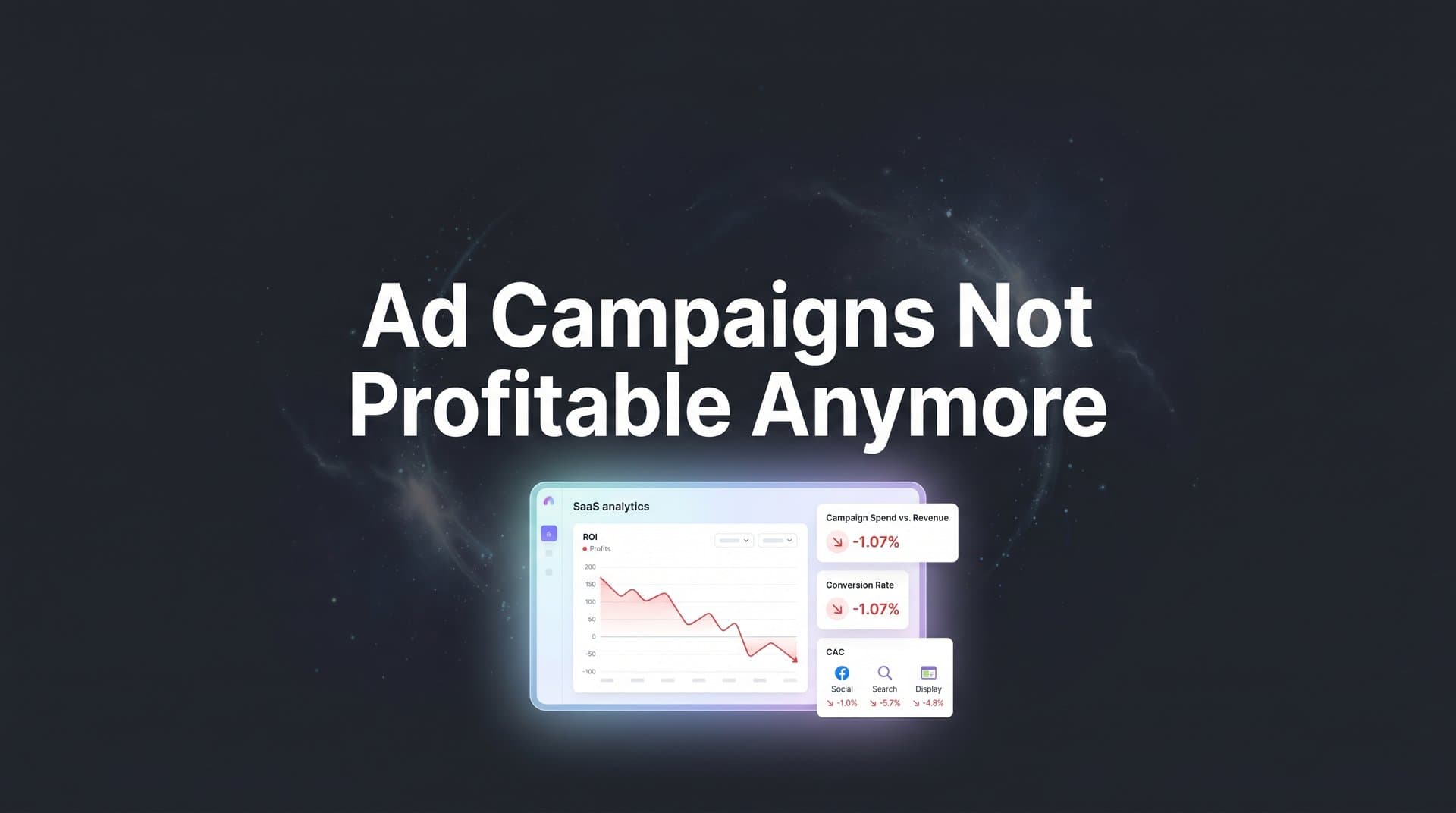
Your ad campaigns used to print money. You'd check the dashboard, see strong ROAS numbers, and confidently scale spend. Then something shifted. The same campaigns, same targeting, same creative approach—suddenly underwater. CPMs climbing, conversions dropping, and your CFO asking uncomfortable questions about marketing efficiency.
You're not alone in this frustration. The advertising landscape has fundamentally changed. Privacy updates have created tracking blind spots. Competition has intensified across every platform. Ad costs continue rising while conversion visibility decreases. But here's what most marketers miss: the problem usually isn't that your market dried up or your offer stopped working.
The real issue? Data gaps are sabotaging your campaigns from the inside. When ad platforms can't see your actual conversions, their algorithms optimize blindly. When you're using outdated attribution models, you're making budget decisions based on incomplete information. When tracking infrastructure breaks down, you're flying without instruments.
The good news: unprofitable campaigns are rarely a death sentence. They're a signal that your measurement and optimization systems need an upgrade. This guide walks through seven proven strategies to diagnose what's broken, restore accurate tracking, and get your campaigns back to profitability. Let's fix what's actually broken instead of abandoning channels that still work.
1. Audit Your Tracking Infrastructure for Data Gaps
The Challenge It Solves
Privacy changes have created invisible holes in your conversion tracking. When iOS users opt out of tracking or browsers block cookies, ad platforms lose visibility into which ads drove conversions. Your campaigns might be performing better than reported, but if the platform can't see those conversions, its algorithm optimizes incorrectly. You end up cutting budgets on campaigns that actually work while scaling ones that don't.
The Strategy Explained
A comprehensive tracking audit reveals where your conversion data is leaking. Start by comparing conversion counts across different sources: your ad platform dashboard, your analytics tool, and your actual sales records. Significant discrepancies indicate tracking gaps that need immediate attention.
The goal isn't just identifying problems but understanding their impact. A 10% tracking gap might be acceptable. A 40% gap means you're making decisions based on fiction. Focus on high-value conversion events first, especially purchases and qualified leads, since these directly impact profitability calculations. Understanding why cookie-based tracking isn't working anymore is essential to diagnosing these issues.
Implementation Steps
1. Pull conversion data from all sources for the same date range: ad platforms, Google Analytics, your CRM, and actual transaction records from your payment processor or database.
2. Calculate the tracking gap percentage for each conversion type by comparing platform-reported conversions against your source of truth (actual sales or CRM records).
3. Test your conversion tracking by completing test purchases or form submissions, then verify these events fire correctly in your ad platform pixel helpers and analytics tools.
4. Document every tracking method currently in use: pixel implementations, conversion APIs, tag managers, and third-party integrations to identify potential failure points.
Pro Tips
Run your audit weekly for the first month to catch intermittent tracking failures that might not show up in a single snapshot. Pay special attention to mobile conversions, where tracking gaps are typically largest. If you discover significant discrepancies, resist the urge to immediately change campaign settings. First fix the tracking, then give algorithms time to relearn with accurate data.
2. Reconnect Revenue Data to Your Ad Platforms
The Challenge It Solves
Ad platform algorithms need conversion data to optimize effectively. When privacy restrictions block standard tracking, platforms lose the feedback loop that tells them which audiences and placements actually drive results. Without this data, machine learning systems optimize for proxy metrics like clicks or landing page views rather than actual revenue. Your campaigns drift toward cheaper engagement instead of profitable conversions.
The Strategy Explained
Server-side tracking and conversion APIs create a direct pipeline between your business systems and ad platforms. Instead of relying on browser cookies that users can block, you send conversion data directly from your server to Meta, Google, and other platforms. This approach captures conversions that client-side tracking misses and provides richer data about purchase values, customer segments, and downstream events.
The implementation involves connecting your CRM, e-commerce platform, or analytics system to ad platform APIs. When someone converts, your server sends that conversion event with detailed parameters directly to the platform. This enriched data helps algorithms identify high-value audiences and optimize bidding strategies for revenue rather than just conversion volume. If you're experiencing issues with Facebook ads not tracking conversions, server-side implementation is often the solution.
Implementation Steps
1. Set up Meta's Conversions API or Google's Enhanced Conversions by connecting your server or using a platform integration that handles the technical implementation.
2. Configure conversion events to include revenue values, product categories, and customer identifiers that help platforms match conversions back to ad interactions.
3. Implement event deduplication so conversions tracked by both browser pixels and server-side methods aren't counted twice in platform reporting.
4. Monitor the Event Match Quality score in Meta or similar metrics in Google to ensure your server events contain enough information for accurate attribution.
Pro Tips
Start with your highest-value conversion events rather than trying to implement server-side tracking for everything at once. Include customer lifetime value data in your conversion events when possible so platforms can optimize for long-term profitability instead of just initial purchase value. After implementing server-side tracking, expect a learning period of 7-14 days as algorithms adjust to the improved data quality.
3. Switch from Last-Click to Multi-Touch Attribution
The Challenge It Solves
Last-click attribution gives 100% credit to whichever channel someone clicked right before converting. This creates a distorted view of campaign performance. Your awareness campaigns on social media get zero credit even though they introduced prospects to your brand. Your retargeting campaigns look like superstars because they get credit for conversions that earlier touchpoints made possible. You end up slashing budgets on campaigns that actually drive pipeline while overinvesting in bottom-funnel tactics.
The Strategy Explained
Multi-touch attribution distributes conversion credit across all the touchpoints in a customer journey. When someone sees your Facebook ad, clicks a Google search ad a week later, then converts through an email link, each channel receives appropriate credit for its role. This complete picture reveals which combinations of channels work together to drive conversions. Understanding attribution modeling for multi-channel campaigns is critical for accurate performance measurement.
Different attribution models weight touchpoints differently. Linear attribution splits credit evenly. Time decay gives more credit to recent interactions. Position-based models emphasize first and last touches. The right model depends on your sales cycle and how customers typically discover and evaluate your offering. The key is moving beyond the oversimplification of last-click thinking.
Implementation Steps
1. Map your typical customer journey by analyzing how many touchpoints prospects encounter before converting and which channels appear at different stages.
2. Compare your current performance data under different attribution models to understand how channel credit shifts when you account for the full journey.
3. Select an attribution model that reflects your business reality, giving appropriate weight to awareness activities that start relationships and consideration-stage content that builds trust.
4. Recalculate your ROAS and CPA metrics under the new attribution model to identify campaigns that deserve more budget and ones that are overvalued under last-click.
Pro Tips
Don't abandon last-click data completely. Use it alongside multi-touch attribution to understand both direct response performance and full-journey contribution. Focus on attribution changes for your most important conversion events rather than trying to implement complex models for every micro-conversion. When reallocating budget based on new attribution insights, make gradual shifts rather than dramatic changes that could disrupt campaign learning.
4. Segment Performance by True Customer Value
The Challenge It Solves
Blended metrics hide the truth about campaign profitability. When you optimize for average ROAS across all customers, you miss that some segments deliver 10x returns while others barely break even. Your campaigns might look marginally profitable overall while actually combining highly profitable customer segments with money-losing ones. Without segmentation, you can't identify which audiences, products, or channels deserve more investment.
The Strategy Explained
Customer value segmentation breaks down performance by the metrics that actually matter to your business. Instead of treating all conversions equally, you analyze campaigns based on customer lifetime value, average order value, repeat purchase rates, or profit margins. This reveals which campaigns attract your most valuable customers versus ones that drive high volume but low quality.
The analysis often uncovers surprising patterns. A campaign with modest ROAS might acquire customers who make repeat purchases for years. Another with impressive initial returns might attract bargain hunters who never buy again. Geographic segments might show dramatically different profitability. Product categories could reveal that some offerings subsidize customer acquisition while others generate pure profit. Using cohort analysis for marketing campaigns helps identify these long-term value patterns.
Implementation Steps
1. Define your customer value segments based on metrics that matter to your business model, such as lifetime value tiers, product margin categories, or subscription retention rates.
2. Tag conversion events with segment identifiers so you can track which campaigns drive which customer types, connecting your CRM or e-commerce data to campaign reporting.
3. Calculate segment-specific ROAS and CPA metrics to understand true profitability beyond surface-level conversion counts.
4. Create audience exclusions or bid adjustments based on segment performance, reducing spend on low-value segments while scaling investment in high-value ones.
Pro Tips
Start with just two or three meaningful segments rather than creating dozens of micro-segments that complicate analysis without adding clarity. Include time-based value metrics like 30-day or 90-day customer value, not just initial purchase value, to account for repeat business. Review segment performance monthly to catch shifts in which customer types your campaigns attract as markets and competition evolve.
5. Optimize Creative Based on Conversion Data
The Challenge It Solves
Vanity metrics mislead creative decisions. An ad with high engagement rates and low cost per click looks successful in platform dashboards. But if those clicks don't convert to revenue, you're optimizing for the wrong outcome. Creative that drives awareness might win on reach metrics while losing on profitability. Without connecting creative performance to actual business results, you scale ads that generate activity instead of revenue.
The Strategy Explained
Revenue-focused creative optimization evaluates every ad variant by its contribution to profitable conversions. Instead of picking winners based on click-through rates or engagement, you analyze which creative approaches drive the highest-value customers at acceptable acquisition costs. This means tracking performance beyond the ad platform's native metrics to connect creative elements with downstream revenue.
The approach requires tagging creative variants so you can trace conversions back to specific messages, formats, and calls-to-action. You might discover that benefit-focused messaging outperforms feature lists for high-value segments. Video formats might drive more initial conversions while image ads attract better long-term customers. Certain value propositions could resonate with profitable niches while others attract price-sensitive browsers. Learning how to attribute revenue to specific campaigns makes this analysis possible.
Implementation Steps
1. Implement consistent naming conventions for ad creative that identify key variables like message angle, format, call-to-action, and visual style so you can aggregate performance across campaigns.
2. Connect creative performance to revenue outcomes by analyzing which ad variants drive conversions that turn into actual sales, not just landing page visits or add-to-carts.
3. Test creative variables systematically rather than changing everything at once, isolating whether message, format, or offer drives performance differences.
4. Build a creative performance database that tracks which approaches work for different audience segments and campaign objectives so you can apply proven patterns to new campaigns.
Pro Tips
Give creative tests enough time and budget to reach statistical significance on revenue metrics, not just click metrics. Low-volume conversion events need larger sample sizes than clicks to identify true winners. Document why you think certain creative approaches will work before testing so you can learn from both successes and failures. Revisit creative winners quarterly since message effectiveness can decay as audiences see the same approaches repeatedly.
6. Reallocate Budget Using Cross-Channel Insights
The Challenge It Solves
Platform silos create blind spots in budget allocation. When you optimize each channel independently, you miss how they work together. Facebook might look expensive on a last-click basis while actually driving awareness that makes your Google Search campaigns more efficient. Email might appear to have low acquisition costs because it's closing deals that paid social initiated. Without cross-channel visibility, you make budget decisions that optimize individual platforms while hurting overall performance.
The Strategy Explained
Cross-channel analysis reveals the true economics of your marketing mix by tracking how channels influence each other. You examine customer journeys that span multiple platforms to understand which combinations drive the best results. This might show that prospects who engage with both paid social and search convert at higher rates than those who only see one channel. Or that display advertising reduces your search CPCs by increasing branded search volume. Implementing attribution for multi-channel campaigns provides the visibility needed for these insights.
The insights guide budget reallocation that improves total marketing efficiency rather than just individual channel metrics. You might increase spending on a channel with modest direct returns because it makes other channels more effective. Or you could identify redundant spending where multiple channels target the same audiences without adding incremental value.
Implementation Steps
1. Map common customer journeys by analyzing which channel sequences appear most frequently in your conversion paths and which combinations show the highest conversion rates.
2. Calculate incremental contribution for each channel by measuring how performance changes when you pause or scale specific channels while holding others constant.
3. Identify channel synergies where combined performance exceeds what you'd expect from adding individual results, such as social awareness campaigns that improve search conversion rates.
4. Rebalance budgets based on total contribution rather than siloed metrics, potentially investing more in channels with strong indirect effects even if their direct ROAS looks modest.
Pro Tips
Run controlled experiments where you deliberately pause one channel in specific markets or time periods to measure its true incremental value beyond what attribution models show. Look for diminishing returns within channels where the first dollars spent are highly efficient but additional budget shows declining performance. Consider the time lag between channels since awareness campaigns might take weeks to influence conversions while retargeting shows immediate results.
7. Implement AI-Powered Optimization Recommendations
The Challenge It Solves
Marketing data complexity overwhelms human analysis. You're juggling dozens of campaigns across multiple platforms, each with hundreds of audience segments, creative variants, and bidding options. Attribution data adds another layer showing how touchpoints interact. Manually processing this information to identify optimization opportunities takes hours and still misses patterns that span multiple dimensions. By the time you spot a trend, the opportunity has passed.
The Strategy Explained
AI-powered optimization analyzes your complete marketing dataset to surface actionable recommendations. Machine learning systems process attribution data, performance trends, and audience behavior to identify specific actions that will improve results. Instead of staring at dashboards trying to spot patterns, you receive clear recommendations: shift budget from Campaign A to Campaign B, adjust bids for this audience segment, or test new creative angles for underperforming ad sets.
The technology handles the complexity of multi-touch attribution and cross-channel analysis that's impossible to process manually. It spots subtle signals like audience segments that start strong but show declining performance, or creative fatigue before it tanks your results. The recommendations account for statistical significance so you're not chasing random noise. Leveraging predictive analytics for ad campaigns takes this optimization to the next level.
Implementation Steps
1. Connect your marketing data sources to an AI-powered attribution platform that can ingest conversion data, campaign performance, and customer journey information from all channels.
2. Configure your business rules and constraints so the AI understands your profitability targets, budget limits, and strategic priorities when generating recommendations.
3. Review and implement high-confidence recommendations first to build trust in the system while learning how it analyzes your specific business patterns.
4. Monitor the impact of implemented recommendations and provide feedback to improve the AI's understanding of what works for your campaigns.
Pro Tips
Start with AI recommendations for tactical optimizations like bid adjustments and budget reallocation before using it for strategic decisions like channel mix or creative direction. Combine AI insights with your market knowledge since the technology excels at pattern recognition but lacks context about competitive moves or seasonal factors. Set up automated alerts for urgent recommendations that need immediate action, like campaigns burning budget without conversions or tracking failures that corrupt data.
Your Implementation Roadmap
Unprofitable campaigns aren't a death sentence. They're a signal that your measurement and optimization systems need an upgrade. The strategies outlined here address the root causes: tracking gaps that hide true performance, attribution blind spots that distort budget decisions, and optimization approaches that ignore what actually drives revenue.
Start with the foundation. Audit your tracking infrastructure to understand where conversion data is leaking. Fix those gaps and implement server-side tracking to restore visibility. This alone often reveals that campaigns are performing better than you thought.
Next, upgrade your attribution model. Switch from last-click to multi-touch attribution so you understand the full customer journey. Segment performance by customer value to identify which campaigns drive profitable growth versus vanity metrics. These insights will completely change how you allocate budget.
Then optimize with confidence. Use revenue data to guide creative decisions. Analyze cross-channel interactions to find budget reallocation opportunities. Implement AI-powered recommendations to process the complexity of modern marketing data and surface actions that move the needle.
The advertising landscape has changed, but the fundamentals haven't. Campaigns become unprofitable when you're making decisions based on incomplete data. Fix your measurement infrastructure, and you'll find opportunities to restore profitability that were hiding in plain sight.
Ready to elevate your marketing game with precision and confidence? Discover how Cometly's AI-driven recommendations can transform your ad strategy. Get your free demo today and start capturing every touchpoint to maximize your conversions.


