

You're running ads across Meta, Google, TikTok, and LinkedIn. Your website analytics shows one story. Your CRM tells another. Each ad platform claims credit for the same conversions. Meanwhile, you're sitting in a budget meeting trying to explain which channels actually drive revenue, and the data points in ten different directions.
This isn't a data problem. It's a transformation problem.
Between the moment someone clicks your ad and the moment you confidently allocate next quarter's budget lies a complex process called the attribution transformation pipeline. This systematic framework converts fragmented, messy touchpoint data into clear, reliable revenue insights. Understanding how this pipeline works changes everything about how you evaluate marketing performance, optimize campaigns, and scale what's working.
The Journey From Raw Click to Revenue Credit
The attribution transformation pipeline is the end-to-end process that takes disconnected marketing signals and transforms them into actionable attribution insights. Think of it as the assembly line that turns raw materials into finished products, except here the raw materials are clicks, form fills, email opens, and CRM events, and the finished product is knowing exactly which marketing efforts deserve credit for revenue.
Here's why raw data alone fails you: A single customer journey might generate dozens of events across multiple platforms, but those events arrive with different identifiers, timestamps in various formats, duplicate entries from tracking overlaps, and gaps where tracking failed entirely. One platform might record a click at 2:47 PM while your CRM logs the resulting form submission at 2:49 PM with a completely different user ID. Without transformation, these look like separate people.
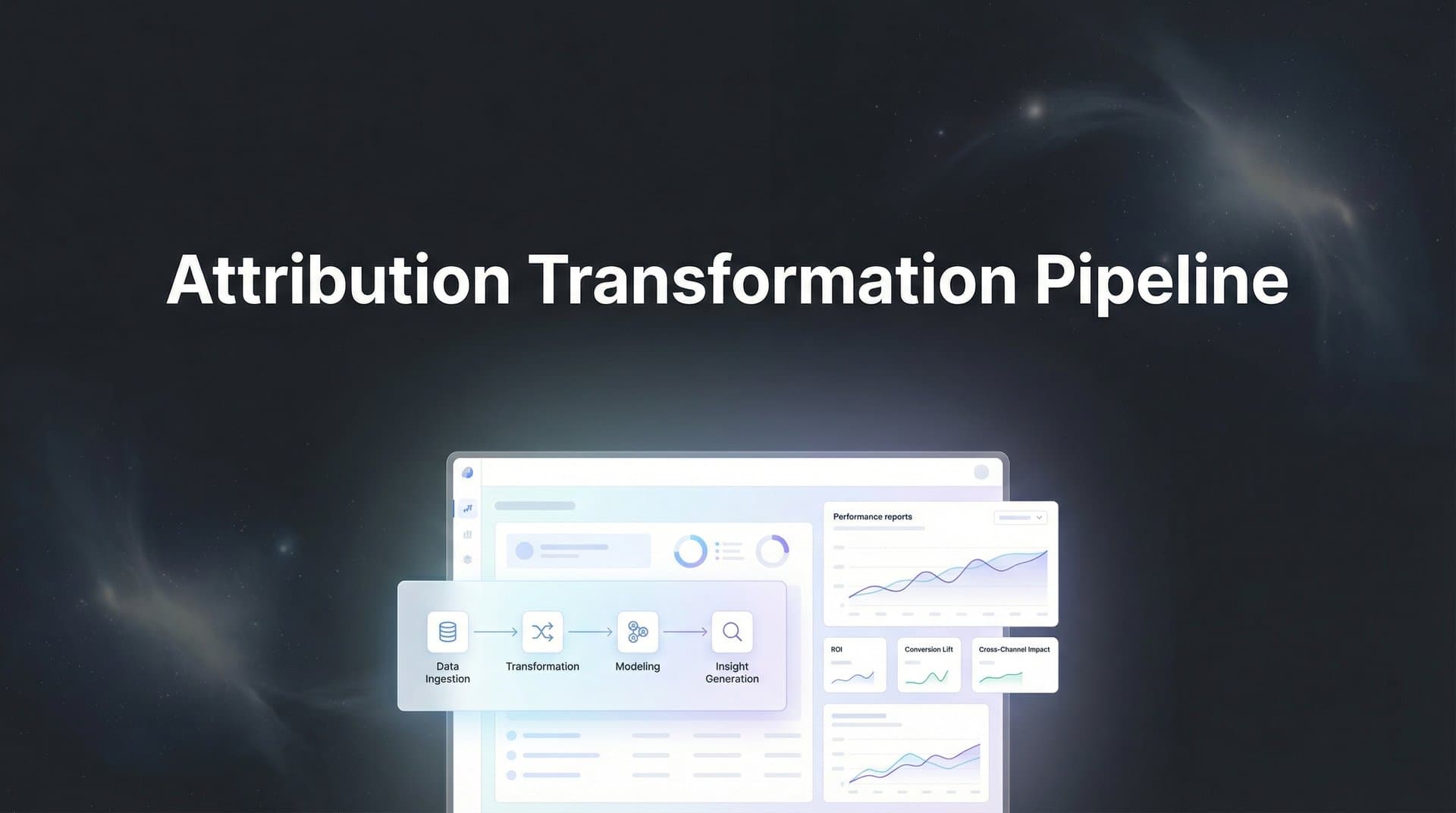
The pipeline operates through four distinct stages, each solving a specific challenge. Data ingestion captures touchpoints from every source. Identity resolution connects anonymous interactions to known customers across devices and sessions. Journey mapping sequences these connected touchpoints chronologically to reconstruct actual customer paths. Credit distribution applies multi-touch attribution models to assign revenue credit across the journey.
Each stage builds on the previous one. Skip identity resolution, and your journey maps show twice as many customers as you actually have. Rush through data cleaning, and your attribution models credit phantom touchpoints that never happened. The transformation pipeline ensures every stage receives quality input, producing reliable output at the end.
This matters because marketing decisions compound. Misattribute revenue to the wrong channel, and you'll scale campaigns that don't actually work while cutting budgets from channels quietly driving conversions. Understanding the pipeline helps you spot where attribution breaks down and why different tools produce conflicting reports.
Data Ingestion: Capturing Every Customer Signal
The pipeline starts with data collection, and this is where many attribution systems fail before they even begin. Traditional client-side tracking methods rely on JavaScript pixels that fire in the user's browser. These work fine in theory, but reality introduces complications: ad blockers strip tracking scripts, iOS privacy features block third-party cookies, and browser restrictions prevent cross-domain tracking.
Server-side tracking solves these limitations by capturing events directly on your server before they reach the browser. When someone clicks your ad, the interaction gets logged server-side where ad blockers can't interfere and privacy restrictions don't apply. This approach captures significantly more touchpoints, particularly from privacy-conscious users and mobile traffic where client-side methods struggle.
The ingestion stage also handles integrations with every platform in your marketing stack. Your attribution pipeline needs direct connections to Meta Ads, Google Ads, LinkedIn, your website analytics, email platform, and CRM. Each integration feeds a continuous stream of events: ad impressions, clicks, page views, form submissions, email opens, sales calls, and closed deals. Understanding how to fix attribution data gaps becomes critical at this stage.
Real-time data collection matters more than you might think. Batch processing that imports data once daily creates attribution delays that compound across the pipeline. By the time yesterday's data finishes processing, you've already spent today's budget based on incomplete information. Real-time ingestion means your attribution insights reflect current performance, enabling faster optimization decisions.
The ingestion stage also begins initial data cleaning. Duplicate events get flagged, malformed data gets corrected, and timestamps get standardized. This preprocessing prevents garbage data from contaminating downstream stages. Quality ingestion creates quality attribution.
Identity Resolution: Connecting the Dots Across Devices and Sessions
This is where attribution gets genuinely complex. The same person who clicks your Instagram ad on their phone during lunch might research your product on their work laptop that afternoon, then convert on their home computer that evening. Without identity resolution, your attribution system sees three separate people, each with incomplete journeys.
Identity graphs solve this by linking anonymous interactions to known customers using first-party data. When someone fills out a form with their email address, that email becomes the key that unlocks their entire journey. The system looks backward through anonymous sessions, matching device fingerprints, IP addresses, and behavioral patterns to connect previous touchpoints to this now-identified person.
Deterministic matching provides the highest accuracy. When a user logs into your site or provides an email address, you have a confirmed identifier that definitively links sessions. This works beautifully for returning customers and leads who engage directly with your content. The challenge comes with cold traffic: anonymous visitors who never identify themselves before leaving.
Probabilistic matching fills these gaps by analyzing patterns. If two sessions share the same IP address range, similar browsing behavior, and sequential timestamps, they likely represent the same person. Effective cross-device attribution tracking relies heavily on these probabilistic connections to prevent attribution blind spots where journeys appear to start mid-funnel because earlier anonymous touchpoints went unconnected.
Why this matters: Accurate identity resolution directly impacts attribution accuracy. Undercount connections, and you'll think you need more top-of-funnel traffic when you actually need better conversion optimization. Overcount connections through false matches, and you'll credit touchpoints that didn't influence the actual buyer. The transformation pipeline's identity resolution stage determines whether your attribution reflects reality or fiction.
Journey Mapping: Building the Complete Customer Path
With touchpoints captured and identities resolved, the pipeline now sequences events chronologically to reconstruct actual customer journeys. This stage transforms disconnected data points into coherent narratives: First saw Instagram ad, clicked through to blog post, returned via Google search three days later, attended webinar, received nurture email sequence, clicked email link, booked demo, closed deal.
Journey mapping handles complexity that simple funnel analytics miss. Real customer paths rarely follow linear progressions. Someone might engage with your content multiple times before converting, bounce between awareness and consideration stages, or go dark for weeks before suddenly purchasing. The transformation pipeline captures these non-linear patterns, revealing how customers actually behave versus how we assume they behave.
B2B journeys introduce additional complications. A single deal might involve a marketing manager who first discovered your brand, a director who evaluated alternatives, and a VP who made the final purchase decision. These three people represent one customer journey, but they generate separate touchpoint streams. Advanced journey mapping connects these parallel paths, recognizing that the marketing manager's early touchpoints influenced the eventual deal even though someone else converted.
The pipeline also handles multiple conversion events within a single journey. Someone might sign up for a free trial, then upgrade to paid, then expand their subscription. Each conversion represents a separate attribution question: What drove the trial signup? What convinced them to pay? What triggered the expansion? Journey mapping maintains context across these sequential conversions, enabling nuanced attribution that credits different touchpoints for different outcomes.
Extended sales cycles test journey mapping capabilities. When deals close six months after first touch, the pipeline must maintain journey integrity across that entire timeframe, connecting touchpoints that span multiple campaigns, budget periods, and strategic initiatives. Robust cross-platform attribution tracking reveals which early-stage activities reliably predict eventual conversions, even when the connection isn't immediately obvious.
Credit Distribution: Applying Attribution Models to Transformed Data
Here's where the pipeline delivers its payoff. With clean, connected, sequenced journey data, you can finally apply attribution models that accurately distribute revenue credit across touchpoints. The same raw data that produced conflicting reports now yields reliable insights because the transformation pipeline resolved the underlying data quality issues.
Different attribution models answer different questions. First-touch attribution credits the initial touchpoint that started the journey, revealing which channels excel at generating new awareness. Last-touch attribution credits the final interaction before conversion, showing what closes deals. Understanding the difference between single-source attribution and multi-touch attribution models helps you choose the right approach for your specific business questions.
The transformation pipeline enables sophisticated model comparison. You can apply multiple attribution models to the same journey data, comparing how different crediting philosophies change your understanding of channel performance. This reveals which channels dominate early-stage awareness versus late-stage conversion, informing budget allocation across the funnel.
Data-driven attribution models take this further by analyzing patterns across thousands of journeys to determine which touchpoint combinations most reliably predict conversions. These models can only work with properly transformed data. Feed them messy, unresolved journeys, and they'll identify false patterns. Feed them pipeline-processed data, and they'll surface genuine insights about what actually drives revenue.
The pipeline's final output feeds back into your ad platforms. Modern platforms like Meta and Google rely heavily on conversion data to optimize their algorithms. When you send enriched, accurate conversion events back to these platforms, their AI learns more effectively about what drives results for your business. This creates a virtuous cycle: Better attribution data improves ad platform optimization, which improves campaign performance, which generates more data to refine attribution further.
Evaluating Your Current Pipeline Maturity
Most marketing teams operate with partial pipelines, handling some transformation stages well while others create attribution blind spots. Here's how to assess where you stand and identify improvement opportunities.
Start with data completeness. Can you track a customer journey from first anonymous click through final conversion and beyond? If you're missing touchpoints, your ingestion stage needs work. Common gaps include offline to online attribution tracking that never connects to digital touchpoints, cross-device journeys that appear as separate customers, and interactions that occur outside your primary tracking systems.
Test your identity resolution by examining individual customer journeys. Do they show realistic patterns, or do you see obvious gaps where sessions should connect? If most journeys start mid-funnel or show impossible timing, your identity resolution isn't connecting anonymous and known sessions effectively.
Evaluate journey mapping by comparing platform reports. When Meta says they drove 100 conversions and Google claims 95, but you only had 80 total conversions, you have a double-counting problem. Learning how to fix attribution discrepancies in data prevents this by ensuring each conversion gets credited exactly once across all touchpoints, even when multiple platforms touched the journey.
The clearest sign your pipeline needs improvement: You can't confidently answer which channels drive revenue. When budget decisions feel like guesswork because your data tells conflicting stories, the transformation pipeline is failing at its core purpose.
Modern marketing attribution platforms handle pipeline complexity automatically. Rather than building custom data engineering infrastructure, marketing teams can leverage tools that manage ingestion, identity resolution, journey mapping, and credit distribution as an integrated system. This shifts focus from data plumbing to strategic decisions: which channels to scale, how to optimize creative, where to allocate budget for maximum impact.
The Foundation of Confident Marketing Decisions
The attribution transformation pipeline isn't just technical infrastructure. It's the foundation that determines whether your marketing measurement reflects reality or reinforces biases. Understanding how raw data becomes actionable insights helps you ask better questions: Is this attribution gap a tracking problem or a genuine performance issue? Why do these two platforms report different conversion numbers? Which touchpoints actually influenced this deal?
These questions matter because marketing budgets are finite and competition for attention is infinite. Every dollar misallocated to a channel that doesn't actually drive revenue is a dollar not invested in strategies that work. The transformation pipeline gives you the data quality needed to make those allocation decisions with confidence rather than hope.
The pipeline also reveals opportunities that surface-level analytics miss. When you can trace complete customer journeys, you discover which channel combinations work synergistically, which touchpoint sequences predict high-value customers, and which early-stage interactions reliably lead to eventual conversions. These insights compound over time, creating sustainable competitive advantages.
Looking forward, AI-powered attribution platforms are automating pipeline complexity that previously required dedicated data engineering teams. Machine learning handles identity resolution at scale, automatically maps complex journeys, and applies sophisticated attribution models in real time. This democratizes enterprise-grade attribution, making it accessible to marketing teams of all sizes who want accurate insights without building custom infrastructure.
The transformation pipeline ultimately serves one purpose: converting the chaos of modern multi-channel marketing into clear, reliable answers about what drives revenue. Master this process, and you'll make better decisions, scale more confidently, and prove marketing's impact with data that actually tells the truth.
Ready to elevate your marketing game with precision and confidence? Discover how Cometly's AI-driven recommendations can transform your ad strategy. Get your free demo today and start capturing every touchpoint to maximize your conversions.



