You run a campaign, the conversions roll in on your ad platform dashboard, and everything looks great. Then you check your CRM. The numbers don't match. Not even close. You're staring at two different realities, and neither one is lying to you outright. They're just playing by completely different rules.
That disconnect has a name: attribution window limitations. And for marketers managing paid spend across Meta, Google, TikTok, and LinkedIn simultaneously, it's one of the most quietly destructive forces in performance marketing.
Attribution windows are not just a technical setting buried in your campaign configuration. They are a fundamental constraint that determines how ad platforms assign credit for conversions, how they report ROAS, and ultimately how they allocate your budget through their own algorithms. When those windows are misaligned, misconfigured, or simply misunderstood, every decision you make downstream is built on shaky ground.
This article breaks down exactly what attribution window limitations are, where they create the most damage in real-world campaign reporting, and what modern solutions actually fix the problem. By the end, you'll have a clear framework for evaluating your current setup and a concrete path toward attribution data you can actually trust.
The Hidden Rules That Govern How Your Ads Get Credit
An attribution window is the defined period of time after an ad interaction during which a resulting conversion is credited to that ad. If a user clicks your ad on Monday and purchases on Friday, whether or not that ad gets credit depends entirely on how long your attribution window is set.
There are two primary types of windows to understand. A click-through window tracks conversions that happen after a user actually clicked your ad. A conversion window attribution tracks conversions that happen after a user simply saw your ad, even if they never clicked it. Both types are configurable, but each platform sets its own defaults, and those defaults are rarely the same.
Meta has historically defaulted to a 7-day click window combined with a 1-day view window. Google Ads typically uses a 30-day click window for standard conversion types. TikTok and LinkedIn each operate with their own distinct defaults. None of these platforms coordinate with each other, which means the same conversion event can be claimed by multiple platforms simultaneously, each one applying its own window logic independently.
This is not a bug. It is the structural reality of how siloed, platform-native attribution works. Each platform is designed to demonstrate its own value, and the window settings reflect that incentive.
The core tension in choosing any window length is this: shorter windows miss long sales cycles, longer windows over-credit ads for conversions that would have happened anyway, and there is no universal standard that resolves this across platforms. A 7-day window might be perfectly appropriate for an impulse e-commerce purchase and completely inadequate for a B2B SaaS evaluation cycle that takes weeks. The platform doesn't know the difference unless you configure it deliberately, and even then, you're only solving the problem on one platform at a time. Understanding attribution window performance is essential before you can begin to address these gaps.
Understanding this dynamic is the starting point for everything else. Once you see that attribution windows are essentially arbitrary rules applied independently by competing platforms, the downstream problems become much easier to diagnose.
Where Attribution Windows Break Down in the Real World
Knowing the definition of an attribution window is one thing. Seeing how it distorts your actual data is where the real damage becomes visible. There are three failure modes that show up consistently across campaigns of every size and type.
The Double-Counting Problem: Imagine a prospect who sees your Meta ad on Tuesday, clicks a Google search ad on Thursday, and converts on Friday. Both platforms register the conversion within their respective windows. Meta counts it. Google counts it. Your actual CRM records one sale. The result is that your combined platform reporting shows two conversions for a single revenue event, inflating your total reported conversions and making your blended ROAS look significantly better than it actually is. This is not a rare edge case. For any marketer running campaigns across multiple platforms simultaneously, this is happening constantly, at scale.
The Long Sales Cycle Problem: B2B companies, high-ticket e-commerce brands, and any business where customers take time to evaluate before purchasing face a structural mismatch between platform default windows and real buying behavior. A prospect who clicks a LinkedIn ad in week one, reads case studies, attends a webinar, and finally converts in week six will show up as an unattributed conversion in most default window configurations. The ad that started the journey gets zero credit. This causes marketers to systematically undervalue top-of-funnel and mid-funnel campaigns, often cutting the very ads that are doing the most important work. This is one of the most persistent attribution challenges in marketing analytics that B2B teams face.
The iOS and Privacy Problem: Apple's App Tracking Transparency framework and the ongoing deprecation of third-party cookies have materially reduced the ability of ad platforms to track user behavior across sessions and devices. The practical effect is that even when your nominal attribution window is set to 30 days, the actual tracking signal often disappears mid-journey because the cookie that was supposed to carry the user's identity has been blocked or expired. Your window says 30 days. Your real tracking coverage might be far shorter. This makes window-based attribution increasingly unreliable regardless of the settings you choose, because the underlying data collection mechanism is broken before the window logic even applies.
These three failure modes compound each other. Double-counting inflates your numbers. Long sales cycle gaps deflate credit for your best campaigns. Privacy restrictions erode the signal quality of whatever data remains. The result is a reporting environment where it becomes genuinely difficult to know which campaigns are working and which ones are consuming budget without producing real returns.
How Platform-Specific Windows Distort Your Budget Decisions
The reporting problem is frustrating enough on its own. But the real cost of attribution window limitations shows up in budget allocation decisions, and this is where misaligned windows become genuinely expensive.
Consider an illustrative scenario. A marketer is running campaigns on both Meta and Google with separate budgets. Meta is reporting strong ROAS using its default 7-day click window. Google is reporting moderate ROAS using its 30-day click window. The marketer looks at the numbers and concludes that Meta is outperforming Google, so they shift budget toward Meta. But because the windows are different, the comparison is not apples-to-apples. Meta's 7-day window captures a different set of conversions than Google's 30-day window. Some of those Meta conversions are also being counted by Google. The budget reallocation is based on a fundamentally flawed comparison, and the marketer has no way to know this from within native platform dashboards. Learning how to fix attribution discrepancies in data is the critical next step for any team in this situation.
The problem goes deeper when you factor in how ad platform algorithms actually work. These algorithms optimize toward the conversion signals they can see within their attribution window. If your window is too short, the algorithm is optimizing toward a subset of your actual conversions and ignoring the ones that happen outside the window. It learns the wrong patterns, bids on the wrong audiences, and surfaces the wrong creative. You end up paying for optimization that is actively working against your actual revenue goals.
View-through attribution windows add another layer of distortion. When a platform credits an ad for a conversion simply because a user was exposed to it, without any click or direct engagement, it becomes nearly impossible to distinguish genuine ad influence from coincidental exposure. A user might have seen your display ad once, forgotten about it entirely, and converted three days later through a completely unrelated channel. Under view-through attribution, your display campaign gets credit. Your ROAS looks impressive. Your budget flows toward display. But the underlying causal relationship may not exist at all.
This is why view-through attribution is particularly controversial for awareness campaigns. The optics look good in the dashboard. The actual impact on revenue is much harder to isolate. Marketers who rely heavily on VTA data without cross-referencing against a centralized attribution source often end up over-investing in channels that are capturing credit rather than driving results. Understanding cross-channel attribution and marketing ROI is what separates teams that allocate budget confidently from those that guess.
The Framework for Choosing the Right Attribution Window
Given all of this, how do you actually choose the right attribution window? The answer starts with a principle that sounds obvious but is rarely applied in practice: your window length should match your actual sales cycle, not the platform default.
Start by mapping your average time-to-conversion from first touch. Look at your CRM data and calculate how long it typically takes a prospect to move from their first ad interaction to a closed conversion. If your average is 14 days, a 7-day window will systematically miss a significant portion of your conversions. If your average is 3 days, a 30-day window may be over-attributing credit to ads that had little real influence. The goal is alignment between your window and your actual buying behavior.
Once you have that baseline, the next step is to recognize that a single window endpoint, no matter how well-calibrated, is still a blunt instrument. This is where multi-touch attribution models become essential. Rather than asking "which single ad gets credit for this conversion," multi-touch attribution distributes credit across every touchpoint in the customer journey. Common models include linear attribution, which spreads credit equally across all touchpoints; time-decay, which weights recent interactions more heavily; position-based, which emphasizes first and last touch; and data-driven, which uses algorithmic analysis to assign credit based on actual conversion patterns.
The key advantage of multi-touch models is that they reduce the distortion caused by any single window setting. Even if your window isn't perfectly calibrated, the distribution of credit across multiple touchpoints produces a more accurate picture of which channels and campaigns are genuinely influencing revenue.
The third piece of the framework is consistency. Cross-channel comparisons are only meaningful when the same attribution logic and window settings are applied to all channels simultaneously. This is impossible to achieve inside native platform dashboards, because each platform applies its own logic independently. The only way to achieve true consistency is to move your attribution analysis outside of individual platforms and into a centralized system that applies the same rules to every channel at once. This eliminates double-counting, standardizes your ROAS calculations, and gives you a comparison baseline that is actually valid.
Modern Solutions That Go Beyond Window-Based Attribution
Choosing the right window and model is necessary, but it's not sufficient. The underlying data quality problems created by iOS restrictions, cookie deprecation, and cross-device tracking gaps mean that even a perfectly configured window will produce incomplete data if the signal collection layer is broken. Modern attribution solutions address this at the infrastructure level, not just the settings level.
Server-Side Tracking: Traditional browser-based tracking relies on JavaScript pixels and cookies to capture conversion events. When a user has ad blockers enabled, when iOS restricts cross-app tracking, or when a third-party cookie is blocked or expired, the conversion event is simply lost. Server-side tracking solves this by capturing conversion events directly from your server and sending them to ad platform APIs, bypassing the browser entirely. The result is a more complete dataset. Conversions that would have disappeared under browser-based tracking are recovered, making your window-based attribution data more accurate because there are fewer gaps in the underlying signal. Cometly's server-side tracking is built specifically to address this, helping marketers recover the signal that privacy changes have eroded.
Centralized Attribution Platforms: A centralized attribution platform sits outside of individual ad platforms and aggregates data from every channel into a single attribution model. By applying consistent logic and window settings across Meta, Google, TikTok, LinkedIn, and any other channel simultaneously, it eliminates the double-counting problem at the source. Instead of seeing inflated totals in each platform's native dashboard, you see a single, unified view of how many conversions actually occurred and which touchpoints contributed to each one. Cometly does exactly this: it connects your ad platforms, CRM, and website to track the entire customer journey in real time, giving you a source of truth that no individual platform can provide on its own.
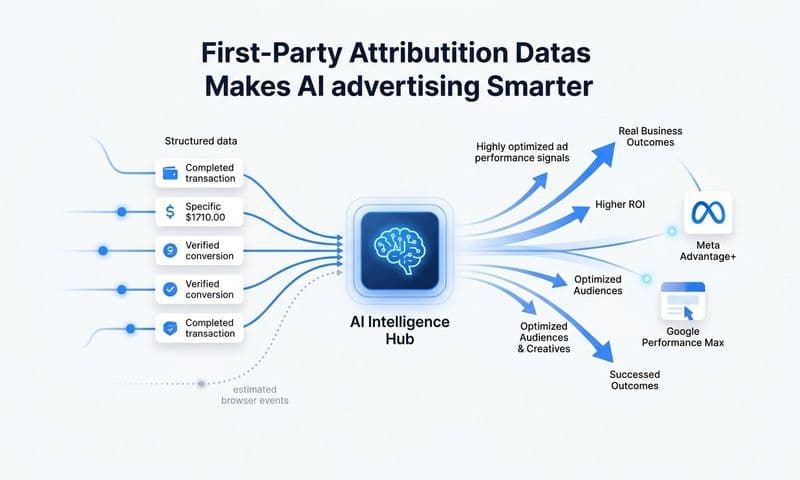
Conversion API Enrichment: Once you have accurate, complete conversion data from server-side tracking and centralized attribution, the next step is feeding that data back to the ad platforms themselves. This is where Conversion APIs like Meta CAPI and Google Enhanced Conversions become powerful. When you send enriched, revenue-matched conversion events back to the platform, its algorithm receives better signals. Instead of optimizing toward truncated, window-limited proxy events, it optimizes toward actual revenue outcomes. Cometly's Conversion Sync feature handles this automatically, sending enriched conversion data back to Meta, Google, and other platforms so their algorithms can optimize more effectively. The result is better targeting, more efficient bidding, and improved ad ROI over time. Reviewing the best marketing campaign attribution solutions available can help you evaluate which approach fits your stack.
Together, these three layers form a complete attribution solution: server-side tracking recovers lost signal, centralized attribution applies consistent logic across all channels, and conversion API enrichment feeds better data back to the platforms that need it most.
The Bottom Line on Attribution Window Limitations
Attribution window limitations are not a minor reporting inconvenience. They are a structural problem that affects how every dollar of ad spend is evaluated and allocated. When your windows are misaligned, your ROAS numbers are inflated, your budget decisions are based on flawed comparisons, and your ad platform algorithms are optimizing toward the wrong signals. The compounding effect of these distortions adds up quickly across a real campaign budget.
The fix starts with an audit. Review your current window settings across every platform you're running. Compare them against your actual average time-to-conversion. Ask whether your current analytics stack gives you a unified view of performance across all channels or whether you're stitching together native dashboards and hoping the numbers reconcile.
Cometly is built to solve exactly this problem. It captures every touchpoint from ad click to CRM event, applies consistent multi-touch attribution across all your channels, uses server-side tracking to recover the signal that iOS restrictions and cookie deprecation have eroded, and feeds enriched conversion data back to ad platforms so their algorithms optimize toward real revenue. The result is attribution data you can build decisions on, not just reports you file away.
If you're ready to move from window confusion to clear, confident campaign decisions, Get your free demo today and see how Cometly turns attribution accuracy into a genuine competitive advantage.