

Your B2B marketing dashboard shows promising engagement numbers. Ad clicks are up, form submissions are flowing in, and your team is celebrating another strong quarter of top-of-funnel activity. Then you sit down with sales for the quarterly review, and reality hits: the campaigns you nearly cut last month actually closed three major deals this week. Meanwhile, the "high-performing" LinkedIn campaign that dominated your reports? Zero revenue attributed.
This disconnect is not a fluke. It is the predictable result of tracking B2B sales cycles with tools designed for B2C impulse purchases.
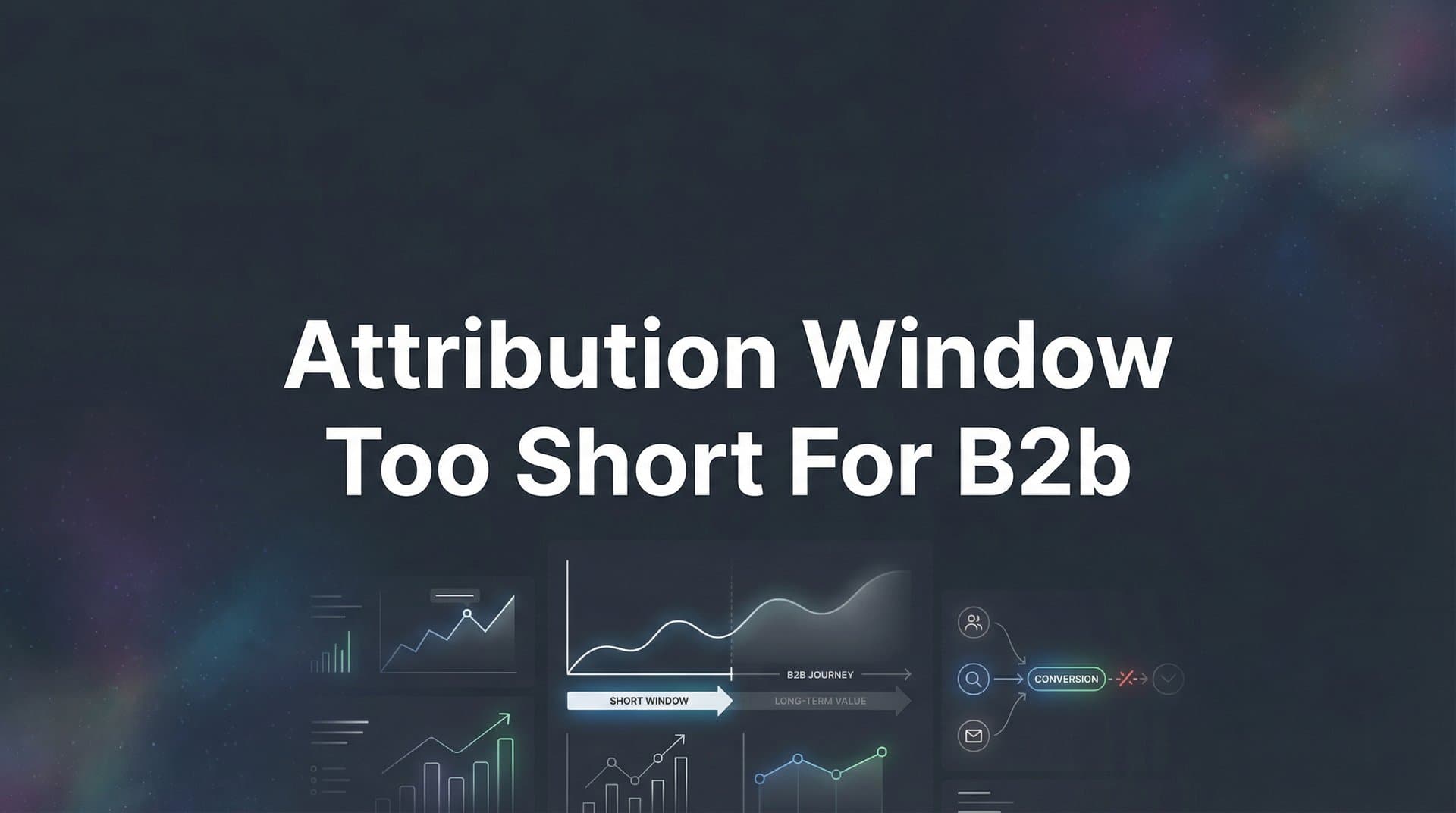
When your average deal takes 90 days to close but Meta only tracks conversions for 7 days, you are making million-dollar decisions based on incomplete data. The marketing touchpoints that actually influenced your biggest deals happened months ago, long after your attribution window expired. Your ad platforms have no idea those conversions even occurred.
The solution is not to accept this blind spot as "just how B2B works." You can fix short attribution windows with the right tracking infrastructure and methodology. This guide walks you through the exact process: auditing your current setup, calculating your true sales cycle, implementing server-side tracking, connecting your CRM, and building a complete view of every touchpoint that drives revenue.
By the end, you will know which marketing efforts actually close deals, not just which ones happen to convert within an arbitrary platform window.
Step 1: Audit Your Current Attribution Setup and Identify the Gaps
Before you can fix your attribution problem, you need to understand exactly how broken it is. Most B2B marketers have never documented their actual attribution windows across platforms, which means they are operating on assumptions rather than facts.
Start by logging into each advertising platform you use and documenting the current attribution window settings. For Meta Ads, navigate to Events Manager and check your conversion event settings. The default is typically 7-day click and 1-day view attribution. Google Ads defaults to 30-day click attribution, which you can verify in your conversion action settings under Tools & Settings. LinkedIn Campaign Manager also uses a 30-day default attribution window.
Write these numbers down. They represent the maximum time gap between when someone clicks your ad and when a conversion gets credited back to that ad. Understanding attribution window settings for ads is the first step toward fixing your tracking gaps.
Now comes the critical comparison. Pull your CRM data to calculate your actual sales cycle length. In Salesforce, HubSpot, or your CRM of choice, run a report showing the average number of days from lead creation date to closed-won date for the past six months. Segment this by deal size if possible, because enterprise deals typically take longer than mid-market opportunities.
The gap between these two numbers is your attribution blind spot. If your sales cycle averages 87 days but your Meta attribution window is 7 days, you are missing 92% of your sales cycle in your ad reporting. That LinkedIn campaign with the 30-day window? Still missing two-thirds of the buyer journey.
Next, identify which conversions are falling through the cracks. Look at deals that closed in the past quarter and trace them back to their first marketing touchpoint. How many of those initial touchpoints happened outside your current attribution windows? This exercise reveals the real cost of short attribution: the campaigns that actually drove revenue but received zero credit.
Create a simple spreadsheet documenting platform name, current attribution window, your actual sales cycle length, and the attribution gap percentage. This becomes your baseline for improvement and the business case for investing in better tracking infrastructure.
Step 2: Calculate Your Ideal Attribution Window Based on Sales Cycle Data
Your ideal attribution window is not a guess or an industry benchmark. It is a calculation based on your actual customer behavior and sales data.
Start by pulling detailed time-to-close data from your CRM. You want more than just the average. Export a dataset showing every closed-won deal from the past 12 months with the number of days from first touch to close. This gives you the distribution, not just the mean.
Segment this data by deal size and customer type. Enterprise deals with six-figure contracts follow different timelines than small business deals. Your attribution window needs to account for these variations. If your enterprise deals average 120 days but represent 70% of your revenue, optimize for them, not for the faster-closing small deals.
Here is where most marketers make a critical mistake: they set their attribution window to match the average sales cycle. If the average is 90 days, they track 90 days and call it done. But averages hide outliers, and in B2B, those outliers often represent your biggest deals. Following attribution window best practices for paid ads helps you avoid these common pitfalls.
Instead, calculate the 90th percentile of your time-to-close data. This is the point where 90% of your deals have closed. If your average is 90 days but your 90th percentile is 150 days, you need a 150-day attribution window to capture the vast majority of revenue. Yes, you will still miss the extreme outliers who take nine months to close, but you will capture the bulk of your business.
Add a buffer for the complete buying committee journey. Your CRM might show 90 days from lead creation to close, but that lead creation date probably was not the first touchpoint. Someone from that account likely engaged with your content, clicked an ad, or attended a webinar weeks earlier. Add 20-30% to your calculated window to account for this pre-CRM activity.
Verify your calculation by testing it against historical data. If you implement a 180-day attribution window, go back and check: what percentage of your closed deals would have been captured? You are looking for 90% or higher. If you are only capturing 75%, extend the window further.
The goal is not perfection. You will never capture every single touchpoint for every single deal. The goal is comprehensive coverage that reflects how B2B buyers actually behave, not how ad platforms wish they behaved.
Step 3: Implement Server-Side Tracking to Break Platform Limitations
Understanding your ideal attribution window is one thing. Actually tracking conversions across that timeframe is another challenge entirely. This is where client-side tracking fails and server-side tracking becomes essential.
Client-side tracking relies on browser cookies to remember who clicked your ad. When someone converts, the cookie tells the ad platform to credit that click. The problem? Cookies expire. Third-party cookies typically last 7 days, and Safari's Intelligent Tracking Prevention reduces them to 24 hours. Even if you set your Meta attribution window to 90 days, the cookie that would connect the conversion back to the original click is long gone.
Add cross-device journeys to the mix and the problem compounds. Your prospect clicks a LinkedIn ad on their phone during their commute, researches your solution on their work laptop that afternoon, and finally converts on a tablet in a conference room two weeks later. Client-side cookies cannot connect these dots across devices and browsers. A cross platform attribution tool becomes essential for tracking these complex journeys.
Server-side tracking solves this by moving the identification and tracking logic off the browser and onto your server. Instead of relying on cookies, you maintain persistent user identification through your own database. When someone fills out a form, downloads content, or takes any tracked action, your server records it with a unique identifier that does not expire.
Implementation starts with setting up a server-side tracking infrastructure. If you are using Google Tag Manager, deploy a server-side container. For Meta, implement the Conversions API. LinkedIn offers a similar Conversions API for server-side event tracking. These tools allow you to send conversion data directly from your server to the ad platforms, bypassing browser limitations entirely.
The real power comes when you connect this tracking to your CRM events. Instead of firing a conversion when someone fills out a form, you fire it when they reach meaningful sales stages. When a lead becomes an SQL in your CRM, that event gets sent to your ad platforms. When an opportunity moves to closed-won three months later, that conversion fires and credits the original marketing touchpoints.
Tools like Cometly are built specifically for this use case. The platform captures every touchpoint from ad click to CRM event, maintaining the connection regardless of how much time passes or how many devices are involved. When a deal closes 120 days after the initial ad click, Cometly ensures that conversion gets attributed back to the right campaign, ad set, and creative.
The technical setup requires coordination between your marketing team, development resources, and CRM administrators. You need to map which CRM events should trigger conversion signals, ensure your server can handle the API calls, and verify that data flows correctly between systems. Test thoroughly with recent conversions before relying on the system for optimization decisions.
Once implemented, server-side tracking gives you attribution capabilities that platform defaults cannot match. You are no longer constrained by cookie expiration or platform window limits. You can track the full B2B journey from first impression to closed revenue.
Step 4: Connect Your CRM to Create a Unified Customer Journey View
Server-side tracking provides the infrastructure, but your CRM holds the truth about what actually drives revenue. Connecting these systems transforms your attribution from theoretical to actionable.
Start by choosing an attribution platform that integrates natively with your CRM. If you use Salesforce, HubSpot, Pipedrive, or another major CRM, verify that your attribution tool can pull data directly from it. Native integrations are more reliable than custom API connections and require less ongoing maintenance. The right attribution platform for B2B companies will offer these integrations out of the box.
The integration setup process varies by platform, but the core concept remains consistent. You are giving your attribution tool permission to read specific data from your CRM: contact records, company records, deal stages, opportunity values, and timestamps for when records move between stages.
Map your CRM stages to attribution events carefully. Not every stage change deserves to fire a conversion signal back to your ad platforms. Focus on the stages that represent meaningful progression toward revenue. Common mappings include MQL creation, SQL acceptance, opportunity creation, and closed-won status.
For each mapped stage, define the conversion value. An MQL might be worth $50 in potential value, while a closed-won enterprise deal is worth its actual contract value. These values help ad platforms optimize for the outcomes that matter most to your business.
Enable retroactive attribution so that when a deal closes, the revenue gets credited back to all the marketing touchpoints that influenced it. This is where the magic happens. That webinar someone attended 87 days ago? It now shows up in your attribution reports as contributing to this month's closed revenue. The LinkedIn ad they clicked 112 days ago? Also credited.
Verify your integration by testing with recent conversions. Create a test contact in your CRM, move it through your sales stages, and confirm that each stage transition appears correctly in your attribution platform. Check that the timestamps match, the values are accurate, and the touchpoint history is complete.
Pay special attention to data hygiene in your CRM. If your sales team creates duplicate records, merges contacts inconsistently, or backdates deal close dates, your attribution data will reflect those problems. Clean CRM data is the foundation of accurate revenue attribution for B2B SaaS companies.
The unified view you create should show the complete customer journey: which ad they first clicked, which content they engaged with, which sales touches occurred, and ultimately which deal closed and for how much revenue. When you can see this end-to-end journey, you can finally answer the question every B2B marketer asks: what actually drives revenue?
Step 5: Configure Multi-Touch Attribution for Complex B2B Journeys
B2B buyers do not convert because of a single ad click. They convert after multiple touchpoints across weeks or months. Your attribution model needs to reflect this reality.
Last-click attribution, the default for most ad platforms, gives 100% of the credit to the final touchpoint before conversion. For B2B, this is almost always misleading. The last touch might be a branded search ad that someone clicked right before filling out a demo request, but the real work happened months earlier when they discovered you through a LinkedIn ad, attended your webinar, and downloaded three whitepapers.
Multi-touch attribution distributes credit across all the touchpoints that contributed to the conversion. The question is how to distribute that credit fairly. Understanding attribution modeling for B2B helps you make this decision strategically.
Linear attribution gives equal credit to every touchpoint. If someone had 10 interactions before converting, each gets 10% of the credit. This model is simple and acknowledges that every touchpoint mattered, but it treats a casual blog visit the same as a product demo, which does not match reality.
Time-decay attribution weights recent touchpoints more heavily than earlier ones. The assumption is that interactions closer to conversion had more influence on the decision. This works well for B2B because it recognizes that a sales call two days before close probably mattered more than a blog post three months earlier, while still giving some credit to that early awareness.
Position-based attribution, also called U-shaped, gives 40% credit to the first touch, 40% to the last touch, and splits the remaining 20% among the middle touchpoints. This model acknowledges that both discovery and final conversion moments are critical while not ignoring the nurture touches in between.
Choose your model based on what you need to optimize. If you want to understand which channels are best at generating awareness, weight first-touch heavily. If you need to prove ROI to executives who care about closed revenue, weight last-touch more. For a balanced view of the entire funnel, linear or time-decay works well.
Many attribution platforms now offer data-driven or algorithmic models that use machine learning to assign credit based on actual conversion patterns in your data. These models analyze which touchpoint combinations historically led to conversions and weight them accordingly. The advantage is objectivity, the disadvantage is complexity and the need for substantial data volume to train the algorithm effectively.
Once you have chosen a model, apply it consistently across all your reporting. Switching between models makes trend analysis impossible because you are comparing apples to oranges. Pick one primary model for decision-making and stick with it for at least a quarter before evaluating whether to adjust.
Use AI-powered recommendations to identify which channels truly drive revenue under your chosen model. Platforms like Cometly analyze your multi-touch attribution data and surface insights like which channel combinations produce the highest conversion rates or which touchpoint sequences correlate with larger deal sizes. These recommendations help you allocate budget more effectively across the full customer journey.
Step 6: Feed Accurate Conversion Data Back to Ad Platforms
All the attribution insights in the world do not help if your ad platforms are still optimizing based on incomplete data. The final step is feeding your accurate, CRM-connected conversion data back to Meta, Google, LinkedIn, and other platforms so their algorithms can learn what actually drives revenue.
Ad platform algorithms are powerful, but they are only as good as the conversion signals they receive. When you optimize for form submissions that happen within 7 days, the algorithm learns to find more people who fill out forms quickly. It has no idea whether those forms turn into revenue or disappear into your CRM as unqualified junk leads.
When you feed closed-won deal data back to the platform, everything changes. Now the algorithm can learn the characteristics of people who actually buy, not just people who fill out forms. It can identify patterns in demographics, behaviors, and contexts that correlate with revenue, not just top-of-funnel activity. This approach is essential for effective attribution for B2B lead generation.
Set up conversion sync through your attribution platform or directly through platform APIs. For Meta, this means using the Conversions API to send server-side events when deals close in your CRM. For Google Ads, use offline conversion imports or enhanced conversions. LinkedIn offers similar functionality through its Conversions API.
Configure these syncs to send the events that matter most. At minimum, send closed-won conversions with accurate revenue values. More sophisticated setups send multiple events: MQL, SQL, opportunity created, and closed-won, each with appropriate values. This gives the algorithm more signals to learn from across the entire funnel.
Match the conversion events back to the original ad interactions using click IDs or other identifiers. Meta uses fbclid, Google uses gclid, and LinkedIn uses similar tracking parameters. Your attribution platform should capture these identifiers when someone clicks an ad and include them when sending conversion data back, allowing the platform to connect the closed deal to the original click.
Expect a learning period of 2-4 weeks after you start sending accurate conversion data. Ad platform algorithms need time to process the new signals, identify patterns, and adjust their targeting accordingly. During this period, you might see performance fluctuate as the system recalibrates. Resist the urge to make major changes. Let the algorithm learn.
Monitor the impact by comparing campaign performance before and after implementing conversion sync. Look for improvements in cost per acquisition, conversion rates for high-value actions, and ultimately revenue per dollar spent. The algorithms should get better at finding prospects who actually close, not just prospects who click. Choosing the right B2B marketing attribution tools makes this entire process significantly easier.
The feedback loop you create is powerful. Your CRM tells your attribution platform when deals close, your attribution platform tells your ad platforms which campaigns drove those deals, and your ad platforms use that information to find more similar prospects. This closed-loop system is how you move from guessing to knowing what drives B2B revenue.
Putting It All Together
Fixing attribution windows that are too short for B2B sales cycles is not a single setting you change. It is a systematic rebuild of your tracking infrastructure, data connections, and optimization approach.
You started by auditing your current setup and identifying exactly how much of your sales cycle falls outside your attribution windows. You calculated your ideal window based on actual sales data, not platform defaults. You implemented server-side tracking to break free from cookie limitations and cross-device tracking gaps. You connected your CRM to create a unified view of the customer journey from first touch to closed revenue. You configured multi-touch attribution to reflect the complex reality of B2B buying decisions. And you fed accurate conversion data back to ad platforms so their algorithms could optimize for revenue, not just form fills.
Before you start implementing these steps, make sure you have the prerequisites in place. Document your current platform attribution windows across Meta, Google, LinkedIn, and any other channels you use. Pull your sales cycle data from your CRM, including average time to close and the 90th percentile to account for longer deals. Evaluate server-side tracking solutions that integrate with both your ad platforms and your CRM. Identify which CRM stages represent meaningful progression toward revenue and should trigger attribution events.
With these foundations solid, you can build an attribution system that actually reflects B2B reality. You will finally see which marketing efforts drive real revenue, not just which ones happen to convert within an arbitrary 7-day window. You will make budget allocation decisions based on complete data rather than partial visibility. And you will prove marketing's impact on revenue in a way that resonates with sales and executive leadership.
The difference between good B2B marketing and great B2B marketing often comes down to attribution accuracy. When you can see the complete picture of what drives revenue, you can double down on what works and cut what does not. You can justify budget increases for channels that appear expensive on a cost-per-lead basis but deliver the highest-value customers. You can identify which content, offers, and messages resonate at different stages of the buyer journey.
Ready to elevate your marketing game with precision and confidence? Discover how Cometly's AI-driven recommendations can transform your ad strategy. Get your free demo today and start capturing every touchpoint to maximize your conversions.



