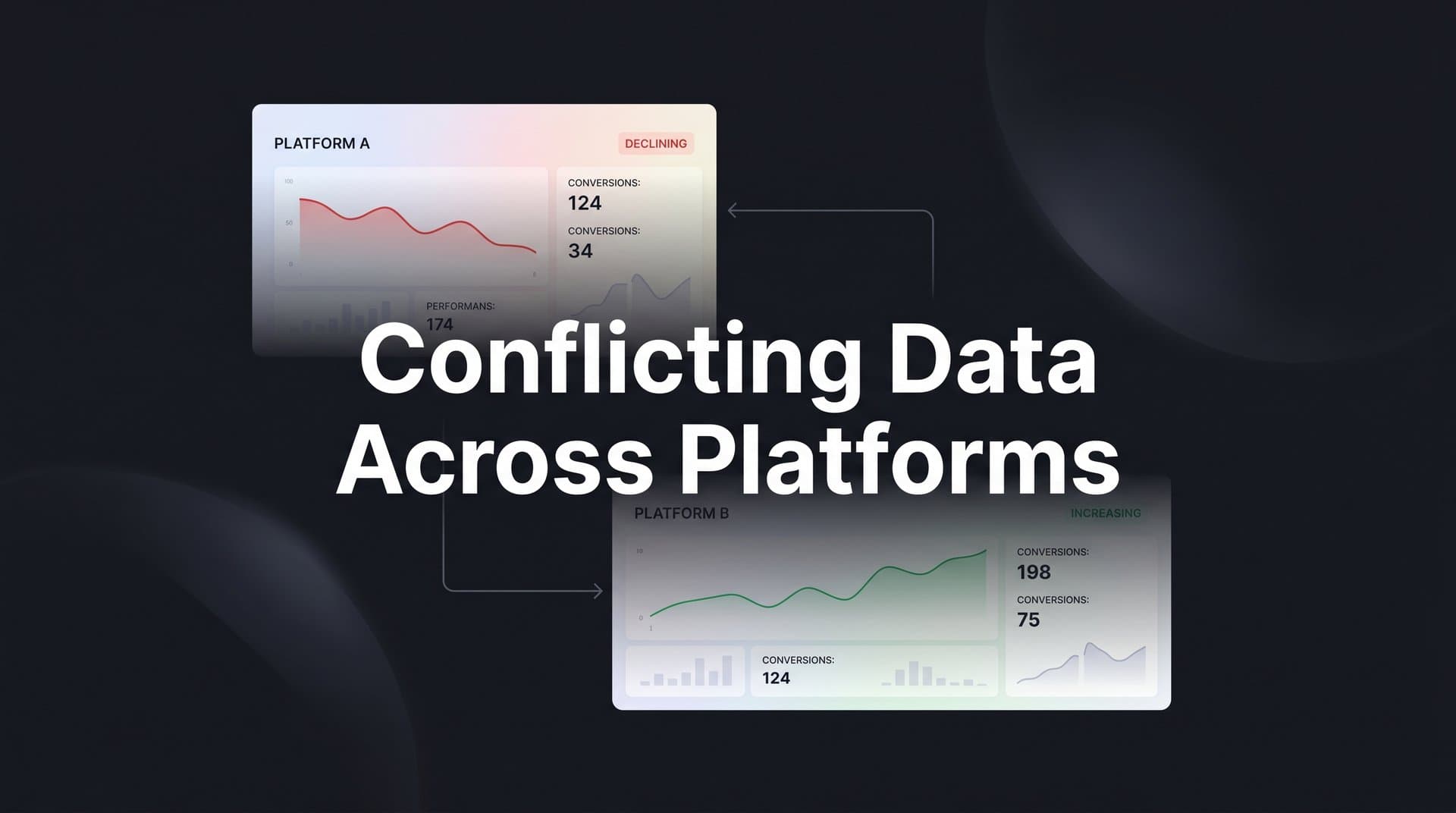
If your Meta Ads dashboard says one thing, Google Analytics says another, and your CRM tells a completely different story, you are not alone. Conflicting data across platforms is one of the most frustrating challenges facing modern marketing teams, and the root cause is not broken tools. It is that each platform measures conversions, attribution windows, and user journeys using completely different logic.
Meta counts view-through conversions by default. Google Ads uses its own click-based model. GA4 applies session-based logic. Your CRM records only closed deals. The result: the same conversion can appear in three or four platforms simultaneously, inflating reported totals and making cross-channel comparison unreliable. Wasted ad spend, misattributed revenue, and a team that cannot agree on what is actually working are the predictable outcomes.
The tools in this list address the root causes of these conflicts. Whether you need unified attribution, cleaner data pipelines, or a single source of truth across every channel, here are the top platforms helping marketers stop guessing and start scaling.
1. Cometly
Best for: Marketers who need accurate, unified attribution across every ad platform and touchpoint
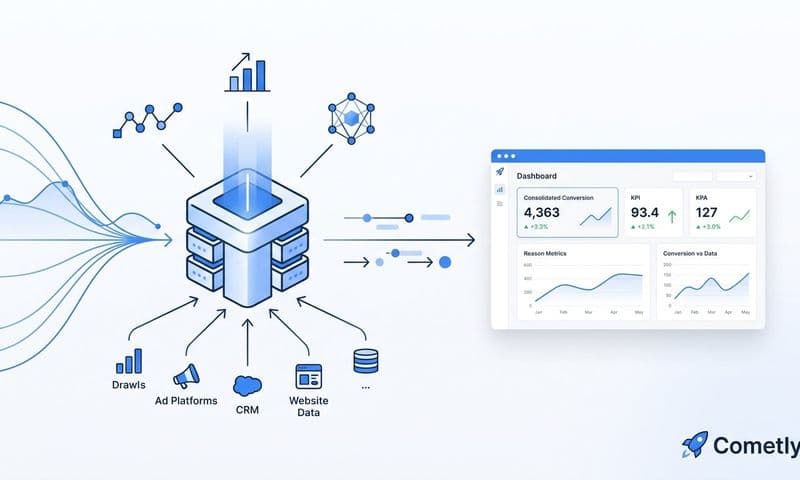
Cometly is an AI-powered marketing attribution platform that connects your ad platforms, CRM, and website to deliver a single, accurate view of what is actually driving revenue.
 9 Best Marketing Attribution Platforms to Compare in 2026
Where This Tool Shines
Cometly tackles data conflicts at the source. Rather than asking you to reconcile numbers across disconnected dashboards, it captures every touchpoint from the first ad click through to the final CRM conversion and presents it all in one unified view. Server-side tracking means you are not relying solely on browser-based pixels that get blocked by ad blockers, iOS restrictions, or browser privacy settings.
The Conversion Sync feature feeds enriched, conversion-ready event data back to Meta, Google, and other ad platforms. This closes the feedback loop that typically causes algorithmic targeting to degrade over time, and it helps the platforms optimize toward the conversions that actually matter to your business rather than the ones they can easily detect on their own.
Key Features
Server-Side Tracking: Captures conversion data beyond the limitations of client-side pixels, improving accuracy especially in post-iOS privacy environments.
Multi-Touch Attribution: Assigns credit across every channel and touchpoint in the customer journey, not just the last click.
Conversion Sync: Sends enriched event data back to Meta, Google, and other ad platforms to improve targeting and algorithmic optimization.
AI Ads Manager: Delivers optimization recommendations based on real attribution data so you can scale what is working with confidence.
AI Chat: Lets you ask natural language questions about your marketing data without needing a dedicated data analyst.
Unified Analytics Dashboard: Connects ad platforms, CRM data, and website behavior in a single reporting view.
Best For
Cometly is built for digital marketers, paid media managers, and marketing teams running campaigns across multiple ad platforms who need accurate attribution data to make confident budget decisions. It is particularly valuable for teams who have struggled with iOS tracking gaps or inflated conversion counts from platform self-reporting.
Pricing
Paid plans available. Visit cometly.com for current pricing details or to request a demo.
2. Triple Whale
Best for: E-commerce and DTC brands running paid ads across Meta, Google, and TikTok
Triple Whale is an attribution and analytics platform built specifically for Shopify-based e-commerce and direct-to-consumer brands.
 9 Best Conversion Tracking Platforms Compared by Pricing in 2026
Where This Tool Shines
Triple Whale earns its reputation among DTC marketers by pulling together data from Meta, Google, TikTok, Klaviyo, and Shopify into a single summary dashboard. The blended ROAS view is particularly useful for teams who want a quick read on overall profitability without toggling between five different platforms.
The Triplestore first-party pixel is Triple Whale's answer to cookie deprecation and privacy-driven tracking loss. It collects data directly from your storefront, reducing reliance on third-party cookies that are increasingly unreliable. The post-purchase survey integration adds a zero-party data layer, asking customers directly how they found you and supplementing algorithmic attribution with self-reported data.
Key Features
Triplestore Pixel: First-party cookieless tracking that captures conversion data directly from your store.
Summary Dashboard: Blended ROAS and channel-level performance in a single view across all connected platforms.
Creative Analytics: Ad-level performance breakdowns to identify which creatives are actually driving results.
Post-Purchase Survey Integration: Adds zero-party attribution data by asking customers directly about their discovery path.
Sonar Pixel: Improves attribution accuracy in privacy-limited tracking environments.
Best For
Triple Whale is purpose-built for Shopify stores and DTC brands. If you are running a multi-channel paid strategy and need a clean, consolidated view of e-commerce performance without building a custom data stack, it is a strong fit.
Pricing
Pricing tiers are based on monthly revenue. A free plan is available for smaller stores, with paid tiers unlocking advanced attribution and analytics features.
3. Northbeam
Best for: Enterprise and high-spend brands needing ML-driven multi-touch attribution and media mix modeling
Northbeam is an enterprise-grade multi-touch attribution platform that uses machine learning to model customer journeys and deliver channel-level attribution data for performance marketing teams.
 9 Best Attribution Tools for Digital Marketing Agencies in 2026
Where This Tool Shines
Northbeam is designed for brands that have outgrown simpler attribution tools and need a more rigorous, model-driven approach to understanding what is working across large, complex ad programs. The ability to compare multiple attribution models side by side, including first-touch, last-touch, linear, and ML-driven models, helps teams pressure-test their assumptions rather than defaulting to a single perspective.
The media mix modeling layer adds budget allocation guidance that goes beyond click-based attribution. For brands spending significantly on upper-funnel channels like display or video, where last-click models consistently underreport value, this kind of modeling is genuinely useful for making smarter budget decisions.
Key Features
ML-Driven Multi-Touch Attribution: Machine learning models that reflect how customers actually move through the funnel rather than applying static rules.
Attribution Model Comparison: Side-by-side view of multiple models to understand how attribution logic affects reported performance.
Media Mix Modeling: Budget allocation guidance that accounts for upper-funnel and offline channel contributions.
Cross-Channel Reporting: Granular ad-level breakdowns across all connected channels.
Forecasting Tools: Budget planning features to project performance based on historical attribution data.
Best For
Northbeam is best suited for brands with meaningful ad spend who need more than a dashboard aggregator. Marketing teams with analysts who want to model and compare attribution approaches will get the most value here.
Pricing
Custom pricing. Northbeam is typically positioned for brands with significant monthly ad spend. Contact their team directly for a quote.
4. Rockerbox
Best for: Marketing analysts who need a model-agnostic, normalized data foundation across paid, organic, and offline sources
Rockerbox is a marketing data platform that normalizes and centralizes data from a wide range of sources into a single, consistent dataset you can analyze on your own terms.
 9 Best Tools for Fixing Conflicting Data Across Platforms in 2026
Where This Tool Shines
Where most attribution tools force you to accept their specific attribution model, Rockerbox takes a different approach. It focuses on giving you clean, de-duplicated, normalized data and then lets you apply whatever attribution logic fits your business. This model-agnostic philosophy is genuinely valuable for analyst-heavy teams that want to own their attribution methodology rather than inherit someone else's.
The de-duplication logic is a standout feature for teams dealing with inflated conversion counts. When the same conversion is being claimed by Meta, Google, and your email platform simultaneously, Rockerbox's deduplication layer identifies and eliminates the overlap, giving you a more honest read on actual conversion volume.
Key Features
100+ Data Source Connectors: Connects paid, organic, and offline marketing channels into a single normalized dataset.
Model-Agnostic Attribution: Apply first-touch, last-touch, or custom attribution rules to the same underlying data.
De-Duplication Logic: Eliminates double-counted conversions across platforms that each claim credit for the same event.
Raw Data Export: Sends clean data directly to your data warehouse for custom analysis and modeling.
View-Through and Cross-Device Attribution: Captures conversion credit beyond last-click for a more complete picture.
Best For
Rockerbox is a strong choice for data-driven marketing teams and analysts who want full control over attribution logic and need a reliable, clean data foundation to work from. It pairs well with BI tools and custom reporting setups.
Pricing
Custom pricing based on data volume and the number of connected sources. Contact Rockerbox directly for a quote.
5. Segment (by Twilio)
Best for: Engineering-supported teams who want to resolve data conflicts upstream with a unified customer data layer
Segment is a Customer Data Platform (CDP) that creates unified customer profiles and routes consistent, standardized event data to every tool in your marketing stack.
 8 Best Attribution-Focused Platforms vs Segment: Which Approach Fits Your Marketing Stack in 2026
Where This Tool Shines
Segment addresses data conflicts at the source rather than trying to reconcile them after the fact. By establishing a single event tracking schema that feeds consistent data to all downstream tools, it eliminates the root cause of many cross-platform discrepancies: each tool receiving slightly different, inconsistently formatted data about the same user actions.
The identity resolution capability is particularly powerful for teams dealing with fragmented user profiles. Segment merges anonymous visitor data with known user profiles as identification events occur, creating a continuous, unified view of each customer journey that follows the user across sessions, devices, and channels.
Key Features
Single Event Tracking Schema: One standardized data layer that feeds consistent event data to all connected tools simultaneously.
Identity Resolution: Merges anonymous and known user profiles to create continuous, unified customer records.
500+ Integrations: Connects to ad platforms, CRMs, analytics tools, and data warehouses across your entire stack.
Audience Builder: Creates behavioral audience segments from unified data for activation across ad platforms.
Real-Time Event Streaming: Supports both real-time event streaming and batch data processing depending on use case.
Best For
Segment is best for growth-stage and enterprise companies with engineering resources available for implementation. It is a foundational infrastructure investment rather than a plug-and-play analytics tool, and it delivers the most value when teams are committed to standardizing their entire data collection approach.
Pricing
Free tier available. Paid plans start at approximately $120 per month, with enterprise pricing available for larger data volumes and team requirements.
6. Funnel.io
Best for: Marketing and data teams who need clean, harmonized data delivered to BI tools and dashboards without writing SQL
Funnel.io is a marketing data aggregation and transformation platform that connects hundreds of data sources and delivers clean, normalized data to wherever your team does its analysis.
 9 Best Tools for Fixing Conflicting Data Across Platforms in 2026
Where This Tool Shines
Funnel.io excels at the unglamorous but critical work of data normalization. Different ad platforms use different naming conventions, different field structures, and different definitions for the same metrics. Funnel.io handles the mapping and transformation work that would otherwise fall to a data engineer, making it accessible to marketing ops and analytics teams who need clean data but do not want to write custom pipelines.
The breadth of native connectors is a genuine differentiator. With support for over 500 data sources including niche ad platforms, affiliate networks, and offline channels, Funnel.io can serve as the aggregation layer for complex multi-channel marketing programs where data is coming from many different places.
Key Features
500+ Native Connectors: Connects ad platforms, analytics tools, CRMs, and offline data sources in one place.
Automated Data Normalization: Maps and standardizes fields across sources so your data speaks a consistent language.
No-Code Transformations: Custom data transformations without requiring SQL or engineering support.
BI Tool Exports: Direct integrations with Looker Studio, Tableau, BigQuery, and Snowflake for downstream reporting.
Automated Refresh Scheduling: Controls data freshness with scheduled updates across all connected sources.
Best For
Funnel.io is ideal for marketing teams and analysts who need a reliable, clean data foundation for BI reporting but do not want to build and maintain custom ETL pipelines. It is particularly useful when your data comes from many sources that do not natively talk to each other.
Pricing
Plans start at approximately $400 per month, with pricing scaling based on data volume and the number of active connectors.
7. Supermetrics
Best for: Analysts and marketers who want to pull cross-platform data into Google Sheets, Looker Studio, or a data warehouse for side-by-side reporting
Supermetrics is a data connector tool that pulls marketing data from ad platforms, analytics tools, and CRMs into your preferred reporting destination.
Where This Tool Shines
Supermetrics is the practical choice for marketing analysts who live in Google Sheets or Looker Studio and want to pull data from multiple platforms into a single report without manual exports. It does not resolve attribution conflicts on its own, but it makes side-by-side comparison fast and repeatable, which is often the first step toward understanding where your numbers diverge.
The scheduled refresh capability means your reports stay current without requiring someone to manually update them each morning. For agencies managing multiple client accounts or marketing teams with regular reporting cadences, this automation saves meaningful time and reduces the risk of decisions being made on stale data.
Key Features
70+ Platform Connectors: Pulls data from major ad platforms, analytics tools, and CRMs into a single reporting destination.
Native Reporting Integrations: Works directly with Google Sheets, Looker Studio, Excel, and major BI platforms.
Scheduled Data Refreshes: Automated updates keep reports current without manual intervention.
Cross-Channel Blended Reports: Pre-built templates for combining data from multiple platforms in one view.
Data Warehouse Connectors: BigQuery and Snowflake support for teams building warehouse-based reporting infrastructure.
Best For
Supermetrics is a strong fit for marketing analysts, agencies, and in-house teams who need fast, flexible reporting across platforms without investing in a full data infrastructure. It is a connector, not an attribution platform, so it works best as part of a broader analytics setup.
Pricing
Plans start at approximately $29 per month for single-destination connectors. Team plans and multi-destination options are available at higher tiers.
8. Hyros
Best for: Direct response marketers, high-ticket businesses, and info product creators with long, complex sales funnels
Hyros is an AI-powered ad tracking and attribution platform designed specifically for businesses where standard pixel tracking consistently breaks down.
Where This Tool Shines
Hyros addresses a specific and common pain point: standard pixel-based attribution fails for businesses with long sales cycles, multi-step funnels, or high-ticket offers where the time between first ad click and final purchase can span weeks or months. By using AI-based print tracking to follow users across devices and browsers, Hyros maintains attribution continuity even when cookies are cleared or users switch devices mid-funnel.
The phone call and offline conversion tracking capability is particularly valuable for businesses where a significant portion of revenue closes through sales calls rather than online checkout. Most attribution tools treat offline conversions as a gap in the data. Hyros treats them as a core part of the attribution model.
Key Features
AI Print Tracking: Cross-device and cross-browser user identification that maintains attribution across long, fragmented journeys.
Long Sales Cycle Attribution: Designed to handle attribution windows that extend well beyond standard 7 or 28-day windows.
Phone Call and Offline Conversion Tracking: Connects offline revenue events back to the originating ad touchpoints.
Ad Platform Optimization Feedback: Sends attribution data back to ad platforms to improve algorithmic targeting.
Custom Attribution Models: Flexible model configuration suited for webinar funnels, VSL funnels, and high-ticket offer flows.
Best For
Hyros is purpose-built for direct response marketers, coaches, consultants, course creators, and high-ticket businesses where the standard pixel-to-purchase attribution model consistently misses conversions and misattributes revenue.
Pricing
Custom pricing. Hyros is typically positioned for businesses with meaningful monthly ad spend. Contact their team for a quote.
9. Google Analytics 4
Best for: Any marketing team that needs a free, foundational layer of cross-channel web analytics and funnel reporting
Google Analytics 4 is Google's free web analytics platform offering event-based tracking, cross-channel reporting, and funnel analysis as a baseline layer for understanding user behavior and campaign performance.
Where This Tool Shines
GA4 is the starting point for most marketing teams because it is free, widely supported, and natively integrated with Google Ads. The event-based tracking model is more flexible than the session-based model it replaced, making it easier to track the specific actions that matter to your business rather than defaulting to pageviews and sessions.
The Exploration reports are genuinely useful for teams that want to build custom funnel analyses or path reports without a BI tool. For understanding how users move through your site and where they drop off, GA4 provides a solid foundation. The important caveat: without server-side tracking or enhanced measurement properly configured, GA4 is known to undercount conversions, particularly in the post-iOS privacy environment. It works best as one layer in a broader attribution stack rather than as a standalone source of truth.
Key Features
Event-Based Tracking: Flexible conversion measurement that tracks any user action, not just pageviews and sessions.
Native Google Ads Integration: Seamless connection to Google Ads campaign data for performance reporting.
Exploration Reports: Custom funnel analysis, path analysis, and segment overlap reports without additional tools.
Enhanced Measurement: Automatic event tracking for scrolls, clicks, video views, and downloads without additional code.
Free at Standard Tier: No data volume fees for standard GA4, making it accessible for teams at every stage.
Best For
GA4 is essential for virtually every marketing team as a foundational analytics layer. It is most valuable when paired with a dedicated attribution platform or server-side tracking setup that addresses its known limitations around conversion undercounting and cross-platform reconciliation.
Pricing
Free for standard use. GA4 360, the enterprise version, is available through Google Sales with custom pricing based on data volume and support requirements.
Which Tool Is Right for Your Situation
Solving conflicting data across platforms is not a one-tool problem. The right solution depends on where your data conflicts are originating and what your team needs most.
If you are a performance marketer who needs accurate, unified attribution across every ad platform and wants AI-driven optimization recommendations built on real data, Cometly is the most complete solution. Its combination of server-side tracking, multi-touch attribution, Conversion Sync, and AI-powered analysis addresses both the data accuracy problem and the decision-making problem in one platform.
If you are running a Shopify-based DTC brand and need a clean, e-commerce-focused attribution dashboard, Triple Whale is purpose-built for your use case. For enterprise teams with large budgets and a need for rigorous ML-driven modeling, Northbeam is worth evaluating. If your team is analyst-heavy and wants model-agnostic normalized data to work with on your own terms, Rockerbox is a strong fit.
For teams building out a data infrastructure, Segment solves the problem upstream by standardizing event data before it reaches your tools. Funnel.io and Supermetrics are practical choices for teams that need clean, aggregated data delivered to BI tools and dashboards without engineering overhead. Hyros is the go-to for direct response marketers with long, complex funnels where standard tracking consistently fails. And GA4 remains an essential free baseline that works best as one layer in a broader attribution stack.
The most important thing to understand is that accurate attribution requires both the right tool and the right tracking foundation. No platform can give you reliable data if the underlying event collection is broken, inconsistent, or privacy-limited. Start with your tracking infrastructure, then layer in the attribution and analytics tools that match your team's needs and technical capabilities.
If you are ready to stop reconciling conflicting dashboards and start making decisions from a single, accurate source of truth, Get your free demo of Cometly and see how AI-powered attribution can transform the way you manage and scale your ad spend.