
Picture your Monday morning: you open Google Ads, note the conversion numbers, then switch to Meta Business Manager, then LinkedIn Campaign Manager, then pull everything into a spreadsheet to try to make sense of it all. By the time you've reconciled the data, half your morning is gone and you still aren't sure which campaigns are actually working. If this sounds familiar, you're not alone.
For B2B SaaS marketing teams, this fragmented workflow isn't just inefficient. It's actively misleading. Each platform reports its own version of the truth, and those versions rarely agree. The result is a patchwork of metrics that makes confident budget decisions feel nearly impossible.
Consolidated ad reporting solves this problem by replacing the tab-switching, spreadsheet-wrangling ritual with a single, unified view of all your paid channel performance. Instead of piecing together disconnected snapshots, you get one accurate picture of how every campaign, creative, and dollar is performing across every channel simultaneously.
For B2B SaaS teams specifically, this matters more than it might for a direct-to-consumer brand. Your buyers don't click one ad and convert. They interact with multiple touchpoints across weeks or months before becoming a customer. Without a consolidated view, you can't see that full journey, and you can't make smart decisions about where to invest next. This article walks through why siloed data is so damaging, what true consolidation looks like, and how to use unified reporting to make smarter ad spend decisions.
Why Siloed Ad Data Quietly Destroys Your Budget
Here's a scenario that plays out across marketing teams every week. Your Google Ads dashboard reports 80 conversions last month. Your Meta dashboard reports 65. Your LinkedIn dashboard reports 30. Add them up and you're looking at 175 conversions. But your CRM shows 90 new leads. Something doesn't add up, and the gap between those numbers is where bad budget decisions get made.
The root cause is straightforward: every ad platform attributes conversions according to its own rules. Meta claims credit when someone saw your ad and later converted, even if they clicked a Google search ad first. Google claims credit for the final click. LinkedIn claims credit for anyone who engaged with your content in the past 30 days. Each platform is telling you a technically accurate story about its own data. The problem is that none of them are telling you the whole story.
This overlap and double-counting means the sum of conversions across platforms almost always exceeds your actual conversion count. It's a widely acknowledged challenge in digital advertising, and it creates a fundamental trust problem. If you can't trust the numbers, you can't make confident decisions. Understanding discrepancies in conversion reporting is the first step toward fixing them.
The operational cost compounds the analytical one. Marketing teams running multi-channel campaigns often spend a significant portion of their week manually exporting data, cleaning it, and attempting to reconcile it across platforms. That's time not spent analyzing what's working, testing new creative, or refining targeting. The manual reconciliation process also introduces human error, meaning the spreadsheet you finally build may be no more accurate than the raw platform data you started with.
The downstream impact lands hardest on budget allocation. When each channel looks strong in isolation, it's tempting to conclude that all of them deserve more investment. But without a unified view that deduplicates conversions and maps the full customer acquisition funnel, you're likely over-investing in channels that appear to perform well on their own metrics but contribute less to actual pipeline than the data suggests. In B2B SaaS, where customer acquisition costs are high and sales cycles are long, those misallocated dollars add up quickly.
Siloed reporting also creates an internal credibility problem. When marketing presents one set of numbers, sales references another from the CRM, and leadership looks at a third from the finance dashboard, the conversation about performance devolves into a debate about whose data is right rather than a discussion about what to do next. That alignment gap slows decisions and erodes trust in the marketing function.
What Consolidated Ad Reporting Actually Means
The term gets used loosely, so it's worth being precise. Consolidated ad reporting is not simply pulling all your platform data into one place. That's aggregation, and while it's a step in the right direction, it doesn't solve the core problem.
True consolidated ad reporting means pulling performance data from all your paid channels into a unified interface and then applying consistent attribution logic, deduplication, and cross-channel mapping to that data. The distinction matters enormously. If you aggregate raw numbers from five platforms without normalizing how each one counts a conversion, you've just moved the chaos into a single dashboard instead of eliminating it.
Think of it this way. Aggregation is like combining five different clocks that all show different times into one room. You still don't know what time it actually is. Consolidation is like synchronizing all five clocks to the same accurate source. Now you can trust what you're looking at.
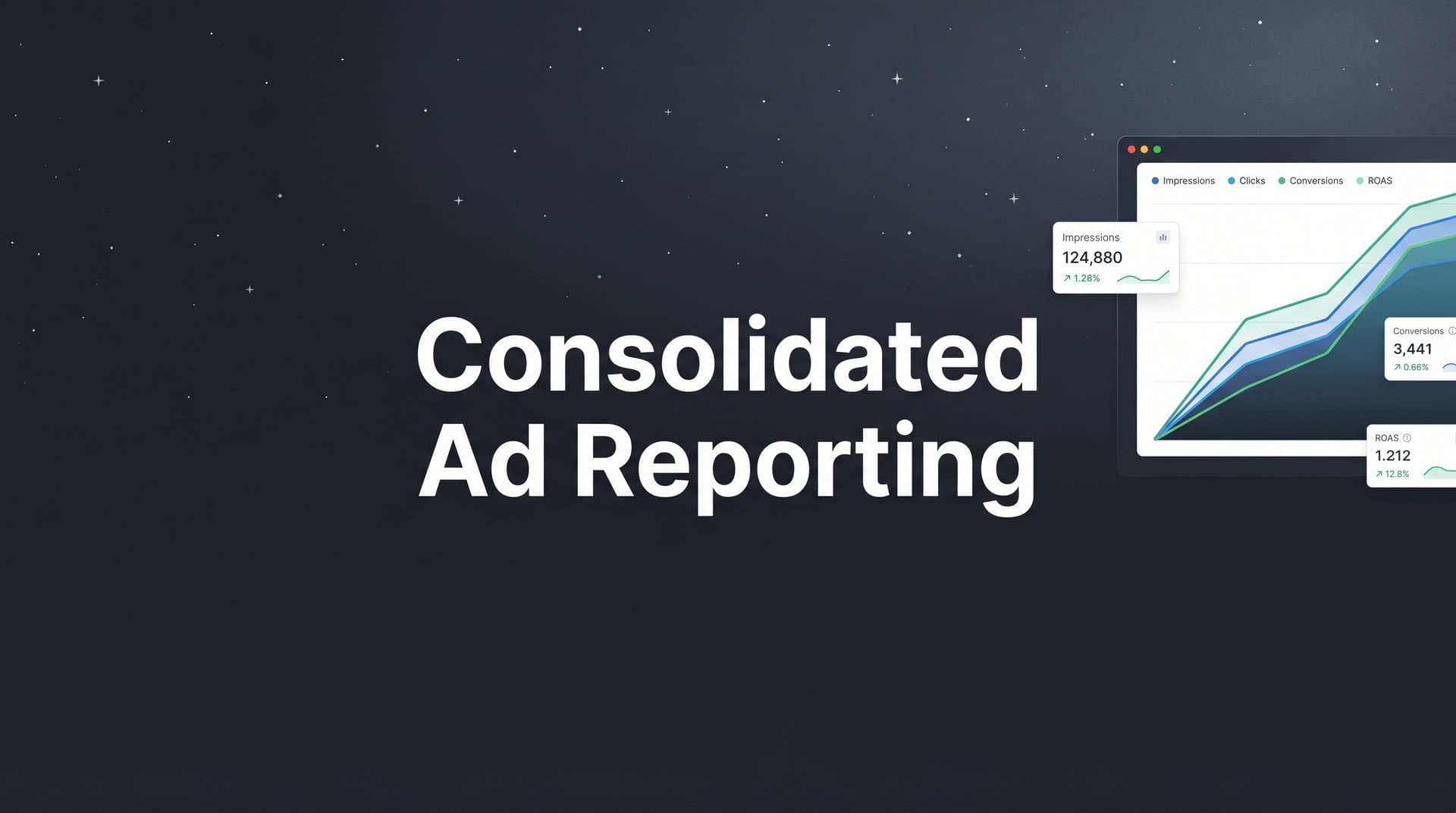
A properly consolidated ad report includes several key components, all visible in one place across every channel simultaneously. Spend tells you how much you're investing in each platform and campaign. Impressions and clicks give you reach and engagement context. Conversions show you how many meaningful actions resulted from your ads, with deduplication applied so the same person isn't counted multiple times across platforms. Cost per acquisition tells you what you're actually paying to generate a lead or customer. And revenue attribution connects ad activity to downstream pipeline and closed-won revenue, which is the metric that matters most for B2B SaaS teams.
The normalization layer is what makes this possible. Different platforms use different naming conventions, different conversion windows, and different attribution defaults. A consolidated reporting platform standardizes all of this so that a conversion on Meta and a conversion on Google are being measured by the same rules before they appear side by side in your dashboard.
This is also where the difference between a reporting aggregation tool and a true attribution reporting software becomes clear. Aggregation tools pull data. Attribution platforms apply logic to that data, map it to the customer journey, and give you an accurate, deduplicated view of what's actually happening across your entire paid media program. For B2B SaaS teams navigating complex, multi-touch buyer journeys, that distinction is the difference between a report that looks clean and one that's actually trustworthy.
How Attribution Models Shape What You See
Once your data is consolidated into a single view, the attribution model you apply becomes the lens through which you interpret everything. And the model you choose has a bigger impact on your conclusions than most teams realize.
Attribution models determine which touchpoints receive credit for a conversion. Last-click attribution gives 100% of the credit to the final interaction before conversion. First-touch attribution gives all the credit to the first touchpoint that introduced the prospect to your brand. Linear attribution splits credit equally across every touchpoint in the journey. Time-decay models give more credit to touchpoints closer to the conversion. Multi-touch models, including data-driven variants, distribute credit across touchpoints based on their actual influence in the journey.
The same consolidated dataset can tell very different stories depending on which model you apply. Under last-click, branded search campaigns look like heroes because they capture intent at the bottom of the funnel. Under first-touch, your top-of-funnel paid social campaigns get all the credit for starting conversations. Under multi-touch, the picture becomes more nuanced: you see which channels open doors, which ones nurture consideration, and which ones close deals.
For B2B SaaS specifically, multi-touch attribution inside a consolidated report is often the most revealing. Your buyers are researching solutions, comparing vendors, and engaging with multiple pieces of content before they ever talk to sales. A LinkedIn thought leadership ad might introduce them to your brand. A Google search ad might bring them back when they're ready to evaluate. A retargeting campaign might push them to request a demo. Last-click reporting would credit only the retargeting ad. Multi-touch reporting shows you that all three touchpoints played a role, and that cutting the LinkedIn budget would have starved the top of the funnel even if the retargeting numbers still looked fine for a while.
Choosing the right attribution model isn't a one-time decision, and it doesn't have to be. This is one of the most practical advantages of consolidated reporting: you can compare attribution models side by side without rebuilding your data infrastructure. Understanding how attribution models affect reporting lets you ask the right questions and get answers in seconds rather than rebuilding a spreadsheet from scratch.
Different strategic questions call for different models. When you're trying to understand what's driving brand awareness and filling the top of the funnel, first-touch tells you more. When you're optimizing for pipeline velocity and close rates, last-touch or time-decay might be more useful. When you need a holistic view for budget planning, multi-touch gives you the most complete picture. A consolidated reporting platform that lets you toggle between models gives you the flexibility to ask all of these questions from the same data.
Connecting Ad Spend to Pipeline and Revenue
Click-through rates and cost per click tell you how ads are performing in the platform. They don't tell you whether those ads are generating revenue. For B2B SaaS teams, the gap between an ad click and a closed deal can span weeks or months, which means platform-native metrics are almost always measuring something far upstream from what actually matters.
Consolidated ad reporting becomes most powerful when it bridges that gap. By connecting ad data to CRM pipeline stages and closed-won revenue, you move from reporting on activity to reporting on outcomes. You can see not just which campaigns generated clicks, but which ones generated qualified leads, which ones advanced to opportunity, and which ones ultimately converted to paying customers. This is the foundation of understanding how SaaS growth teams attribute revenue to marketing efforts.
This connection requires more than just pulling data from two systems. It requires accurate event tracking at every stage of the journey, and this is where server-side tracking and Conversion API integrations become essential infrastructure rather than optional enhancements.
Browser-based tracking, which relies on pixels and cookies, has become increasingly unreliable. Ad blockers, browser privacy settings, and the phaseout of third-party cookies all create gaps in the data that get passed back to ad platforms. When conversion events are missed or misattributed, the ad platform's optimization algorithm works with incomplete information, which degrades targeting quality over time and makes your consolidated reports less accurate. The shift away from third-party cookies makes server-side solutions increasingly non-negotiable.
Server-side tracking solves this by sending conversion events directly from your server to ad platforms, bypassing the browser entirely. Conversion API integrations with Meta, Google, and other platforms ensure that the events you care about, form fills, demo requests, trial signups, CRM stage changes, closed-won deals, are passed back accurately and completely. The result is a feedback loop where your consolidated reporting reflects reality, and where the data you're using to optimize is the same data that's informing your attribution analysis.
When ad data connects to revenue data at this level of fidelity, you can calculate true return on ad spend by channel, by campaign, and even by individual ad creative. You're no longer asking "which channel had the lowest cost per click?" You're asking "which channel generated the highest revenue per dollar spent?" Those are very different questions, and the second one is the one that actually drives business outcomes. Confident budget scaling becomes possible when you can see, with accuracy, which investments are compounding into revenue and which are generating activity that doesn't convert.
What to Look for in a Consolidated Ad Reporting Platform
Not all reporting tools offer the same depth, and the differences matter significantly when you're trying to make high-stakes budget decisions. Here's what to evaluate when choosing a platform for consolidated ad reporting.
Native integrations across all major ad platforms: The platform should connect directly to Meta, Google Ads, LinkedIn, TikTok, and any other channels you're running without requiring manual data exports or custom scripts. Every manual step in the data pipeline is a potential point of failure and a source of delay. Native integrations that pull data automatically ensure your consolidated view is always current and complete.
First-party data and server-side tracking capabilities: As browser-based tracking becomes less reliable, a platform's ability to support server-side event tracking and Conversion API connections is increasingly critical. Look for platforms that allow you to send enriched, first-party conversion events back to ad platforms, maintaining data accuracy as third-party cookie tracking continues to degrade. This isn't just a technical feature; it directly affects the quality of the data your consolidated reports are built on.
CRM and revenue integration: A consolidated reporting platform that only connects to ad platforms is giving you half the picture. The ability to pull in CRM data, pipeline stages, and closed-won revenue is what transforms a reporting tool into an attribution platform. This integration is what makes true ROAS analysis possible. The best SaaS reporting tools make this connection seamlessly.
AI-driven insights and recommendations: Reading a report is one thing. Knowing what to do with it is another. Platforms that layer AI analysis on top of consolidated data can surface which campaigns and creatives are driving the highest quality pipeline, flag underperforming budget allocations, and recommend where to shift spend. This moves the value from passive reporting to active optimization.
Attribution model flexibility: As discussed earlier, different strategic questions call for different attribution models. A strong platform lets you compare models side by side and apply the right lens for the question you're asking, without rebuilding your data setup each time.
Cometly is built specifically for B2B SaaS teams with these requirements in mind. It combines multi-touch attribution, server-side conversion tracking, Conversion API integration across major ad platforms, and AI-driven recommendations into a single platform. With more than 70 native integrations, it pulls your ad data, CRM data, and revenue data into one unified view so you can see exactly which ads and channels are driving pipeline and closed-won revenue.
Turning Unified Data Into Smarter Ad Spend
Having consolidated data is only valuable if it changes how you make decisions. Here's how teams that use unified reporting actually put it to work.
Identifying and eliminating budget waste: With a consolidated view that connects ad spend to pipeline contribution, it becomes straightforward to identify channels or campaigns that generate high click volume but low downstream conversion rates. These are the investments that look active in platform dashboards but don't show up in revenue. Reallocating that budget toward channels with demonstrated pipeline impact is one of the most direct ways consolidated reporting translates into business results. Learning how ad tracking tools help you scale with accurate data can accelerate this process significantly.
Uncovering cross-channel patterns: Some of the most valuable insights in consolidated reporting are invisible in platform-native dashboards. You might find that a paid social campaign consistently assists conversions that Google Ads later closes, meaning that cutting the social budget to improve efficiency would actually starve the bottom of the funnel over time. Or you might discover that a specific ad creative performs exceptionally well on LinkedIn but poorly on Meta, suggesting a targeting or messaging mismatch rather than a creative problem. These patterns only emerge when you're looking at all your data together.
Aligning teams around a single performance narrative: One of the underappreciated benefits of consolidated reporting is what it does for internal alignment. When marketing, sales, and leadership are all looking at the same dashboard with the same numbers, conversations about performance focus on strategy rather than data disputes. The credibility gap that comes from conflicting platform reports disappears when everyone is working from a single source of truth. This makes it easier to get budget approved, justify channel investments, and move quickly when opportunities emerge.
Scaling with confidence: When you know, with accuracy, which campaigns are generating pipeline and revenue, scaling becomes a calculated decision rather than a gamble. You're not hoping that more spend on a channel that looks good in its own dashboard will translate to more revenue. You're increasing investment in channels and campaigns where the full-funnel data confirms the connection between ad spend and closed deals.
Your Next Steps Toward Unified Ad Reporting
Fragmented ad data leads to fragmented decisions. When every platform is reporting its own version of the truth and your team is spending hours reconciling numbers that don't agree, you're not just losing time. You're making budget decisions based on an incomplete picture, and in B2B SaaS, where customer acquisition is expensive and sales cycles are long, those decisions compound over time.
Consolidated ad reporting gives you the single source of truth your team needs to operate with confidence. It replaces the manual reconciliation ritual with a unified view where every channel's performance is measured by the same rules, every conversion is deduplicated, and every ad dollar is connected to its downstream impact on pipeline and revenue.
The path from siloed reporting to unified attribution runs through the right platform. You need native integrations that pull data automatically, server-side tracking that maintains accuracy as browser-based methods degrade, CRM connectivity that bridges the gap between ad clicks and closed deals, and AI-driven insights that tell you not just what happened but what to do next.
Cometly is built to do exactly that for B2B SaaS teams. It connects your ad platforms, CRM, and website tracking into one unified attribution view, giving you real-time visibility into which campaigns are driving pipeline and which are burning budget. From multi-touch attribution to Conversion API integration to AI recommendations, it's designed to replace the spreadsheet reconciliation workflow with something that actually scales.
Ready to elevate your marketing game with precision and confidence? Discover how Cometly's AI-driven recommendations can transform your ad strategy. Get your free demo today and start capturing every touchpoint to maximize your conversions.