
The marketing world has been watching the third-party cookie countdown for years. Timelines have shifted, deadlines have moved, and the full deprecation story has grown more nuanced than the original headlines suggested. But here is what has not changed: the direction of travel is unmistakable. Browsers are blocking cross-site tracking. Privacy regulations are tightening consent requirements. And users themselves increasingly expect their data to be handled with more care than the old cookie-based web allowed.
If you are running paid campaigns on Meta, Google, TikTok, or LinkedIn, you are already feeling the effects. Conversion data is incomplete. Retargeting audiences are smaller than they used to be. Attribution reports are telling you stories that do not quite add up. The data gaps that cookie deprecation creates are not theoretical future problems. For a meaningful portion of your traffic, they are happening right now.
This article is not about the history of cookies or a technical deep dive into browser specifications. It is about what cookie deprecation actually means for your day-to-day marketing operations, why the consequences go further than most marketers realize, and what practical solutions you can implement today to maintain tracking accuracy, attribution quality, and campaign performance. Whether you are a solo marketer managing a single ad account or a team running complex multi-channel campaigns, this guide will give you a clear picture of the problem and a concrete path forward.
Why Third-Party Cookies Are Disappearing and What That Actually Means
Before diving into solutions, it helps to be precise about the problem. Not all cookies are going away. First-party cookies, the ones set by the website you are actually visiting, are staying. These are what keep you logged into your favorite tools, remember your shopping cart, and power most on-site analytics. They are privacy-compliant, user-expected, and not under threat.
Third-party cookies are a different story. These are set by domains other than the one you are visiting. When you land on a news website and a Meta pixel fires, that pixel is setting a third-party cookie on your browser. When you visit an e-commerce site and a Google remarketing tag loads, same thing. These cookies travel with you across the web, allowing ad platforms and data brokers to build profiles of your browsing behavior, serve retargeted ads, and connect ad clicks to eventual conversions on other websites. Understanding the difference between first-party and third-party cookies is essential for navigating this transition.
The forces pushing these cookies out are multiple and reinforcing. Apple's Safari browser has used Intelligent Tracking Prevention (ITP) to block third-party cookies by default for several years. Mozilla Firefox has done the same with Enhanced Tracking Protection. Together, these two browsers represent a substantial share of web traffic, which means a significant portion of your audience is already unreachable through traditional cookie-based tracking.
Google Chrome, which holds the largest share of global browser usage, has taken a more gradual approach. Rather than an outright ban, Google has moved toward user-choice mechanisms through its Privacy Sandbox initiative, giving users more control over how they are tracked. The result is a more fragmented landscape rather than a clean cutoff, but the trajectory is the same: third-party cookie reliability is declining.
Privacy regulations are accelerating this shift. GDPR in Europe requires explicit consent for tracking. US state-level privacy laws continue to expand. Each new regulation adds friction to the consent process, reducing the pool of users who can be tracked even when the technical capability still exists.
The practical impact lands squarely on marketing operations. Cross-site user journeys become invisible. A user who clicks a Facebook ad, visits your site, leaves, and converts three days later on a different device may never be connected back to that original click. Retargeting audiences shrink because the cookies needed to build those audiences are not being set. Conversion tracking from ad platform pixels becomes unreliable, and attribution models built on pixel data start producing results that do not reflect reality.
The Cascade Effect of Incomplete Conversion Data
Here is where cookie deprecation becomes more than a tracking inconvenience. When your ad platform pixels miss conversions, those missing signals do not just create gaps in your reports. They actively degrade the performance of your campaigns.
Related reading: our complete guide to cookie deprecation solutions.
Ad platform algorithms, particularly Meta's Advantage+ and Google's Performance Max, are machine learning systems that depend on conversion signal quality to optimize. They use conversion data to understand which users are most likely to convert, which placements are working, and how to allocate budget for the best results. When that conversion data is incomplete because cookies failed to fire or were blocked, the algorithm is essentially learning from a corrupted dataset. The result is worse targeting, higher costs per acquisition, and campaigns that cannot reach their potential even with a healthy budget.
The attribution blind spot compounds the problem. When a cookie fails to connect a click to a conversion, one of two things happens. Either the conversion gets attributed to a different channel entirely (usually the last touchpoint that was trackable, like direct or organic), or it disappears from your reports altogether. Both outcomes lead to the same mistake: misallocating budget based on data that does not reflect what actually drove revenue. Platforms that offer accurate revenue tracking become critical for avoiding these costly errors.
Imagine scaling a campaign that appears to have a high CPA because its conversions are being credited elsewhere. Meanwhile, you are pouring more budget into the channel that is getting the attribution credit, even though it was not the one doing the heavy lifting. This is not a hypothetical scenario. It is a pattern that plays out regularly when marketers rely on cookie-dependent tracking in an environment where those cookies are increasingly blocked.
For marketers running campaigns across multiple platforms simultaneously, the problem is even more acute. Each platform's pixel sees only a partial picture of the customer journey. None of them can reliably track the full path from first touchpoint to conversion when third-party cookies are blocked at various points along the way. You end up with four different platforms each claiming credit for the same conversion, or conversions that none of them can see at all.
Server-Side Tracking: The Foundation of a Cookieless Strategy
If client-side pixel tracking is the problem, server-side tracking is the most important part of the solution. Understanding the difference between these two approaches is essential for any marketer building a durable tracking strategy.
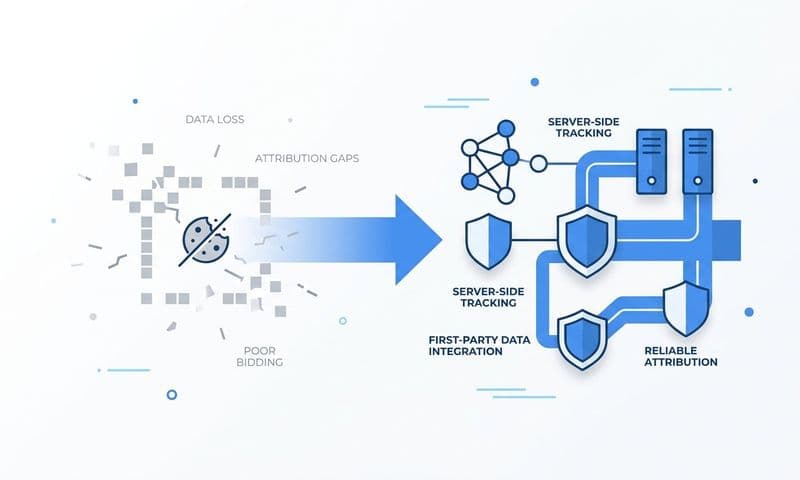
Client-side tracking works through JavaScript pixels that load in the user's browser. When a conversion happens, the pixel fires and sends data to the ad platform. The problem is that this entire process happens inside the browser, which means it is subject to browser privacy features, ad blockers, cookie restrictions, and the increasingly aggressive tracking prevention built into Safari and Firefox. If the browser blocks the cookie or the pixel fails to load, the conversion is lost.
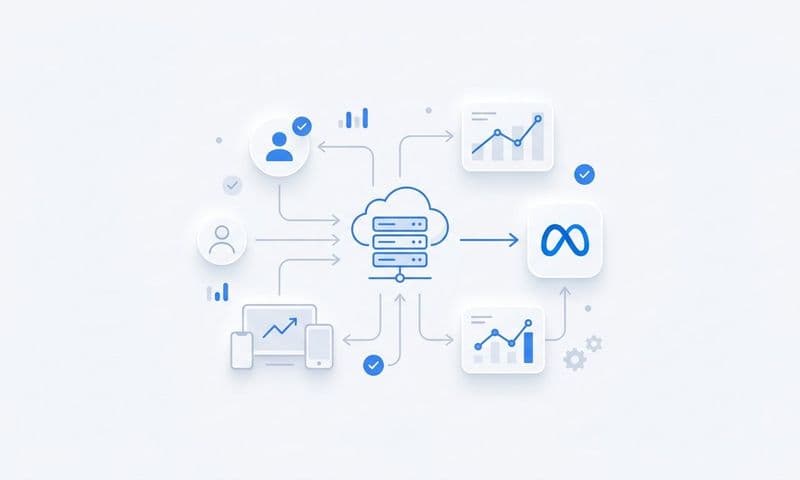
Server-side tracking works differently. Instead of relying on a pixel in the browser, conversion data is captured by your server and sent directly to the ad platform's server through an API. The data never has to pass through the browser at all. This means browser-level restrictions cannot interfere with it. Ad blockers cannot block it. Safari's Intelligent Tracking Prevention cannot touch it. Exploring a dedicated cookieless tracking solution is the fastest way to get this infrastructure in place.
Meta's Conversions API (CAPI) and Google's Enhanced Conversions are prominent examples of server-side tracking solutions that the ad platforms themselves have built and actively promote. The fact that Meta and Google are investing heavily in these tools is a clear signal: they know their pixels are becoming unreliable, and they need server-side data to keep their algorithms functioning properly.
The key advantages of server-side tracking extend beyond simply bypassing browser restrictions. Because the data comes from your server rather than a browser cookie, it is more accurate and more complete. You can include richer conversion data, such as customer lifetime value, lead quality scores, or CRM events, that a browser pixel could never capture. This enriched data is far more valuable to ad platform algorithms than a simple pixel fire.
Implementation does require connecting your website, CRM, or backend systems to ad platform APIs. This is where purpose-built platforms become genuinely valuable. Rather than building and maintaining custom API integrations for each ad platform you use, a dedicated tracking software for performance marketing handles the technical infrastructure, letting you focus on using the data rather than plumbing it together.
First-Party Data and Multi-Touch Attribution as Your New Compass
Server-side tracking solves the data capture problem. But capturing data is only half the equation. You also need to make sense of it across the full customer journey, and that is where first-party data strategy and multi-touch attribution come in.
First-party data is information you collect directly from your own website visitors, customers, and CRM. It includes form submissions, email sign-ups, purchase events, sales call records, and any other interaction that happens within your own systems. Unlike third-party cookie data, first-party data is privacy-compliant by design, fully within your control, and not subject to browser restrictions or regulatory uncertainty.
Building a first-party data strategy means shifting from passive reliance on what ad platforms tell you to active collection and ownership of your own customer data. It means connecting your website analytics to your CRM, tracking the full customer journey from first ad click through lead nurturing to closed deal, and using that unified data as the foundation for all your attribution and optimization decisions. The best multi-touch attribution platforms are designed to unify exactly this kind of first-party data.
Multi-touch attribution is the methodology that makes this data actionable. Rather than crediting a single touchpoint for a conversion (which is what last-click attribution does), multi-touch attribution distributes credit across all the touchpoints in a customer's journey. In a cookieless world, this works by stitching together touchpoints from your own first-party data sources rather than relying on third-party cookie trails that no longer exist.
The different attribution models each tell a different part of the story. First-touch attribution highlights which channels are best at generating initial awareness. Last-touch attribution shows what closes the deal. Linear attribution spreads credit evenly across all touchpoints. Time-decay attribution gives more weight to the touchpoints closest to conversion. A thorough comparison of attribution models helps you understand which approach fits your specific business goals.
For example, you might discover that a channel that looks weak under last-touch attribution is actually responsible for introducing a large share of your highest-value customers. Or that a channel you are scaling aggressively contributes heavily to first touches but rarely appears in the paths that actually convert. These are the kinds of insights that only become visible when you can analyze the full journey with flexible attribution models built on first-party data.
Feeding Better Data Back to Ad Platforms
Here is where the strategy becomes a competitive advantage rather than just a defensive measure. Once you have accurate, first-party conversion data captured through server-side tracking, you can send it back to the ad platforms in a way that actively improves their performance.
This is called conversion syncing, and it works by sending enriched, verified conversion events from your own tracking back to Meta, Google, TikTok, and other platforms. Instead of those platforms relying solely on their own pixels (which are increasingly unreliable), they receive a richer, more complete picture of what is actually converting. Their algorithms can then use this better data to optimize targeting, bidding, and creative delivery. Understanding key digital marketing performance metrics ensures you are syncing the signals that matter most.
The feedback loop this creates is significant. Better conversion data leads to better audience modeling. Better audience modeling leads to ads reaching people who are more likely to convert. More conversions at lower cost means a higher return on ad spend. The ad platforms' machine learning is only as good as the signals it receives, and marketers who consistently feed in higher-quality signals gain a measurable edge over competitors still relying on degraded pixel data.
AI-powered recommendations can layer on top of this foundation to surface optimization opportunities that would be invisible with cookie-dependent tracking. When your attribution system has a complete view of which ads, audiences, and channels are actually driving revenue, AI can identify patterns across that data and suggest specific actions: which campaigns to scale, which to pause, where to shift budget for the highest impact. The growing impact of artificial intelligence on marketing strategies makes this capability increasingly essential for competitive teams.
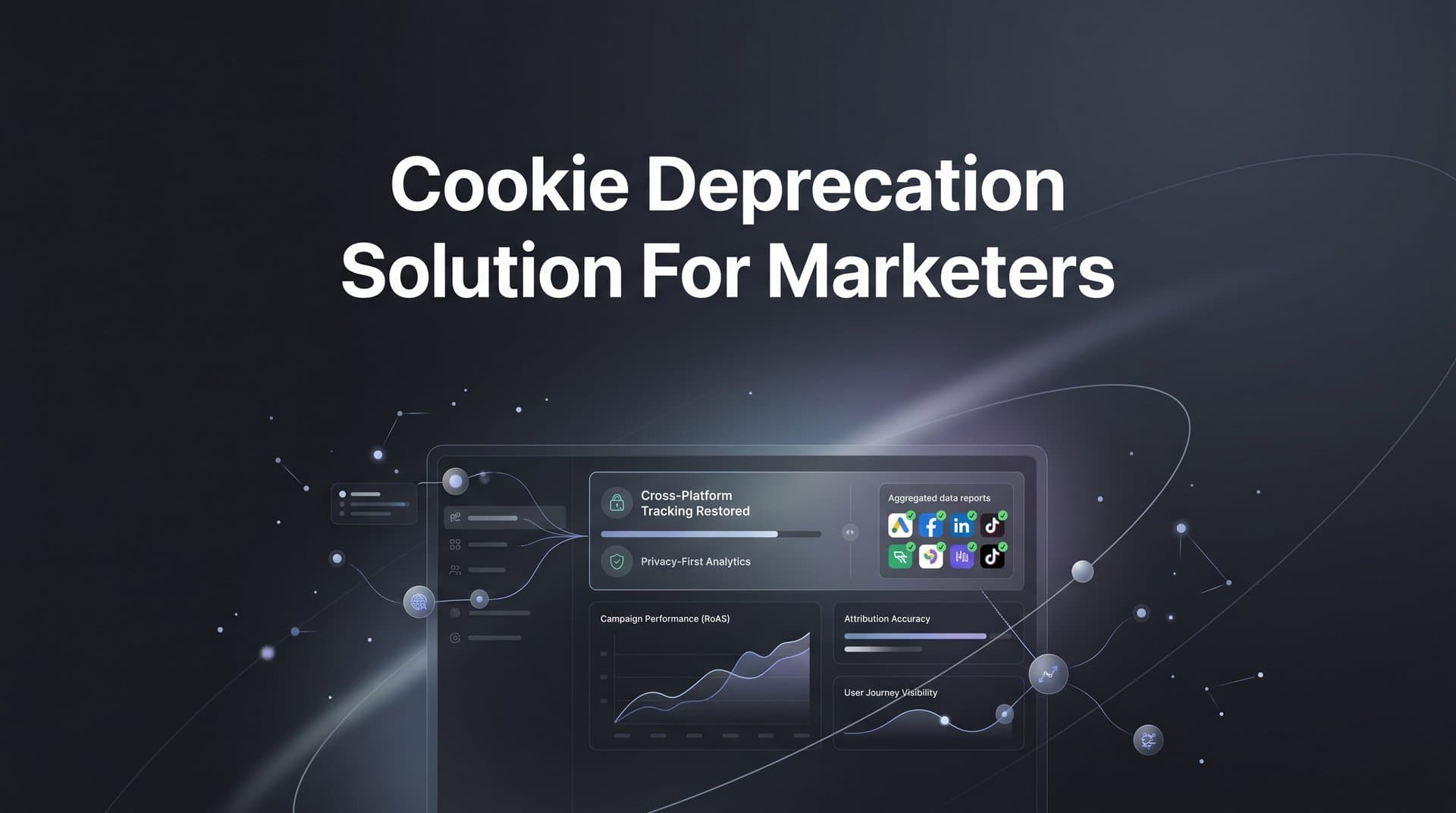
This is the full picture of what a modern cookie deprecation solution looks like. It is not just about preserving what you had before. It is about building a tracking and attribution infrastructure that is more accurate, more durable, and more capable of driving performance than the old cookie-dependent approach ever was.
Building Your Cookie Deprecation Strategy Step by Step
Knowing the components of a strong cookieless strategy is one thing. Knowing where to start is another. Here is a practical sequence for building your approach.
Step 1: Audit your current tracking setup. Identify every place in your marketing stack where you are relying on third-party cookies. This typically includes ad platform pixels (Meta Pixel, Google Ads tag, TikTok Pixel, LinkedIn Insight Tag), retargeting audiences built from cookie data, and any attribution reporting that depends on cross-site cookie tracking. Understanding your current exposure tells you exactly what is at risk and where to prioritize.
Step 2: Implement server-side tracking for your key conversion events. Start with your highest-value conversions: purchases, qualified leads, booked calls, or whatever actions directly connect to revenue. Getting server-side tracking in place for these events ensures that your most important signals are captured reliably, regardless of browser restrictions. Reviewing the top third-party cookie deprecation solutions can help you shortlist the right platform for your needs.
Step 3: Connect your ad platforms and CRM into a unified attribution system. First-party data sitting in silos is not much better than no data at all. The value comes from connecting your website events, ad platform data, and CRM records into a single view of the customer journey. This is what enables multi-touch attribution across the full funnel, from first ad impression to closed deal.
Step 4: Start syncing verified conversions back to each ad platform. Once your server-side tracking is capturing accurate conversion data, feed it back to Meta via CAPI, to Google via Enhanced Conversions, and to other platforms through their respective APIs. This is what closes the loop and starts improving algorithm performance.
One important mindset shift: this is not a future problem you are preparing for. Safari and Firefox users have been invisible to cookie-based tracking for years. If your campaigns are running to a broad audience, a meaningful share of your traffic is already in a cookieless environment. Every day you operate without a server-side tracking strategy is a day you are making decisions on incomplete data.
When evaluating platforms to help with this transition, look for solutions that handle server-side tracking, multi-touch attribution, conversion syncing across major ad platforms, and AI-driven insights in one place. Stitching together multiple point solutions creates its own complexity and data fragmentation. Learning how to improve campaign performance with analytics becomes far easier when all your data lives in a unified platform.
The Bottom Line on Cookieless Marketing
Cookie deprecation is not a single event with a hard cutoff date. It is an ongoing shift in how digital marketing works, driven by browser technology, privacy regulation, and user expectations that are all moving in the same direction. The marketers who adapt early are not just protecting themselves from data loss. They are building a more accurate, more durable measurement foundation than the cookie-dependent approach ever provided.
The path forward is clear: move from passive reliance on browser cookies to active, first-party data strategies powered by server-side tracking and intelligent attribution. Capture every conversion event at the server level. Connect your ad platforms and CRM into a unified view of the customer journey. Use multi-touch attribution to understand which channels truly drive revenue. Sync verified conversions back to ad platforms to improve their algorithms. And use AI-powered recommendations to act on the insights your data reveals.
Cometly is built for exactly this transition. It captures every touchpoint from ad clicks to CRM events, connects your ad platforms and website into a single attribution system, provides flexible multi-touch attribution models you can compare side by side, syncs enriched conversions back to Meta, Google, and more, and uses AI to surface actionable recommendations for scaling what works. It is the complete cookie deprecation solution for marketers who want full visibility and confident optimization in a world that has moved beyond third-party cookies.
Ready to stop flying blind and start making decisions on data you can trust? Get your free demo today and see how Cometly helps you capture every touchpoint, attribute revenue accurately, and maximize the return on every dollar you spend.