Most B2B SaaS marketing teams can tell you how much they spent on ads last quarter. Far fewer can tell you what actually happened between a prospect's first ad click and the moment a deal closed. That gap, between spend and outcome, is where growth stalls and budgets get wasted.
This is the core problem that customer experience flow is designed to solve. It gives marketing and sales teams a structured way to understand the sequence of interactions a buyer moves through, from the first time they encounter your brand to the moment they become a paying customer and beyond. When you can see the full flow, you can measure it. When you can measure it, you can optimize it.
The challenge is that most B2B SaaS teams are working with incomplete data. Ad platforms report on clicks. CRMs track leads and deals. Product analytics tools measure in-app behavior. But these systems rarely talk to each other in a way that reveals the full picture. The result is a fragmented view of a journey that is anything but linear.
This article will walk you through what customer experience flow actually means in a B2B SaaS context, why it breaks down so easily, which touchpoints carry the most weight, and how attribution data can give you the visibility you need to make smarter decisions at every stage.
The Journey Behind Every Conversion
Customer experience flow is the end-to-end sequence of touchpoints a prospect encounters from first awareness through purchase and into post-purchase expansion. It sounds simple in theory. In practice, it is one of the most complex things a B2B SaaS marketing team has to manage.
The reason is that modern B2B buying is not linear. A prospect might discover your product through a LinkedIn ad, read a blog post a week later through organic search, attend a webinar, download a comparison guide, and then request a demo after seeing a retargeting ad. Each of those interactions is a touchpoint in the flow, and each one plays a different role in moving that prospect closer to a decision. Understanding the full scope of the B2B customer journey is essential for building a flow that actually reflects how buyers behave.
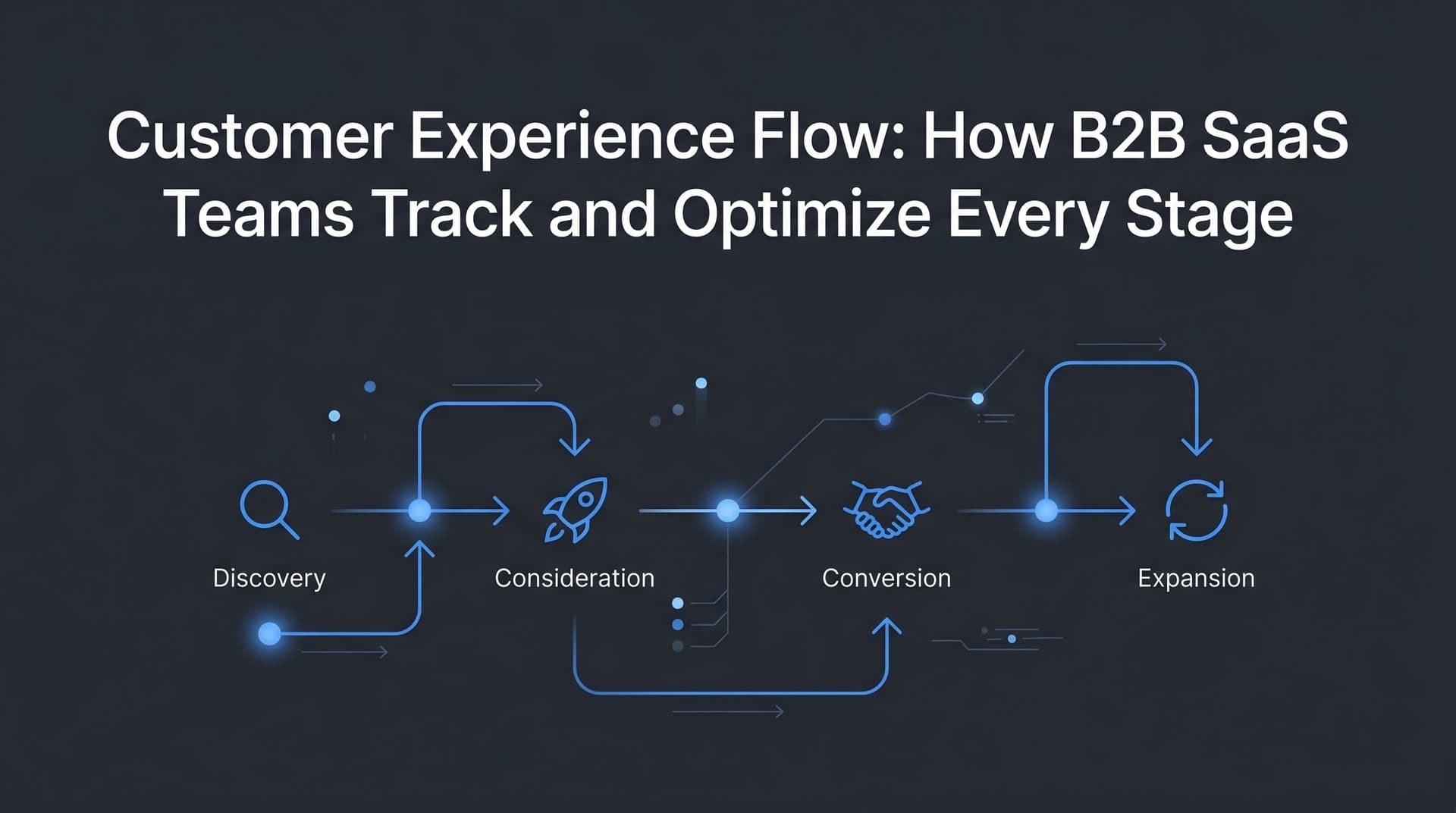
In B2B SaaS specifically, the flow typically moves through six recognizable stages: awareness, consideration, evaluation, conversion, onboarding, and expansion. Each stage requires a different approach to both messaging and measurement.
Awareness: The prospect encounters your brand for the first time. Paid ads, organic content, and social media are the primary drivers here. The goal is visibility and relevance, not conversion.
Consideration: The prospect is actively researching solutions. Content marketing, SEO, and comparison resources play a central role. Measurement here focuses on engagement quality, not just volume.
Evaluation: The prospect is assessing your product against alternatives. Demo requests, free trials, and sales conversations become the critical touchpoints. This stage often involves multiple stakeholders.
Conversion: The prospect becomes a customer. Attribution data here connects marketing activity to closed-won revenue, which is where most teams want to focus but rarely have the infrastructure to do accurately.
Onboarding and Expansion: The customer activates and grows their usage. Marketing's role shifts toward retention and upsell, but the flow data collected here informs future acquisition campaigns.
It is worth distinguishing customer experience flow from customer journey mapping. Journey maps are typically static documents built on assumptions about how buyers behave. They are useful for alignment but do not update based on what is actually happening in your data.
Customer experience flow, by contrast, is dynamic. It reflects real behavioral signals from real prospects moving through your marketing and sales ecosystem in real time. It changes as your channels change, as your buyer behavior shifts, and as your product evolves. That distinction matters because the decisions you make based on static assumptions and the decisions you make based on live attribution data can be very different.
Why B2B SaaS Flows Are Harder to Track Than They Look
If you have ever tried to answer the question "which campaign generated this deal?" and found yourself staring at conflicting data across three different tools, you already understand the core problem. B2B SaaS flows are genuinely difficult to track, and the reasons go deeper than most teams initially realize.
The first challenge is the length and complexity of the sales cycle. Unlike B2C purchases that often resolve in a single session, B2B SaaS deals typically unfold over weeks or months and involve multiple stakeholders. A champion inside the buying organization might engage with your content for weeks before looping in a decision-maker who has never seen your brand before. Standard analytics tools are not built to handle that kind of multi-person, multi-session journey.
The second challenge is data fragmentation. Your ad performance data lives in Google Ads and LinkedIn Campaign Manager. Your lead data lives in your CRM. Your product usage data lives in your analytics tool. Each system has its own attribution logic, its own session windows, and its own definition of a conversion. When these systems are not connected, you end up with a different story from each one, and no single source of truth. Building a reliable system to track the customer journey across all of these touchpoints is what separates teams with clear flow visibility from those operating on guesswork.
Channel proliferation makes this worse. A single prospect might encounter your brand through paid search, a LinkedIn sponsored post, an organic blog article, a retargeting campaign, and a direct email sequence before ever speaking to sales. Without a unified tracking infrastructure, each of those channels will claim credit for the conversion, and the picture you get is distorted at best.
The third challenge is the gap between marketing-qualified leads and actual revenue. Many teams optimize their campaigns toward MQL volume because it is the metric they can measure reliably. But MQL volume and closed-won revenue are not the same thing. A campaign that generates a high volume of leads that never convert to pipeline is not a successful campaign, even if it looks like one in your ad platform dashboard.
Offline conversions and sales-assisted deals add another layer of complexity. When a prospect requests a demo, has three discovery calls, and then signs a contract, the final conversion event often happens outside any digital tracking system. Unless your team has built a process for connecting CRM outcomes back to marketing touchpoints, those deals become invisible in your attribution data.
The result is that most B2B SaaS marketing teams are optimizing based on partial information. They can see the top of the funnel clearly. They have some visibility into the middle. But the connection between marketing activity and actual revenue remains murky, which means budget decisions are made on incomplete evidence.
The Touchpoints That Actually Shape Buying Decisions
Not all touchpoints carry equal weight in a B2B SaaS customer experience flow. Understanding which interactions actually move prospects toward a decision, and which ones are passive noise, is one of the most valuable things attribution data can reveal.
Paid ads at the top of funnel serve an awareness function. They introduce your brand to prospects who may not have been actively searching for a solution. LinkedIn ads are particularly effective in B2B SaaS for reaching specific job titles, industries, and company sizes. The goal at this stage is not immediate conversion but qualified engagement: getting the right people to take a meaningful next step.
Content and SEO touchpoints tend to dominate the consideration stage. A prospect who finds your blog post through organic search while researching a specific problem is already demonstrating intent. They are not just browsing. They are actively looking for information that will help them make a decision. Tracking these touchpoints accurately requires connecting your SEO and content analytics to the same attribution model you use for paid channels. Understanding what customer journey touchpoints are and how they interact is foundational to building that model correctly.
Demo requests and free trial signups are the highest-intent touchpoints in most B2B SaaS flows. When a prospect asks to see your product in action or signs up to use it themselves, they are signaling serious evaluation intent. These interactions carry far more predictive weight than a content download or a page view, even though many attribution setups treat all events with similar weight unless specifically configured otherwise.
Sales interactions and nurture sequences close the gap between evaluation and decision. The conversations that happen between a demo and a signed contract are often where the real buying decision is made. These touchpoints are the hardest to track digitally, but connecting them to your attribution model through CRM integration is what separates a complete flow picture from a partial one.
This is where the choice of attribution model becomes consequential. A last-click model assigns all credit to the final touchpoint before conversion, which in B2B SaaS is often a direct visit or a branded search. That tells you very little about what actually drove the decision. A first-touch model overcredits the initial awareness channel and ignores everything that happened in between.
Multi-touch attribution models distribute credit across the touchpoints that actually influenced the journey. Linear, time-decay, and position-based models each make different assumptions about how value should be distributed, and the right choice depends on your specific sales cycle and channel mix. The key insight is that the model you choose directly changes which channels appear to be performing, which means it directly influences where you invest your budget.
Touchpoint quality matters as much as touchpoint quantity. A single high-intent interaction, such as a demo request from a targeted LinkedIn ad campaign, often carries more predictive value than dozens of passive impressions. Building your attribution setup to reflect that distinction is what makes your flow data actionable rather than just descriptive.
Measuring Customer Experience Flow With Attribution Data
Understanding your customer experience flow conceptually is one thing. Measuring it accurately is another. The technical infrastructure you build to track the flow determines the quality of every insight and decision that follows.
The foundation is connecting your ad platform data to your CRM events and revenue data. This sounds straightforward but requires intentional architecture. When a prospect clicks a LinkedIn ad, lands on your website, fills out a demo request form, goes through a sales process, and eventually closes as a customer, you need a system that can connect all of those events back to the original ad click. Without that connection, you cannot calculate true return on ad spend, and you cannot know which campaigns are actually generating revenue. This is precisely the challenge that SaaS revenue attribution is designed to solve.
Server-side tracking has become increasingly important for maintaining this accuracy. Browser-based tracking, which relies on cookies and client-side JavaScript, is becoming less reliable as privacy regulations evolve and ad blockers become more widespread. Server-side tracking sends conversion data directly from your server to ad platforms, bypassing the browser entirely. This preserves attribution accuracy regardless of what is happening in the user's browser environment.
First-party data collection is the other critical piece. When you collect data directly from your own systems, through your CRM, your product, and your website, you are not dependent on third-party data sources that can disappear or degrade. First-party data is more accurate, more durable, and more useful for building a complete flow picture.
Pipeline and revenue attribution take this a step further by connecting marketing activity to the outcomes that actually matter to the business. Instead of measuring success by MQL volume or cost per lead, pipeline attribution measures how much qualified pipeline each channel and campaign generates. Revenue attribution measures how much closed-won revenue can be traced back to specific marketing investments.
This shift in measurement changes the conversation inside your organization. When marketing can show that a specific campaign generated a measurable amount of pipeline and a specific amount of closed revenue, the discussion moves away from vanity metrics and toward business outcomes. Finance and leadership teams care about revenue, not impressions. Pipeline and revenue attribution give marketing the language to speak in those terms.
This is where platforms like Cometly become the practical infrastructure layer for B2B SaaS teams. Cometly connects every touchpoint from the first ad click to closed-won revenue, integrating with your ad platforms, CRM, and website to create a unified flow map that updates in real time. Rather than manually stitching together data from disconnected systems, teams get a single source of truth that shows exactly where prospects are in the flow, which channels brought them there, and which campaigns are generating actual revenue.
With more than 70 native integrations and support for server-side conversion tracking and Conversion API connections, Cometly is built specifically for the kind of multi-channel, multi-stakeholder environment that B2B SaaS teams operate in. The result is flow visibility that is accurate, current, and actionable.
Optimizing Each Stage of the Flow Using Marketing Intelligence
Measuring your customer experience flow is the prerequisite. Optimizing it is where the real growth happens. The question is not just which channels are generating conversions, but which channels are generating the right conversions: prospects who move through the full flow to become customers, and customers who stay and expand.
AI-driven marketing intelligence makes this distinction visible. By analyzing patterns across your full flow data, AI can surface which ads and campaigns are generating leads that actually convert to pipeline and revenue, rather than just generating volume at the top of funnel. This is a fundamentally different signal than what most ad platforms report natively. A campaign that generates a high volume of demo requests looks successful in isolation. But if attribution data shows that those leads consistently stall at the evaluation stage and rarely close, the campaign is not performing as well as it appears. Applying customer journey optimization principles to this data is what turns those insights into measurable improvements.
The ability to identify these patterns early allows teams to make proactive adjustments rather than reactive ones. Instead of waiting until the end of a quarter to discover that a campaign underperformed, you can see mid-flight that the leads it generates are not progressing through the flow and redirect budget accordingly.
Enriched conversion data fed back to ad platforms through Conversion API integrations creates a compounding optimization effect. When you send high-quality, first-party conversion signals back to Meta, Google, and LinkedIn, their targeting algorithms use that data to find more prospects who match the behavioral profile of your best customers. This improves the quality of future traffic, which improves the quality of future leads, which generates better flow data, which further improves targeting. The loop compounds over time.
Cometly's Conversion API integration is built specifically to support this feedback loop. By sending enriched, conversion-ready events back to ad platforms, it helps those platforms optimize toward the outcomes that matter most to your business, not just the surface-level events they can observe natively.
Flow data also enables more strategic budget allocation decisions. When attribution data consistently shows that a specific channel drives prospects who stall at the evaluation stage, the answer is rarely to spend more on that channel. It might mean adjusting the messaging to attract higher-intent prospects, changing the offer to better qualify leads before they enter the evaluation stage, or revisiting the sales handoff process to understand why those prospects are not converting.
This kind of flow-informed decision-making requires moving beyond channel-level reporting to stage-level analysis. The question is not just "which channel generated the most leads?" but "which channel generated leads that moved through each stage of the flow most efficiently?" That distinction drives fundamentally different optimization decisions.
Turning Flow Insights Into Scalable Growth
A well-measured customer experience flow is not just a reporting tool. It is a growth asset. When you can see exactly how prospects move through your marketing and sales ecosystem, you gain the ability to reduce waste, shorten cycles, and align your entire revenue team around the same data.
Wasted ad spend is one of the most immediate benefits of flow visibility. When you can trace every dollar of ad spend to its impact on pipeline and revenue, underperforming campaigns become obvious. Budget that was previously allocated based on incomplete data can be redirected toward the channels and campaigns that demonstrably drive revenue. This does not require spending more. It requires spending smarter, based on evidence rather than assumption.
Flow data also accelerates sales cycles by surfacing high-intent signals earlier. When marketing can see which behavioral patterns correlate with fast-moving deals, those signals can be used to prioritize outreach, trigger automated nurture sequences, or alert sales reps to engage at the right moment. The result is a shorter path from first touch to closed deal.
Perhaps most importantly, a shared flow data model aligns marketing and sales around the same revenue metrics. Marketing stops optimizing for MQL volume. Sales stops treating every lead as equal. Both teams can see the same picture of how prospects move through the flow, where they accelerate, and where they stall. That shared visibility creates the foundation for genuine collaboration rather than the finger-pointing that often characterizes the marketing-sales relationship in B2B SaaS organizations.
Continuous flow analysis enables compounding improvements over time. Each optimization you make generates better data, which informs better decisions, which produces better outcomes. The attribution model becomes more accurate as it learns from more complete data. The campaigns become more efficient as the targeting algorithms receive better conversion signals. The sales process becomes more effective as it is informed by clearer flow insights.
Cometly is built to be the infrastructure layer that makes this possible. By connecting ad platforms, CRM data, and website behavior into a single real-time view, it gives B2B SaaS teams the flow visibility they need to make every stage of the customer journey measurable and improvable. The AI-powered recommendations layer surfaces the patterns that matter most, so teams can act on insights rather than spend hours in spreadsheets trying to find them.
Your Next Steps Toward Full Flow Visibility
Customer experience flow is not a static diagram you draw once and file away. It is a living data asset that reflects how real buyers move through your marketing and sales ecosystem right now, today, based on real behavioral signals from real campaigns.
The teams that treat it that way, as something to measure continuously and optimize systematically, are the ones that build durable competitive advantages. They waste less budget. They close deals faster. They attract better-fit customers. And they make better decisions because they are working from complete information rather than partial data stitched together from disconnected tools.
The first step is auditing your current attribution setup. Where does your flow visibility break down? Is it the connection between ad clicks and CRM events? The gap between pipeline data and closed revenue? The inability to track multi-stakeholder journeys across a long sales cycle? Identifying the specific gaps is what makes the path to better measurement clear.
From there, the goal is building the infrastructure to close those gaps: server-side tracking, first-party data collection, CRM integration, and a unified attribution model that connects every touchpoint to the outcomes that matter most to your business.
Ready to see your full customer experience flow from first ad click to closed revenue? Get your free demo and discover how Cometly can help you map, measure, and optimize every stage of the journey with real-time attribution data and AI-powered recommendations.