
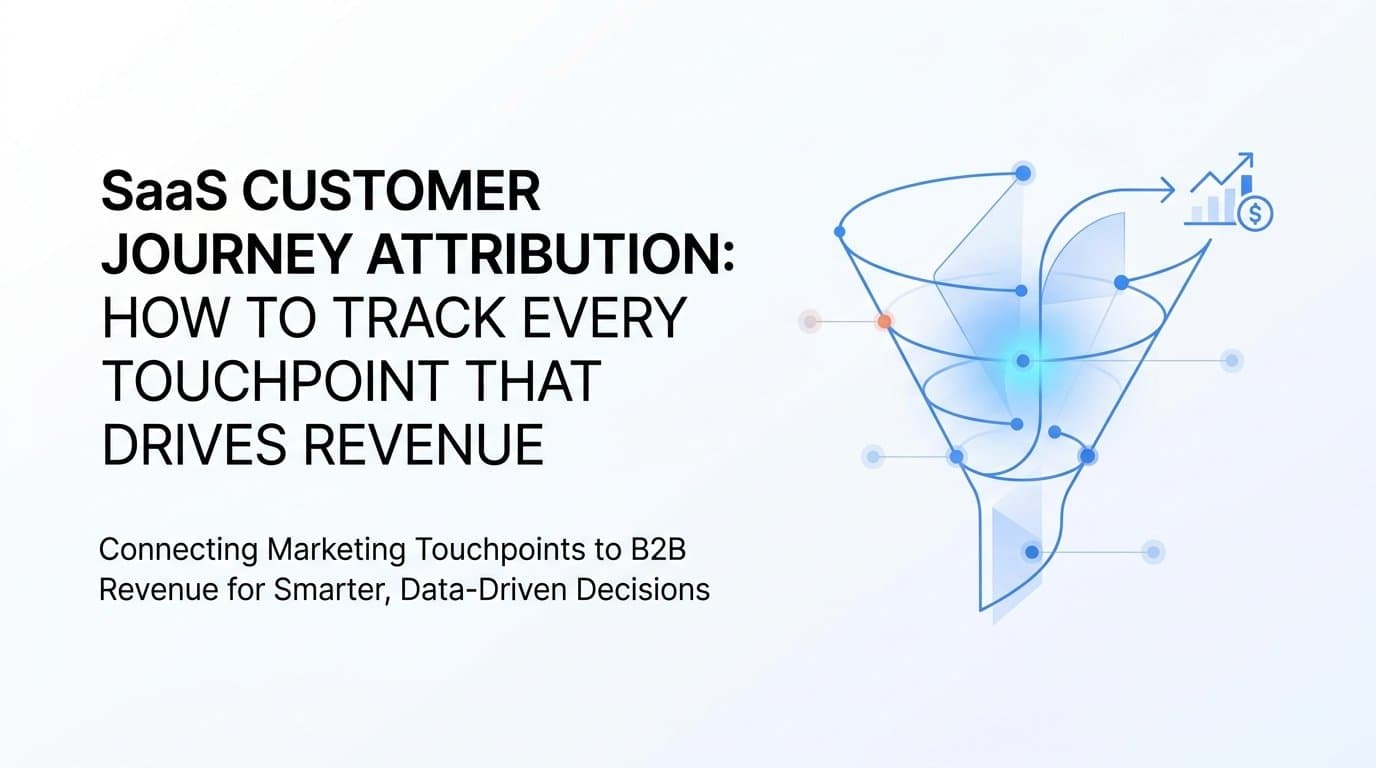
When a prospect signs a contract six weeks after clicking a LinkedIn ad, watching a YouTube demo, and attending a webinar, which of those touchpoints gets credit? The answer shapes every budget decision you make.
This is the central challenge facing every B2B SaaS marketing team running campaigns across multiple channels. You are generating leads, nurturing prospects, and closing deals, but somewhere between the first ad impression and the signed contract, the thread breaks. You cannot reliably connect what you spent to what you earned.
SaaS customer journeys are uniquely complex. They span weeks or months, involve multiple stakeholders, and touch dozens of channels before a deal closes. Standard analytics tools were not built for this kind of journey. They capture fragments, not the full picture. And when you make budget decisions based on fragments, you inevitably over-invest in the wrong channels and under-invest in the ones actually driving revenue.
This guide breaks down how SaaS customer journey attribution works, why it matters more than most teams realize, which attribution models fit the B2B SaaS context, and how to build a system that connects your ad spend to closed-won revenue. Whether you are just starting to think about multi-touch attribution or looking to sharpen an existing setup, this is the strategic foundation you need.
Why the SaaS Customer Journey Is Harder to Track Than You Think
Most SaaS buyers do not convert on first contact. That is not a pessimistic assumption; it is simply how B2B purchasing decisions work. A prospect might discover your product through a paid search ad, visit your website, and leave without taking any action. Weeks later, they see a retargeting ad on LinkedIn. They click through, read a few blog posts, and download a guide. A month after that, they request a demo. If your attribution system only captures the demo request, you have missed everything that built the relationship up to that point.
This is the structural problem with single-touch attribution in a SaaS context. First-touch and last-touch models were designed for short, linear buying journeys. When someone clicks an ad and buys a product in the same session, last-click attribution works fine. But B2B SaaS deals rarely close in a single session, and the journey is rarely linear.
Multiple stakeholders make this even harder. Consider a typical mid-market SaaS deal. A marketing manager discovers your product through a paid ad and becomes an internal champion. They share a demo video with their VP. The VP forwards a case study to the CFO. The CFO visits your pricing page and reads your security documentation before giving the green light. Each of those interactions is a real touchpoint that influenced the outcome. But standard analytics tools only see the sessions tied to a single browser or device. The CFO's pricing page visit looks like an anonymous session with no prior history.
There is also a fundamental gap between lead generation and revenue recognition that is unique to SaaS. A free trial signup or demo request is not revenue. It is a signal of intent, but it sits at the beginning of a conversion process that might take another four to eight weeks to complete. Most marketing teams track leads because that data is easy to capture. Connecting those leads to closed-won deals requires pulling CRM data into the picture, and that is where most attribution setups fall short.
The result is a measurement environment where marketers know a lot about the top of the funnel and very little about what actually drove revenue. Budget decisions get made on lead volume and cost-per-lead rather than pipeline contribution and revenue impact. That is an expensive way to operate when you are scaling ad spend.
The Core Stages of a SaaS Customer Journey and What to Attribute at Each One
Understanding attribution starts with mapping the journey itself. A SaaS customer journey typically moves through three broad phases, and each phase requires a different attribution focus.
Awareness and Discovery: This is where prospects first encounter your brand. Paid search ads, social media content, YouTube pre-rolls, and organic blog posts all play a role here. Attribution at this stage is about identifying which channels are surfacing your brand to the right audience, not just which ones generate clicks. A channel might drive significant impressions and initial visits without producing immediate conversions, but it is still doing essential work. First-touch attribution is most relevant here because it answers the question: how did this prospect find us in the first place?
Consideration and Evaluation: Once a prospect knows you exist, they move into a deeper evaluation phase. They compare you to alternatives, read reviews, watch demo videos, and engage with your content more deliberately. Demo requests, free trial signups, pricing page visits, webinar registrations, and email sequence engagement all happen in this phase. These are high-intent actions, and they are critical for understanding which channels produce qualified pipeline rather than just raw volume. A channel that drives a lot of top-of-funnel traffic but produces very few evaluation-stage actions is telling you something important about audience quality.
Decision and Closed-Won: The final phase is where the deal closes. This involves CRM events like opportunity creation, proposal sent, and closed-won, as well as sales activity like follow-up calls and contract negotiations. Attribution at this stage means connecting the closed deal back to every marketing touchpoint that contributed to it. This is the hardest part technically, because it requires your CRM data and your ad platform data to share a common identifier that links the prospect's first interaction to their eventual conversion.
Most SaaS marketing teams have reasonable visibility into the first two phases. They can see which ads drive clicks and which channels generate form submissions. The third phase is where attribution breaks down. Without a system that connects closed-won CRM data to marketing touchpoints, you are essentially flying blind on the most important question: which channels actually drive revenue?
The practical implication is that your attribution setup needs to span all three phases. Tracking only leads means you are optimizing for the wrong outcome. Tracking only closed deals without connecting them to earlier touchpoints means you cannot act on the insight. The full picture requires data flowing continuously from awareness through decision.
Attribution Models Explained for SaaS Marketing Teams
Attribution models are frameworks for distributing credit across the touchpoints in a customer journey. Each model answers a different question, and choosing the right one depends on what decision you are trying to make.
First-Touch Attribution: This model gives 100% of the credit to the channel or campaign that first introduced the prospect to your brand. It is useful for understanding which channels are generating awareness and bringing new audiences into your funnel. If you are trying to evaluate the reach and discovery impact of a top-of-funnel campaign, first-touch gives you a clear signal. The limitation is that it ignores everything that happened after that first interaction, which in a long B2B SaaS sales cycle is often the majority of the journey.
Last-Touch Attribution: Last-touch gives all credit to the final interaction before a conversion event. This is the default model in most analytics platforms and ad networks. It is simple to implement and easy to understand, but it systematically undervalues awareness and nurturing channels. If a prospect first found you through a LinkedIn ad six weeks ago but converted after clicking a Google Search ad, last-touch gives all the credit to Google Search and none to LinkedIn. Over time, this causes teams to over-invest in bottom-of-funnel channels and starve the top of the funnel of budget.
Linear Attribution: Linear models distribute credit equally across every touchpoint in the journey. If a prospect had five interactions before converting, each gets 20% of the credit. This is a more balanced approach than single-touch models, but it treats every touchpoint as equally important regardless of when it occurred or what action it drove.
Time-Decay Attribution: This model gives more credit to touchpoints that occurred closer to the conversion event, on the assumption that recent interactions had more influence on the decision. For SaaS teams with long sales cycles, time-decay can be useful for understanding which late-stage channels are most effective at closing deals.
Data-Driven Attribution: Data-driven models use machine learning to analyze your actual conversion paths and assign credit based on which touchpoints statistically correlate with higher conversion rates. This is generally the most accurate approach for teams with sufficient data volume, because it reflects your specific customer journey rather than applying a generic framework. For B2B SaaS companies with complex, multi-stakeholder journeys, data-driven attribution produces the most actionable insights.
For most B2B SaaS teams, the honest answer is that no single model is perfect. Multi-touch models, whether linear, time-decay, or data-driven, produce a far more accurate picture than single-touch alternatives. The goal is not to find the perfect model but to move beyond last-click and start seeing the full journey.
How to Build a Reliable Attribution System for Your SaaS Stack
Understanding attribution models is the strategic layer. Building a system that actually captures the data is the technical layer. Here is what a reliable SaaS attribution setup requires.
Connect Your Ad Platforms, Website, and CRM Into a Single Data Pipeline: Attribution only works when every system shares a common identifier. That identifier, typically a unique user ID or a UTM-tagged session parameter, must follow the prospect from their first ad click through every subsequent interaction to their eventual closed deal in your CRM. Without this thread, you cannot connect the dots. Most marketing stacks have the data; they just do not have a system that links it together. A dedicated attribution platform solves this by ingesting data from all your sources and mapping it to a unified customer journey.
Use Server-Side Tracking and Conversion API Integrations: Browser-based pixel tracking has become significantly less reliable in recent years. Safari's Intelligent Tracking Prevention, Firefox's enhanced privacy protections, and the widespread use of ad blockers all degrade pixel data. In 2026, relying solely on client-side pixels means you are likely missing a meaningful share of your conversion events. Server-side tracking captures events at the server level before they can be blocked or lost. Meta's Conversion API and Google's enhanced conversions are the standard implementations for sending accurate, first-party event data directly from your server to the ad platforms. This is no longer optional for teams that need accurate attribution data.
Define Your Conversion Events Before You Build: One of the most common attribution mistakes is tracking whatever is easy to track rather than what actually matters. Before you set up any tracking infrastructure, map out the specific events that represent meaningful progress through your funnel. This typically includes form submissions, trial activations, demo completions, opportunity creation in your CRM, and closed-won deals. Each event should be tracked consistently, passed back to your ad platforms for optimization, and connected to the prospect's full journey history. Without clear event definitions, your attribution data will be noisy and difficult to act on.
Bridge the CRM-to-Ad-Platform Gap: The most valuable attribution data lives in your CRM. Closed-won deals, MRR values, and customer lifetime data are all there. But most ad platforms only see what happens on your website. Bridging this gap means pushing CRM events, particularly opportunity creation and closed-won signals, back to your ad platforms so they can optimize toward actual revenue rather than raw leads. This is the difference between telling Google to find more form submitters and telling Google to find more customers who convert to paying accounts.
Turning Attribution Data Into Smarter Budget Decisions
Attribution data is only valuable if it changes how you allocate resources. Here is how to translate attribution insights into concrete budget decisions.
Distinguish Between Channels That Generate Leads and Channels That Generate Revenue: This is the most important distinction attribution enables. A channel might produce a high volume of leads at a low cost per lead while contributing very little to closed-won pipeline. Another channel might generate fewer leads at a higher cost but produce a disproportionate share of your revenue. Without attribution data connecting leads to deals, you will consistently over-invest in the first channel and under-invest in the second. Attribution lets you evaluate channels on their revenue contribution, not just their lead volume.
Identify Drop-Off Points in the Customer Journey: Attribution data reveals not just what is working but where the journey breaks down. If a particular channel consistently drives prospects to the awareness stage but those prospects rarely progress to evaluation, that is a signal. It might mean the channel is reaching the wrong audience. It might mean the handoff between marketing and sales needs improvement. It might mean your nurture sequences are not relevant to that audience segment. Attribution gives you the visibility to ask those questions with data rather than intuition.
Feed Enriched Conversion Data Back to Ad Platforms: Meta, Google, and LinkedIn all use conversion signals to train their optimization algorithms. When you send these platforms accurate, revenue-level conversion data rather than raw lead counts, their machine learning models can identify patterns in the audiences that actually become customers. This improves targeting quality over time, which means your ad spend reaches higher-value prospects and your cost per acquisition decreases. The feedback loop between your attribution system and your ad platforms is one of the highest-leverage optimizations available to a SaaS marketing team in 2026.
Review Attribution Data on a Regular Cadence: Attribution is not a set-it-and-forget-it analysis. Customer journeys evolve, new channels emerge, and your product and pricing changes affect which touchpoints matter most. Building a regular attribution review into your marketing operations, whether weekly for tactical decisions or monthly for budget planning, ensures that your spending reflects current reality rather than assumptions that were valid six months ago.
Putting It All Together: Attribution as a Growth System
The progression through this guide mirrors the progression every SaaS marketing team needs to make. Start by accepting that the SaaS customer journey is genuinely complex and that simple attribution models will give you a distorted picture of reality. Then map the journey stages and understand what needs to be attributed at each one. Choose attribution models that reflect the multi-touch nature of B2B buying decisions. Build the technical infrastructure to capture every touchpoint accurately, including server-side tracking and CRM integration. And finally, use the data to make smarter budget decisions and feed better signals back to your ad platforms.
What makes this a growth system rather than a one-time project is that it improves continuously. The more complete your touchpoint data, the more accurate your revenue attribution becomes. The more accurate your attribution, the better your budget decisions. The better your budget decisions, the more efficiently you scale. And as you feed richer conversion signals back to your ad platforms, their optimization engines become more effective at finding the customers who actually convert.
This is where Cometly comes in. Built specifically for B2B SaaS teams, Cometly connects your ad platforms, website, and CRM into a single attribution system that tracks every touchpoint from the first ad click to closed-won revenue. With multi-touch attribution, server-side tracking, Conversion API integration, and AI-powered insights, Cometly gives growth teams a single source of truth for the entire customer journey. You can see which channels contribute to pipeline, compare attribution models side by side, and send enriched revenue signals back to Meta and Google to improve algorithmic targeting. It is the purpose-built infrastructure that makes SaaS customer journey attribution actually work in practice.
If your team is currently making budget decisions based on last-click data or platform-reported conversions alone, you are optimizing on incomplete information. Every dollar you shift toward a channel based on lead volume rather than revenue contribution is a dollar that could have compounded your growth instead. The path forward is a complete attribution system, and the time to build it is now.
Ready to see exactly which touchpoints are driving your revenue? Get your free demo and discover how Cometly connects your entire SaaS customer journey, from the first impression to closed-won, in one clear, actionable platform.