
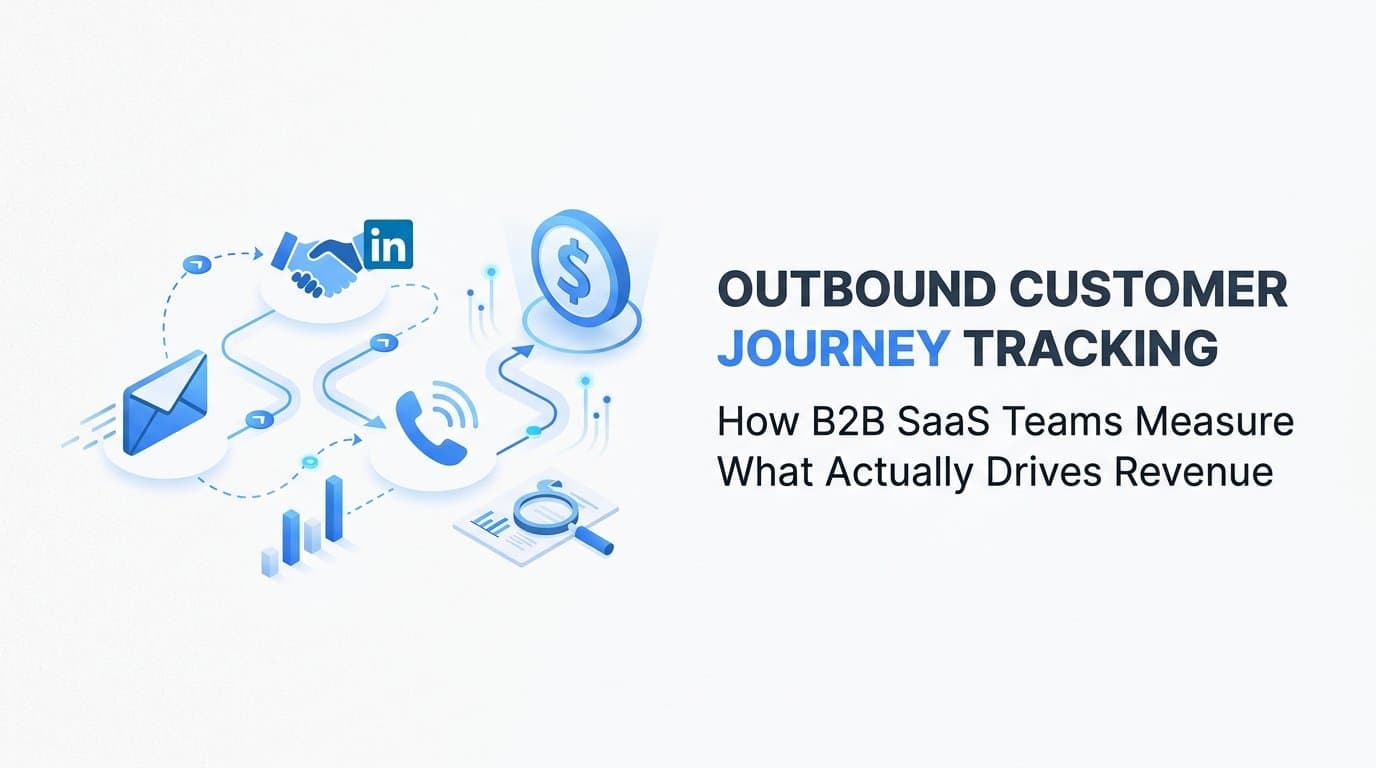
Most B2B SaaS marketing teams running outbound campaigns can tell you how many emails got opened, how many LinkedIn messages got replies, and how many meetings got booked. What they struggle to tell you is which of those outbound efforts actually produced revenue. That gap between outbound activity and closed-won deals is where most attribution falls apart, and it costs teams real money in the form of misdirected budget and wasted rep time.
The core tension is this: outbound campaigns generate a trail of signals across email platforms, dialers, LinkedIn, and ad networks, but those signals rarely connect cleanly to what eventually happens inside the CRM. The moment a prospect enters a sales sequence and starts moving through pipeline stages, the marketing data often stops following along. You end up with two separate stories where marketing sees engagement metrics and sales sees pipeline, but nobody can read the full chapter from first touch to closed deal.
This article is a practical guide to closing that gap. We will walk through why outbound journeys are uniquely difficult to track, which touchpoints actually matter, how to build the infrastructure to capture them, and how to use that data to make smarter decisions about where to invest your outbound efforts. If you are tired of guessing which campaigns drive real pipeline, this is where to start.
Why Outbound Journeys Are Harder to Track Than Inbound Ones
Inbound marketing has a natural advantage when it comes to tracking: the prospect comes to you. They click an ad, land on your website, fill out a form, and hand you their information along with a clear signal of intent. Every step leaves a digital footprint that your analytics tools are designed to capture. Outbound flips that dynamic entirely, and standard tracking infrastructure was not built for it.
When you send a cold email or a LinkedIn message, you are initiating contact with someone who has not yet raised their hand. They may read your message, visit your website later that day through a direct search, attend a webinar two weeks later, and then finally book a demo after seeing a retargeting ad. Each of those moments happened because your outbound motion started the conversation, but a standard analytics setup will credit the retargeting ad because it was the last click before the conversion event. The outbound sequence that did the heavy lifting disappears from the attribution record entirely.
The data silo problem makes this worse. In most B2B SaaS companies, marketing data lives in ad platforms, email sequencing tools, and analytics platforms. Sales data lives in the CRM. These systems rarely talk to each other in a meaningful way. Marketing can see that a prospect opened three emails and clicked a link. Sales can see that the same prospect became an opportunity and eventually closed. But without a deliberate bridge between those systems, nobody can connect the original outreach to the eventual revenue event. The two stories exist in parallel rather than as one continuous journey.
Outbound also introduces touchpoints that are inherently difficult to track. A phone call leaves no pixel trail. A LinkedIn connection request and a follow-up message happen inside a closed platform. An in-person event conversation exists only in a rep's notes. These offline or semi-offline interactions are genuine touchpoints in the customer journey, but they require manual logging and system integration to become part of any attribution model. Most teams skip this step, which means their attribution data is incomplete before they even look at it.
The result is a systematic undervaluing of outbound. When attribution models cannot see the full journey, they credit the touchpoints they can see, which tend to be the inbound and paid touchpoints closer to the conversion event. Outbound teams then struggle to justify their budget and headcount because the data does not reflect their actual contribution to revenue. Fixing this requires rethinking both the infrastructure and the models used to interpret the data.
The Touchpoints That Matter in an Outbound Customer Journey
Before you can track an outbound journey, you need a clear map of what that journey actually looks like. Outbound B2B sales cycles are not linear, but they do follow a recognizable pattern of stages, and each stage has touchpoints that need tracking instrumentation to become visible in your attribution data.
The journey typically begins with some form of initial awareness or outreach. This might be a cold email, a LinkedIn connection request, a direct message, or a paid ad impression on a platform like LinkedIn or Google. These early touchpoints set the context for everything that follows. Even if the prospect does not respond immediately, that first exposure shapes how they interpret later interactions with your brand.
From there, the journey moves through engagement touchpoints: email opens, link clicks, reply messages, profile views, and ad interactions. These signals tell you that a prospect is paying attention, but they are not conversion events. They are indicators of interest, and they matter for understanding which sequences and messages resonate with which types of prospects. Tracking them gives you the early-funnel data you need to optimize outreach quality.
Conversion touchpoints are a different category entirely, and they carry more weight in attribution. A meeting booked, a demo attended, an opportunity created in the CRM, a proposal sent, and a deal closed are all conversion events that represent real movement through the pipeline. These are the moments that connect outbound activity to business outcomes, and they need to be captured with precision rather than approximated from engagement data.
Here is where it gets more complex for outbound-heavy teams: paid channels often run in parallel with outbound sequences. A prospect might receive a cold email on Monday, see a LinkedIn ad on Wednesday, visit your pricing page on Friday, and book a demo the following week after seeing a retargeting ad. In that scenario, the outbound email started the journey, but paid touchpoints contributed to the conversion. Neither channel deserves full credit, and neither should be invisible in your attribution model.
Engagement touchpoints to track: Email opens and clicks from sequencing tools, LinkedIn message replies and profile visits, ad impressions and clicks from LinkedIn and Google campaigns, and website sessions that originate from outbound-linked URLs.
Conversion touchpoints to track: Meeting booked events tied to specific sequences or reps, opportunity created events in the CRM with source attribution, proposal sent and demo completed stages, and closed-won events with deal value and time-to-close data.
Mapping these touchpoints before you build your tracking infrastructure ensures that you instrument the right events rather than capturing data that looks busy but does not connect to revenue. The goal is a complete picture of the journey from first outbound signal to closed deal, with every meaningful moment in between accounted for.
Building an Outbound Tracking Infrastructure That Actually Works
Knowing which touchpoints matter is the first step. Building the infrastructure to capture them reliably is where most teams either succeed or give up. The good news is that the core components are well understood. The challenge is implementing them consistently across every outbound channel and making sure the data flows into a single place where it can be analyzed.
Start with UTM parameters in every outbound email and sequence. Every link you include in a cold email or LinkedIn message should carry UTM tags that identify the campaign, the channel, the specific sequence, and ideally the rep sending it. When a prospect clicks that link and visits your website, those UTM parameters get captured in your analytics platform and attached to any subsequent conversion event on that session. This creates a traceable connection between the outbound touch and the web behavior that followed it.
The implementation is straightforward in most email sequencing tools. You define a UTM structure, apply it consistently across campaigns, and then verify that your analytics platform is capturing those parameters correctly. The discipline is in maintaining consistency. If some emails have UTMs and others do not, your data will have gaps that make analysis unreliable. Build UTM generation into your campaign creation process so it becomes a standard step rather than an afterthought.
Server-side tracking is the next critical layer. Browser-based pixels miss a meaningful portion of conversion events because of ad blockers, browser privacy settings, and the ongoing changes to how browsers handle third-party cookies. If you are relying solely on a pixel to capture demo bookings or form submissions from outbound-influenced prospects, you are likely undercounting conversions. Server-side tracking sends event data directly from your server to your attribution platform and to ad networks via their Conversion API integrations, bypassing the browser entirely. This improves data completeness and gives you a more accurate picture of how many conversions your outbound campaigns are actually generating.
The third component is syncing CRM pipeline data back to your attribution platform. This is the step that most teams skip, and it is the one that matters most for connecting outbound activity to revenue. When an opportunity is created in Salesforce or HubSpot, that event needs to flow back to your attribution system along with the deal value, the stage, and the eventual closed-won outcome. Without this sync, your attribution data stops at the conversion event closest to the top of the funnel, and you can never see which outbound touchpoints contributed to deals that actually closed.
Platforms like Cometly are built specifically to solve this integration challenge for B2B SaaS teams. By connecting ad platforms, CRM data, website events, and revenue data in one place, Cometly gives outbound teams a continuous view of the customer journey from first ad impression or cold email all the way through to closed-won revenue. The Stripe revenue sync and native CRM integrations mean that pipeline and revenue data are connected to the original touchpoints rather than sitting in isolation inside separate tools.
When these three components work together, UTM tracking, server-side event capture, and CRM revenue sync, you have an outbound tracking infrastructure that can actually answer the questions that matter: which sequences drive pipeline, which ad and email combinations produce the fastest closes, and where your outbound budget is generating real return.
Attribution Models and Which One Fits Outbound Motions
Even with solid tracking infrastructure in place, the attribution model you choose will determine whether your data tells an accurate story or a misleading one. For outbound B2B motions with long sales cycles and multiple touchpoints, model selection is not a minor technical detail. It fundamentally shapes how your team understands what is working.
Last-click attribution is the default in many analytics tools, and it is consistently the worst fit for outbound. The reason is structural: in a long B2B sales cycle, the final click before a conversion event is almost always a branded search or a retargeting ad. The prospect received your cold email weeks earlier, visited your site, saw your ads, read your content, and finally typed your brand name into Google before booking a demo. Last-click gives all the credit to that branded search click and zero credit to the outbound sequence that introduced them to your brand in the first place. Your outbound team looks ineffective. Your paid brand campaign looks like a revenue engine. Neither conclusion is accurate.
First-touch attribution has the opposite problem. It gives all the credit to the very first touchpoint, which in an outbound scenario might be a cold email that prompted a website visit weeks before the prospect was ready to buy. That email deserves some credit, but attributing the entire deal to it ignores everything that happened in between to nurture the prospect toward a decision.
Multi-touch attribution distributes credit across the full customer journey, which makes it a much better fit for outbound B2B motions. Linear attribution spreads credit equally across every touchpoint. Time-decay attribution gives more weight to touchpoints closer to the conversion event. Position-based attribution, sometimes called U-shaped or W-shaped depending on the variant, gives heavier weight to the first and last touches while distributing the remainder across middle touchpoints. Each of these models is more honest than last-click for outbound scenarios because they acknowledge that multiple interactions contributed to the deal.
Data-driven attribution takes this further by using machine learning to weight touchpoints based on actual conversion patterns in your data rather than applying a fixed rule. Instead of assuming that the first touch and last touch are equally important, a data-driven model analyzes which touchpoint combinations actually correlate with closed deals and assigns credit accordingly. For outbound teams with enough conversion volume to train a model, this approach produces the most accurate picture of what is driving revenue.
The practical implication is this: if you are currently using last-click attribution to evaluate your outbound campaigns, you are almost certainly undervaluing them. Switching to a multi-touch model, or ideally a data-driven one, will likely reveal that outbound sequences are contributing to pipeline at a much higher rate than your current reports suggest. That insight changes how you allocate budget, how you set rep priorities, and how you make the case for outbound investment to leadership.
Turning Outbound Journey Data Into Smarter Campaign Decisions
Tracking data is only valuable if it changes how you make decisions. Once you have an outbound tracking infrastructure in place and an attribution model that accurately reflects your go-to-market motion, the next step is using that data to optimize your campaigns, your sequences, and your budget allocation.
Start by analyzing which outbound sequences or combinations of outbound and paid touchpoints produce the shortest time-to-close and the highest average deal values. These are your highest-performing journeys, and they deserve more investment. If a specific cold email sequence followed by a LinkedIn retargeting campaign consistently produces deals that close in fewer days than other combinations, that pattern is worth scaling. Conversely, sequences that generate meeting bookings but rarely convert to closed-won deals are consuming rep time without producing proportional revenue, and that insight should prompt a review of either the targeting or the sequence messaging.
Journey data also helps you identify where prospects are dropping out of the funnel. If a large percentage of prospects book demos but do not move to the proposal stage, the problem is likely in the demo experience or the qualification process, not the outbound sequence that generated the meeting. Without journey-level visibility, this kind of diagnosis is impossible. You end up optimizing the top of the funnel when the real problem is in the middle.
One of the most powerful applications of outbound journey data is feeding enriched conversion events back to ad platforms. When you send high-quality first-party conversion data back to Meta, Google, and LinkedIn through their Conversion APIs, those platforms can optimize their algorithms toward prospects who resemble your best outbound-converted customers. This creates a compounding feedback loop: your outbound data improves your paid targeting, your paid targeting reaches better-fit prospects, and those prospects convert at higher rates through your outbound sequences. Over time, both motions become more efficient because they are learning from the same pool of conversion data.
Cometly is designed to enable exactly this kind of feedback loop. By capturing enriched conversion events and sending them back to ad platforms while simultaneously connecting them to CRM revenue data, Cometly gives your ad platform algorithms the signal quality they need to optimize toward real pipeline rather than surface-level engagement metrics.
Finally, build a unified dashboard that shows outbound pipeline contribution alongside paid channel performance. When leadership can see outbound-sourced pipeline, outbound-influenced revenue, and paid channel ROI in a single view, they have the context to make resource allocation decisions that reflect how your go-to-market motion actually works. Siloed reporting produces siloed thinking. A single source of truth for revenue attribution across all channels produces better strategy.
From Outbound Activity to Revenue Clarity
The framework for outbound customer journey tracking comes down to four connected steps. Map the touchpoints that matter across your full outbound sequence, from first impression or cold email through to closed-won revenue. Build the infrastructure to capture those touchpoints reliably, using UTM parameters, server-side tracking, and CRM data sync. Choose an attribution model that reflects the multi-touch reality of B2B outbound sales cycles rather than defaulting to last-click. And connect all of that data to revenue outcomes so that your optimization decisions are grounded in what actually drives deals rather than what generates activity.
It is worth being direct about one thing: outbound customer journey tracking is not a one-time setup. It is an ongoing practice that improves as more data flows through the system. The first month of clean data will be useful. The sixth month will be significantly more useful because you will have enough conversion volume to identify patterns, test attribution model assumptions, and make confident decisions about where to invest. The teams that commit to this infrastructure early build a compounding advantage over those who continue to rely on incomplete data.
Cometly is built specifically for this challenge. It connects your ad platforms, CRM, website events, and revenue data into a single attribution view so that B2B SaaS teams can finally see which outbound efforts drive real pipeline. With multi-touch attribution, server-side tracking, Conversion API integration, and native CRM and Stripe revenue sync, Cometly gives you the infrastructure and the models you need to stop guessing and start making decisions backed by real data.
If your outbound campaigns are generating activity but you cannot connect that activity to closed revenue, the answer is not to run more sequences. The answer is to build the tracking infrastructure that makes every sequence, every ad, and every rep interaction visible in your attribution data. Start that process today.
Ready to stop guessing which outbound campaigns are actually driving revenue? Get your free demo and see how Cometly connects every outbound touchpoint to real pipeline and closed-won revenue, so your team can scale what works with confidence.