

There is a real tension sitting at the center of modern B2B SaaS marketing. On one side, you need rich, accurate data to make confident decisions about where to spend your budget, which campaigns are driving pipeline, and what is actually converting to closed revenue. On the other side, privacy regulations, browser restrictions, and platform policy changes are steadily eroding the data signals marketers have relied on for years.
This is not just a legal or compliance issue. It is a strategic one. When your attribution data degrades, your budget allocation decisions degrade with it. You end up cutting spend on channels that are quietly driving results, or doubling down on campaigns that look good in platform dashboards but have little connection to actual revenue.
For B2B SaaS marketing teams, the stakes are especially high. Longer sales cycles, multiple touchpoints across paid, organic, email, and sales channels, and the need to connect ad spend directly to pipeline and closed-won revenue make data quality non-negotiable. Losing even a fraction of your conversion signals can distort your entire attribution picture.
This guide is written for marketing teams who want to stay ahead of privacy changes without sacrificing the data quality they need to grow. The goal is not to help you do less with your data. It is to help you build a smarter, more durable tracking infrastructure that performs better precisely because it is privacy-aligned.
How Privacy Changes Are Reshaping the Tracking Landscape
The shift away from third-party cookies has been building for years, but the pace has accelerated. Apple's App Tracking Transparency framework, introduced with iOS 14, required apps to explicitly ask users for permission before tracking them across apps and websites. The impact on browser-based pixel tracking and mobile advertising signals was significant and well-documented by the ad platforms themselves.
Google has been moving in a similar direction with Chrome, progressively restricting third-party cookie access and signaling a longer-term shift toward privacy-preserving alternatives. Safari and Firefox already block third-party cookies by default. The result is that the browser environment marketers relied on to track user behavior across sessions and sites has become fundamentally less reliable.
These changes create what the industry calls signal loss. When a cookie cannot be set, when a pixel is blocked by a browser or an ad blocker, or when a user declines tracking consent, that conversion event goes unreported. The ad platform never learns that the click led to a form fill, a demo request, or a closed deal.
The downstream effect on ad platform algorithms is significant. Platforms like Meta and Google use conversion data to train their machine learning models. These models determine who sees your ads, how your budget is allocated across audiences, and how aggressively the system bids on high-intent users. When the conversion signals feeding those models are incomplete, the optimization degrades. Campaigns that appear to be underperforming may simply be underreported.
For B2B SaaS companies with complex, multi-touch customer journeys, this signal loss compounds quickly. A prospect might click a LinkedIn ad, return through organic search a week later, engage with a retargeting ad, and then book a demo through a direct visit. If any of those touchpoints go untracked due to cookie restrictions, the attribution model loses the thread. The result is an incomplete and often misleading picture of what is actually driving pipeline.
Understanding this landscape is the first step. The next is recognizing where the gaps appear in your own funnel and what they are costing you.
The Core Tension: Attribution Accuracy vs. Privacy Expectations
Traditional pixel-based tracking was built for a different era. A JavaScript snippet fires in the browser, reads a cookie, and sends an event back to the ad platform. It is simple, fast, and widely deployed. It is also increasingly unreliable in a privacy-first environment.
The gaps appear at predictable points. Users who decline cookie consent banners generate no pixel-based conversion data. Users on Safari or Firefox, where third-party cookies are blocked, create partial or broken attribution paths. Ad blockers, which are widely used among the technical and professional audiences that B2B SaaS companies often target, prevent pixels from firing entirely. Each of these scenarios creates a hole in your funnel data.
Here is where the real damage happens. When conversion data is incomplete, attribution models compensate in ways that distort your reporting. Last-click attribution, which already oversimplifies the customer journey, becomes even less accurate because the final trackable click may not actually be the most recent touchpoint. Channels that contribute early in the journey but are harder to track, such as display ads or top-of-funnel content, lose credit they legitimately earned. Budget flows toward channels that look good in incomplete data rather than channels that are genuinely driving revenue.
This creates a compounding problem for B2B SaaS marketing teams. If your attribution model consistently undervalues certain channels due to signal loss, you make decisions based on a distorted reality. You might reduce spend on a paid social campaign that is actually generating qualified pipeline, or over-invest in a channel that appears to dominate last-click attribution simply because it is easier to track.
The important distinction here is between collecting less data and collecting smarter data. Privacy regulations do not require you to fly blind. They require you to collect data in ways that respect user consent and operate within platform rules. The marketers who are navigating this transition successfully are not the ones who have given up on data. They are the ones who have rebuilt their data collection around first-party signals and server-side infrastructure.
Smarter data collection means being intentional about what you capture, where you capture it, and how you send it to the platforms and tools that depend on it. It means building a tracking architecture that is resilient to browser restrictions because it does not depend on the browser to do the heavy lifting.
Server-Side Tracking and Conversion APIs: Restoring Signal Quality
Server-side tracking is the most direct solution to the signal loss problem, and it works by moving data collection out of the browser entirely. Instead of relying on a JavaScript pixel firing in a user's browser, server-side tracking sends conversion events directly from your server to the ad platform. The browser's privacy settings, ad blockers, and cookie restrictions have no effect on a server-to-server data transfer.
Meta's Conversions API, commonly referred to as CAPI, and Google's Enhanced Conversions are the two most widely adopted implementations of this approach. Both are officially documented and recommended by their respective platforms as the preferred method for improving event match quality and data reliability in a privacy-restricted environment.
Meta CAPI allows you to send web events, app events, and offline events directly from your server to Meta's marketing API. When a lead fills out a form on your website, that event can be captured server-side and sent to Meta with hashed customer data such as email address, phone number, or other identifiers. This allows Meta to match the event to a user in its system with far greater accuracy than a browser pixel alone, especially when that user has opted out of browser-based tracking.
Google Enhanced Conversions works on a similar principle. When a conversion occurs, you send hashed first-party data alongside the conversion event, allowing Google to match it to a signed-in Google account. This improves the accuracy of conversion reporting and feeds better data into Smart Bidding algorithms.
The privacy alignment here is important to understand. Server-side tracking does not bypass user consent. It operates on first-party data that your users have provided directly to you, typically through form fills, account creation, or other owned interactions. That data is hashed before transmission, meaning it is not readable in plain text by the ad platform. The platform uses it only for matching purposes.
For B2B SaaS companies, the practical benefit is significant. When you send enriched, server-side conversion events back to Meta and Google, you restore the signal quality that browser restrictions have eroded. Your ad platform's algorithm gets a more complete picture of which ads are driving results. Optimization improves. Match rates improve. And your attribution data becomes a more accurate reflection of what is actually happening in your pipeline.
Running server-side tracking alongside your existing browser pixels, rather than replacing them, gives you redundancy. Events that the pixel misses due to ad blockers or cookie restrictions are captured server-side. The result is more complete conversion data across the board.
Building a First-Party Data Strategy That Supports Attribution
Server-side tracking is a critical piece of the infrastructure, but it works best when it is part of a broader first-party data strategy. First-party data is information collected directly from your users through channels you own: your website, your CRM, your email platform, your product. It is collected with user consent, it is not subject to third-party cookie restrictions, and it is the most durable data asset you can build in a privacy-first environment.
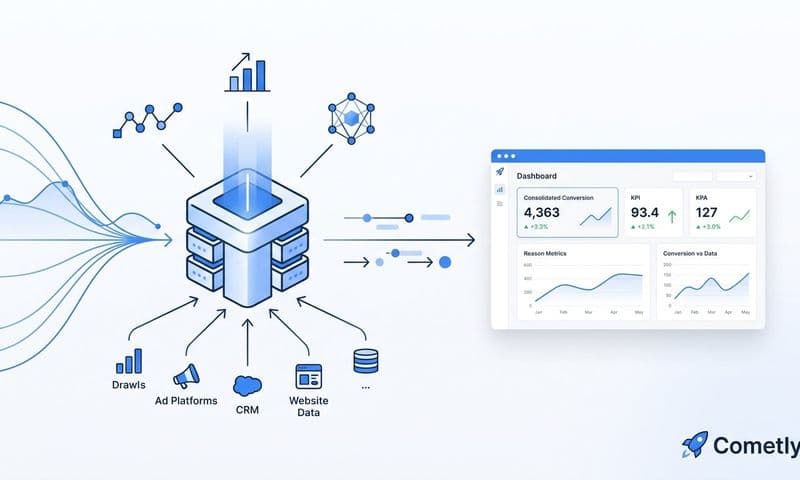
For B2B SaaS marketing teams, structuring your data flows correctly is what makes attribution work at scale. The goal is to create a connected system where your ad platform data, your website event data, and your CRM data all speak to each other. When a prospect clicks a paid ad, visits your site, fills out a demo request form, and eventually converts to a paying customer, every step of that journey should be trackable and attributable.
This requires intentional data architecture. Your CRM should capture lead source and campaign data at the point of form fill, not just at the point of sale. Your website should be instrumented to pass UTM parameters and session data into your forms so that CRM records carry attribution context. Your server-side events should include the identifiers needed to match ad platform records to CRM records.
Data enrichment plays an important role in closing the gaps between anonymous ad clicks and identified leads. When a user clicks an ad and arrives on your site, they are initially anonymous. The moment they fill out a form, they become identifiable. Connecting that identification event back to the original ad click, and forward to the eventual closed deal in your CRM, is what makes multi-touch attribution possible.
Consent-based data collection is not just a legal requirement. It is a quality signal. Users who actively engage with your content and provide their information are more likely to be genuinely interested in your product. Building your attribution foundation on this consent-aligned data means you are working with higher-quality signals from the start.
When you pair consent-based data collection with server-side event transmission, you create a tracking infrastructure that is both more reliable and more privacy-aligned than traditional pixel-based approaches. The data you collect is accurate because it comes directly from your users. The data you transmit is durable because it does not depend on browser behavior. And the attribution picture you build is more complete because you are capturing events across the full customer journey.
How Privacy-Aware Analytics Strengthens Ad Performance
There is a counterintuitive truth at the heart of privacy-aligned tracking: when you do it well, your ad performance often improves. The reason comes back to the machine learning models that power modern ad platforms.
Meta, Google, and other major platforms use conversion signals to train their optimization algorithms. The more complete and accurate those signals are, the better the algorithm can identify high-intent users, allocate budget efficiently, and improve campaign performance over time. When signal loss degrades the quality of that input data, the algorithm works with an incomplete picture and optimization suffers.
When you implement server-side tracking and feed enriched, first-party conversion data back to ad platforms, you are giving those algorithms better inputs. Better inputs produce better outputs. Marketers who have rebuilt their tracking infrastructure around server-side events and first-party data often report improved event match rates, which is the platform's measure of how well it can connect your conversion events to users in its system.
Higher match rates mean the platform has more confidence in its optimization decisions. It can identify which audience segments are converting, which ad creatives are driving quality leads, and where to allocate budget for the best return. The practical result is that your campaigns become more efficient over time, not less.
For B2B SaaS companies, the connection between data quality and budget scaling confidence is direct. When you trust your attribution data, you can make scaling decisions with conviction. You know which campaigns are driving pipeline. You know which channels are contributing to closed revenue. You can increase spend on what is working and reduce spend on what is not, based on accurate data rather than incomplete signals.
This is the competitive advantage that privacy-aware analytics creates. It is not just about staying compliant. It is about building a data infrastructure that performs better than the alternatives, because it is built on more reliable, more complete, and more accurately attributed information.
Putting It All Together: Your Path to Durable Attribution
The shift happening in marketing data is not temporary, and it is not going to reverse. Browser restrictions will continue to tighten. Privacy expectations among users will continue to grow. The marketers who treat this as a compliance burden will find themselves making increasingly poor decisions based on increasingly degraded data. The marketers who treat it as a strategic opportunity will build infrastructure that outperforms the competition.
The path forward starts with an honest audit of your current tracking setup. Where are your attribution gaps? Are you relying solely on browser-based pixels? Is your CRM capturing campaign data at the point of lead creation? Are you sending server-side conversion events back to your ad platforms? These are the questions that reveal where your data quality is at risk.
From there, the priorities are clear: implement server-side tracking to restore signal quality, build a first-party data strategy that connects your ad platforms, website, and CRM, and use consent-aligned data collection as the foundation for multi-touch attribution.
This is exactly where Cometly is built to help. Cometly is a marketing attribution and analytics platform designed specifically for B2B SaaS companies. It connects your ad platforms, CRM, and website to track the entire customer journey in real time. With server-side conversion tracking and Conversion API integration, Cometly captures the touchpoints that browser pixels miss. Its AI-driven recommendations help you identify which ads and campaigns are actually driving revenue, not just which ones look good in platform dashboards. And by feeding enriched, conversion-ready events back to Meta, Google, and other platforms, Cometly helps improve your ad platform's targeting and optimization performance.
For marketing teams ready to close their attribution gaps and build a tracking infrastructure that grows with them, the next step is to see it in action. Get your free demo today and start capturing every touchpoint with the precision and privacy alignment your B2B SaaS growth strategy demands.