

You've spent hours crafting the perfect email campaign. The subject line is sharp, the design is clean, and the copy drives action. You hit send, watch the open rates climb, see those clicks roll in, and feel that familiar rush of validation. Then you check revenue three weeks later and wonder: did any of that actually matter?
This is the frustration every email marketer knows too well. Your dashboard shows engagement, but your CFO wants to know about revenue. Your email platform celebrates clicks, but your boss asks which campaigns actually drove customers to buy. The gap between what email tools measure and what your business cares about can feel impossible to bridge.
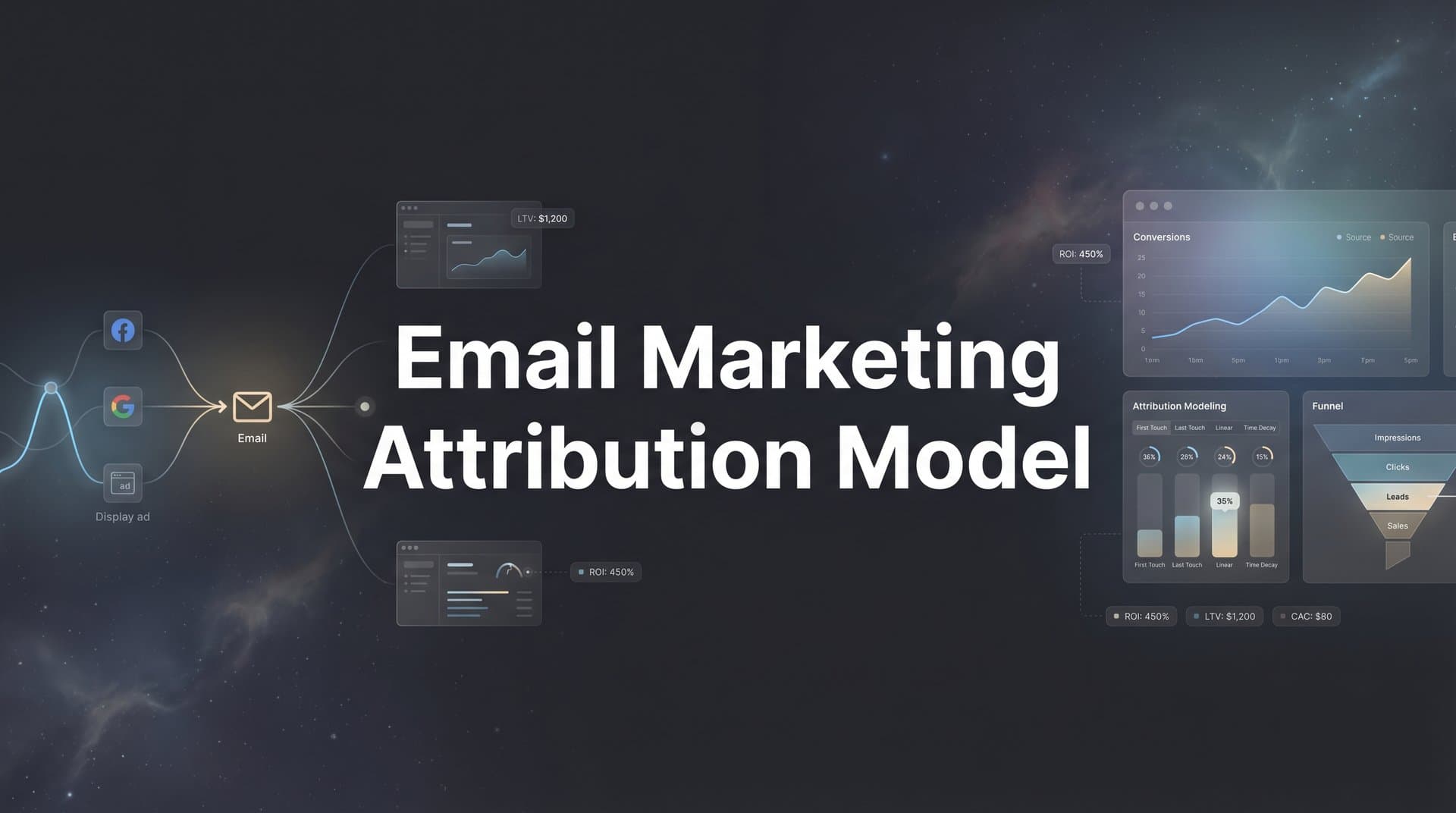
Email marketing attribution models solve this disconnect. They connect every email touchpoint—from that first welcome message to the tenth nurture email—to real business outcomes like leads, sales, and revenue. Instead of guessing which campaigns matter, you get a clear view of how email fits into the complete customer journey and exactly how much credit it deserves when someone converts.
The Attribution Challenge Every Email Marketer Faces
Open rates and click-through rates tell you if people engaged with your email. They don't tell you if those people became customers.
Think about your own inbox behavior. You might open a promotional email out of curiosity, click through to browse, then close the tab and forget about it. A week later, you see a Facebook ad from the same company, click again, and still don't buy. Two weeks after that, you Google the product directly and finally make a purchase. Which marketing channel gets credit for that conversion?
Traditional email metrics would celebrate that initial open and click as a success. But without attribution, you have no idea if that email actually influenced your decision to buy or if it was just noise in a longer journey.
This measurement gap gets worse when email plays a supporting role rather than a closing role. Your nurture sequences might introduce prospects to your solution, educate them over weeks, and build trust gradually. By the time they're ready to buy, they might convert through a direct website visit or a retargeting ad. Your email platform shows decent engagement numbers but zero conversions tied directly to email clicks.
The result? Email looks underperforming when measured in isolation, even when it's doing critical work throughout the customer journey. Understanding email marketing attribution tracking helps reveal this hidden value.
Multi-channel customer journeys make this even more complex. Your prospects don't experience your marketing one channel at a time. They see your LinkedIn ad, visit your website, sign up for your email list, ignore three nurture emails, click the fourth one, leave without converting, see a Google ad two days later, and finally purchase. Email is one thread in a complex web of touchpoints.
Without attribution, you're forced to make decisions based on incomplete data. You might cut budget from email campaigns that are actually driving conversions because the last click before purchase came from paid search. Or you might double down on promotional emails that generate clicks but never actually lead to revenue.
The gap between email engagement and revenue attribution isn't just a reporting problem. It's a strategic blindspot that leads to misallocated budgets, wrong optimization decisions, and missed opportunities to scale what's actually working.
Single-Touch vs. Multi-Touch: Choosing Your Attribution Approach
Attribution models answer one fundamental question: which touchpoints in the customer journey deserve credit for the conversion? The model you choose determines how you evaluate email performance and where you invest your effort.
First-touch attribution gives 100% of the credit to the first interaction a prospect has with your brand. If someone's initial contact with your company came through a welcome email after they downloaded a lead magnet, that email gets full credit for any eventual purchase.
This model makes sense when your primary goal is understanding what brings people into your ecosystem. For top-of-funnel email campaigns focused on awareness and acquisition, first-touch attribution shows which messages successfully introduce prospects to your brand. It's particularly useful for content-driven email strategies where the initial hook matters most.
But first-touch attribution has a glaring limitation: it ignores everything that happens after that first interaction. The nurture emails that educated the prospect, the promotional messages that created urgency, and the retention campaigns that brought them back all get zero credit. For complex sales cycles where multiple touchpoints matter, first-touch attribution oversimplifies reality.
Last-touch attribution takes the opposite approach. It gives 100% of the credit to the final touchpoint before conversion. If a prospect clicked your promotional email and purchased within the same session, that email gets full credit.
Last-touch works well for short sales cycles and direct-response campaigns. When your email is designed to drive immediate action and conversions happen quickly, last-touch attribution accurately reflects email's role. It's also simpler to implement and easier to explain to stakeholders who want clear cause-and-effect relationships.
The downside? Last-touch attribution completely ignores the journey that brought someone to that final click. All the nurture emails, educational content, and brand-building messages that warmed up the prospect get dismissed as irrelevant. For B2B companies with longer sales cycles or ecommerce brands with multiple touchpoints before purchase, last-touch attribution dramatically undervalues email's true contribution. Exploring types of attribution models in digital marketing helps you find the right fit.
Multi-touch attribution models distribute credit across multiple touchpoints in the customer journey. These models recognize that conversions rarely happen because of a single interaction.
Linear attribution spreads credit equally across every touchpoint. If a customer interacted with five emails before converting, each email gets 20% of the credit. This approach values consistency and acknowledges that every interaction contributed to the final decision. It works well when you believe all touchpoints matter roughly equally.
Time-decay attribution gives more credit to recent interactions and less to older ones. An email sent one day before conversion gets more credit than one sent 30 days before. This model reflects the reality that recent touchpoints often have more influence on purchase decisions. It's particularly effective for promotional campaigns where recency and timing matter.
Position-based attribution (also called U-shaped) emphasizes the first and last touchpoints while still crediting everything in between. Typically, the first interaction gets 40% of the credit, the last gets 40%, and the remaining 20% is distributed among middle touchpoints. This model works well when you want to value both acquisition (first touch) and conversion (last touch) while acknowledging the nurturing that happened between them.
The right attribution model depends on your sales cycle, campaign types, and business goals. Short sales cycles and direct-response campaigns may work fine with last-touch. Complex B2B journeys with long nurture sequences need multi-touch models to capture email's full impact. Many sophisticated marketers use different models for different campaign types rather than forcing one model across all email efforts.
Building Your Email Attribution Framework
Attribution models are theoretical until you have the technical infrastructure to track email touchpoints and connect them to conversions. Building this framework requires three core elements: consistent tracking parameters, proper integration with your conversion data, and the ability to follow users across devices and channels.
UTM parameters are the foundation of email attribution. These tags added to your email links tell your analytics platform exactly where traffic came from. Every email link should include utm_source (typically "email"), utm_medium (like "newsletter" or "promotional"), and utm_campaign (your specific campaign name).
But consistency matters more than perfection. If your team uses "email" as the source in some campaigns and "Email" or "newsletter" in others, your data fragments into separate buckets. Create a standardized naming convention and enforce it across all email campaigns. Document it, share it with your team, and audit your links regularly to catch inconsistencies.
UTM parameters capture the click, but they don't automatically connect that click to revenue. That's where CRM integration becomes critical. When someone clicks your email and fills out a form, your system needs to capture both the form submission and the UTM data that brought them there. When that lead eventually becomes a customer, your attribution system needs to trace back through their entire journey to credit the original email touchpoint.
This requires your email platform, website analytics, form tools, and CRM to communicate with each other. Many marketers use marketing automation platforms that handle this integration automatically, storing UTM data with contact records and passing it through to the CRM when leads convert. Learning how to build a marketing attribution model provides a practical roadmap.
Unique identifiers make attribution more accurate by connecting anonymous website visitors to known contacts in your database. When someone clicks an email link, your system can append a unique identifier to the URL that persists as they browse your site. If they return later from a different source, you can still connect their behavior back to that original email interaction.
Cross-device tracking adds another layer of complexity. Your prospect might click your email on their phone during their morning commute, browse your website on their work laptop during lunch, and finally convert on their tablet that evening. Without cross-device tracking, these look like three separate people. With it, you can connect all three sessions to the same individual and properly credit the email that started their journey.
Modern attribution platforms handle cross-device tracking through probabilistic matching (using signals like IP address, browser type, and behavior patterns) or deterministic matching (using login data when users authenticate). Neither approach is perfect, but both dramatically improve attribution accuracy compared to treating each device as a separate user.
Cross-channel attribution extends this concept beyond devices to different marketing channels. Your email might introduce someone to your brand, but they might convert after seeing a Facebook ad and clicking a Google search result. True attribution requires connecting email data with your paid advertising platforms, organic search traffic, and direct website visits to understand how channels work together.
This is where unified attribution platforms become valuable. Instead of looking at email performance in isolation, you can see the complete picture: which emails work best when combined with paid ads, which nurture sequences increase conversion rates from organic traffic, and which promotional campaigns drive direct website visits that lead to purchases.
Building this framework takes time and technical effort, but the alternative is making decisions based on incomplete data. Start with consistent UTM parameters, ensure your email clicks connect to conversion data in your CRM, then layer in cross-device and cross-channel tracking as your attribution sophistication grows.
Matching Attribution Models to Email Campaign Types
Not all email campaigns deserve the same attribution approach. The model that accurately measures your weekly newsletter might completely misrepresent the value of your automated nurture sequence. Matching attribution models to campaign types reveals the true impact of each email strategy.
Nurture sequences are where multi-touch attribution proves its worth. These automated series send 5, 10, or even 20 emails over weeks or months, gradually educating prospects and building trust. Someone might open the first email, ignore the next three, engage with the fifth, skip two more, and finally convert after the eighth message.
Last-touch attribution would give all the credit to that eighth email, making the previous seven look worthless. But those earlier messages did critical work—introducing your solution, addressing objections, and establishing credibility. Understanding multi-touch attribution vs marketing mix modeling helps clarify when each approach works best.
Time-decay attribution works particularly well for nurture sequences because it acknowledges that recent emails often have more influence while still crediting earlier touchpoints. Position-based attribution also makes sense here, valuing both the email that brought someone into the sequence and the one that finally drove conversion.
Promotional campaigns operate differently. These time-sensitive emails announce sales, product launches, or limited-time offers designed to drive immediate action. The customer journey is often shorter—someone receives the promotional email, clicks through, and converts within hours or days.
For these campaigns, last-touch attribution often accurately reflects reality. The promotional email deserves most of the credit because it created the urgency that drove the purchase. Time-decay attribution also works well here, giving maximum credit to the promotional email while acknowledging any supporting touchpoints that happened in the days leading up to conversion.
The key consideration for promotional campaigns is the attribution window. If you set a seven-day window, any conversion within a week of the email click gets attributed to that campaign. But if your typical customer converts within 24 hours of clicking a promotional email, a seven-day window might give your email credit for conversions that were actually influenced by other channels. Match your attribution window to your actual conversion patterns.
Transactional and retention emails present a unique attribution challenge. These messages—order confirmations, shipping notifications, password resets, re-engagement campaigns—often happen after the initial conversion. Traditional attribution focuses on the path to first purchase, but these emails drive repeat purchases, prevent churn, and increase customer lifetime value. For ecommerce brands, attribution model ecommerce marketing strategies address these specific challenges.
For retention emails, you need attribution models that measure impact beyond the initial conversion. When a re-engagement email brings back a dormant customer who makes another purchase, that email deserves credit even though it didn't contribute to the first sale. When a post-purchase nurture sequence leads to an upsell, that sequence should get attribution for the incremental revenue.
This requires expanding your attribution framework beyond first-purchase metrics. Track second purchases, subscription renewals, upsells, and customer lifetime value as separate conversion events. Apply attribution models to these events the same way you would to initial conversions, giving credit to the emails that influenced each decision.
The sophistication of your attribution approach should match the complexity of your email strategy. Simple promotional blasts to drive immediate sales can work with straightforward last-touch attribution. Complex nurture sequences supporting long sales cycles need multi-touch models. Retention and lifecycle campaigns require attribution frameworks that measure ongoing customer value, not just initial conversions.
From Attribution Data to Smarter Email Decisions
Attribution data only creates value when it changes your decisions. The insights you gain should directly influence how you structure campaigns, allocate resources, and optimize your email strategy. Here's how to translate attribution insights into action.
Send timing optimization becomes more sophisticated when you understand attribution patterns. You might discover that emails sent on Tuesday mornings generate high open rates but rarely contribute to conversions, while Thursday afternoon emails have lower engagement but higher attribution to revenue. This insight should shift your send schedule toward Thursday, even though it contradicts traditional engagement metrics.
Attribution data also reveals optimal timing within sequences. If your nurture sequence shows that conversions typically happen 3-5 days after the fourth email, you can test sending that fourth email earlier in the sequence or adding a follow-up promotional email right in that high-conversion window.
Segmentation decisions improve dramatically with attribution insights. You might find that one segment converts primarily through email while another segment needs multiple touchpoints across email and paid ads. This should change how you communicate with each segment. The email-driven segment might receive more frequent campaigns with stronger calls-to-action, while the multi-touch segment gets gentler nurture content designed to work alongside other channels.
Attribution can also reveal which segments are worth more investment. If enterprise prospects show strong multi-touch attribution across your nurture sequence while small business leads typically convert through last-touch promotional emails, you know to invest more in sophisticated nurture content for enterprise and focus on conversion-driven campaigns for small business. B2B marketers can dive deeper into attribution model B2B marketing strategies for longer sales cycles.
Content optimization shifts from engagement metrics to conversion influence. Traditional email analytics might show that educational blog roundups get high open rates and clicks, while case study emails perform worse on engagement. But attribution data might reveal that case study emails have much higher conversion attribution, meaning they play a critical role in moving prospects toward purchase even if fewer people engage with them.
This insight should increase the frequency of case study emails in your mix, even though they'll likely lower your average engagement rates. You're optimizing for revenue, not vanity metrics.
Budget and resource allocation becomes evidence-based rather than assumption-based. If attribution shows that your automated welcome sequence drives 40% of email-attributed revenue while your weekly newsletter drives only 10%, you should invest more in optimizing and expanding your welcome sequence. This might mean testing new welcome email variations, extending the sequence, or creating segment-specific welcome journeys.
Attribution data also helps you make the case for email investment to leadership. Instead of reporting that your nurture sequence has a 25% open rate, you can show that it contributes to 35% of closed deals and has a specific dollar value in attributed revenue. This transforms email from a cost center into a measurable revenue driver.
The key is moving from reactive optimization to strategic planning. Attribution data shows you which email campaigns, content types, and strategies actually drive business outcomes. Use these insights to double down on what works, eliminate what doesn't, and test new approaches based on patterns you've discovered rather than best practice assumptions.
Putting Your Email Attribution Model Into Practice
Building an email attribution model can feel overwhelming when you're starting from scratch. The key is beginning with clarity about what you're measuring and working backward through the customer journey to identify the touchpoints that matter.
Start by defining your conversion events clearly. For ecommerce, this might be completed purchases above a certain value. For B2B, it could be closed deals, qualified leads, or demo requests. For SaaS, it might be trial signups that convert to paid subscriptions. Whatever you choose, make sure it aligns with actual business value, not just marketing activity.
Once you know what conversion looks like, map the typical customer journey backward. What happens right before someone converts? What touchpoints occur in the days or weeks leading up to that decision? Which emails are part of this journey? This reverse engineering helps you identify which email campaigns need attribution tracking and which ones are peripheral.
Testing different attribution windows is critical because the right window depends on your actual sales cycle. Set up multiple views of your attribution data with different windows—1 day, 7 days, 30 days, 90 days—and compare the results. For direct-response ecommerce, you might find that 95% of email-attributed conversions happen within 7 days, making longer windows unnecessary. For B2B with 60-day sales cycles, a 30-day window might miss conversions that your email actually influenced. The right marketing attribution modeling software makes this testing much easier.
The attribution window that captures most of your conversions without including too many unrelated ones is your sweet spot. You can always use different windows for different campaign types—shorter windows for promotional emails, longer windows for nurture sequences.
Integration with your broader marketing measurement strategy prevents email attribution from existing in a silo. Your email attribution model should connect with your overall marketing attribution system so you can see how email works alongside paid advertising, content marketing, and other channels. This unified view shows whether email amplifies other channels, drives independent conversions, or plays a supporting role that only becomes valuable in combination with other touchpoints. Understanding marketing channel attribution modeling helps you build this comprehensive view.
Many marketers start with a simple model and increase sophistication over time. You might begin with last-touch attribution and consistent UTM parameters, then add CRM integration to connect email clicks to closed deals, then layer in multi-touch models as your data quality improves, and finally incorporate cross-channel attribution when you're ready for complete visibility.
The perfect attribution model doesn't exist. What matters is having a consistent, documented approach that gives you better insights than you had before. Start simple, measure what matters, and evolve your model as your email strategy and business needs become more sophisticated.
Moving Forward with Email Attribution
The right email marketing attribution model depends entirely on your customer journey complexity and business goals. If your customers convert quickly after a single email interaction, last-touch attribution might tell you everything you need to know. If your sales cycle spans weeks or months with multiple email touchpoints, multi-touch attribution is essential to understanding email's true contribution.
What matters most is making the shift from vanity metrics to revenue-connected insights. Open rates and click-through rates have their place, but they can't tell you which emails actually drive business outcomes. Attribution connects your email efforts to real conversions, giving you the data you need to optimize with confidence rather than guessing based on engagement alone.
The marketers who win aren't necessarily the ones with the most sophisticated attribution models. They're the ones who use attribution data to make better decisions—reallocating budget to high-performing campaigns, optimizing content based on conversion influence rather than engagement, and building email strategies that complement their broader marketing ecosystem instead of operating in isolation.
Email attribution becomes even more powerful when it's part of a unified view of your entire marketing performance. When you can see how email works alongside paid advertising, organic search, social media, and direct traffic, you unlock insights that single-channel analysis can't provide. You discover which combinations of channels drive the highest conversion rates, which email campaigns amplify your paid advertising ROI, and where gaps in your customer journey create missed opportunities.
Ready to elevate your marketing game with precision and confidence? Discover how Cometly's AI-driven recommendations can transform your ad strategy—Get your free demo today and start capturing every touchpoint to maximize your conversions.



