You're managing a $10 million annual ad budget. Your team runs campaigns across Meta, Google, LinkedIn, TikTok, display networks, and offline events. Leads flow through three different CRM systems. Sales cycles stretch across six months with fifteen touchpoints. And when the CFO asks "which channels are actually driving revenue?" you're stuck cobbling together spreadsheets that contradict each other.
This is the reality of enterprise marketing today. The complexity isn't just annoying—it's expensive. Without clear visibility into what's working, you're essentially flying blind while burning through millions in ad spend.
Enterprise marketing attribution solves this problem by connecting every customer interaction to actual revenue outcomes. It's the difference between guessing which campaigns matter and knowing exactly where your best customers come from. This guide breaks down how attribution works at scale, why traditional tracking methods fail enterprises, and how modern attribution systems turn marketing chaos into strategic clarity.
Why Traditional Tracking Falls Apart at Enterprise Scale
Small businesses can get away with basic Google Analytics and platform-reported metrics. Enterprises cannot. The moment you scale beyond a handful of campaigns, traditional tracking methods collapse under their own weight.
Here's what complexity looks like at enterprise scale: You're running campaigns across eight ad platforms. Your company operates in twelve countries with localized messaging. Three different business units manage their own marketing budgets. Your sales team uses Salesforce while marketing automation runs on HubSpot and Marketo. Website visitors interact with your brand through paid ads, organic search, email campaigns, webinars, trade shows, and content syndication.
The average B2B buyer now interacts with 8-15 touchpoints before converting. That's not a marketing funnel—that's a marketing maze. And every platform claims credit for the same conversion.
Google Ads reports 500 conversions this month. Meta says they drove 450. LinkedIn claims 300. Add them up and you've supposedly generated 1,250 conversions. But your CRM shows only 400 actual customers. The math doesn't work because every platform uses last-click attribution by default, creating a fantasy world where conversions multiply like rabbits.
This isn't just a reporting annoyance. Attribution gaps cost real money. When you can't identify which channels actually drive revenue, you misallocate budgets toward platforms that look good on paper but don't deliver results. You duplicate efforts across teams who can't see each other's impact. You scale campaigns that contribute nothing to your bottom line while starving the channels that actually work.
The cost compounds over time. A 20% budget misallocation on a $10 million annual spend means $2 million wasted every year. Multiply that across multiple years and you're looking at eight-figure mistakes that could have funded entire product lines.
Traditional tracking also breaks down when customers switch devices. Your prospect discovers your brand on their phone during their commute, researches on their work laptop, and converts on their home computer three weeks later. Platform pixels see three different anonymous visitors. They have no idea it's the same person.
Privacy changes have made everything worse. iOS App Tracking Transparency blocks tracking for users who opt out. Cookie deprecation eliminates third-party tracking entirely. GDPR and CCPA compliance requirements add legal complexity to technical challenges. Browser-based tracking that worked perfectly five years ago now captures maybe 60% of actual conversions.
Enterprise marketing attribution exists because traditional methods cannot handle this complexity. Understanding the common attribution challenges in marketing analytics is the first step toward solving them. The question isn't whether you need better attribution—it's whether you can afford to keep making decisions based on incomplete data.
The Core Components of Enterprise Attribution Systems
Modern attribution platforms solve the complexity problem through three interconnected systems: identity resolution, data unification, and attribution modeling. Each component addresses a specific failure point in traditional tracking.
Identity Resolution: Connecting the Dots Across Devices and Sessions
Identity resolution is the foundation of accurate attribution. It answers the question: "Is this anonymous website visitor the same person who clicked our ad yesterday and filled out a form last week?"
The technical challenge is significant. When someone first visits your site, they're anonymous. You know their IP address, browser fingerprint, and session behavior—but not who they are. When they click an ad, the ad platform passes a click ID. When they fill out a form, you capture their email. When they return later on a different device, you need to connect all these fragments into a single customer profile.
Enterprise attribution platforms use probabilistic and deterministic matching to stitch these identities together. Deterministic matching connects interactions using known identifiers like email addresses or user IDs. When someone logs into your site or fills out a form, you can definitively link their previous anonymous sessions to their identity.
Probabilistic matching uses behavioral patterns and device signals to make educated guesses about identity. If an anonymous visitor from New York visits your pricing page at 2pm, and thirty minutes later someone from the same IP address submits a form with a New York business address, the platform can reasonably infer these are the same person.
This identity graph becomes more accurate over time as the system observes more behavior patterns and collects more data points. The result is a unified view of each customer's complete journey across devices, sessions, and channels.
Data Unification: Creating a Single Source of Truth
Enterprise marketing generates data in dozens of disconnected systems. Ad platforms track clicks and impressions. Your website analytics captures page views and events. CRM systems record leads and opportunities. Email platforms log opens and clicks. Offline events generate badge scans and meeting notes.
Data unification brings all these sources together into a centralized database where every interaction is timestamped and connected to the correct customer identity. This isn't simple data aggregation—it's intelligent integration that resolves conflicts, deduplicates records, and maintains data quality.
The platform connects to each data source through APIs, webhooks, or direct integrations. When someone clicks a Meta ad, that event gets logged with the click ID, timestamp, campaign details, and cost data. When they visit your website, their session data connects to that click. When they convert in your CRM, that revenue event links back to every touchpoint that preceded it.
This unified dataset becomes the foundation for accurate attribution. You can finally see the complete customer journey from first anonymous visit to closed deal, including every ad interaction, content download, email open, and sales conversation along the way.
Attribution Modeling: Assigning Credit Across Touchpoints
Once you have a complete view of customer journeys, you need rules for assigning credit. Understanding what a marketing attribution model is helps you choose the right approach for your business. Attribution models determine how much credit each touchpoint receives for a conversion.
First-touch attribution gives 100% credit to the first interaction. Last-touch gives everything to the final touchpoint before conversion. Linear attribution splits credit equally across all touchpoints. Time-decay attribution gives more credit to recent interactions. U-shaped and W-shaped models emphasize specific journey stages.
Each model answers different business questions. First-touch reveals which channels generate initial awareness. Last-touch shows what closes deals. Linear attribution values every interaction equally. The model you choose depends on what you're trying to optimize.
Algorithmic attribution uses machine learning to analyze thousands of conversion paths and identify which touchpoint combinations most frequently lead to revenue. Instead of applying arbitrary rules, the algorithm learns from your actual data to assign credit based on observed patterns.
The most sophisticated attribution platforms let you compare multiple models simultaneously. You might discover that LinkedIn drives awareness but rarely closes deals, while retargeting campaigns excel at converting prospects who've already engaged with your content. This insight would be invisible if you only looked at last-click attribution.
Multi-Touch Attribution Models: Choosing the Right Approach
Attribution models aren't one-size-fits-all. The right approach depends on your business model, sales cycle length, and the specific questions you're trying to answer. Most enterprises benefit from using multiple models rather than committing to a single methodology.
Rule-Based Models: Simple, Transparent, and Purpose-Built
Rule-based attribution models apply predetermined formulas to assign credit. They're straightforward to understand and explain to stakeholders, making them ideal for specific business questions.
First-touch attribution makes sense when you're focused on top-of-funnel performance. If your goal is building brand awareness or generating net-new leads, first-touch reveals which channels introduce prospects to your brand. Marketing teams running demand generation campaigns often use first-touch to justify their budget allocation.
Last-touch attribution works well for understanding what converts ready-to-buy prospects. Sales teams prefer last-touch because it highlights the final interaction that pushed someone over the finish line. If you're optimizing for conversion rate rather than overall pipeline influence, last-touch provides clear answers.
Linear attribution treats every touchpoint equally. This model works when you believe each interaction contributes meaningfully to the outcome. For complex B2B sales with long consideration periods, linear attribution acknowledges that nurturing matters just as much as initial awareness and final conversion.
Time-decay attribution gives more credit to recent interactions while still acknowledging earlier touchpoints. This model reflects the reality that a prospect's most recent experiences often matter more than what happened months ago. It's particularly useful for businesses with defined sales cycles where momentum builds toward a decision.
The limitation of rule-based models is their rigidity. They apply the same formula to every conversion regardless of whether the actual customer journey matched the model's assumptions. A prospect who converts after one touchpoint gets the same treatment as someone who engaged fifteen times over six months.
Data-Driven Attribution: Let the Algorithms Decide
Data-driven attribution uses machine learning to analyze your actual conversion data and assign credit based on observed patterns. Instead of applying arbitrary rules, the algorithm identifies which touchpoint combinations most frequently lead to revenue. Exploring data science for marketing attribution reveals how these algorithms work under the hood.
The system examines thousands of customer journeys—both those that converted and those that didn't. It looks for patterns: Do prospects who engage with webinars convert at higher rates? Does LinkedIn interaction early in the journey predict eventual conversion? Which sequence of touchpoints most reliably leads to closed deals?
Based on these patterns, the algorithm assigns credit proportionally. A touchpoint that frequently appears in successful conversion paths gets more credit than one that shows up randomly. The model continuously learns and adjusts as it processes more data.
Data-driven attribution works best when you have substantial conversion volume. The algorithm needs hundreds or thousands of conversions to identify statistically significant patterns. If you're only generating fifty conversions per month, rule-based models may provide more reliable insights.
The challenge with algorithmic models is explainability. When the algorithm assigns 23% credit to a specific LinkedIn ad and 18% to a retargeting campaign, stakeholders want to know why. The answer—"because the machine learning model identified this pattern in the data"—doesn't always satisfy executives who prefer transparent logic.
The Hybrid Approach: Compare, Don't Commit
Most sophisticated enterprises don't pick one attribution model and call it done. They compare multiple models to understand their marketing from different angles.
You might run first-touch attribution to evaluate demand generation performance, last-touch to assess sales enablement effectiveness, and data-driven attribution to optimize overall budget allocation. Each model reveals different insights. First-touch might show that organic search generates the most new prospects, while last-touch reveals that sales outreach closes deals, and data-driven attribution demonstrates that prospects who engage with both channels convert at 3x the rate of those who only touch one.
This multi-model approach prevents the blind spots that come from relying on a single methodology. Understanding the differences between multi-touch attribution vs marketing mix modeling helps you determine when each approach makes sense. It also makes attribution data more actionable because you can answer different stakeholder questions with the appropriate model rather than forcing everyone to accept one perspective.
Server-Side Tracking: The Foundation of Accurate Enterprise Data
Browser-based tracking is dying. Not slowly—rapidly. And enterprises that rely exclusively on client-side pixels are watching their data quality deteriorate in real time.
The problem is straightforward: traditional tracking relies on cookies and pixels that fire in the user's browser. When someone clicks your ad and visits your site, JavaScript code executes in their browser to record the event. This method worked well when browsers cooperated and users didn't block tracking.
Today, that assumption no longer holds. iOS App Tracking Transparency allows users to block tracking entirely. Safari's Intelligent Tracking Prevention automatically deletes cookies after seven days. Firefox blocks third-party cookies by default. Chrome is phasing out third-party cookies completely. Ad blockers eliminate tracking pixels before they load.
The impact is significant. Many enterprises now capture only 60-70% of actual conversions through browser-based tracking. The other 30-40% happen in the dark, invisible to your analytics. You're making budget decisions based on incomplete data, which means you're systematically underinvesting in channels that work and overinvesting in channels that benefit from attribution bias.
Server-side tracking solves this problem by moving data collection from the browser to your server. Instead of relying on cookies that can be blocked, your server captures events directly and sends them to your analytics platform and ad platforms through secure server-to-server connections.
Here's how it works: When someone clicks your ad, they land on your website. Your server records this visit—not through browser JavaScript, but through server logs that cannot be blocked. When they fill out a form, your server captures the conversion event directly. When they make a purchase, your backend system logs the transaction. All of this happens server-side, immune to ad blockers and privacy restrictions.
The data quality improvement is dramatic. Server-side tracking captures events that client-side methods miss entirely. You see the complete picture instead of a fraction of reality. This accuracy matters enormously when you're allocating millions in ad spend based on attribution insights.
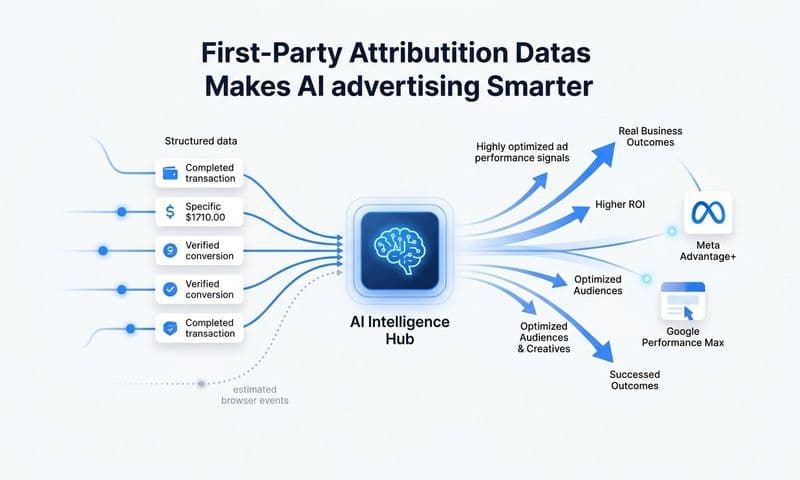
There's another crucial advantage: server-side tracking enables conversion sync, which feeds enriched data back to ad platforms. When you send conversion events to Meta or Google through server-side connections, you can include additional context—customer lifetime value, product category, lead quality score, or any other data your business captures.
This enriched conversion data improves ad platform optimization algorithms. Meta's algorithm learns which audiences and creative drive high-value customers, not just any customers. Google's Smart Bidding adjusts bids based on actual revenue potential, not just conversion probability. The feedback loop turns your ad platforms into smarter systems that optimize for outcomes you actually care about.
Turning Attribution Data Into Actionable Decisions
Attribution data is worthless if it doesn't change what you do. The point isn't creating dashboards that look impressive in executive presentations—it's making better decisions that directly impact revenue.
Budget Reallocation: Shift Spend Toward What Works
Attribution reveals which channels drive actual revenue, not just clicks or impressions. When you discover that LinkedIn generates 40% of your pipeline despite receiving only 15% of your budget, the action is obvious: reallocate spend toward the channel that's working.
This sounds simple but requires courage. Shifting budget away from channels that look good on paper but don't drive revenue means challenging assumptions and potentially upsetting stakeholders who've championed those channels. Data makes these conversations easier because you're not arguing opinions—you're following evidence.
The reallocation process should be gradual and test-driven. Don't slash budgets overnight. Instead, run controlled experiments where you increase investment in high-performing channels by 20-30% while maintaining baseline spend elsewhere. Measure the impact over several weeks. If the additional investment generates proportional returns, scale further. If not, investigate why the channel's performance doesn't scale linearly.
Campaign Optimization: Identify What Contributes at Each Stage
Multi-touch attribution reveals that different channels excel at different journey stages. You might discover that display ads generate awareness but rarely convert directly, while retargeting campaigns excel at closing prospects who've already engaged with your content.
This insight transforms campaign strategy. Instead of judging every channel by last-click conversions, you optimize each channel for its actual role in the customer journey. Display campaigns get evaluated on reach and initial engagement. Content syndication gets measured on lead quality and pipeline influence. Retargeting campaigns get assessed on conversion rate and cost per acquisition.
Creative optimization follows the same logic. Attribution data shows which ad creative, messaging angles, and audience segments contribute to conversions at each stage. You might find that problem-focused messaging drives initial clicks while solution-focused messaging converts prospects who've already engaged. This insight lets you tailor creative to journey stage rather than running the same message everywhere.
Cross-Team Alignment: Break Down Data Silos
Attribution data creates a shared reality across marketing, sales, and finance teams who typically operate with conflicting metrics and misaligned incentives.
Marketing teams can finally prove their pipeline contribution beyond vanity metrics. When you show that marketing-sourced leads convert at 2x the rate of sales-sourced leads and generate 40% higher customer lifetime value, you're making a business case for investment rather than defending budget based on activity metrics.
Sales teams gain visibility into which marketing touchpoints warm up prospects before sales conversations. When your sales rep knows that a prospect attended two webinars and downloaded three whitepapers before booking a demo, they can personalize the conversation based on demonstrated interest rather than starting from scratch.
Finance teams get the ROI visibility they've always demanded. Instead of marketing reporting "we generated 5,000 leads this quarter" while finance asks "but how many became customers?", marketing attribution platforms enable revenue tracking that connects marketing activity directly to revenue outcomes. You can finally calculate true customer acquisition cost across the entire journey rather than relying on last-click metrics that underestimate marketing's contribution.
Building Your Enterprise Attribution Strategy
Implementing enterprise attribution isn't a technology project—it's a strategic initiative that requires clear objectives, organizational alignment, and commitment to data-driven decision making.
Start by defining the business questions attribution needs to answer. Don't implement attribution because it seems like something you should do. Implement it because you have specific decisions to make and need better data to make them confidently. Are you trying to optimize budget allocation across channels? Improve sales and marketing alignment? Prove marketing ROI to the board? Each objective requires different attribution approaches and data integrations.
Prioritize data quality over model sophistication. A simple attribution model built on accurate, complete data beats a sophisticated algorithmic model built on garbage data. Before you worry about whether to use linear or time-decay attribution, make sure you're actually capturing all the touchpoints in the customer journey. Implement server-side tracking. Connect your CRM to your ad platforms. Ensure your identity resolution accurately links interactions across devices and sessions.
Plan for iteration rather than perfection. Your attribution strategy should evolve as your marketing mix changes and customer behavior shifts. The channels that drive revenue today might not be the same ones that work next year. Privacy regulations will continue tightening. New platforms will emerge while existing ones decline. Build attribution infrastructure that can adapt rather than optimizing for current conditions.
Get stakeholder buy-in before implementation. Attribution projects fail when marketing implements a sophisticated system that sales ignores and finance doesn't trust. Involve all stakeholders in defining what success looks like. Show them how attribution data will answer their specific questions. Create shared dashboards that everyone can access rather than hoarding data in marketing tools. Knowing the right questions for marketing attribution vendors helps ensure you select a platform that meets cross-functional needs.
Start with a pilot program rather than company-wide rollout. Choose one business unit or product line to implement attribution first. Prove the value with concrete results—"we reallocated 30% of budget based on attribution insights and increased pipeline by 25%"—then expand to other teams. Early wins create momentum and make broader adoption easier.
The Path Forward: From Attribution to Optimization
Enterprise marketing attribution isn't the end goal—it's the foundation for something more valuable: confident, data-driven decision making that directly impacts revenue. When you know exactly which marketing efforts drive results, you stop guessing and start scaling what works.
The competitive advantage is real. While your competitors argue about which channels deserve budget based on incomplete data and platform-reported metrics, you're reallocating millions toward channels that demonstrably drive revenue. While they struggle to justify marketing spend to skeptical executives, you're showing precise ROI calculations that connect every dollar invested to actual business outcomes.
The next frontier is AI-powered attribution recommendations. Modern platforms don't just show you what happened—they tell you what to do next. Machine learning analyzes your conversion patterns, identifies high-performing combinations, and provides specific recommendations for budget allocation and campaign optimization. Staying current with the latest trends in marketing attribution technology ensures your strategy remains competitive. The system learns continuously, adjusting suggestions as your marketing mix evolves and customer behavior changes.
This is where enterprise marketing is heading: from manual analysis and gut-feel decisions to automated insights and algorithmic optimization. The companies that build robust attribution infrastructure today will be the ones making faster, smarter decisions tomorrow.
Ready to elevate your marketing game with precision and confidence? Discover how Cometly's AI-driven recommendations can transform your ad strategy—Get your free demo today and start capturing every touchpoint to maximize your conversions.