

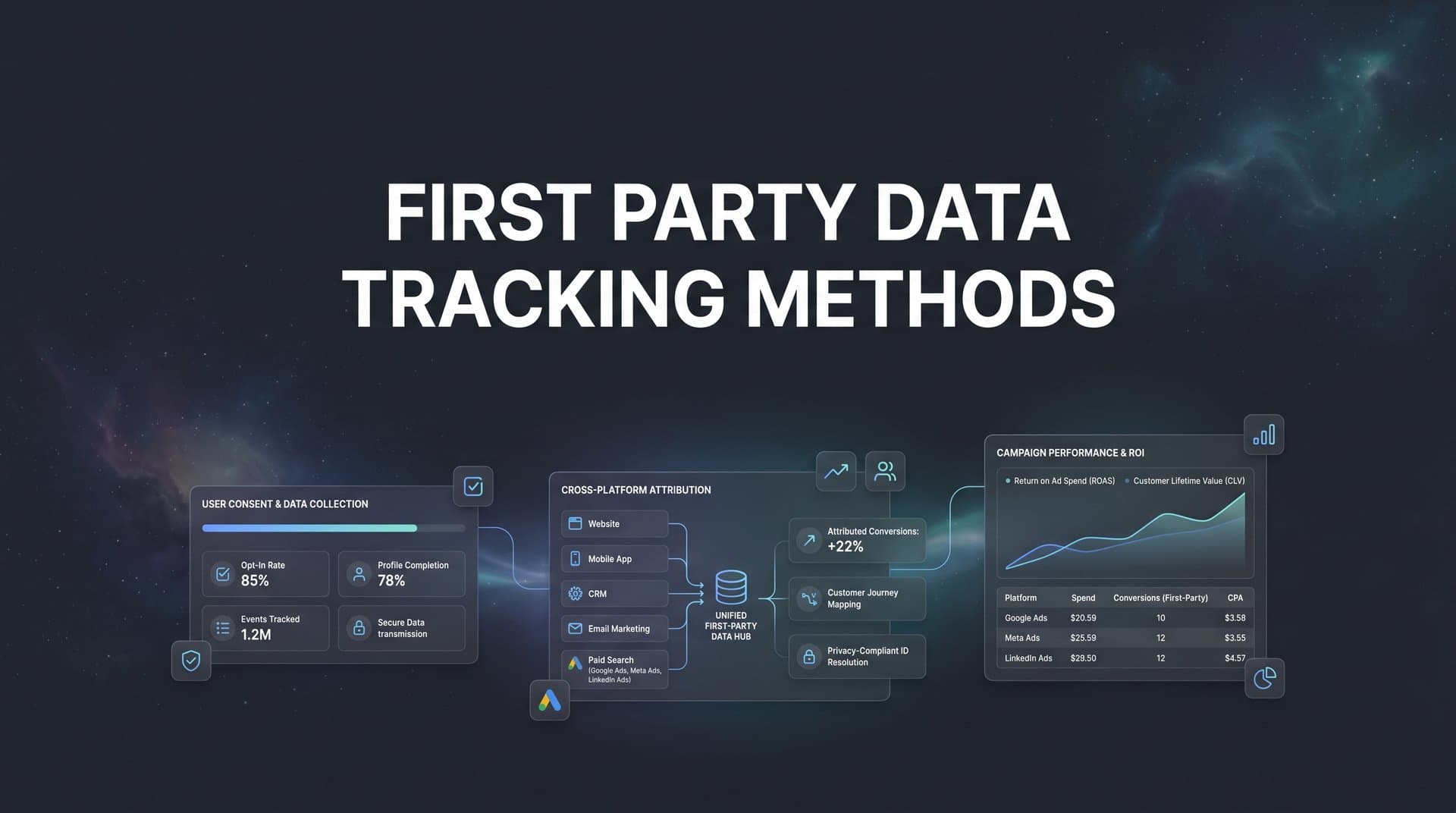
Third-party cookies are disappearing, privacy regulations are tightening, and ad platforms are losing visibility into customer journeys. For digital marketers running paid campaigns across multiple platforms, this creates a significant challenge: how do you maintain accurate attribution and optimize ad spend when traditional tracking methods are failing?
The answer lies in first party data tracking, which collects information directly from your own customers with their consent. This approach not only survives privacy changes but actually delivers more accurate, reliable data than third-party methods ever did.
Think of it like this: instead of relying on borrowed information from third parties who track users across the web, you're building direct relationships with your customers and capturing data they willingly share with you. It's more accurate, more reliable, and completely future-proof.
In this guide, we'll explore seven proven first party data tracking methods that help you capture every touchpoint, understand what truly drives revenue, and feed better data back to ad platforms for improved targeting and optimization.
1. Server-Side Tracking Implementation
The Challenge It Solves
Browser-based tracking faces significant obstacles in 2026. Ad blockers, intelligent tracking prevention in Safari, and enhanced privacy settings in Chrome all interfere with traditional pixel-based tracking. The result? Marketers lose visibility into 30-40% of their conversions, making it nearly impossible to optimize campaigns effectively.
When your tracking data goes through browsers, you're at the mercy of user privacy settings, extensions, and browser policies that actively block or limit tracking capabilities.
The Strategy Explained
Server-side tracking routes all your tracking data through your own server before sending it to ad platforms. Instead of relying on browser pixels that can be blocked, your server captures the conversion event and then communicates directly with platforms like Meta and Google.
This approach bypasses browser restrictions entirely because the data never depends on client-side JavaScript or cookies that users can block. Your server becomes the source of truth for all conversion events. Many marketers are exploring pixel alternative tracking methods to overcome these browser limitations.
The technical implementation typically involves setting up a server container (like Google Tag Manager Server-Side or a custom solution) that receives events from your website, processes them, and then forwards them to your ad platforms through their server-side APIs.
Implementation Steps
1. Set up a server container using Google Tag Manager Server-Side or implement Meta's Conversions API with a custom server endpoint that can receive and process conversion events from your website.
2. Configure your website to send conversion events to your server using secure POST requests that include all relevant conversion data like purchase value, product IDs, and customer identifiers.
3. Implement event deduplication by assigning unique event IDs to each conversion, ensuring that the same purchase isn't counted twice when both browser and server events fire.
4. Test your implementation thoroughly by triggering test conversions and verifying they appear correctly in your ad platform's events manager with complete attribution data.
Pro Tips
Always implement both browser-side and server-side tracking together. The browser pixel captures events that make it through, while server-side tracking catches everything else. Use event deduplication to prevent double-counting. This dual approach maximizes your data capture while maintaining accuracy.
2. First Party Cookie Architecture
The Challenge It Solves
Third-party cookies are blocked by default in Safari and Firefox, and Chrome's deprecation means cross-site tracking is essentially dead. Without persistent user identification, you can't track returning visitors, understand multi-session journeys, or attribute conversions that happen days after the initial ad click.
Many marketers still rely on tracking systems that depend on third-party cookies, which means they're flying blind when users return to their site from different sources or on different days. Understanding the difference between first-party and third-party cookies is essential for building a resilient tracking strategy.
The Strategy Explained
First-party cookies are set on your own domain and are not affected by third-party cookie blocking. When a user visits your site, you set a unique identifier cookie on your domain that persists across their sessions with your site.
This identifier allows you to recognize returning visitors, track their behavior across multiple visits, and ultimately connect their initial touchpoint to their final conversion, even if days or weeks pass between interactions.
The key difference is ownership: these cookies belong to your domain, not an advertising platform's domain, which means browsers treat them as legitimate, necessary cookies for site functionality rather than tracking cookies to be blocked.
Implementation Steps
1. Implement a first-party cookie system that generates a unique user ID on the first visit and stores it in a cookie with an appropriate expiration period (typically 365 days for marketing purposes).
2. Configure your cookies with proper security attributes including HttpOnly and Secure flags, and set the SameSite attribute to Lax or Strict depending on your cross-domain tracking needs.
3. Create a server-side system that reads these cookie values and associates them with conversion events, allowing you to track the complete user journey from first touch to conversion.
4. Implement cookie consent management that clearly requests permission for marketing cookies while explaining the value users receive in exchange for allowing tracking.
Pro Tips
Store your first-party cookie data in a database linked to user profiles. This creates a backup if cookies are cleared and allows you to enrich the data over time with additional behavioral information and conversion history.
3. CRM Integration for Complete Journey Mapping
The Challenge It Solves
Most attribution systems only track online conversions that happen immediately after an ad click. But for businesses with longer sales cycles, the real conversion often happens offline: a phone call, an in-person meeting, a signed contract weeks after the initial website visit.
Without connecting your CRM to your marketing data, you're missing the final and most important piece of the attribution puzzle. You might think a campaign isn't working when it's actually driving your highest-value customers.
The Strategy Explained
CRM integration connects your customer relationship management system to your marketing analytics platform, allowing you to track leads from their first ad interaction all the way through to closed deals and revenue.
When a lead enters your CRM, the integration matches it back to the original marketing touchpoints using identifiers like email address, phone number, or a unique tracking ID. This creates a complete view of the customer journey that includes both online and offline conversions. A comprehensive attribution marketing tracking guide can help you understand how to connect these touchpoints effectively.
The result is attribution that reflects actual revenue, not just form submissions or initial conversions. You can see which ads, keywords, and campaigns drive customers who actually close, not just leads who fill out forms.
Implementation Steps
1. Connect your CRM (such as Salesforce, HubSpot, or Pipedrive) to your attribution platform using native integrations or API connections that can sync lead and opportunity data bidirectionally.
2. Implement a lead tracking system that captures marketing source data when leads first convert and passes this information into your CRM as custom fields on the contact or lead record.
3. Configure your attribution platform to receive CRM events like opportunity creation, deal closure, and revenue amounts, matching these back to the original marketing touchpoints using email or unique identifiers.
4. Set up automated workflows that update your attribution data when deal stages change in your CRM, ensuring your marketing reports always reflect the current pipeline and closed revenue.
Pro Tips
Create custom conversion events in your ad platforms based on CRM stages. Send a "qualified lead" event when a lead is marked as sales-qualified in your CRM, and a "closed deal" event when revenue is won. This teaches ad algorithms to optimize for quality, not just quantity.
4. Authenticated User Tracking with Login Data
The Challenge It Solves
Users interact with your brand across multiple devices: they might click an ad on their phone, research on their laptop, and convert on their tablet. Without a way to connect these sessions, each device looks like a different person, fragmenting your attribution data and making it impossible to understand the true customer journey.
Traditional cookie-based tracking can't follow users across devices because cookies are device-specific. This multi-device reality means your attribution is fundamentally incomplete.
The Strategy Explained
Authenticated user tracking leverages login events to create persistent user identities that transcend devices and browsers. When users log into your site or app, you can definitively identify them and connect all their activity across every device they use.
This creates a unified user profile that includes every touchpoint: the ad they clicked on mobile, the product pages they viewed on desktop, the cart they abandoned on tablet, and the purchase they completed on their phone. Implementing effective cross-device conversion tracking methods is critical for capturing these multi-device journeys.
The key is using the login event as an anchor point. Once someone authenticates, you can retroactively connect their anonymous browsing sessions to their authenticated identity, building a complete picture of their journey.
Implementation Steps
1. Implement a user identification system that captures a unique user ID at login and stores it both in your database and in a first-party cookie for persistent tracking across sessions.
2. Configure your analytics platform to accept user ID parameters that override anonymous tracking IDs, allowing you to merge all previous anonymous sessions into the authenticated user profile.
3. Create a backend process that associates all marketing touchpoints with the authenticated user ID, connecting ad clicks, email opens, and website visits to the same person regardless of device.
4. Implement privacy-compliant data collection that clearly communicates how you use login data for personalization and analytics, obtaining explicit consent where required by regulations.
Pro Tips
Offer incentives for account creation early in the customer journey. The sooner users authenticate, the more complete your attribution data becomes. Consider gated content, personalized recommendations, or saved carts as reasons for users to create accounts.
5. Enhanced Conversion Tracking with Hashed Data
The Challenge It Solves
Even with first-party tracking, ad platforms struggle to match conversions back to ad clicks when users clear cookies, switch devices, or use privacy features. This attribution gap means ad algorithms receive incomplete signals, limiting their ability to optimize for conversions and find similar high-value customers.
The challenge is improving match rates without compromising user privacy or violating data protection regulations.
The Strategy Explained
Enhanced conversion tracking uses hashed customer data (typically email addresses or phone numbers) to improve the match rate between conversions on your site and ad interactions on platforms like Google and Meta.
When someone converts on your site, you hash their email address using a one-way cryptographic function and send this hashed value to the ad platform along with the conversion event. The platform compares this hash to hashed identifiers in their database to match the conversion to the correct user, even without cookies. This is one of the most effective privacy-compliant conversion tracking methods available today.
This approach maintains privacy because the hashing is irreversible, but it dramatically improves attribution accuracy. Match rates often improve by 20-30% compared to cookie-based tracking alone.
Implementation Steps
1. Implement Google's Enhanced Conversions or Meta's Advanced Matching by modifying your conversion tracking code to capture customer data at the point of conversion (typically on the thank-you page).
2. Hash the customer data using SHA-256 encryption on your server before sending it to ad platforms, ensuring that personally identifiable information is never transmitted in plain text.
3. Configure your tracking to send multiple identifiers when available (email, phone, address) to maximize match rates, as platforms use multiple data points to increase matching confidence.
4. Validate your implementation using the ad platform's testing tools to ensure hashed data is formatted correctly and matches are occurring as expected.
Pro Tips
Collect email addresses earlier in the funnel, not just at purchase. Add email capture on high-intent pages like pricing or product detail pages. The earlier you can associate an email with a user session, the more conversion events you can enhance with hashed data.
6. Customer Data Platform Centralization
The Challenge It Solves
Your marketing data lives in fragmented silos: ad platform data here, website analytics there, CRM data somewhere else, email engagement in another system. Each tool has a partial view of the customer, but no single system shows you the complete picture.
This fragmentation makes it nearly impossible to understand true attribution, create unified customer segments, or coordinate messaging across channels. You're essentially marketing blind, making decisions based on incomplete information.
The Strategy Explained
A Customer Data Platform (CDP) centralizes all your first-party data into a unified system that creates comprehensive customer profiles. Every interaction, from ad clicks to email opens to purchase history, flows into the CDP and gets associated with the correct customer.
The CDP becomes your single source of truth for customer data. It ingests information from every touchpoint, resolves identity across devices and channels, and makes this unified data available to all your marketing tools. Developing a solid first-party data strategy is essential before implementing a CDP.
This centralization enables sophisticated attribution analysis, audience segmentation based on complete behavioral data, and coordinated cross-channel campaigns that respond to the customer's entire journey, not just their interaction with a single channel.
Implementation Steps
1. Choose a CDP solution that integrates with your existing marketing stack, connecting your website, ad platforms, CRM, email system, and any other customer touchpoints into a centralized data warehouse.
2. Implement identity resolution rules that determine how the CDP matches customer records across different sources, typically using email as the primary identifier with fallbacks to phone numbers or device IDs.
3. Configure data ingestion pipelines that automatically sync data from all sources into the CDP in real-time or near-real-time, ensuring your customer profiles always reflect the latest interactions.
4. Build audience segments in the CDP based on complete customer journey data, then sync these segments to your ad platforms for targeting and suppression campaigns.
Pro Tips
Start with your highest-value customer actions and work backward. Identify which touchpoints most reliably predict conversions, then prioritize integrating those data sources first. This ensures you see immediate value from your CDP implementation while you build out the complete integration.
7. Conversion API Sync for Algorithm Optimization
The Challenge It Solves
Ad platform algorithms need high-quality conversion signals to optimize effectively. When tracking data is incomplete or delayed due to browser restrictions, the algorithms receive weak signals that limit their ability to find high-value customers and optimize bids.
Poor signal quality means your campaigns underperform not because your targeting is wrong, but because the platform's machine learning systems don't have the data they need to learn what works.
The Strategy Explained
Conversion API sync sends enriched, server-side conversion events directly to ad platforms through their APIs, providing complete and immediate conversion signals that bypass all browser limitations.
Instead of relying on browser pixels that might be blocked or delayed, your server sends conversion data directly to Meta's Conversions API or Google's server-side tracking as soon as conversions happen. These events include all the context the algorithms need: conversion value, product details, customer information, and attribution data. This approach is particularly valuable for ad tracking without third-party cookies.
The result is dramatically improved algorithm performance. Platforms receive complete conversion data for every event, enabling their machine learning systems to identify patterns, optimize bids, and find similar high-value customers with much greater accuracy.
Implementation Steps
1. Implement Meta's Conversions API and Google's server-side tagging to send conversion events directly from your server to ad platforms, including all available customer and conversion data.
2. Enrich your conversion events with additional context that helps algorithms optimize: customer lifetime value predictions, product categories, profit margins, and any other business metrics that indicate conversion quality.
3. Configure event matching parameters that help platforms attribute conversions correctly, including external IDs, click IDs from ad platforms, and hashed customer identifiers.
4. Monitor your event match quality scores in each ad platform's events manager, adjusting your implementation to improve matching and signal quality based on platform feedback.
Pro Tips
Send value-based conversion events, not just binary conversion signals. Instead of just telling Meta someone purchased, tell them the purchase value, the products bought, and the predicted customer lifetime value. This teaches algorithms to optimize for revenue, not just conversions.
Putting It All Together
Implementing first party data tracking is no longer optional for marketers who want accurate attribution and optimized ad performance. The methods we've covered work together to create a comprehensive tracking system that captures every touchpoint and feeds complete data to both your analytics and your ad platforms.
Start with server-side tracking as your foundation. This immediately improves your data capture by bypassing browser restrictions. Then layer in CRM integration to connect marketing touchpoints to actual revenue, not just form submissions.
Next, implement conversion API sync to ensure ad platforms receive complete signals for optimization. This combination of server-side tracking plus API sync creates the most powerful setup for algorithm performance.
From there, add enhanced conversions with hashed data to improve match rates, implement authenticated user tracking to connect cross-device journeys, and build a robust first-party cookie architecture for persistent identification.
Finally, consider a CDP if you're managing complex customer journeys across multiple channels. The CDP becomes your central nervous system, unifying all your first-party data and making it actionable across your entire marketing stack.
The key is building a system where every touchpoint feeds into a unified view, from ad clicks through to revenue. This not only future-proofs your marketing against privacy changes but actually improves your ability to identify what drives conversions and scale winning campaigns with confidence.
Begin with one method, validate the data quality, then progressively add more tracking layers until you have complete visibility into your marketing performance. Each layer you add compounds the value of the others, creating an increasingly accurate picture of what truly drives your business.
Ready to elevate your marketing game with precision and confidence? Discover how Cometly's AI-driven recommendations can transform your ad strategy. Get your free demo today and start capturing every touchpoint to maximize your conversions.


