B2B software buying has changed dramatically, and most marketing teams have not caught up. Buyers no longer wait for a sales rep to educate them. They search, compare, read reviews, ask peers, and form strong opinions about vendors long before they ever fill out a form or request a demo. By the time a prospect appears in your CRM, they have already done the work.
This creates a real problem for SaaS marketing teams. You are investing budget across channels, producing content, and running paid campaigns, but your attribution data only shows you a fraction of the journey. The early-stage research activity that shaped buyer intent? It is largely invisible in standard analytics reports.
Understanding how buyers research B2B software is not just a strategic exercise. It is foundational to making smarter decisions about where to invest, what content to build, and how to measure what is actually working. This article maps the modern B2B research journey from first awareness to final decision, explains where the biggest attribution blind spots exist, and shows how to align your marketing strategy and tracking infrastructure to match how buyers actually behave today.
The Modern B2B Buyer Does the Work Before You Do
The days of a prospect waiting for a cold email or a trade show handshake to learn about your product are largely behind us. Today's B2B buyers are self-directed researchers. They identify a problem, start searching for answers, and build a mental shortlist of vendors well before they ever engage with a sales team.
This shift is not marginal. Many buyers complete a substantial portion of their evaluation independently, relying on search engines, peer communities, and review platforms rather than inbound outreach from vendors. By the time they raise their hand, they often already have preferences formed.
The buying process has also become a team sport. The average B2B software purchase involves multiple stakeholders, each with their own questions, priorities, and research habits. A technical evaluator might be deep in documentation and integration guides while a budget owner is reading analyst comparisons and a department head is asking peers for recommendations on LinkedIn. These parallel research tracks make the journey non-linear and genuinely difficult to map in a single attribution model.
Then there is the challenge of dark social. A significant portion of early-stage B2B research happens in channels that leave no trackable footprint. Private Slack communities, LinkedIn direct messages, peer referrals, and direct URL visits all influence buyer decisions without generating a single data point in your analytics platform. Someone might hear about your product in a Slack group, visit your website directly three times, and only show up in your attribution data at the moment they click a retargeting ad and convert.
This creates a dangerous blind spot. If you are relying on last-click or even basic multi-touch models without server-side tracking, you are seeing only the final moments of a much longer journey. The channels and content that actually built buyer intent are getting no credit, and your budget allocation decisions are being made on incomplete information.
The first step toward fixing this is accepting that the research journey starts long before your attribution window opens. From there, the question becomes: where exactly are buyers going to do that research?
Where B2B Buyers Actually Go to Research Software
If you want to understand how buyers research B2B software, you need to follow them to the channels they actually trust. And those channels are not always the ones you are investing in most heavily.
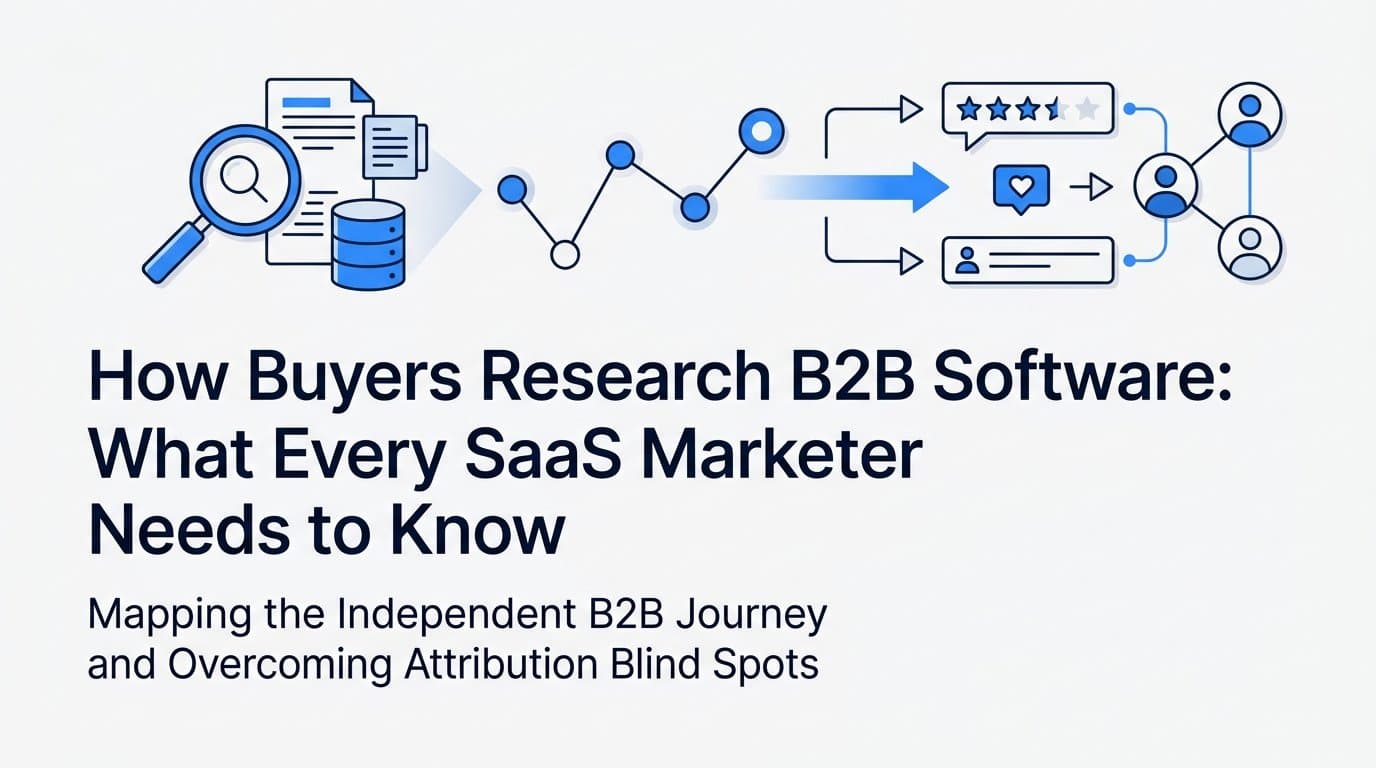
Review aggregator platforms: Sites like G2 and Capterra have become essential stops in the B2B software evaluation process. Buyers use these platforms to compare features side by side, read peer reviews from people in similar roles, and validate their assumptions before visiting a vendor's website. Many buyers arrive at these platforms with a category in mind and leave with a shortlist. If your product is not well-represented on these platforms, you may be losing consideration before you ever get a chance to make your case.
Search engines: Organic search remains one of the most powerful discovery channels in B2B. The key insight is that search intent evolves as buyers move through their research. Early in the process, buyers are using informational queries: "how to improve marketing attribution," "what is multi-touch attribution," or "best practices for B2B pipeline tracking." As they get closer to a decision, queries shift toward comparison and evaluation terms: "Cometly vs [competitor]," "best attribution software for SaaS," or "[product name] pricing." Marketers who only target high-intent commercial terms are missing the early-stage research conversations that shape buyer preferences.
Peer communities and social platforms: LinkedIn, industry Slack groups, and professional communities play a growing role in shaping vendor perception. A recommendation from a trusted peer carries more weight than almost any marketing message. These conversations happen in spaces that are difficult to track directly, but they are highly influential. Buyers ask their networks which tools they use, what they would avoid, and what their experience has been. The brands that show up positively in those conversations have a real advantage.
Word-of-mouth and referrals: Related to peer communities, direct referrals remain one of the highest-converting sources in B2B software. When a buyer hears about a product from someone they respect, the trust transfer is immediate. The challenge for marketers is that these referrals are nearly impossible to attribute in traditional analytics. Someone referred by a colleague may visit your site directly, sign up with no UTM parameters attached, and appear in your data as "direct" traffic with no context about the actual influence that drove them there.
The takeaway is that your buyers are spreading their research across multiple channels, many of which are difficult to capture with standard tracking. Building a presence across all of them, and investing in the right tracking infrastructure to capture as much of that activity as possible, is what separates attribution-mature teams from those flying blind.
The Research Stages Behind Every B2B Purchase Decision
The B2B research journey is not a single event. It unfolds across distinct stages, each with different buyer mindsets, content needs, and channel preferences. Understanding these stages helps you build a content and channel strategy that meets buyers where they are rather than where it is easiest for you to reach them.
Problem awareness: At this stage, buyers have identified a pain point but may not yet know what kind of solution they need. They are asking broad questions and consuming educational content to understand the landscape. Blog posts, explainer videos, category guides, and comparison overviews are the formats that resonate here. The buyer is not ready to evaluate vendors yet. They are trying to understand the problem space and what a solution might look like. Content that helps them think more clearly about their challenge builds trust and brand awareness simultaneously.
Consideration: Once a buyer understands the category and the type of solution they need, they move into active vendor evaluation. This is where comparison pages, feature breakdowns, use-case content, demo videos, and pricing transparency become critical. Buyers at this stage are building a shortlist and trying to understand which solutions fit their specific context. They are visiting multiple vendor websites, reading reviews on aggregator platforms, and asking peers for input. Your job here is to make it easy for them to understand exactly what you do, who you do it for, and why you are the right fit.
Decision: At the decision stage, buyers are validating their top choice. They want proof that the solution works for companies like theirs. Customer success stories framed around outcomes, ROI framing, free trials, and direct conversations with sales all play a role here. This is also where buyers often loop back to earlier touchpoints, revisiting content they consumed weeks ago or returning to a review platform to read a few more testimonials before committing. The decision stage is rarely a straight line. Buyers circle back, seek reassurance, and involve additional stakeholders who may be at an earlier stage in their own research.
What makes this framework practically useful is recognizing that different members of the buying committee may be at different stages simultaneously. Your marketing strategy needs to serve all of them, which means having content and channel presence across the full funnel at all times rather than focusing exclusively on bottom-of-funnel conversion assets.
Why Most Marketing Teams Misread the B2B Research Journey
Here is the uncomfortable truth: most SaaS marketing teams have a fundamentally distorted view of what is driving their pipeline. And the primary reason is how they measure attribution.
Last-click attribution, which credits the final touchpoint before a conversion, is still widely used despite being poorly suited to B2B buying behavior. When a buyer converts after clicking a branded search ad, that ad gets full credit. But what built the intent that made them search for your brand in the first place? The blog post they read three weeks ago, the review they saw on G2, the LinkedIn post a peer shared, the direct visit after a Slack recommendation? None of that appears in a last-click model. It is simply invisible.
Long B2B sales cycles make this problem significantly worse. A buyer who converts today may have first encountered your brand weeks or months ago. The touchpoints that shaped their awareness and consideration happened in an attribution window that has long since closed. If your reporting only looks back 7 or 30 days, you are missing the actual story of how that buyer found you and why they decided to evaluate your product.
The result is predictable but damaging. Marketing teams systematically underinvest in top-of-funnel and mid-funnel channels because those channels do not show up as converters in their attribution reports. They over-invest in bottom-of-funnel channels like branded search and retargeting because those are the touchpoints that appear right before conversion. The channels that built buyer intent get starved of budget because they cannot prove their value in a last-click world.
Without multi-touch attribution and proper customer journey tracking, you cannot accurately identify which channels and content assets are doing the heavy lifting across the full research journey. You end up optimizing for the last mile while ignoring the marathon that preceded it. The fix requires both a better attribution model and better tracking infrastructure to capture the data that model needs to work.
Aligning Your Marketing Strategy to How Buyers Research
Once you understand the research journey, the strategic implications become clear. Your marketing needs to be present and useful at every stage, not just at the moment of conversion.
Build content that matches each research stage: Awareness-stage content should educate without selling. Think category explainers, guides to solving the problem your product addresses, and thought leadership that helps buyers understand their options. Consideration-stage content should help buyers evaluate: comparison pages, use-case breakdowns, feature documentation, and demo videos that show the product in action. Decision-stage content should validate: customer outcomes framed around results, ROI framing, and clear proof that your solution works for companies like theirs. Each content type serves a different moment in the research journey, and you need all of them.
Invest in the channels where buyers self-educate: Organic search, review platforms, and community presence deserve serious investment alongside direct-response channels. A strong presence on G2 with recent, detailed reviews can influence buyers who never clicked an ad. Ranking for informational queries builds awareness with buyers who are just beginning their research. Being visible and helpful in the communities where your buyers spend time builds brand credibility that pays off over time, even if it is difficult to attribute directly.
Use attribution data to understand winning customer journeys: Rather than looking at channel performance in isolation, look at the combinations of touchpoints that appear most often in closed-won deals. Which channels consistently show up early in the journey? Which content assets appear in the paths of your best customers? Attribution data, when captured accurately across the full journey, can answer these questions and give you a data-driven basis for budget allocation rather than gut feel or last-click reporting.
Align sales and marketing around the research journey: When sales teams understand how buyers have been researching before they arrive, they can have more informed conversations. If a prospect has been reading comparison content and visiting pricing pages, they are further along than someone who just read a top-of-funnel blog post. Sharing journey data between marketing and sales creates alignment and improves conversion rates at every handoff point.
Tracking the B2B Research Journey With Accurate Attribution
Understanding the research journey conceptually is only half the challenge. The other half is building the technical infrastructure to actually capture it. And as browser-based tracking has become less reliable, that infrastructure has needed to evolve.
Privacy changes, including cookie deprecation and the growing prevalence of ad blockers, have made client-side tracking increasingly incomplete. Touchpoints that would have been captured by a browser cookie a few years ago are now going unrecorded, creating gaps in attribution data that distort reporting and lead to poor budget decisions. Server-side tracking addresses this directly by moving event capture from the browser to the server, where it is not affected by browser restrictions or user privacy settings. This means more touchpoints are captured accurately, giving your attribution model more complete data to work with.
Conversion API integrations, such as Meta CAPI and Google Enhanced Conversions, extend this principle to ad platforms. Instead of relying on pixel-based tracking that browsers can block, these integrations send conversion data directly from your server to the ad platform. The result is more accurate conversion reporting, better ad optimization, and a clearer picture of which campaigns are actually driving results. For B2B SaaS teams running paid campaigns across multiple channels, this is increasingly a baseline requirement rather than an advanced capability.
Multi-touch attribution models give credit across the full research journey rather than collapsing it to a single touchpoint. Linear, time-decay, and data-driven attribution models each have different strengths, but all of them are more appropriate for B2B contexts than last-click. They allow you to see which channels are influencing buyers at awareness, consideration, and decision stages, giving you a much more accurate picture of where your marketing investment is generating value.
The final piece is connecting ad platform data to CRM and revenue data. This is where the full picture comes together. When you can trace a customer journey from the first ad click or organic search visit all the way through to a closed-won deal in your CRM, you can tie ad spend directly to pipeline and revenue. You can answer questions like: which campaigns are generating the most revenue, not just the most leads? Which channels produce buyers with the highest lifetime value? Which content assets appear most often in the journeys of your best customers?
This is exactly what Cometly is built to do. By connecting your ad platforms, CRM, and website tracking into a single attribution layer, Cometly captures every touchpoint across the B2B research journey and maps it to real revenue outcomes. Its server-side tracking and Conversion API integrations ensure that early-funnel touchpoints are captured accurately even as browser-based tracking becomes less reliable. Its multi-touch attribution models give credit where it is actually due across the full journey. And its CRM and Stripe integrations make it possible to see which ads and channels are driving not just conversions, but actual closed revenue.
Putting It All Together
The core insight running through everything in this article is straightforward: how buyers research B2B software is a data problem as much as it is a strategic one. You can build the right content for every stage of the journey and invest in all the right channels, but if your attribution infrastructure cannot capture what is actually happening, you will keep making decisions based on an incomplete picture.
Buyers are doing the work before you do. They are researching independently, consulting peers, reading reviews, and forming opinions across channels that are difficult to track. The marketing teams that win are the ones who understand this journey deeply, build presence across every stage of it, and invest in the tracking infrastructure needed to see which of their efforts are actually driving pipeline and revenue.
Last-click attribution was never a good fit for B2B. Long sales cycles, multi-stakeholder buying committees, and dark social research phases all demand a more sophisticated approach. Multi-touch attribution, server-side tracking, and CRM-connected revenue data are not optional extras for growth-stage SaaS teams. They are the foundation of any marketing operation that wants to scale with confidence rather than guesswork.
If you are ready to stop flying blind and start seeing the full picture of how your buyers research and convert, Cometly gives you the attribution clarity to make it happen. Get your free demo today and start capturing every touchpoint across the buyer journey to connect your ad spend directly to the revenue it is generating.