

You launch a campaign. The leads start rolling in. Sales close deals. Revenue hits your account. Success, right?
But then you open your analytics dashboard, and something feels off. Google Analytics says one thing. Meta Ads Manager claims credit for half those conversions. Your CRM shows revenue from customers you can't trace back to any specific campaign. You're left staring at numbers that don't add up, wondering which campaigns actually deserve your budget.
This is incomplete customer journey visibility, and it's costing you more than you realize. Every blind spot in your tracking represents budget decisions made in the dark. You're scaling campaigns that might not be your real winners while starving the touchpoints that actually move the needle.
The frustrating part? You're doing everything the platforms tell you to do. You've installed pixels. You're running UTM parameters. You've set up conversion tracking. Yet somehow, the full story of how customers find you, engage with you, and ultimately buy from you remains fragmented across disconnected tools.
This article breaks down why these gaps exist, how they're impacting your marketing performance right now, and what you can do to finally see the complete picture from first impression to final conversion.
The Hidden Cost of Marketing Blind Spots
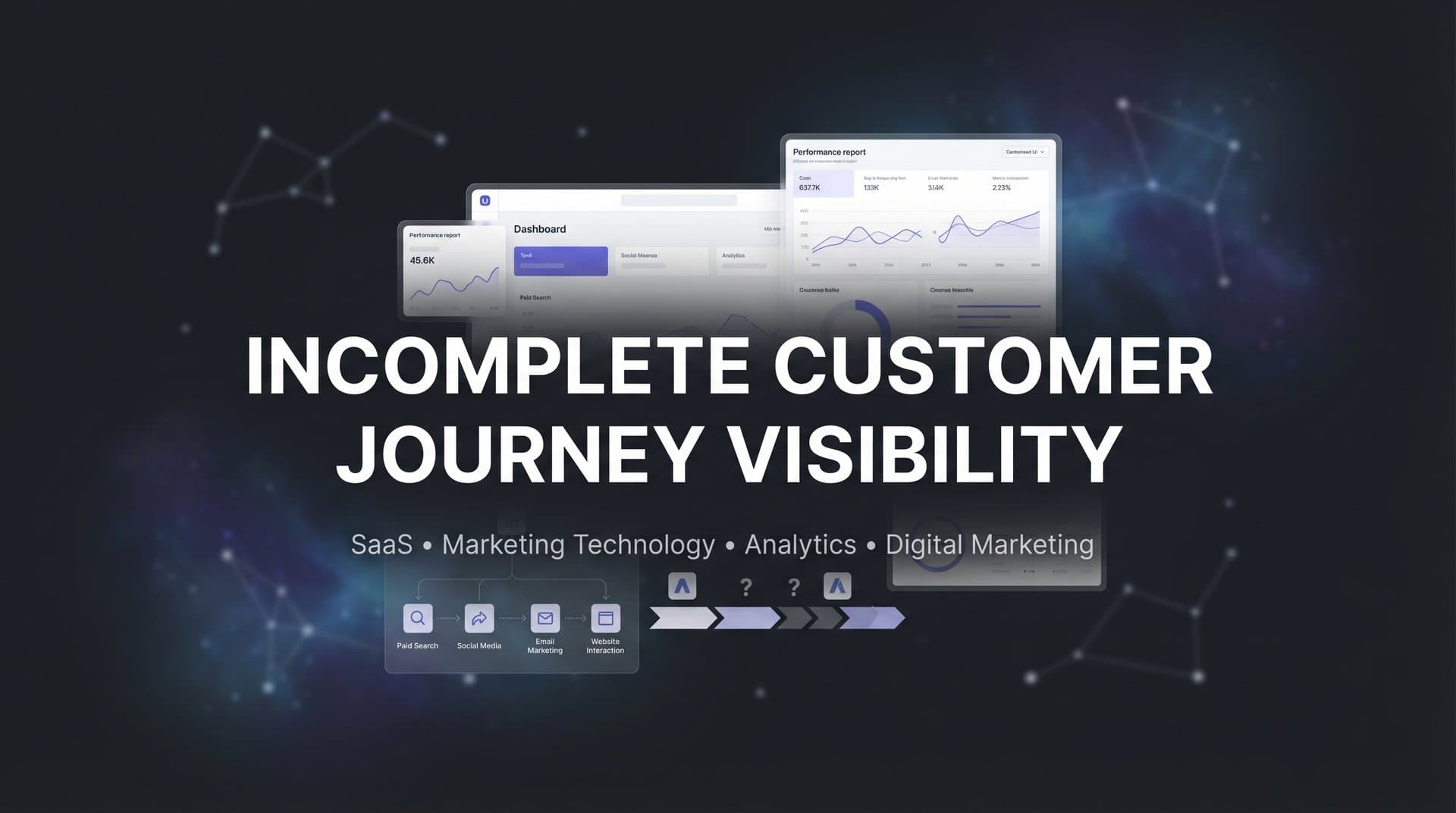
Incomplete customer journey visibility means you can't track all the touchpoints that lead from initial awareness to final conversion. It's the difference between seeing a customer clicked an ad and purchased versus understanding they saw your Instagram ad, visited from a Google search two days later, clicked a retargeting ad, read three blog posts, and then converted through a direct visit.
Without that complete view, you're making critical decisions based on partial information.
The most common consequence? Overinvesting in last-click channels while starving your awareness campaigns. When your tracking only captures the final touchpoint before conversion, bottom-funnel tactics get all the credit. Your retargeting campaigns look like heroes. Your brand awareness efforts appear worthless.
So you do what seems logical: shift more budget to what's "working." You scale retargeting. You invest heavily in branded search. You chase those last-click conversions.
But here's the problem. Those bottom-funnel campaigns only work because your awareness efforts created the audience in the first place. Cut the top of the funnel, and suddenly your retargeting pool shrinks. Your branded search volume drops. The entire system collapses because you optimized for visibility instead of reality.
The ripple effects extend beyond budget misallocation. Your optimization decisions become guesswork. You can't confidently answer which creative messaging drives consideration. You don't know if your podcast ads contribute to conversions or just drain budget. You can't determine whether your content marketing actually influences purchase decisions.
Poor data quality leads to poor testing strategies. You might kill winning campaigns because you can't see their full contribution. You scale losing campaigns because they happen to capture the last click. Every optimization becomes a gamble rather than a calculated decision. Understanding customer journey visibility gaps is essential for avoiding these costly mistakes.
Then there's the reporting problem. Your CMO wants to know marketing ROI. Your CFO needs to justify the advertising budget. But when your data has gaps, your numbers don't tell a coherent story. Platform reports show one set of conversions. Your CRM shows different revenue numbers. Your analytics tool reports yet another version of reality.
You end up spending hours reconciling data instead of analyzing performance. You create spreadsheets to manually connect dots that should be automatically linked. You make educated guesses about attribution instead of relying on accurate tracking.
The hidden cost isn't just wasted ad spend. It's the opportunity cost of not knowing what's actually working. It's the strategic decisions you can't make confidently. It's the growth you're leaving on the table because you're optimizing campaigns based on incomplete information.
Why Traditional Tracking Falls Short in Multi-Channel Campaigns
The tracking methods that worked five years ago are breaking down under the weight of privacy updates and multi-platform customer behavior.
Start with iOS privacy changes. When Apple introduced App Tracking Transparency with iOS 14.5, they gave users a simple choice: allow apps to track you or don't. Most chose don't. Suddenly, a massive portion of mobile traffic became invisible to traditional pixel-based tracking.
Facebook's pixel can't fire if the user opted out of tracking. Your conversion data gets delayed, aggregated, and incomplete. You lose the ability to track individual user journeys across sessions. The detailed attribution you relied on simply stops working for a significant percentage of your audience.
Then there's cookie deprecation. Third-party cookies, the backbone of cross-site tracking for years, are disappearing. Browsers block them by default. Users clear them regularly. The persistent identifiers that let you follow someone from your ad to your website to your checkout page are vanishing.
Cross-device tracking adds another layer of complexity. Your customer sees your ad on their phone during their morning commute. They research your product on their tablet that evening. They convert on their laptop the next day. Without sophisticated identity resolution, these look like three different people, not one customer journey. Learning how to track customer journey across devices has become critical for accurate attribution.
Traditional tracking treats each device as a separate user. Your attribution model credits the laptop visit with the conversion. The mobile and tablet touchpoints that actually drove awareness and consideration? Invisible.
Platform siloing makes everything worse. Meta claims the conversion happened because of your Instagram ad. Google says it was your search campaign. TikTok insists their video drove the sale. Each platform uses its own attribution window and methodology, and they all claim credit for the same purchase.
This isn't necessarily anyone being dishonest. It's just how platform attribution works. Meta sees someone clicked your ad and later converted. From their perspective, they drove that sale. Google sees the same person searched for your brand and bought. From their view, they deserve credit. Both platforms are reporting accurately within their limited visibility, but neither sees the complete journey.
When you add up all the conversions each platform claims, you often get 150% to 200% of your actual sales. The math doesn't work because everyone's counting the same customers. These customer journey attribution problems plague marketers across every industry.
The gap between ad platform data and CRM reality creates another problem. Your ad platforms report conversions based on pixel fires and click data. Your CRM tracks actual revenue based on closed deals and collected payments. These systems rarely align perfectly.
A conversion might fire on your thank you page, but the customer never completes payment. Or they complete payment, but your pixel didn't fire due to a technical issue. Or they purchased through a phone call that your tracking never captured. The discrepancies compound across hundreds or thousands of transactions.
You end up with ad platforms showing strong performance while your actual revenue tells a different story. Or vice versa: your CRM shows great sales numbers, but you can't trace them back to specific marketing efforts. Either way, you're flying blind.
Recognizing the Warning Signs in Your Own Data
How do you know if incomplete customer journey visibility is affecting your marketing? The warning signs show up in your data, often hiding in plain sight.
The most obvious red flag: conversion numbers that don't match between platforms. You check Meta Ads Manager and see 100 conversions. Google Analytics reports 75. Your CRM shows 60 actual purchases. Which number is real?
If you're seeing significant discrepancies, something's broken in your tracking chain. Maybe pixels aren't firing consistently. Maybe attribution windows differ across platforms. Maybe cross-device behavior isn't being captured. Whatever the cause, you can't trust any single data source. These are classic customer journey tracking gaps that require immediate attention.
Another warning sign: unexplained drops in attributed revenue. Your actual sales stay steady or even grow, but the revenue your analytics tools attribute to marketing campaigns decreases. This often happens after browser updates or privacy changes that break tracking without breaking actual customer behavior.
Your marketing is still working. Customers are still finding and buying from you. But your tracking systems can't see it anymore, so it looks like performance declined when it actually didn't.
Watch for campaigns that seem to underperform despite strong engagement. You're running a top-of-funnel awareness campaign. The engagement metrics look great: high view rates, strong click-through rates, lots of landing page visits. But when you check conversion attribution, it shows minimal impact.
Does that mean the campaign isn't working? Or does it mean your attribution model can't see the awareness touchpoint's contribution to conversions that happen days or weeks later through different channels?
Direct and organic traffic spikes without clear explanation suggest attribution gaps. When tracking breaks down, conversions get misattributed to direct traffic or organic search. If you see these channels growing disproportionately while your paid campaigns show declining performance, you're probably losing visibility on customer journey data.
Here's how to audit your current setup. Start by comparing conversion totals across all your platforms for the same time period. Document the discrepancies. If the numbers vary by more than 10-15%, you have a tracking problem worth investigating.
Next, trace a few recent conversions manually. Pick customers who recently purchased and try to reconstruct their journey using your available data. Can you see all their touchpoints? Do you know which ad they first saw? Can you track their website visits? If you hit dead ends quickly, that's incomplete visibility.
Ask yourself these critical questions: Can I confidently say which campaigns drive new customer acquisition versus which just capture existing demand? Do I know how many touchpoints the average customer needs before converting? Can I track a customer from their first interaction to their final purchase? Do my conversion numbers align with actual revenue?
If you're answering "no" or "I'm not sure" to these questions, you're operating with blind spots that affect every marketing decision you make.
Building a Complete Picture With Multi-Touch Attribution
Single-touch attribution models, whether first-click or last-click, tell you which touchpoint started or ended the journey. Multi-touch attribution tells you how the entire journey actually happened.
Instead of giving 100% credit to one interaction, multi-touch models distribute credit across all the touchpoints that contributed to a conversion. This creates a more accurate picture of how your marketing channels work together to drive results. A solid understanding of customer journey attribution is foundational to implementing these models effectively.
Think about how customers actually buy. They rarely see one ad and immediately purchase. They encounter your brand multiple times across different channels. They research. They compare. They consider. Then they convert. Multi-touch attribution acknowledges this reality.
Linear attribution gives equal credit to every touchpoint in the journey. If a customer had five interactions before converting, each gets 20% of the credit. This model works well when you want to value all touchpoints equally and understand the full scope of your marketing influence.
The downside? It might overvalue touchpoints that didn't really influence the decision. Not every interaction carries the same weight in moving someone toward a purchase.
Time-decay attribution gives more credit to touchpoints closer to conversion. The theory: interactions that happen right before someone buys are more influential than those from weeks ago. This model makes sense for longer sales cycles where recent touchpoints often push prospects over the finish line.
But time-decay can undervalue crucial early touchpoints. That initial brand awareness ad might have been essential for starting the journey, even if it happened a month before the purchase.
Position-based attribution, sometimes called U-shaped, gives the most credit to the first and last touchpoints, with remaining credit distributed to middle interactions. This recognizes that introducing someone to your brand and closing the sale are both critical moments, while middle touchpoints play supporting roles.
Which model should you use? It depends on your sales cycle and business model. E-commerce with short consideration periods might favor time-decay. B2B with long sales cycles might prefer position-based. Testing different models helps you understand which view of your data drives better decisions.
The real power comes from connecting all your data sources into a unified view. Your ad platforms, website analytics, CRM, and any other customer touchpoint systems need to feed into a single attribution system that can track individuals across channels and devices. A dedicated customer journey attribution software can unify these disparate data sources.
This requires robust identity resolution. You need to recognize that the person who clicked your Facebook ad, visited from Google search, and later converted through a direct visit is the same individual, not three separate users.
Without this connection, multi-touch attribution becomes impossible. You can't assign credit across a journey you can't see. The technical infrastructure to unify your data is just as important as choosing the right attribution model.
When implemented correctly, multi-touch attribution transforms how you evaluate campaigns. You stop obsessing over last-click metrics and start understanding how channels work together. You can see which campaigns excel at awareness versus conversion. You can identify the optimal sequence of touchpoints that leads to purchases.
Most importantly, you can make budget allocation decisions based on each channel's true contribution rather than which one happened to capture the last click.
Server-Side Tracking: Closing the Gap That Browsers Create
Browser-based tracking is breaking down. Privacy features block pixels. Users delete cookies. Ad blockers strip tracking parameters. Server-side tracking bypasses these limitations entirely by sending data directly from your servers to analytics and ad platforms.
Here's how it works. Instead of relying on JavaScript pixels that fire in the user's browser, server-side tracking captures events on your server and sends them to your tracking destinations. The user's browser settings, privacy features, and ad blockers can't interfere because the tracking happens server-side, outside their control.
This captures significantly more touchpoints than browser-based tracking. When someone visits your site with an ad blocker enabled, traditional pixels never fire. You lose that data point. With server-side tracking, the visit still gets recorded because the tracking happens on your infrastructure, not in their browser. This approach directly addresses many customer journey tracking challenges that marketers face today.
The data quality improvements extend beyond just capturing more events. Server-side tracking provides more accurate information because it's not subject to the timing issues and technical failures that affect client-side pixels. Pages load faster because you're not running multiple tracking scripts in the browser. And you control exactly what data gets sent and when.
But the real advantage is how enriched conversion data improves ad platform algorithms. When you send more complete and accurate conversion data back to Meta, Google, and other platforms, their machine learning systems can better understand what drives results.
Think about how platform optimization works. The algorithms need to learn which types of users convert so they can find more people like them. If your conversion data is incomplete because browser tracking missed half your sales, the algorithm learns from a biased sample. It optimizes toward the subset of users you can track, not the full population that actually converts.
Server-side tracking fixes this by feeding platforms more complete conversion data. The algorithms see a more accurate picture of who's buying, leading to better audience targeting and bid optimization.
You can also send richer data with server-side events. Beyond just "a conversion happened," you can include purchase value, product categories, customer lifetime value predictions, and other context that helps platforms optimize more effectively. This level of detail often gets lost or stripped out with browser-based tracking.
The conversion sync capability becomes particularly powerful. You're not just tracking conversions for your own reporting. You're feeding high-quality conversion data back to ad platforms so they can optimize your campaigns in real time.
When Meta's algorithm knows exactly which ads drove high-value purchases, it can automatically shift spend toward those creative variations and audience segments. When Google's system understands the full conversion picture, it can bid more aggressively on searches that actually drive revenue.
This creates a virtuous cycle. Better data leads to better platform optimization, which drives better results, which generates more data to further improve the algorithms. Your campaigns become more efficient not just because you're making better manual decisions, but because the platforms themselves are optimizing with more complete information.
Putting Full Journey Visibility Into Practice
Understanding the problem and the solutions is one thing. Actually implementing complete customer journey visibility requires a systematic approach.
Start with a comprehensive audit of your current tracking setup. Document every tracking pixel, analytics tool, and data collection point you're using. Map out what each system captures and where gaps exist. Check if your pixels are firing correctly across your entire site. Verify that conversion events are being recorded accurately.
Look for the disconnects. Are there customer touchpoints you're not tracking at all? Do you have data sources that aren't connected to each other? Can you trace individual customer journeys from first touch to conversion, or do you lose the thread somewhere in the middle? Understanding what customer journey touchpoints matter most helps prioritize your tracking efforts.
Next, implement server-side tracking to close the browser-based gaps. This typically involves setting up a server-side tagging infrastructure that can receive events from your website and forward them to your analytics and advertising platforms. The technical implementation varies by platform, but the goal is consistent: move tracking from the browser to your servers.
Connect all your data sources into a unified system. Your advertising platforms, website analytics, CRM, email marketing tools, and any other customer touchpoint systems need to feed into a central attribution platform. This requires both technical integration and identity resolution to match users across systems. A robust customer journey tracking platform can serve as this central hub.
Choose and implement a multi-touch attribution model that aligns with your business. Start with a simple model like linear or position-based, then refine based on what you learn. The key is moving beyond last-click attribution to understand the full contribution of each channel.
Validate your attribution accuracy by comparing attributed conversions to actual revenue. Your attribution system should align reasonably well with your CRM and financial data. Significant discrepancies indicate tracking gaps that still need to be addressed.
Remember that data quality isn't a one-time project. It requires ongoing maintenance. Tracking breaks when you update your website. New privacy regulations change what you can collect. Platforms update their APIs and attribution methodologies. You need regular audits to ensure your tracking stays accurate as your marketing and technology evolve.
Build this into your operational rhythm. Monthly data quality checks. Quarterly deep audits. Immediate investigation when you notice anomalies in your numbers. Treat data integrity as a core competency, not an afterthought.
The investment in complete visibility pays dividends across every marketing decision you make. You'll allocate budget more effectively. You'll optimize campaigns with confidence. You'll scale what actually works rather than what appears to work in incomplete data. And you'll finally be able to answer the question every marketer should be able to answer: what's really driving our growth?
The Path to Marketing Clarity
Incomplete customer journey visibility isn't just a reporting inconvenience. It's a strategic liability that undermines every budget decision, optimization effort, and growth initiative you undertake. When you can't see the full path from awareness to conversion, you're essentially making million-dollar decisions based on partial information.
The cost shows up in overinvested last-click channels, undervalued awareness campaigns, and the opportunity cost of not knowing what actually drives results. It appears in the hours spent reconciling conflicting reports instead of analyzing performance. It manifests in the campaigns you scale incorrectly and the winning strategies you accidentally kill.
But the solution is within reach. Unified tracking that connects all your customer touchpoints. Multi-touch attribution that distributes credit across the entire journey. Server-side data capture that bypasses browser limitations and feeds better information to platform algorithms. These aren't futuristic concepts; they're available tools that forward-thinking marketers are already using to gain competitive advantages.
The question is whether you're willing to prioritize data quality as a foundation for growth. Every day you operate with blind spots is another day of suboptimal decisions compounding across your marketing programs.
Start by auditing your current setup. Identify the gaps. Understand where you're losing visibility. Then systematically address each weakness until you can confidently trace customer journeys from first impression to final conversion.
The marketers who win in increasingly complex, multi-channel environments aren't necessarily the ones with the biggest budgets. They're the ones with the clearest visibility into what's actually working. They make decisions based on complete data rather than fragmented reports. They optimize based on reality rather than the limited view their tracking happens to capture.
Ready to elevate your marketing game with precision and confidence? Discover how Cometly's AI-driven recommendations can transform your ad strategy. Get your free demo today and start capturing every touchpoint to maximize your conversions.



