Picture this: your team is scaling ad spend across Meta, Google, and TikTok. The campaigns are live, the budget is flowing, and you're watching click numbers climb. But when you open your dashboard, the story falls apart. Clicks come from one platform, leads appear in the CRM with no source attached, and revenue gets credited entirely to the last touchpoint before purchase. The awareness campaign that started the whole journey? Invisible.
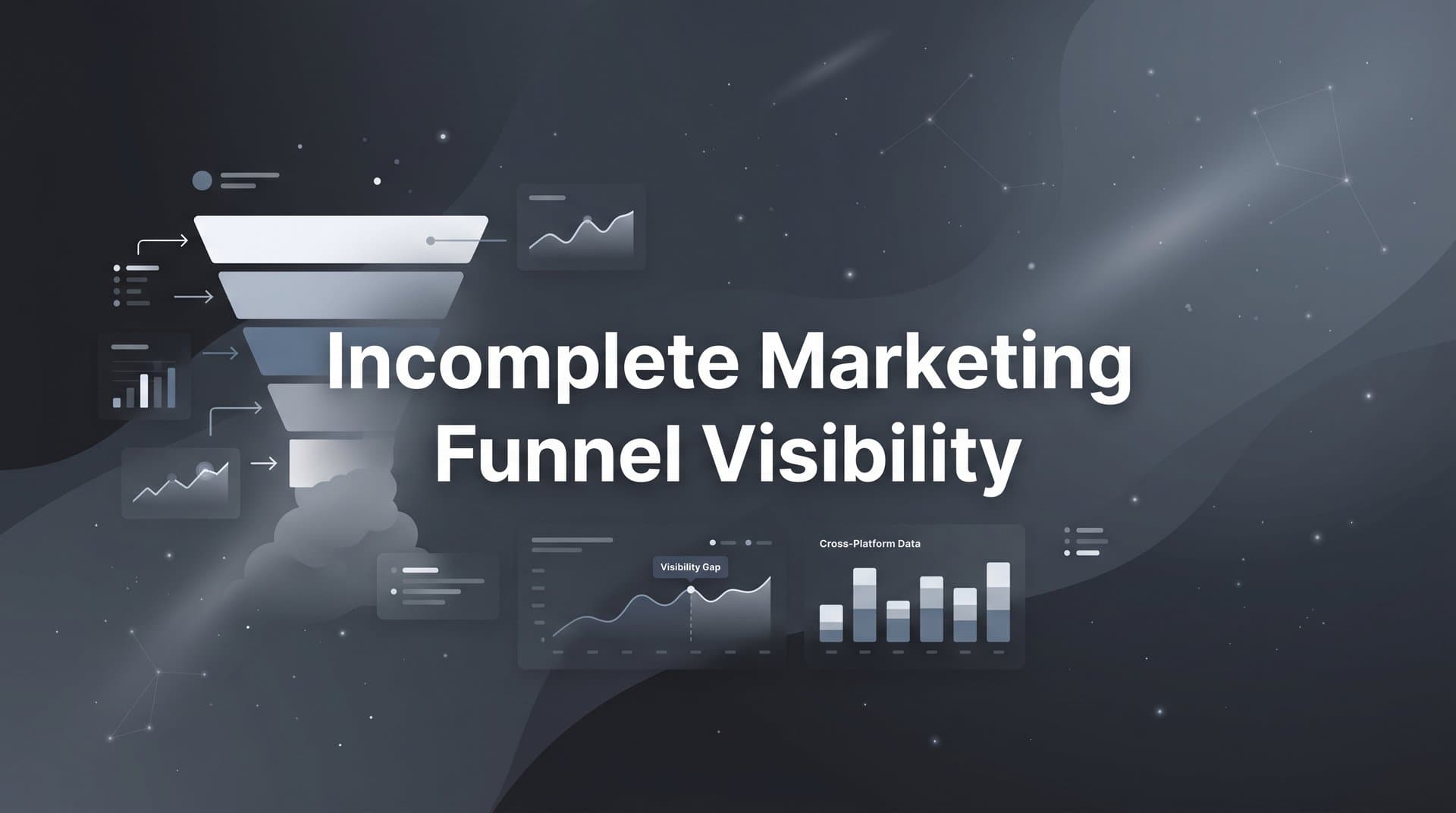
This is incomplete marketing funnel visibility, and it is one of the most expensive problems in modern digital marketing. Not because it causes an obvious failure, but because it quietly distorts every decision you make. You optimize toward the wrong channels, feed bad data to ad algorithms, and lose confidence in your ability to scale.
Incomplete funnel visibility means you cannot see the full path from first ad impression to closed revenue. You have fragments, not a picture. And in a world where buyers interact across multiple devices, platforms, and channels before converting, fragments are not enough. This article breaks down why this problem exists, what it actually costs your business, and how modern marketing teams are solving it with server-side tracking, multi-touch attribution, and unified analytics.
The Anatomy of a Broken Funnel View
At its core, incomplete marketing funnel visibility is the inability to connect every stage of the customer journey into one unified view. That means tracing a buyer from their first ad impression, through their website visit, into the CRM as a lead, through the sales process, and finally to closed revenue. Most teams can see pieces of this journey. Very few can see all of it.
Think about how a typical multi-platform funnel actually works. A prospect sees a prospecting video ad on Meta or TikTok. Days later, they search for a solution on Google and click a search ad. They land on a product page, browse, and leave without converting. A week after that, they come back through a retargeting ad, fill out a form, become a lead in the CRM, and eventually close as a customer. That is five or six distinct touchpoints across three platforms, two devices, and multiple days.
Here is where the data breaks down. Each platform involved in that journey reports its own version of reality. Meta claims the conversion because it served the original prospecting ad. Google claims the conversion because the buyer clicked a search ad. The CRM shows the lead but has no source data attached because the form was filled out through a retargeting click that the pixel missed. And Google Analytics shows a direct visit for the final session because the UTM parameters were stripped somewhere along the way.
The root cause is siloed tools that were never designed to communicate with each other natively. Ad platforms are built to show their own performance in the best possible light. Website analytics tools track on-site behavior but lose visibility once a user leaves. CRMs store lead and revenue data but rarely connect back to the specific ads that initiated the journey. Understanding marketing funnel analytics is essential to bridging these gaps between disconnected systems.
The result is a funnel full of blind spots. Marketers are left guessing which channels actually contribute to revenue, which campaigns are worth scaling, and which ones are consuming budget without producing results. These are not small gaps. They are structural problems that compound over time, especially as campaigns grow in complexity and spend.
Why Tracking Gaps Keep Getting Worse
If funnel visibility was already a challenge, recent privacy changes have made it significantly harder. Apple's App Tracking Transparency framework, introduced with iOS 14.5, gave users the ability to opt out of cross-app tracking. A large portion of iOS users chose to do exactly that. The immediate impact was felt most sharply on Meta, where pixel-based tracking relies on following user behavior across apps and websites after an ad click. When users opt out, that behavioral data disappears.
The broader shift away from third-party cookies compounds the problem. Browsers have been progressively restricting third-party cookie tracking, and the direction of travel across the industry is clear: client-side, cookie-based tracking is becoming less reliable. Ad blockers add another layer of signal loss. When a user has an ad blocker installed, browser-based pixels often fail to fire entirely, meaning conversions go unrecorded. Understanding the digital marketing strategy that tracks users across the web helps contextualize why these restrictions are so disruptive.
Cross-device and cross-channel complexity makes this even harder to solve. Modern buyers do not follow a neat, linear path. They might discover your brand on a smartphone during a commute, research competitors on a work laptop during the day, and convert on a home desktop in the evening. Each of those sessions can look like a separate, anonymous user to your tracking systems unless there is a mechanism to stitch them together. Without that stitching, each platform sees only its own fragment of the journey, and attribution becomes a guessing game.
Then there is the problem of dark social and offline touchpoints. A prospect hears your brand mentioned on a podcast. A colleague recommends your product in a Slack channel. Someone sees your billboard or attends an industry event where your team is present. These interactions generate genuine interest and often drive people into your funnel, but they never appear in standard tracking setups. The buyer eventually searches for your brand directly, converts, and gets attributed to branded search or direct traffic. The actual source of that interest remains invisible.
The cumulative effect is a tracking environment where the data you do capture is increasingly incomplete. The channels that look like they are performing well are often the ones that happen to be measurable, not necessarily the ones that are actually driving results. This distinction matters enormously when you are making budget decisions.
The Real Cost of Flying Blind
Incomplete marketing funnel visibility is not just a reporting inconvenience. It has direct financial consequences that show up in wasted budget, degraded ad performance, and an inability to make confident strategic decisions.
Budget misallocation through last-click bias: When teams rely on last-click attribution, all the credit goes to the final touchpoint before conversion. This systematically over-rewards bottom-of-funnel channels like branded search and retargeting, which are excellent at capturing demand that already exists. Meanwhile, the top-of-funnel awareness campaigns that created that demand in the first place receive no credit. Over time, teams cut the awareness spend because it "doesn't convert," which gradually shrinks the pipeline feeding those bottom-of-funnel channels. It is a slow bleed that often goes unnoticed until the pipeline is already thin. Adopting cross-channel marketing attribution is one of the most effective ways to correct this bias.
Degraded ad platform optimization: Meta, Google, and TikTok all rely on conversion signals to train their machine learning algorithms. When the conversion data you send back to these platforms is incomplete or inaccurate, their algorithms optimize toward the wrong audiences. They learn from bad data and replicate bad results. Over time, this shows up as rising cost per acquisition, declining return on ad spend, and a general sense that the platforms are "not working as well as they used to." In many cases, the platforms are performing exactly as trained. The problem is the training data.
Strategic paralysis at the leadership level: When the data tells a fragmented story, leadership cannot confidently scale campaigns, commit budget to new channels, or make the case for cutting underperformers. Every decision becomes a negotiation between competing platform reports, each claiming credit for the same conversions. This is why measuring marketing campaign effectiveness accurately is so critical to organizational alignment. This erodes trust in the marketing data overall, which means decisions get made on gut feel rather than evidence.
The common thread across all three consequences is the same: without a complete view of the funnel, you are optimizing a system you cannot fully see. And optimizing what you cannot see reliably produces suboptimal results.
Server-Side Tracking and Multi-Touch Attribution: The Fix
The good news is that the tools to solve incomplete marketing funnel visibility now exist and are accessible to teams of all sizes. The solution has two core components: server-side tracking to capture more complete data, and multi-touch attribution to interpret that data accurately.
Server-side tracking addresses the data capture problem at its root. Instead of relying on browser-based pixels that can be blocked by ad blockers, restricted by cookie settings, or degraded by iOS privacy changes, server-side tracking sends conversion events directly from your server to ad platforms. The user's browser is no longer the middleman. This means that even when a user has an ad blocker installed or has opted out of tracking in their browser, the conversion event can still be recorded accurately. Teams looking for the right solution should explore performance marketing tracking software that supports server-side event transmission natively.
The practical impact is meaningful. Conversion events that would previously go unrecorded now get captured. The data sent back to ad platforms is more complete, more accurate, and more timely. Platforms like Meta offer their Conversions API specifically to enable this kind of server-side event transmission. When enriched, server-side conversion data flows back to these platforms, their machine learning algorithms have better signal to work with. Better signal means better audience targeting, more efficient delivery, and lower acquisition costs over time. This is sometimes called conversion sync, and it is one of the most direct ways to improve ad platform performance without changing your creative or your bids.
Multi-touch attribution addresses the interpretation problem. Rather than assigning all credit to a single touchpoint, multi-touch marketing attribution distributes credit across every interaction in the customer journey. This gives you a far more accurate picture of which channels and campaigns are actually contributing to revenue.
The most common attribution models each tell a different story. First-touch credits the initial interaction, which is useful for understanding what creates awareness. Last-touch credits the final interaction before conversion, which is useful for understanding what closes deals. Linear attribution distributes credit equally across all touchpoints. Time-decay attribution gives more credit to recent touchpoints, reflecting the idea that interactions closer to the conversion are more influential. Position-based attribution, sometimes called U-shaped, gives the most credit to the first and last touches while distributing the remainder across the middle.
No single model is universally correct. The value of multi-touch attribution is the ability to compare models and understand how different parts of your funnel contribute at different stages. A channel that looks weak under last-touch attribution might look essential under first-touch or linear, revealing its true role in initiating or assisting the journey.
Together, server-side tracking and multi-touch attribution create the foundation for genuine full-funnel visibility. You capture more of what is actually happening, and you interpret it in a way that reflects reality rather than rewarding the last click.
Building a Full-Funnel Visibility Stack
Understanding the concepts is one thing. Actually building a visibility stack that works in practice requires the right components connected in the right way.
The foundation is a unified tracking layer that connects your ad platforms, website, and CRM into a single source of truth. This means that when a lead is created in your CRM, it can be traced back to the specific ad, campaign, and channel that initiated the journey. When that lead converts to a customer, that revenue gets attributed back to the marketing touchpoints that contributed to it. Implementing robust marketing campaign tracking is the first step toward building this unified layer.
UTM parameters are the connective tissue that makes attribution possible at scale. These are the tracking parameters appended to your URLs that tell your analytics system where traffic came from: the source, medium, campaign name, ad content, and keyword. The critical word here is consistency. A UTM naming convention that varies by team member, platform, or month produces data that cannot be reliably aggregated or compared. Establishing a clear, documented naming convention and enforcing it across every campaign is one of the highest-leverage operational improvements a marketing team can make. It costs nothing and dramatically improves the quality of your attribution data.
Once you have clean, structured data flowing through a unified tracking layer, AI marketing analytics can surface patterns that humans would miss on their own. This is where the real competitive advantage starts to emerge. An AI system can analyze thousands of campaign combinations, creative variations, and channel interactions simultaneously to identify which specific ads and campaigns are genuinely driving revenue, as opposed to which ones are simply generating clicks, impressions, or top-of-funnel vanity metrics.
This distinction matters more than it might initially seem. A campaign can generate enormous top-of-funnel activity, high click-through rates, and impressive engagement numbers while contributing very little to actual revenue. Conversely, a campaign with modest impression numbers might be consistently initiating journeys that end in high-value conversions. Without AI-powered analysis operating on complete funnel data, these patterns are nearly impossible to detect manually across large, multi-platform campaigns.
The full-funnel visibility stack is not a single tool. It is an architecture: server-side tracking for complete data capture, UTM consistency for clean attribution, CRM integration for revenue connection, multi-touch attribution for accurate credit distribution, and AI-powered analytics for intelligent optimization. Each component reinforces the others, and the value compounds as the data becomes more complete and the analysis becomes more sophisticated.
Putting It All Together: From Blind Spots to Confident Scaling
The path from incomplete marketing funnel visibility to full-funnel clarity follows a clear progression. It starts with diagnosing where your data breaks down: which stages of the funnel are disconnected, which platforms are not sharing data with each other, and where attribution credit is being distorted by last-click defaults.
From there, the fix involves implementing server-side tracking to capture more complete conversion data, connecting that data back to ad platforms through conversion sync, and adopting a multi-touch attribution framework that reflects the actual complexity of your buyers' journeys. Then comes the unification step: connecting ad platforms, website analytics, and CRM data into a single view so that every touchpoint from first impression to closed revenue is visible in one place. Finally, AI-powered analysis turns that unified data into actionable recommendations, identifying which campaigns to scale, which to cut, and where the next opportunity lies.
This is not just a reporting upgrade. Complete funnel visibility is a competitive advantage. Teams that can see exactly what drives revenue can scale spend with confidence, prove marketing ROI to leadership with real data, and optimize faster than competitors who are still flying blind.
Cometly is built to deliver exactly this kind of full-funnel visibility. It connects your ad platforms, CRM, and website data into one real-time view, so you can see the complete customer journey from first ad click to closed revenue. With server-side tracking, multi-touch attribution, AI-powered recommendations, and conversion sync to feed better data back to Meta, Google, and beyond, Cometly gives your team the clarity it needs to make every dollar count.
If you are ready to stop guessing and start scaling with confidence, Get your free demo today and see exactly what is driving your revenue.