

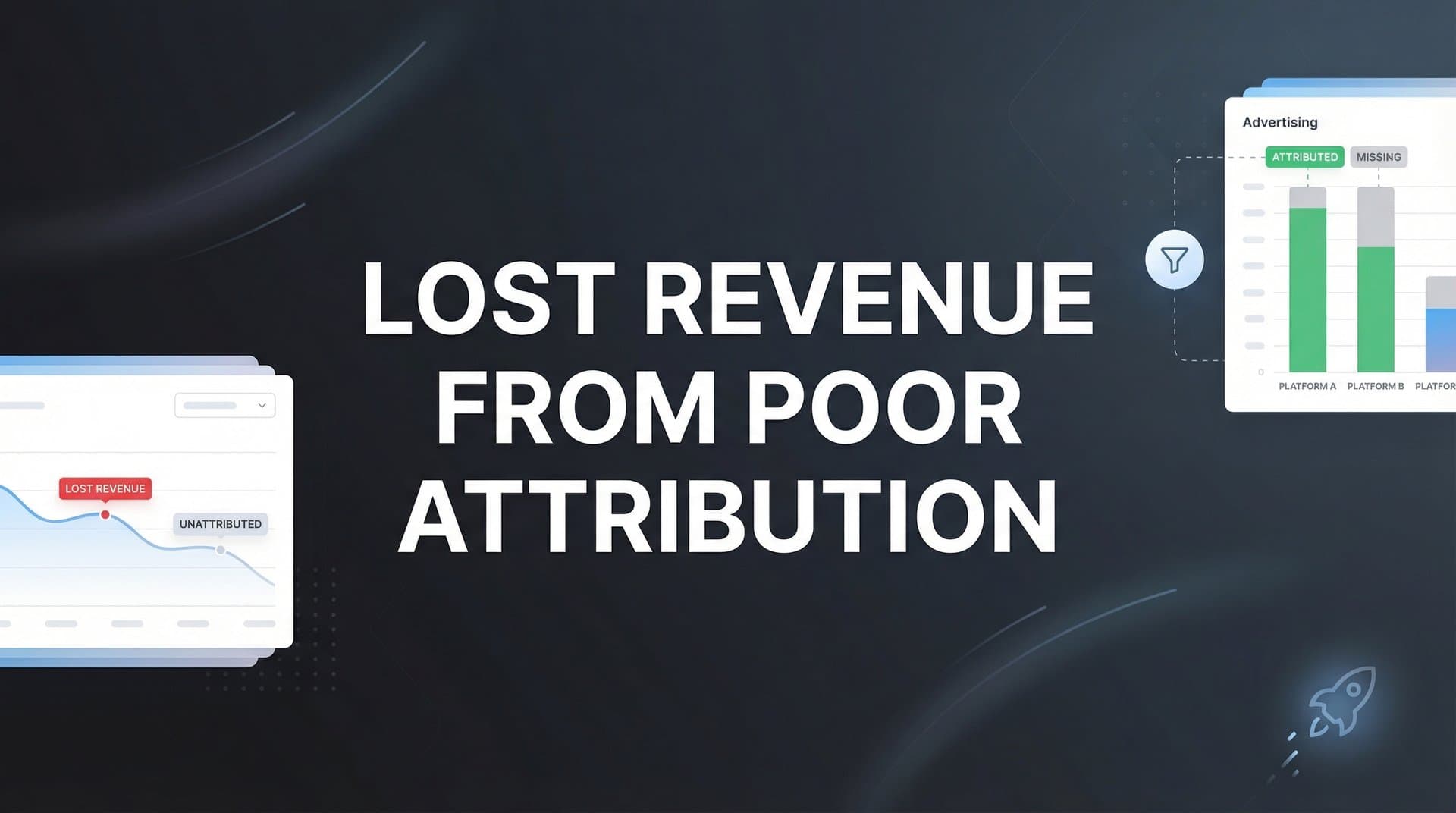
Your Meta Ads Manager shows 847 conversions this month. Google Ads reports 612. Your analytics dashboard claims 534. But when your finance team pulls the actual revenue numbers, something doesn't add up. The conversions are there, but the money isn't matching what the platforms promised.
This isn't just a reporting discrepancy. It's lost revenue from poor attribution, and it's costing you far more than you realize.
Poor attribution doesn't just create confusion in your spreadsheets. It actively drains your marketing budget by sending you down the wrong path, every single day. You're making decisions about where to spend your next dollar based on incomplete, inaccurate, or entirely misleading data. And each of those decisions compounds into real revenue loss.
Here's what makes this problem particularly insidious: the platforms you're advertising on have every incentive to show you the rosiest possible picture of their performance. Meanwhile, the actual customer journey that leads to revenue is happening across devices, channels, and touchpoints that your current tracking simply can't see.
The result? You're celebrating campaigns that aren't actually profitable. You're cutting budgets from channels that are secretly driving your best customers. And you're feeding your ad platform algorithms with conversion signals that bear little resemblance to what's actually happening in your business.
This article breaks down exactly how attribution gaps translate into lost revenue, why traditional tracking methods are failing modern marketers, and what you can do to build an attribution system that captures real results instead of vanity metrics.
The Hidden Cost of Attribution Blind Spots
Poor attribution isn't a single problem. It's a collection of gaps, each one quietly redirecting your budget away from what works and toward what merely appears to work.
At its core, poor attribution means your tracking system is missing critical pieces of the customer journey. Maybe it's the LinkedIn post that first introduced someone to your brand. Maybe it's the email sequence that nurtured them over three weeks. Maybe it's the Google search that happened on their phone, even though they eventually converted on their laptop days later.
Each missing touchpoint creates a blind spot. And in those blind spots, your revenue is hiding. Understanding lost revenue from tracking gaps is the first step toward recovering what you're missing.
Think of it like trying to navigate a city with a map that's missing half the streets. You can still get around, but you'll take longer routes, miss better options, and waste gas on detours that looked promising but led nowhere. That's what happens when your attribution is broken.
The compounding effect is where things get expensive. Bad data doesn't just sit there passively. It actively influences your decisions. You see a Facebook campaign with a 4x ROAS according to Meta's reporting, so you increase the budget. But that campaign is getting credit for conversions that actually came from your email nurture sequence or organic search. Now you're over-investing in Facebook while under-funding the channels that are genuinely driving revenue.
Meanwhile, the channels that aren't getting proper credit start looking like underperformers. You cut their budgets. You stop testing new creative. You shift resources elsewhere. And the actual revenue drivers in your marketing mix slowly starve while you feed the channels that simply have better self-reporting.
This differs from simple tracking errors in a crucial way. A tracking error is usually obvious and fixable: a broken pixel, a misconfigured tag, a form that isn't firing events. Attribution blind spots are systemic and subtle. Your tracking might technically be working, firing all the right events, and still giving you a fundamentally wrong picture of what's driving results.
The customer journey is complex. People research on mobile and buy on desktop. They click an ad, leave, come back through organic search, and convert weeks later. They interact with your brand across five different touchpoints before ever filling out a form. Traditional attribution systems simply weren't built to handle this reality.
And because these blind spots feel like they're working—after all, you're seeing conversions being reported—they're incredibly hard to detect until you start asking the uncomfortable question: why doesn't our revenue match what our platforms are telling us?
Why Traditional Tracking Methods Fall Short
The attribution methods that worked perfectly well five years ago are struggling to keep up with today's privacy-first internet. And the gap between what your tracking can see and what's actually happening is getting wider every month.
Apple's App Tracking Transparency framework fundamentally changed the game. When iOS users started opting out of tracking at scale, pixel-based attribution suddenly lost visibility into a massive portion of mobile traffic. Facebook's tracking pixel, which used to capture nearly every conversion, now misses significant chunks of the customer journey on iOS devices.
Cookie deprecation is accelerating this trend. As browsers phase out third-party cookies, the ability to track users across websites and attribute conversions back to specific ads continues to erode. The tracking methods that marketers have relied on for years are simply losing their effectiveness, contributing to significant lost ad revenue from tracking issues.
Cross-device tracking adds another layer of complexity. Your customer might discover your brand by clicking a Facebook ad on their iPhone during their morning commute. They might research your product on their work laptop during lunch. And they might finally convert on their home computer that evening. Traditional attribution systems see these as three different people, not one customer journey.
Then there's the self-reporting bias problem. Ad platforms like Meta and Google have their own attribution windows and methodologies, and they're not exactly conservative in giving themselves credit. Meta might claim a conversion happened because someone saw your ad three weeks ago, even if they came back through a Google search and your email campaign did the heavy lifting.
This creates a phenomenon where your platforms collectively report more conversions than you actually received. Meta says 500, Google says 400, LinkedIn says 150, but you only had 600 total conversions. The math doesn't work because everyone's taking credit for the same customers.
Platform-native attribution is designed to optimize for the platform's success, not necessarily yours. When Facebook tells you a campaign is performing well, it's measuring performance by Facebook's standards, using Facebook's attribution window, and giving Facebook the benefit of the doubt on every borderline conversion.
The disconnect between ad platform data and actual CRM revenue is where this all comes to a head. Your CRM knows exactly who became a customer and how much revenue they generated. Your ad platforms know who clicked and who converted according to their tracking. But connecting those two data sources? That's where traditional methods break down completely.
You end up with ad platforms reporting one version of reality, your analytics showing another, and your actual revenue telling a third story. And when you're making budget decisions based on the ad platform version—because that's the data that's easiest to access—you're essentially flying blind.
Five Ways Poor Attribution Silently Drains Your Budget
Let's get specific about how attribution gaps translate into actual revenue loss. These aren't theoretical problems. They're happening in marketing accounts right now, quietly redirecting thousands of dollars away from profitable channels.
Over-investing in channels that appear to perform but don't actually convert. This is the most common and most expensive attribution mistake. A channel looks like it's crushing it according to platform metrics, so you keep increasing the budget. But those conversions are being over-attributed. The channel is getting credit for sales that other touchpoints actually drove. You're pouring money into something that's riding on the coattails of your other marketing efforts, and the more you invest, the worse your overall ROAS becomes. You just can't see it because your attribution is lying to you. This is a classic example of ad spend waste from poor tracking.
Under-funding high-performing touchpoints that get lost in last-click models. Last-click attribution gives all the credit to whatever touchpoint happened right before the conversion. Sounds logical until you realize this systematically under-values everything that happened earlier in the journey. Your top-of-funnel content, your brand awareness campaigns, your nurture sequences—all the marketing that actually created the demand—gets zero credit because it didn't happen to be the last thing someone clicked. So you cut budgets from the channels that are genuinely building your pipeline, starving the foundation of your marketing engine.
Making scaling decisions based on incomplete customer journey data. You find a campaign that's working. The numbers look great. You decide to scale it aggressively. Then performance falls off a cliff. What happened? The campaign was never as strong as it appeared. It was benefiting from other marketing efforts that created the demand, and when you scaled it without scaling those supporting elements, the whole system broke down. Or it was converting customers who were already close to buying, and once you exhausted that warm audience, the economics completely changed. Incomplete attribution data makes scaling feel like gambling instead of science.
Feeding ad platform algorithms with inaccurate conversion signals. Modern ad platforms rely heavily on machine learning to optimize targeting and bidding. But machine learning is only as good as the data you feed it. When your conversion tracking is incomplete or inaccurate, you're teaching the algorithm to optimize for the wrong things. Facebook's algorithm thinks it should find more people like the ones who converted according to your pixel, but if your pixel is only catching 60% of actual conversions and over-attributing others, the algorithm is learning from fundamentally flawed data. The result? Targeting that drifts away from your actual best customers.
Missing the true ROI of multi-touch campaigns. Complex customer journeys mean your best customers often interact with multiple touchpoints before converting. A sophisticated buyer might see your LinkedIn ad, visit your website, download a resource, receive nurture emails, attend a webinar, and then finally request a demo. If your attribution can't connect all those dots, you have no idea which combination of touchpoints actually drives your highest-value customers. You might cut the LinkedIn ads because they don't show direct conversions, not realizing they're the essential first step in your most profitable customer journeys.
Each of these problems doesn't just waste the money you're spending wrong. It also represents the opportunity cost of the money you're not spending on what actually works. When you over-invest in Channel A because attribution makes it look good, you're simultaneously under-investing in Channel B where your real growth opportunity lives.
The cumulative effect can be staggering. A marketing team spending $100,000 per month with even moderately poor attribution might be wasting $20,000 to $30,000 of that budget on the wrong channels while simultaneously missing opportunities to invest in channels that could deliver 2x to 3x better returns.
Recognizing the Warning Signs in Your Own Data
How do you know if poor attribution is costing you revenue? The symptoms are usually hiding in plain sight, but they're easy to miss if you're not looking for them.
The most obvious red flag is when platform-reported conversions don't match actual revenue. You see 1,000 conversions across your ad platforms this month, but your CRM only shows 700 new customers. Or the platforms report a combined ROAS of 5x, but when you calculate actual revenue against ad spend, you're barely breaking even. This discrepancy is your attribution system waving a giant red flag. Learning how to fix attribution discrepancies in data should be a top priority.
Some marketers dismiss this as normal variation or different attribution windows. It's not. It's your tracking telling you it can't see the full picture.
Another warning sign is inconsistent performance when scaling campaigns. You have a campaign that's been delivering solid results at $1,000 per day. You increase the budget to $3,000 per day, expecting roughly 3x the results. Instead, performance tanks. The cost per acquisition doubles or triples, and the quality of leads drops noticeably.
This often happens because your attribution was over-crediting the campaign. It was picking up conversions from customers who were already in your funnel from other sources. When you scaled, you exhausted that pool and started reaching genuinely cold traffic, which performs completely differently. But your attribution never showed you this distinction.
Customer acquisition costs that don't align with lifetime value calculations are another telltale sign. Your ad platforms say you're acquiring customers at $50 each. Your finance team calculates that actual CAC is closer to $120 when you factor in all marketing spend and actual customer counts. That's not a minor accounting difference. That's your attribution system fundamentally misrepresenting your unit economics.
Watch for situations where your best-performing channels according to platform data are not the channels that sales says deliver the best leads. If your sales team consistently reports that leads from organic search or email convert at higher rates and stick around longer, but your ad platform attribution makes paid social look like your star performer, someone's lying. And it's probably not your sales team.
The "mystery conversions" phenomenon is another indicator. You see conversion spikes that you can't explain with any specific campaign or marketing activity. Revenue comes in, but you can't trace it back to any particular effort. This usually means your attribution is so fragmented that you're losing visibility into what's actually working. You're getting results, but you have no idea how to replicate them.
If you find yourself constantly surprised by which campaigns work and which don't, that's poor ad attribution data talking. Marketing shouldn't feel like throwing darts blindfolded. When you have clear attribution, you can predict with reasonable accuracy how campaigns will perform because you understand the actual mechanics of what drives conversions in your business.
Building an Attribution System That Captures Real Revenue
Fixing attribution isn't about adding more tracking pixels or switching to a fancier analytics platform. It's about fundamentally changing how you connect marketing activities to actual revenue outcomes.
Server-side tracking has emerged as the foundation for reliable attribution in the privacy-first era. Unlike browser-based pixels that can be blocked by ad blockers, deleted by cookie restrictions, or limited by iOS privacy settings, server-side tracking happens on your own servers where these limitations don't apply.
Here's why this matters: when someone converts on your website, server-side tracking sends that conversion data directly from your server to ad platforms and analytics tools. It doesn't rely on the user's browser cooperating. It doesn't get disrupted when someone switches devices. It captures the conversion regardless of their privacy settings.
This dramatically improves data accuracy. You're no longer losing 20% to 40% of your conversions to iOS privacy restrictions or browser limitations. You're capturing the complete picture of what's actually happening.
But server-side tracking alone isn't enough. You need to connect three critical data sources: your ad platforms, your website behavior, and your CRM. Implementing revenue attribution tracking tools can help bridge these gaps effectively.
Your ad platforms know which ads people clicked and when. Your website analytics knows how people behaved after they arrived: what pages they visited, how long they stayed, what content they engaged with. Your CRM knows who actually became a customer, how much revenue they generated, and whether they're still a customer six months later.
The magic happens when you connect all three. Suddenly you can trace a customer journey from initial ad click through website behavior all the way to closed revenue. You can see that the customer who generated $10,000 in revenue first clicked a LinkedIn ad, visited your pricing page, left, came back through organic search, downloaded a whitepaper, received three nurture emails, and then requested a demo.
This complete visibility changes everything about how you evaluate channel performance. You're no longer asking "which channel gets the last click?" You're asking "which combination of touchpoints creates our most valuable customers?"
The feedback loop with ad platform algorithms is particularly powerful. When you send accurate, complete conversion data back to platforms like Meta and Google, their machine learning systems can actually learn what good looks like. Facebook's algorithm gets better at finding people similar to your real customers, not just people similar to whoever happened to trigger your pixel.
This creates a compounding advantage. Better data leads to better algorithmic optimization, which leads to better targeting, which leads to more efficient customer acquisition. The platforms start working for you instead of against you.
Modern attribution platforms can track conversions that happen offline or in your CRM and attribute them back to the original marketing touchpoint. Someone fills out a form on your website after clicking a Google ad. Two weeks later, they become a customer through your sales process. Traditional attribution loses that connection. Advanced attribution maintains it, giving you true visibility into which marketing efforts drive actual closed revenue.
The key is moving from conversion tracking to revenue tracking. Don't just measure who converted. Measure who became a valuable customer, how much revenue they generated, and which marketing touchpoints influenced that journey. That's the data that actually matters for making smart budget decisions.
Turning Attribution Clarity Into Revenue Growth
Accurate attribution isn't just about knowing what happened. It's about using that knowledge to make fundamentally better decisions about where to invest your marketing budget.
Multi-touch attribution reveals patterns that last-click models completely miss. You might discover that your highest-value customers almost always interact with three specific touchpoints: a LinkedIn ad, your comparison page, and a nurture email sequence. Armed with this knowledge, you can build campaigns specifically designed to guide prospects through this proven journey instead of hoping they stumble into it randomly. Understanding multi-touch attribution models is essential for this level of insight.
You can identify assist channels that don't get many last-click conversions but play crucial roles in customer journeys. Maybe your YouTube content rarely gets direct credit for conversions, but customers who watch your videos convert at twice the rate and generate 50% more lifetime value. Without multi-touch attribution, you'd never see this pattern. With it, you can confidently invest in content that builds the foundation for conversions even if it doesn't get the final click.
Scaling becomes predictable instead of risky. When you understand the complete customer journey, you can scale the entire journey, not just the last touchpoint. You know that to double your demo requests, you need to proportionally increase your top-of-funnel awareness campaigns, your mid-funnel nurture, and your bottom-funnel conversion campaigns. You're scaling a system, not just throwing more money at whatever got the last click.
The confidence this creates is transformative. You're no longer second-guessing every budget decision or wondering if your platforms are lying to you. You have a clear, accurate picture of what drives revenue in your business. You can defend your marketing spend to leadership with actual data connecting marketing activities to revenue outcomes.
Better data creates a virtuous cycle. When you feed ad platforms accurate conversion data, they optimize better. When they optimize better, your campaigns perform better. When your campaigns perform better, you generate more revenue. When you generate more revenue, you have more budget to invest in the channels that are actually working. The whole marketing engine starts running more efficiently.
This is where attribution moves from being a reporting exercise to being a competitive advantage. Most of your competitors are still making decisions based on incomplete platform data. They're over-investing in channels that look good but don't deliver. They're under-investing in the complex, multi-touch strategies that actually drive valuable customers.
You're not. You can see the full picture. You know which combinations of touchpoints create your best customers. Proper revenue attribution by marketing channel gives you the clarity to invest confidently in strategies that your competitors think are too risky or unproven because their attribution can't show the ROI.
The revenue impact compounds over time. Better attribution leads to better budget allocation. Better budget allocation leads to more efficient customer acquisition. More efficient customer acquisition leads to faster growth at better unit economics. Faster growth with better economics leads to market leadership.
Moving Forward with Clear Attribution
Lost revenue from poor attribution isn't an inevitable cost of doing digital marketing. It's a solvable problem that comes down to connecting the right data sources and tracking the complete customer journey from first touch to closed revenue.
The marketers who solve attribution aren't just fixing a reporting problem. They're building a fundamental competitive advantage. While competitors waste budget on channels that merely appear to work, you're investing confidently in the touchpoints that actually drive valuable customers.
The path forward starts with acknowledging that platform-native attribution isn't enough. Meta's reporting, Google's conversions, and LinkedIn's attribution all tell part of the story, but none of them show you the complete picture of how marketing drives revenue in your business.
You need a system that captures every touchpoint, connects website behavior to CRM outcomes, and attributes revenue back to the marketing activities that genuinely influenced it. You need server-side tracking that works regardless of browser restrictions or privacy settings. And you need the ability to analyze multi-touch journeys instead of just crediting whichever channel happened to get the last click.
When you build this foundation, everything else gets easier. Budget decisions become clearer. Scaling becomes more predictable. Your ad platform algorithms get smarter because you're feeding them better data. And most importantly, you stop leaving revenue on the table because your attribution system couldn't see where it was coming from.
The question isn't whether you can afford to fix your attribution. It's whether you can afford to keep making marketing decisions based on incomplete, inaccurate data that's actively steering you away from your most profitable opportunities.
Ready to elevate your marketing game with precision and confidence? Discover how Cometly's AI-driven recommendations can transform your ad strategy. Get your free demo today and start capturing every touchpoint to maximize your conversions.



