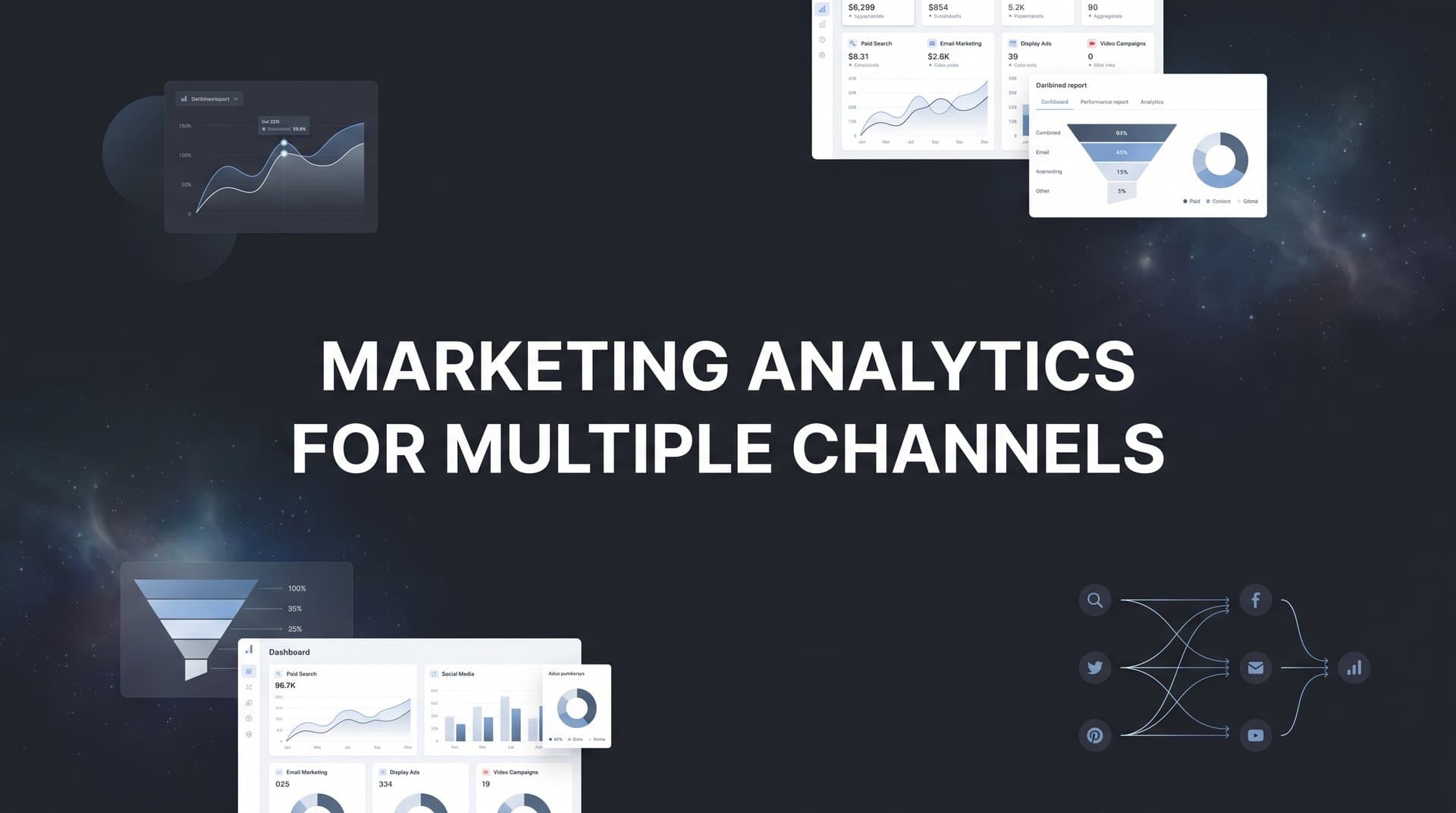
Running paid campaigns across Meta, Google, TikTok, LinkedIn, and other platforms creates a fragmented data landscape that makes it nearly impossible to understand what is actually driving results. Each platform reports conversions in its own silo, often double-counting or misattributing revenue to itself. For marketing teams managing budgets across multiple channels, this lack of clarity leads to wasted spend, missed opportunities, and scaling decisions built on incomplete data.
The problem is not a lack of data. If anything, you have too much of it, scattered across too many places. The real challenge is connecting that data into a coherent picture of what is actually working.
The solution is not more dashboards or more spreadsheets. It is a unified approach to marketing analytics for multiple channels that ties every touchpoint to real business outcomes. Whether you are managing a lean in-house team or running campaigns for multiple clients at an agency, the same principle applies: fragmented data leads to fragmented decisions.
These seven strategies will help you build a cross-channel analytics framework that gives you confidence in your data, clarity on performance, and the ability to scale the campaigns that actually move the needle. Each strategy builds on the last, so by the time you reach the end, you will have a practical roadmap for transforming how you measure and optimize your marketing.
1. Unify Your Data Sources Into a Single Analytics Hub
The Challenge It Solves
When your Meta data lives in Ads Manager, your Google data lives in Google Ads, and your CRM data lives somewhere else entirely, you are not doing cross-channel analytics. You are doing channel-by-channel reporting and hoping it adds up. The problem is it never does. Attribution overlaps, conversion windows differ, and there is no single source of truth to guide your decisions.
The Strategy Explained
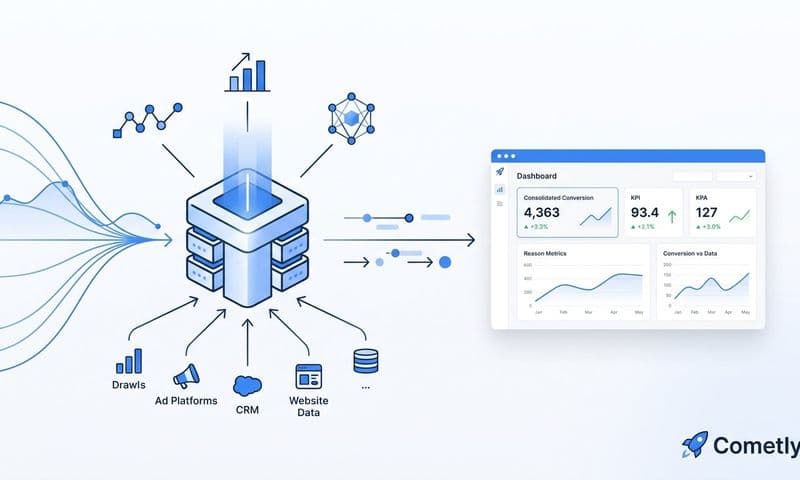
Centralizing your data means pulling ad platform data, CRM events, website behavior, and conversion signals into one unified analytics environment. From there, you can compare channel performance using consistent logic, rather than trusting each platform's self-reported numbers. A strong marketing analytics solution makes this centralization possible without stitching together dozens of disconnected tools.
Think of it like a financial dashboard for your business. You would not make investment decisions by looking at each account in isolation. You want one view that shows the full picture. The same logic applies to your marketing spend. A centralized platform connects your ad platforms, CRM, and website so you can track the entire customer journey in real time, rather than piecing it together manually after the fact.
Implementation Steps
1. Audit every data source you currently use: ad platforms, CRM, website analytics, email, and any offline conversion data.
2. Identify a centralized platform that can ingest data from all of these sources and apply consistent attribution logic across them.
3. Map your conversion events across platforms so they align to the same actions, using consistent naming conventions and definitions.
4. Establish a single reporting cadence based on the unified view rather than individual platform dashboards.
Pro Tips
Resist the temptation to keep platform dashboards as your primary reporting tool. They are useful for in-platform optimization, but they are not designed to give you an accurate cross-channel picture. Your unified hub should be the place where budget and scaling decisions get made.
2. Adopt Multi-Touch Attribution Instead of Last-Click Defaults
The Challenge It Solves
Last-click attribution assigns all the credit for a conversion to the final touchpoint before purchase. It sounds logical until you realize it completely ignores every ad, email, or piece of content that influenced the customer before that final click. In a multi-channel environment, last-click attribution systematically undervalues upper-funnel channels and overvalues lower-funnel ones, leading to budget cuts in exactly the wrong places.
The Strategy Explained
Multi-touch attribution distributes credit across every meaningful interaction in the customer journey. Depending on the model you choose, that credit might be distributed evenly, weighted toward the first and last touch, or assigned based on data-driven analysis of which touchpoints actually correlate with conversion. Understanding the common attribution challenges in marketing analytics helps you avoid pitfalls when selecting and implementing your model.
As customer journeys grow more complex, often spanning multiple platforms, devices, and days before a purchase decision is made, single-touch attribution becomes increasingly misleading. A prospect might discover your brand through a TikTok ad, research via a Google search, click a retargeting ad on Meta, and then convert through a direct visit. Last-click gives all the credit to direct. Multi-touch attribution gives you the full story.
Implementation Steps
1. Map out the typical customer journey for your business, identifying the key touchpoints that appear most often before conversion.
2. Choose an attribution model that reflects your sales cycle: linear models work well for longer cycles, while time-decay models suit shorter, intent-driven funnels.
3. Compare your current last-click data against a multi-touch view to identify which channels are being systematically under or over-credited.
4. Use the multi-touch view as the basis for budget allocation decisions going forward.
Pro Tips
Do not switch attribution models in the middle of a campaign evaluation period. Establish your multi-touch baseline first, then run a consistent comparison over at least 30 days before drawing conclusions. Consistency in your measurement window matters as much as the model itself.
3. Implement Server-Side Tracking to Close Data Gaps
The Challenge It Solves
Apple's App Tracking Transparency framework, introduced with iOS 14.5, fundamentally changed the accuracy of pixel-based tracking on mobile devices. Combined with the growing prevalence of ad blockers and browser-level cookie restrictions, pixel-based tracking now misses a meaningful portion of conversions across most campaigns. If your attribution relies entirely on browser-side pixels, your data has gaps you may not even be aware of.
The Strategy Explained
Server-side tracking moves the conversion event capture from the user's browser to your own server. Because the data flows directly from your server to the ad platform's API, it bypasses browser restrictions, ad blockers, and iOS privacy limitations entirely. The right performance marketing tracking software can streamline this implementation across all your active channels simultaneously.
This is not just a technical upgrade. It is a foundational requirement for accurate marketing analytics in the current privacy landscape. Marketers who continue to rely solely on browser-side pixels are making budget decisions based on an increasingly incomplete dataset.
Implementation Steps
1. Audit your current tracking setup to identify which conversion events are being captured via browser-side pixels only.
2. Implement a server-side tracking solution that connects your website or CRM events directly to the ad platform APIs, such as Meta's Conversions API or Google's Enhanced Conversions.
3. Run a parallel tracking period where both pixel and server-side data are captured, then compare the two to quantify how many conversions were previously being missed.
4. Transition your primary attribution reporting to rely on server-side data as the more accurate signal.
Pro Tips
Server-side tracking also enables you to enrich conversion events with additional data, such as customer lifetime value or lead quality scores from your CRM. This enriched data becomes even more powerful when you feed it back to ad platform algorithms, which we cover in Strategy 5.
4. Build Cross-Channel Budget Allocation Models Based on Revenue
The Challenge It Solves
Most marketing teams allocate budget based on cost-per-click, cost-per-lead, or ROAS as reported by individual platforms. The problem is that these metrics are siloed, often inflated by platform self-reporting, and disconnected from actual downstream revenue. Optimizing for CPA on Meta tells you nothing about whether those leads actually close. Allocating more budget to the channel with the lowest CPC often means investing in traffic that never converts.
The Strategy Explained
Revenue-attributed budget allocation starts from a different question: which channels are actually contributing to closed revenue, not just reported conversions? By connecting ad spend data to CRM outcomes and actual revenue, you can build allocation models that reflect true business impact rather than platform-reported metrics. Platforms that offer marketing attribution with revenue tracking make this connection seamless.
This approach requires unified data, which is why Strategy 1 comes first. Once your data is centralized and your attribution is accurate, you can start comparing channels on an apples-to-apples basis using revenue as the common denominator. That changes the conversation from "which channel has the best ROAS?" to "which channel drives the most actual business value per dollar spent?"
Implementation Steps
1. Connect your ad platform spend data to your CRM revenue data so you can calculate revenue per channel, not just cost per conversion.
2. Apply your multi-touch attribution model to distribute revenue credit across all contributing channels, not just the last click.
3. Build a budget allocation scorecard that ranks channels by revenue contribution, customer acquisition cost, and payback period.
4. Review and adjust allocations on a defined cadence, such as monthly, rather than reacting to short-term platform metric fluctuations.
Pro Tips
Factor in the time lag between ad exposure and revenue realization, especially for longer sales cycles. A channel that looks weak on a 7-day attribution window might look very strong on a 30 or 60-day view. Build your allocation models around the attribution window that matches your actual sales cycle.
5. Sync Enriched Conversion Data Back to Ad Platforms
The Challenge It Solves
Ad platform algorithms, including Meta's Advantage+, Google's Performance Max, and TikTok's Smart Performance Campaigns, are only as good as the conversion signals they receive. When those signals are incomplete, delayed, or based on low-quality events like page views or form submissions that never convert, the algorithm optimizes for the wrong outcomes. The result is wasted spend on audiences and placements that look good in the platform but do not drive real business results.
The Strategy Explained
Conversion syncing means feeding validated, downstream conversion events back to ad platforms via their APIs. Instead of sending a generic "lead submitted" event, you send a "lead converted to paying customer" event, complete with revenue data and any other enrichment signals available from your CRM. This gives the algorithm the information it needs to find more people who actually convert, not just more people who fill out forms. Learning how to use data analytics in marketing effectively is essential for setting up these feedback loops correctly.
This strategy has a compounding effect. Better signals lead to better targeting, which leads to higher-quality conversions, which generate better signals. Over time, your campaigns become progressively more efficient because the algorithm is learning from real business outcomes rather than surface-level engagement metrics.
Implementation Steps
1. Identify the downstream conversion events in your CRM that represent real business value, such as qualified leads, opportunities, or closed deals.
2. Set up server-side integrations that push these events back to Meta's Conversions API, Google's Enhanced Conversions, and TikTok's Events API.
3. Include revenue values and any available customer data with each event to maximize the signal quality sent to each platform.
4. Monitor campaign performance over 30 to 60 days after implementing enriched conversion syncing to measure the impact on lead quality and cost per acquisition.
Pro Tips
Match rates matter. The more customer data you can include with each conversion event, such as hashed email addresses or phone numbers, the better the platform can match that event back to a user profile and use it for optimization. Prioritize data completeness in your CRM to maximize match rates.
6. Create Standardized Cross-Channel Reporting Dashboards
The Challenge It Solves
Even when your data is unified, reporting can still break down if different team members are using different KPIs, different attribution windows, or different naming conventions for the same campaigns. One analyst might look at a 7-day click attribution window while another uses a 28-day view. One team might call a channel "Paid Social" while another calls it "Meta." These inconsistencies make cross-channel comparison unreliable and slow down decision-making.
The Strategy Explained
Standardized reporting means establishing a shared framework that every team member uses when evaluating campaign performance. This includes consistent KPI definitions, aligned attribution windows, standardized naming conventions for campaigns and channels, and a single dashboard that serves as the primary reporting surface for the whole team. Reviewing the top marketing analytics dashboard companies can help you identify the right platform for building this unified reporting layer.
The goal is to eliminate ambiguity. When your CMO, your media buyer, and your agency partner all look at the same dashboard and see the same numbers defined the same way, decisions happen faster and with more confidence. Standardization is not glamorous, but it is one of the highest-leverage improvements a marketing team can make to its analytics practice.
Implementation Steps
1. Define your core KPIs for cross-channel reporting: which metrics matter most for evaluating each channel and the overall portfolio.
2. Align on a single attribution window for all cross-channel comparisons and document it clearly for the whole team.
3. Establish naming conventions for campaigns, ad sets, and channels across all platforms and enforce them as a standard operating procedure.
4. Build a unified dashboard that surfaces these standardized metrics in one place, with filters that allow channel-level drill-down without losing the cross-channel context.
Pro Tips
Document your reporting standards in a shared reference document that new team members and agency partners can access. Reporting consistency breaks down most often during team transitions or when new channels are added. A written standard prevents drift and keeps everyone aligned as your marketing program scales. Understanding how to properly evaluate marketing performance metrics ensures your standardized framework measures what truly matters.
7. Use AI-Powered Recommendations to Scale Winning Campaigns Faster
The Challenge It Solves
Manual analysis of cross-channel performance data is time-consuming and prone to blind spots. When you are managing campaigns across five or more channels simultaneously, the volume of data generated every day makes it nearly impossible to surface every meaningful insight by hand. Optimization opportunities get missed, scaling decisions get delayed, and underperforming campaigns run longer than they should because no one had time to dig into the data.
The Strategy Explained
AI-powered analytics tools can process your cross-channel data continuously, identifying patterns and anomalies that would take a human analyst hours to find. More importantly, they can surface actionable recommendations: which campaigns to scale, which to pause, where budget should shift, and which audience segments are showing early signs of strong performance. Exploring the power of AI marketing analytics reveals just how transformative these capabilities can be for teams managing complex multi-channel programs.
This is where unified data and accurate attribution pay their biggest dividends. An AI layer built on top of fragmented, incomplete data produces unreliable recommendations. But when your data is clean, centralized, and attributed correctly, AI can dramatically accelerate the speed at which you act on what the data is telling you. Tools like Cometly's AI Ads Manager are designed to do exactly this, surfacing real-time optimization opportunities across all channels so your team can focus on execution rather than analysis.
Implementation Steps
1. Ensure your data foundation is solid before layering on AI recommendations: unified sources, server-side tracking, and consistent attribution are prerequisites.
2. Identify an AI analytics tool that works across all of your active channels and integrates with your existing data infrastructure.
3. Define the decision thresholds that matter to your team: at what ROAS, CPA, or revenue contribution level should a campaign be scaled, paused, or reallocated?
4. Use AI recommendations as inputs to human decisions rather than as automatic actions, at least initially, so your team can validate the logic and build confidence in the outputs.
Pro Tips
The best AI recommendations come from the richest data. Prioritize feeding your AI layer with downstream revenue signals from your CRM, not just platform-reported conversions. The more complete the picture of what actually drives business outcomes, the more precise and actionable the recommendations become.
Putting It All Together: Your Cross-Channel Analytics Roadmap
These seven strategies are most powerful when implemented as a connected system rather than a checklist of isolated improvements. The right sequence matters.
Start with the foundation: unify your data sources and implement server-side tracking. These two steps give you the accurate, complete data that everything else depends on. Without them, your attribution models, reporting dashboards, and AI recommendations are all built on shaky ground.
From there, layer in multi-touch attribution and conversion syncing. These strategies transform your data from a record of what happened into an active tool for improving what happens next, both in your own decision-making and in the ad platform algorithms that are constantly optimizing your campaigns.
Then build the reporting and intelligence layer: standardized dashboards and AI-powered recommendations. This is where the compounding value of the earlier work becomes visible. With clean data, accurate attribution, and enriched conversion signals feeding your analytics, the insights you surface are genuinely reliable and the decisions you make from them can be made with real confidence.
Accurate cross-channel analytics is not a one-time setup. It is an ongoing discipline that requires consistent maintenance, regular audits, and a commitment to measuring what actually matters to your business rather than what is easiest to report.
The good news is that you do not have to build this infrastructure from scratch or stitch together a dozen separate tools to get there. Cometly brings all of these capabilities together in one platform, from server-side tracking and multi-touch attribution to conversion syncing, unified dashboards, and AI-powered optimization recommendations across every channel.
Ready to elevate your marketing game with precision and confidence? Discover how Cometly's AI-driven recommendations can transform your ad strategy. Get your free demo today and start capturing every touchpoint to maximize your conversions.