Choosing a marketing analytics platform is rarely straightforward. The market is crowded, the feature sets overlap, and the pricing models vary wildly. What actually matters is finding the platform whose strengths align with your specific workflow, whether that means multi-touch attribution, real-time dashboards, or feeding cleaner conversion data back to your ad platforms.
Not every platform excels in the same areas. Some are built for ecommerce brands tracking profit in real time. Others are designed for enterprise teams that need deep segmentation and raw data access. A few are focused squarely on improving the quality of signals you send back to Meta and Google so their algorithms can do a better job for you.
To help you cut through the noise, we evaluated each platform below based on attribution capabilities, cross-channel tracking, AI-powered insights, integrations, and pricing transparency. Here are the top marketing analytics platforms and the standout features that make each one worth considering.
1. Cometly
Best for: Marketers who want AI-powered attribution and first-party conversion data synced back to ad platforms.
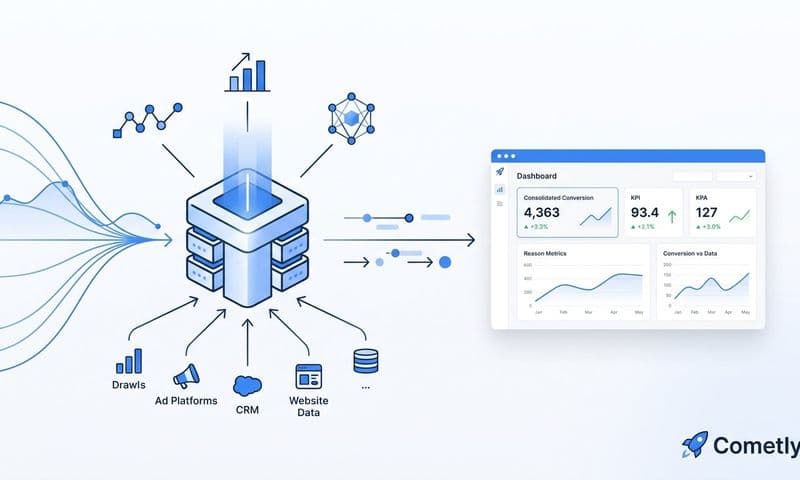
Cometly is an AI-powered marketing attribution platform that tracks the full customer journey and syncs enriched conversion data back to ad platforms for smarter optimization.
 9 Best Marketing Attribution Platforms to Compare in 2026
Where This Tool Shines
Cometly stands out because it does not just report on what happened. It helps you act on the data. The AI Ads Manager surfaces optimization recommendations based on actual revenue attribution, so you are not making budget decisions based on clicks or impressions alone.
The platform's server-side tracking is a meaningful differentiator in a world where iOS restrictions and cookie deprecation have made browser-based tracking increasingly unreliable. By capturing conversion events server-side and syncing them back to Meta, Google, TikTok, and other platforms, Cometly improves the quality of signals that ad algorithms use for targeting and optimization.
Key Features
AI Ads Manager: Analyzes campaign performance across channels and delivers actionable optimization recommendations based on attributed revenue.
AI Chat: Lets you query your marketing data using natural language, so you can get answers without building custom reports from scratch.
Server-Side Tracking: Captures conversion events outside the browser, bypassing iOS limitations and ad blockers for more complete data collection.
Multi-Touch Attribution: Maps every touchpoint across the customer journey so you can see which channels and ads are actually driving conversions.
Conversion Sync: Feeds enriched, first-party conversion data back to Meta, Google, TikTok, and more to improve ad platform targeting and algorithmic performance.
Best For
Cometly is built for digital marketers, media buyers, and agencies managing paid advertising across multiple platforms. It is particularly valuable for teams that want to connect ad spend directly to revenue and improve downstream ad performance through better data signals.
Pricing
Custom pricing based on ad spend volume. A demo is available on request through the Cometly website.
2. Google Analytics 4
Best for: Teams that need a free, flexible web and app analytics foundation with Google ecosystem integration.
Google Analytics 4 is Google's event-based analytics platform for tracking web and app user behavior with machine learning-powered insights.
 11 Best Marketing Analytics Tools to Track and Optimize Campaign Performance in 2026
Where This Tool Shines
GA4's event-based data model is a significant departure from the old session-based approach, and it gives marketers much more flexibility in how they define and track user actions. You are not locked into predefined metrics. You can track any interaction as an event and build custom funnels around what actually matters to your business.
The native BigQuery integration is a standout feature for data-forward teams. It gives you direct access to raw, unsampled event data, which opens the door to custom modeling, advanced segmentation, and integration with other data sources in your stack.
Key Features
Event-Based Data Model: Replaces session-based tracking with a flexible event structure that adapts to any user interaction you want to measure.
Predictive Audiences and Metrics: Uses machine learning to identify users likely to convert or churn, enabling smarter audience targeting in Google Ads.
Cross-Device and Cross-Platform Tracking: Unifies user behavior across web and app environments for a more complete picture of the customer journey.
BigQuery Integration: Exports raw event data to BigQuery for advanced analysis, custom modeling, and data warehouse workflows.
Funnel and Path Exploration Reports: Visualizes user journeys and drop-off points with flexible exploration tools built into the interface.
Best For
GA4 is a strong choice for businesses of all sizes that want a free analytics foundation with solid Google Ads integration. It is especially useful for teams already invested in the Google ecosystem.
Pricing
The standard version is free. GA4 360, the enterprise tier, offers higher data limits and SLAs; pricing is available on request from Google.
3. Adobe Analytics
Best for: Enterprise teams that need deep segmentation, real-time processing, and integration with the Adobe Experience Cloud.
Adobe Analytics is an enterprise-grade analytics platform offering advanced segmentation, real-time data processing, and AI-powered insights through Adobe Sensei.
 9 Best AI Marketing Analytics Tools in 2026
Where This Tool Shines
Adobe Analytics is built for organizations that need granular control over how they collect, segment, and analyze data. The Analysis Workspace is one of the most powerful reporting environments available, giving analysts the ability to build complex, multi-dimensional reports through a drag-and-drop interface without writing a single line of code.
The platform's real-time data processing capabilities are a genuine differentiator for teams that need to act on data quickly. Combined with Adobe Sensei's predictive analytics, it gives enterprise marketers both the depth and speed they need to make confident decisions.
Key Features
Analysis Workspace: A drag-and-drop reporting environment that supports complex, multi-dimensional analysis without requiring SQL or coding skills.
Advanced Segmentation: Supports highly granular audience segments and calculated metrics that go well beyond what most analytics platforms offer out of the box.
Real-Time Data Processing: Delivers data with minimal latency, making it suitable for time-sensitive marketing decisions.
Adobe Sensei AI: Powers predictive analytics, anomaly detection, and contribution analysis to surface insights automatically.
Cross-Channel Data Collection: Ingests data from web, app, offline, and third-party sources for a unified view of the customer.
Best For
Adobe Analytics is best suited for large enterprises with dedicated analytics teams, particularly those already using Adobe Experience Cloud products like Adobe Target or Adobe Campaign.
Pricing
Enterprise pricing is available on request. Adobe Analytics is typically positioned for larger organizations with substantial analytics budgets.
4. HubSpot Marketing Analytics
Best for: B2B marketing teams that want attribution and campaign analytics natively connected to their CRM.
HubSpot Marketing Analytics is a CRM-integrated analytics suite with multi-touch attribution, campaign tracking, and custom dashboards built into the HubSpot ecosystem.
 10 Best Marketing Analytics Software Packages in 2026
Where This Tool Shines
The biggest advantage HubSpot has over standalone analytics tools is the direct connection to contact-level CRM data. When you track a campaign in HubSpot, you can see not just clicks and form fills but which contacts those interactions influenced and what revenue they ultimately generated. That closed-loop view is genuinely valuable for B2B teams.
The custom report builder and dashboard tools are accessible enough for non-technical marketers while still offering meaningful depth. Teams that live inside HubSpot for their sales and marketing workflows will find the analytics experience feels native rather than bolted on.
Key Features
Multi-Touch Revenue Attribution: Available at the Enterprise tier, this feature assigns revenue credit across multiple touchpoints in the customer journey.
Campaign Performance Analytics: Tracks impressions, clicks, contacts, and revenue across all assets associated with a campaign in one view.
Custom Report Builder: Lets you build cross-object reports pulling from contacts, deals, and marketing activity without needing a BI tool.
Contact-Level Journey Tracking: Connects individual contact records to marketing interactions, giving sales and marketing a shared view of the pipeline.
Built-In A/B Testing Analytics: Measures the performance of email, landing page, and CTA tests directly within the platform.
Best For
HubSpot Marketing Analytics is ideal for B2B companies and agencies already using HubSpot as their CRM. The attribution features are most powerful at the Enterprise tier, making it a better fit for teams with larger budgets.
Pricing
Marketing Hub starts at $20 per month for the Starter tier. Multi-touch attribution requires the Enterprise plan, which starts at $3,600 per month.
5. Mixpanel
Best for: Product and growth teams focused on user behavior, retention, and event-level engagement analysis.
Mixpanel is a product analytics platform built around event-based tracking, cohort analysis, and retention measurement for web and mobile products.
 9 Best Cross Device Tracking Solutions for Marketers in 2026
Where This Tool Shines
Mixpanel is purpose-built for understanding what users do inside your product, not just how they arrived. The funnel and retention reports are particularly strong, letting you identify exactly where users drop off in a flow and how different cohorts behave over time. This makes it a go-to for growth teams running experiments and optimizing activation.
The interactive query builder is one of the more accessible tools in the product analytics space. You can answer complex behavioral questions without writing SQL, which makes Mixpanel useful for marketers and product managers who want data independence without relying on engineering resources.
Key Features
Funnel Analysis: Measures conversion rates across multi-step user flows and identifies the specific steps where users are dropping off.
Retention Analysis: Tracks how often users return to your product over time, broken down by cohort and behavior.
Cohort-Based Segmentation: Groups users by shared behaviors or properties for targeted analysis and audience building.
Interactive Query Builder: Enables complex behavioral queries through a point-and-click interface without requiring SQL knowledge.
Data Warehouse Integrations: Connects to BigQuery, Snowflake, and other warehouses for teams that want to combine product data with other sources.
Best For
Mixpanel is best for SaaS companies, mobile app teams, and growth marketers who need deep product usage analytics. It complements paid media attribution tools rather than replacing them.
Pricing
A free tier is available with event limits. The Growth plan starts at $28 per month, with pricing scaling based on data volume.
6. Supermetrics
Best for: Marketing teams that need to centralize data from multiple ad platforms into spreadsheets, dashboards, or data warehouses.
Supermetrics is a marketing data pipeline that pulls data from over 100 sources into the reporting and storage destinations your team already uses.
 9 Best Marketing Analytics Platforms and Their Standout Features in 2026
Where This Tool Shines
Supermetrics is not an analytics platform in the traditional sense. It is a data movement tool, and it does that job exceptionally well. If your team is spending hours manually pulling data from Google Ads, Meta, LinkedIn, and other platforms into spreadsheets or dashboards, Supermetrics automates that process and keeps everything refreshed on a schedule.
The breadth of connectors is a real strength. With over 100 data source integrations and destinations including Google Sheets, Looker Studio, BigQuery, Snowflake, and Excel, Supermetrics fits into almost any existing reporting workflow without requiring a rebuild.
Key Features
100+ Data Source Connectors: Pulls marketing data from virtually every major ad platform, social channel, SEO tool, and analytics source.
Flexible Destinations: Sends data to Google Sheets, Looker Studio, BigQuery, Snowflake, Excel, and other tools your team already uses.
Automated Data Refresh: Schedules automatic data pulls so your reports are always up to date without manual intervention.
Custom Metric Calculations and Data Blending: Lets you combine data from multiple sources and create custom metrics within your reporting destination.
Team-Friendly Sharing and Templates: Provides pre-built templates and sharing features that make it easier to roll out consistent reporting across a team or agency.
Best For
Supermetrics is ideal for marketing agencies managing multiple client accounts and in-house teams that want to centralize reporting without building a custom data pipeline. It works best as a complement to a BI or visualization tool.
Pricing
Plans start at around $39 per month depending on the destination and number of connectors. Pricing scales with data volume and the number of sources included.
7. Triple Whale
Best for: Shopify brands that want ecommerce-specific attribution, creative analytics, and real-time profit tracking in one place.
Triple Whale is an ecommerce-focused analytics and attribution platform built natively for Shopify brands with first-party pixel tracking and real-time financial visibility.
Where This Tool Shines
Triple Whale was designed specifically for direct-to-consumer ecommerce brands, and that focus shows in the product. The real-time profit and loss dashboard gives brand operators a live view of contribution margin, ad spend, and net profit in a single screen, something that most general analytics platforms simply do not offer.
The creative analytics features are particularly useful for performance marketers managing large ad libraries. You can see which creative assets are driving attributed revenue across Meta, TikTok, and other channels, making it easier to identify what to scale and what to cut.
Key Features
Shopify-Native First-Party Pixel: Captures customer journey data directly from your storefront, reducing reliance on browser-based third-party cookies.
Total Impact Attribution Model: Triple Whale's proprietary model distributes conversion credit across all touchpoints rather than defaulting to last-click.
Creative Performance Analytics: Measures attributed revenue and return on ad spend at the individual creative level across channels.
Real-Time Profit and Loss Dashboard: Surfaces live data on revenue, cost of goods, ad spend, and net profit so operators can make faster decisions.
AI-Powered Spend Recommendations: Suggests budget adjustments based on attribution data and performance trends across your active campaigns.
Best For
Triple Whale is built for Shopify-based DTC brands running paid social and search campaigns. It is less suited for B2B companies or businesses not using Shopify as their primary commerce platform.
Pricing
Plans start at around $100 per month, with pricing scaling based on annual revenue. Higher tiers unlock more advanced attribution and AI features.
8. Tableau
Best for: Data teams and BI-focused organizations that need powerful visualization and flexible connectivity to any data source.
Tableau is an industry-leading data visualization and business intelligence platform, now part of the Salesforce ecosystem, built for turning complex data into interactive visual analytics.
Where This Tool Shines
Tableau's core strength is its ability to connect to virtually any data source and transform that data into polished, interactive dashboards. For marketing teams that are pulling data from multiple platforms and need to present findings to stakeholders, Tableau offers a level of visual flexibility that purpose-built marketing analytics tools rarely match.
The natural language query feature, Ask Data, lets non-technical users type questions and get visual answers without building a report from scratch. Combined with the platform's live data connections, this makes Tableau a strong option for organizations that want self-serve analytics across departments, not just marketing.
Key Features
Drag-and-Drop Visual Analytics: Lets users build complex, interactive visualizations without coding by dragging fields onto a canvas.
Ask Data (Natural Language Queries): Accepts plain-English questions and returns auto-generated visualizations based on your connected data.
Live and Extract Data Connections: Supports real-time connections to databases, cloud platforms, spreadsheets, and hundreds of other sources.
Interactive Dashboard Sharing and Embedding: Publishes dashboards to Tableau Server or Tableau Cloud for sharing with internal teams or embedding in other tools.
Native Salesforce CRM Integration: Connects directly to Salesforce data, making it a natural fit for revenue teams already on the Salesforce platform.
Best For
Tableau is best for data and analytics teams that need enterprise-grade visualization and cross-departmental reporting. It is a strong fit for organizations with a dedicated BI function and diverse data sources beyond just marketing.
Pricing
Tableau Creator licenses start at $75 per user per month. Viewer licenses are available at lower price points for stakeholders who consume but do not build reports.
9. Northbeam
Best for: Performance marketing teams that want a hybrid attribution approach combining media mix modeling with multi-touch attribution.
Northbeam is a performance marketing analytics platform that combines media mix modeling with multi-touch attribution to give brands a more complete picture of how their ad spend drives results.
Where This Tool Shines
Most attribution platforms force you to choose between MTA and MMM. Northbeam takes a hybrid approach, blending the granularity of multi-touch attribution with the statistical modeling of media mix modeling. This gives performance marketers both the day-to-day channel-level visibility they need and the longer-term budget allocation insights that MMM provides.
The creative-level analytics and incrementality testing features are standouts for teams running large paid media programs. Rather than relying solely on platform-reported data, Northbeam helps you measure the true incremental lift of your campaigns and make budget decisions based on what is actually moving the needle.
Key Features
Hybrid MMM plus MTA Attribution: Combines media mix modeling with multi-touch attribution for both strategic budget planning and tactical campaign optimization.
Creative-Level Performance Analytics: Breaks down attributed performance to the individual creative asset, helping teams identify what to scale and what to retire.
Incrementality Testing: Measures the true incremental impact of campaigns beyond what last-click or even multi-touch models can capture.
Customizable Attribution Windows: Lets you adjust lookback windows to match your actual sales cycle rather than relying on platform defaults.
Cross-Channel Spend Optimization: Surfaces recommendations for reallocating budget across channels based on attributed revenue and efficiency metrics.
Best For
Northbeam is well-suited for performance marketing teams at brands with meaningful ad spend across multiple channels. It is particularly valuable for teams that have outgrown last-click attribution and want a more sophisticated, statistically grounded approach to measurement.
Pricing
Custom pricing is available on request. Northbeam is typically positioned for brands with significant ad spend who need enterprise-level attribution capabilities.
Which Platform Is Right for Your Stack?
The right marketing analytics platform depends on where your biggest measurement gaps are right now. There is no single tool that wins across every category, and the best choice for your team comes down to your business model, your tech stack, and what you most need to improve.
If your priority is connecting ad spend directly to revenue with AI-powered optimization and first-party data synced back to your ad platforms, Cometly is built exactly for that. It covers attribution, server-side tracking, and conversion data quality in one platform designed for performance marketers.
For ecommerce brands on Shopify, Triple Whale's real-time profit visibility and creative analytics fill a specific gap that general analytics tools do not address. If you are a large enterprise with a dedicated analytics team and complex data requirements, Adobe Analytics or Tableau may be the better fit depending on whether your priority is raw analytical depth or visualization flexibility.
Teams already invested in HubSpot will find the CRM-native attribution features compelling, especially for B2B pipelines. And if your challenge is simply getting all your marketing data into one place for reporting, Supermetrics solves that problem efficiently without requiring a custom data pipeline.
The platforms that tend to deliver the most value in 2026 share a few things in common. They capture first-party data reliably, they connect marketing activity to actual revenue rather than proxy metrics, and they help you act on insights rather than just report on them.
Ready to see how AI-powered attribution can sharpen your ad performance? Get your free demo of Cometly today and start capturing every touchpoint that matters to your business.