There's a tension sitting at the center of every B2B SaaS marketing team's strategy right now. On one side, leadership wants clear proof that ad spend is driving pipeline and revenue. On the other, the tracking infrastructure that marketers relied on for years is quietly falling apart beneath them.
Third-party cookies are disappearing. Browser privacy controls are tightening. Consent frameworks are reducing the signal quality that platforms like Meta and Google use to optimize campaigns. The result is a growing disconnect between what your ad dashboards report and what your CRM actually shows. Budget decisions get harder. Attribution gets murkier. And the pressure to justify spend keeps rising.
This is the reality that privacy-first marketing measurement was built to address. Not as a workaround or a compliance checkbox, but as a fundamentally more durable way to understand what is actually driving your pipeline and revenue. For B2B SaaS teams navigating longer sales cycles, multiple touchpoints, and complex buyer journeys, getting measurement right is not optional. It is the foundation everything else is built on.
This guide breaks down why traditional measurement is breaking, what privacy-first measurement actually means in practice, and how to build a tracking stack that gives you accurate attribution without depending on third-party identifiers that are increasingly unreliable.
Why the Old Measurement Playbook Is Breaking Down
For years, the standard approach to measuring ad performance was simple enough: drop a pixel on your website, let it fire when someone converts, and trust the ad platform to connect that event back to the campaign that drove it. It worked reasonably well when browsers passed third-party cookies freely and users moved predictably across sessions.
That world no longer exists.
Safari and Firefox have blocked third-party cookies for years. Chrome has been moving in the same direction. The cumulative effect is that browser-based pixel tracking has become systematically unreliable. When a pixel cannot read or set third-party cookies, it loses the ability to stitch together a user's journey across sessions and devices. Conversions go unattributed. Ad platforms underreport results. And the data you use to make budget decisions becomes progressively less accurate.
Apple's App Tracking Transparency framework, introduced with iOS 14.5, compounded the problem significantly. By requiring apps to request explicit permission before tracking users, Apple reduced the match rates that Meta and other platforms depend on to attribute ad-driven conversions. For campaigns with a meaningful mobile component, this created a visible gap between reported performance and actual results. Cost per acquisition figures inflated. Targeting algorithms lost signal. Campaigns that were genuinely working looked worse on paper than they actually were.
For B2B SaaS teams specifically, this creates a particularly difficult situation. B2B buying cycles are long. A prospect might click a LinkedIn ad in week one, return through organic search in week three, and finally convert through a direct visit six weeks later. Traditional pixel-based tracking was never great at capturing this kind of multi-session journey. With cookie restrictions now in place, it has become even less reliable.
The downstream effect is a growing gap between ad platform dashboards and CRM reality. Your Google Ads account might show a certain number of conversions for a campaign. Your CRM shows a different number of leads attributed to paid search. Neither number tells you which campaigns actually drove closed-won revenue. Without a modern measurement foundation, marketing teams end up making budget decisions based on data that is incomplete at best and misleading at worst.
The old playbook is not just underperforming. It is actively creating blind spots that cost money and erode confidence in marketing as a revenue driver.
Defining Privacy-First Marketing Measurement
Privacy-first marketing measurement is not about collecting less data. That is a common misconception worth clearing up immediately. It is about collecting the right data, through the right methods, using signals that are durable, consent-aligned, and not dependent on third-party identifiers that users cannot control.
At its core, privacy-first measurement replaces reliance on third-party cookies and browser-level tracking with first-party data signals collected directly from your own systems. Your CRM, your website, your ad platforms, and your payment infrastructure all become the source of truth. Instead of depending on a browser to pass information between your site and an ad platform, you use your own server to send that information directly.
This shift centers on two foundational concepts: server-side tracking and Conversion APIs. Rather than firing a browser pixel that can be blocked, degraded, or stripped of its identifiers by privacy controls, you send conversion events from your own server directly to ad platforms. The data travels through a pathway you control, not one that depends on browser behavior.
The methodology is also built on data minimization and consent. Privacy-first measurement does not mean you stop measuring. It means you are deliberate about what you collect and how you collect it. You gather what you need to understand performance accurately. You do not store or share personally identifiable information beyond what users have agreed to. And you use first-party identifiers, such as hashed email addresses or CRM IDs, rather than third-party tracking identifiers that users have no visibility into.
For B2B SaaS teams, this approach aligns naturally with how the business already operates. You have CRM data. You have form submissions. You have product usage events and payment data. All of that is first-party information you own and control. Privacy-first measurement is about connecting those signals into a coherent attribution system rather than relying on ad platforms to do the tracking for you through methods that are increasingly blocked.
The result is a measurement foundation that is more accurate, more durable, and better aligned with where the industry is heading. Privacy regulations will continue to evolve. Browser restrictions will continue to tighten. Teams that build on first-party data now will not need to rebuild their measurement infrastructure every time a new privacy change lands.
The Core Technologies Behind Privacy-Safe Attribution
Understanding the methodology is one thing. Knowing which technologies actually make it work is another. Three capabilities sit at the center of any modern privacy-first measurement stack for B2B SaaS teams.
Server-Side Tracking and Conversion APIs: Meta's Conversions API and Google's Enhanced Conversions are the most widely used implementations of this approach. Instead of relying on a browser pixel to fire when a user converts, these integrations allow you to send conversion data directly from your server to the ad platform. The event travels through a backend connection that is not subject to browser-level blocking, ad blockers, or cookie restrictions. Signal quality improves. Match rates improve. And the ad platform's optimization algorithms receive the data they need to do their job effectively.
First-Party Data Enrichment: Server-side tracking is more powerful when you can connect anonymous ad clicks to actual records in your CRM. This is where first-party data enrichment comes in. By using your own identifiers, such as a hashed email address captured at form submission, you can link an ad click to a specific lead, opportunity, or closed-won deal in your CRM. This allows you to attribute pipeline and revenue back to specific campaigns without relying on third-party cookies to maintain that connection across sessions.
For B2B SaaS teams, this is particularly valuable. A prospect might interact with multiple campaigns over several weeks before converting. First-party enrichment lets you trace that journey using data you already have, rather than depending on a cookie chain that may have broken somewhere along the way.
Multi-Touch Attribution on First-Party Data: Once you have a first-party data foundation in place, you can apply multi-touch attribution models that reflect the reality of how B2B buyers actually behave. A linear model distributes credit evenly across touchpoints. A time-decay model weights more recent interactions more heavily. A position-based model emphasizes the first and last touch. None of these models are perfect, but all of them are more useful than last-click attribution applied to incomplete, cookie-degraded data.
The key is that when attribution is built on first-party signals tied to actual CRM events, the models you apply produce results you can act on. You can see which campaigns are generating top-of-funnel awareness, which are driving pipeline, and which are contributing to closed-won revenue. That is the level of visibility B2B SaaS marketing teams need to make confident budget decisions.
How Privacy-First Measurement Improves Ad Performance, Not Just Compliance
Here is where the conversation shifts from risk mitigation to competitive advantage. Privacy-first measurement is not just about protecting your data practices or staying ahead of regulations. It is about feeding ad platform algorithms better data, which directly improves campaign performance.
Meta and Google's machine learning systems are only as good as the conversion signals they receive. When signal quality degrades because pixels are being blocked or match rates are low, those algorithms optimize against an incomplete picture. They make targeting and bidding decisions based on partial data. The campaigns that appear to be performing well may simply be the ones that happen to convert in environments where tracking still works, not the ones that are genuinely most effective.
When you implement server-side tracking and send enriched conversion events back to these platforms, you restore and often improve the signal quality their algorithms depend on. Better signals lead to better audience modeling. Better audience modeling leads to more efficient targeting. Over time, this typically translates to lower cost per acquisition and more qualified leads, not because you changed your creative or your offer, but because the platform now has better data to work with.
There is also a direct impact on how you allocate budget. When your attribution is based on first-party data tied to actual revenue events in your CRM, you can identify which campaigns are genuinely driving pipeline rather than which ones are generating form fills that never convert. This distinction matters enormously in B2B SaaS, where the gap between a marketing qualified lead and a closed deal can represent months of nurturing and significant revenue variance.
Teams that move to server-side tracking often discover something else: conversion events that pixel-based tracking was simply missing. When a browser pixel fails to fire because of an ad blocker, a consent opt-out, or a cookie restriction, that conversion disappears from your data. Server-side tracking captures those events because it does not depend on the browser to report them. The result is a more complete dataset, which means better budget allocation decisions across every channel in your mix.
Privacy-first measurement, in other words, makes your ads work better. That is the argument that should drive adoption, not just the regulatory one.
Building a Privacy-First Measurement Stack for B2B SaaS
Knowing the principles is useful. Having a clear picture of what the stack actually looks like is more useful. Here is how to think about building a privacy-first measurement foundation that serves a B2B SaaS marketing team.
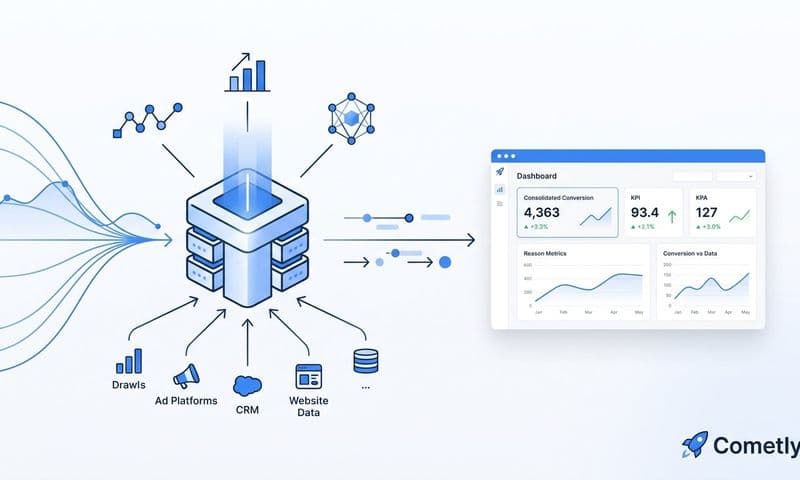
Start with a unified attribution system: The foundation is connecting your ad platforms, CRM, and website into a single system that uses server-side events as the primary data layer. This means your conversion events are not siloed inside individual ad platform dashboards. They flow into a central attribution layer where you can analyze performance across channels, compare attribution models, and connect ad spend to pipeline and revenue in one place.
Implement event deduplication carefully: Most teams run browser pixels and server-side tracking in parallel during the transition, which creates a real risk of double-counting conversion events. If both your pixel and your server-side integration report the same form submission to Meta, the platform counts it twice. Your reported conversion volume inflates. Your CPAs look artificially low. And your optimization algorithms train on inaccurate data. Deduplication logic, typically using a unique event ID that both the pixel and the server-side event share, ensures each conversion is counted once and only once across your reporting.
Connect revenue data directly to your attribution layer: This is the step that separates surface-level measurement from true ROI tracking. Integrating payment data from tools like Stripe directly into your attribution system allows you to measure actual closed revenue at the campaign and channel level, not just lead volume or MQL counts. For B2B SaaS teams, this means you can finally answer the question that matters most: which campaigns are generating revenue, not just leads?
Use first-party identifiers to close the loop: When a prospect submits a form, capture a first-party identifier such as a hashed email that can be used to connect that lead to downstream CRM events. When that lead becomes an opportunity, and eventually a closed-won deal, that identifier allows you to attribute the revenue back to the original campaign touchpoints. This is the mechanism that makes multi-touch attribution on first-party data actually work in practice.
Building this stack takes deliberate effort, but the payoff is a measurement foundation that does not degrade every time a browser updates its privacy policies or a platform changes its tracking rules.
Measurement That Scales With Your Growth
The shift from cookie-dependent tracking to a first-party, server-side measurement model is not a one-time fix. It is a strategic investment that compounds over time. As your ad spend grows, as your channel mix expands, and as your sales cycles become more complex, the quality of your measurement foundation determines how confidently you can scale.
Teams that build on first-party data have a durable advantage. Their attribution does not erode when Chrome tightens its cookie policies or when Apple introduces the next privacy framework. Their conversion signals remain clean and complete. Their ad platform algorithms continue to optimize against accurate data. And their budget decisions are grounded in what is actually driving revenue, not what a degraded pixel happened to capture.
Privacy-first marketing measurement is not a constraint. It is a competitive advantage for B2B SaaS teams that want reliable attribution as their growth ambitions scale.
Cometly is built specifically for this environment. It connects your ad platforms, CRM, and revenue data into one attribution system, using server-side tracking, Conversion API integrations, and first-party data enrichment to give you a complete, accurate picture of what is driving pipeline and closed-won revenue. From first ad click to signed contract, Cometly tracks every touchpoint and surfaces the insights you need to allocate budget with confidence.
If your current tracking setup is leaving gaps, now is the right time to close them. Get your free demo today and see how Cometly connects ad spend to revenue with privacy-safe, first-party attribution built for B2B SaaS teams.