

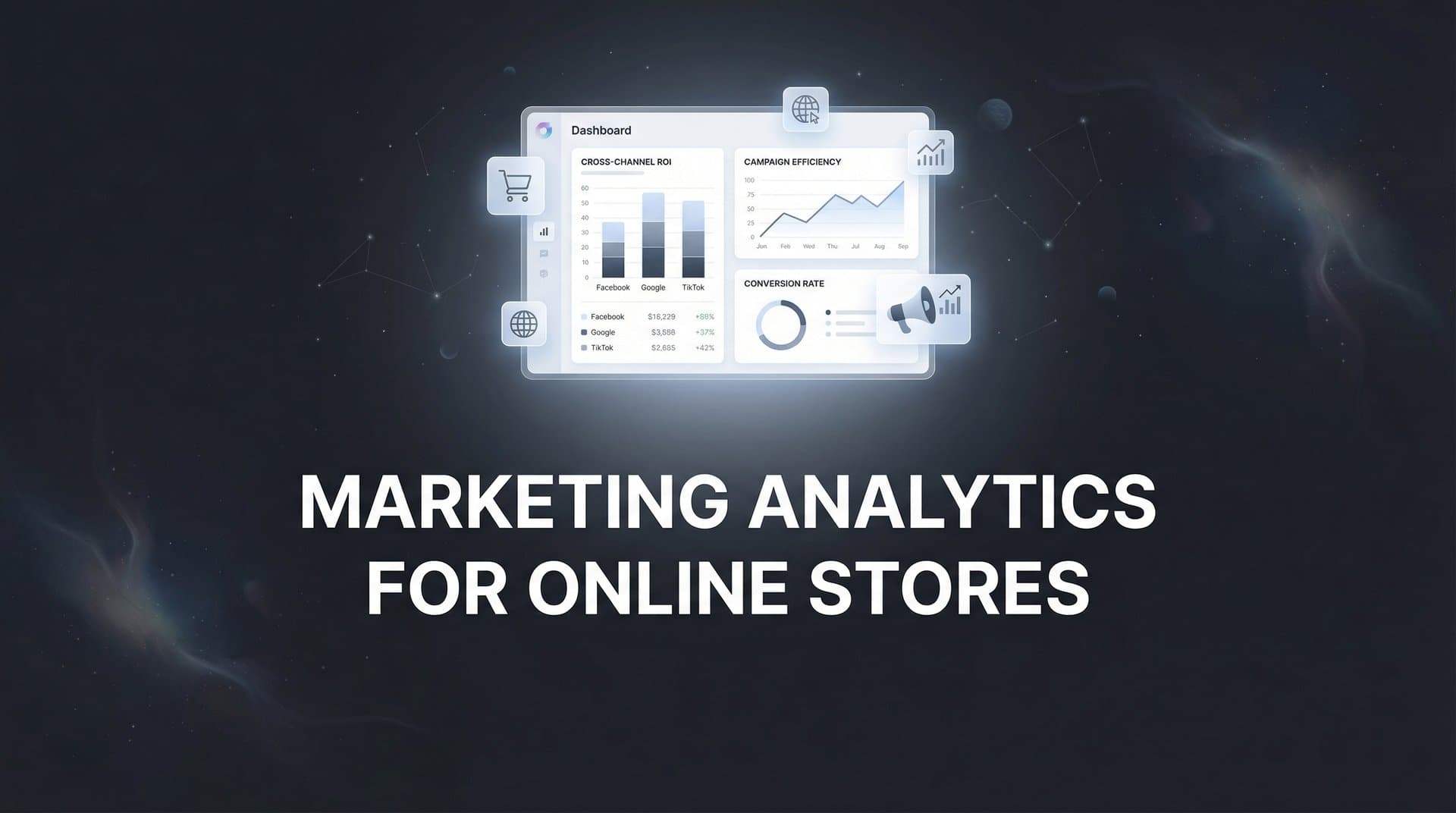
Online stores generate massive amounts of data every day, but most ecommerce businesses struggle to turn that data into profitable decisions. The challenge is not collecting information. It is knowing which metrics actually matter, which channels deserve your budget, and which customer journeys lead to revenue.
Marketing analytics for online stores bridges this gap by connecting your advertising spend directly to sales outcomes. This guide walks through seven actionable strategies that help ecommerce marketers move beyond vanity metrics and build a data foundation that drives real growth.
Whether you are running paid campaigns across multiple platforms or trying to understand why certain products convert better than others, these approaches will help you make confident, data-backed decisions.
1. Implement Cross-Platform Attribution Tracking
The Challenge It Solves
Most online stores run ads across Meta, Google, TikTok, and other platforms simultaneously. Each platform reports conversions in isolation, often claiming credit for the same sale. This creates inflated performance metrics and makes it impossible to know which channels truly drive revenue. Without unified tracking, you are essentially flying blind when allocating budget across platforms.
The Strategy Explained
Cross-platform attribution captures every customer touchpoint across all your advertising channels and connects them to actual purchase outcomes. Instead of trusting fragmented platform reports, you build a single source of truth that shows the complete customer journey.
This approach is especially critical following iOS privacy changes that reduced visibility into mobile user behavior. Server-side tracking has emerged as the solution to browser-based limitations, allowing you to capture conversion data that would otherwise be lost.
Think of it like assembling puzzle pieces. Each ad click, email open, and website visit is a piece. Cross-platform attribution assembles these pieces into a complete picture of how customers actually discover and buy from your store.
Implementation Steps
1. Deploy server-side tracking to capture conversion events directly from your server rather than relying solely on browser pixels that can be blocked.
2. Connect all your advertising platforms to a unified attribution system that tracks customer interactions across channels and devices.
3. Implement first-party data collection through your checkout process to capture customer information that can be matched across touchpoints.
4. Set up conversion tracking for multiple event types beyond just purchases, including add-to-cart actions, checkout initiations, and product views.
Pro Tips
Start with your highest-spend platforms first, then expand coverage progressively. Make sure your tracking captures both new and returning customer journeys, as these often follow completely different paths. Test your tracking setup by making test purchases from different devices and channels to verify data accuracy. For a deeper dive into attribution strategies, explore our guide on marketing attribution for ecommerce stores.
2. Build Customer Journey Maps From Real Data
The Challenge It Solves
Many ecommerce teams operate on assumptions about how customers discover and purchase products. They assume social ads drive immediate purchases or that email is only for existing customers. These assumptions lead to misallocated budgets and missed opportunities. The reality is that customer journeys are rarely linear, and guessing at behavior patterns leaves money on the table.
The Strategy Explained
Customer journey mapping uses actual analytics data to visualize the paths customers take from first awareness to final purchase. Instead of theoretical models, you examine real touchpoint sequences that led to conversions.
This reveals patterns you would never discover through platform-level reporting. You might find that customers typically see three Meta ads, then search for your brand on Google, then click an email before purchasing. Or that TikTok rarely drives immediate sales but consistently initiates journeys that convert weeks later through other channels.
For a deeper dive into this space, see our ecommerce Meta ad tool guide.
Industry best practices suggest that most ecommerce purchases involve multiple touchpoints across several days or weeks. Understanding these sequences helps you allocate budget to the channels that genuinely contribute to conversions, not just the ones that happen to be last-click.
Implementation Steps
1. Pull path analysis reports from your analytics platform showing the sequence of channels customers interacted with before purchasing.
2. Segment journey maps by product category, customer type, and purchase value to identify patterns specific to different segments.
3. Calculate the average time from first touch to conversion for different channel combinations to understand your typical sales cycle.
4. Identify which channels most commonly initiate customer journeys versus which ones typically close sales.
Pro Tips
Look for journey patterns that repeat across multiple customers rather than focusing on individual outliers. Pay special attention to the role each channel plays. A channel that rarely gets last-click credit might be essential for starting customer relationships. Update your journey maps quarterly as customer behavior and your channel mix evolve. Learn how to leverage analytics for marketing strategy to maximize these insights.
3. Connect Revenue Data Back to Ad Platforms
The Challenge It Solves
Ad platforms like Meta and Google use machine learning to optimize campaigns, but their algorithms only work as well as the data you feed them. When platforms only see basic conversion events without revenue values or customer quality indicators, they optimize for any conversion rather than valuable conversions. This leads to wasted spend on low-value customers while missing opportunities to scale campaigns that drive profitable sales.
The Strategy Explained
Conversion sync feeds enriched event data back to your advertising platforms, including actual purchase values, product categories, customer lifetime value indicators, and other business-critical information. This transforms platform optimization from guesswork into precision targeting.
When Meta's algorithm knows that a conversion generated $500 in revenue versus $20, it can optimize toward higher-value customers. When Google understands which products have better margins, it can prioritize those conversions. This feedback loop dramatically improves algorithmic performance over time.
Platform documentation from both Meta and Google emphasizes the importance of sending detailed conversion data to improve campaign optimization. The more context you provide, the better their systems can identify and target your ideal customers. For Google-specific strategies, check out our resource on marketing analytics for Google Ads.
Implementation Steps
1. Configure your analytics system to capture detailed conversion parameters including order value, product categories, and customer type.
2. Set up server-side conversion API connections to Meta, Google, and other platforms you advertise on.
3. Test your conversion sync by making test purchases and verifying that complete event data appears in platform reporting within minutes.
4. Create value-based bidding strategies in your ad platforms that optimize for purchase value rather than just conversion volume.
Pro Tips
Send conversion data as quickly as possible after purchase. The faster platforms receive this information, the more effectively they can optimize in real time. Include customer status indicators like new versus returning to help algorithms understand different customer segments. Monitor your cost per acquisition trends after implementing conversion sync to measure the impact on campaign efficiency.
4. Segment Performance by Product Category and Margin
The Challenge It Solves
Revenue is not the same as profit. An online store might celebrate $100,000 in monthly sales while actually losing money because high-revenue products have razor-thin margins. Standard analytics platforms show revenue performance but rarely connect that data to product costs and profitability. This blind spot leads to scaling campaigns that drive revenue but destroy margins.
The Strategy Explained
Margin-aware analytics layers your product cost data into performance reporting so you can see true profitability by channel, campaign, and product category. Instead of optimizing for revenue, you optimize for contribution margin, which tells you how much money you actually keep after product costs.
This becomes especially important when you sell products with varying margins. Your best-selling category might generate the most revenue but deliver the lowest profit. Meanwhile, a smaller category with better margins might be underinvested because it looks less impressive in revenue-only reports.
Many successful online stores find that shifting budget toward higher-margin products, even if they sell less volume, dramatically improves overall profitability. This strategy helps you make that shift based on data rather than intuition. Explore how marketing analytics for ecommerce brands can enhance your margin tracking capabilities.
Implementation Steps
1. Calculate contribution margin for each product or product category by subtracting cost of goods sold from selling price.
2. Import margin data into your analytics platform and create custom metrics that show profit rather than just revenue.
3. Build reports that rank channels and campaigns by contribution margin instead of revenue to identify your most profitable traffic sources.
4. Set up alerts for campaigns that drive high revenue but low margin so you can adjust targeting or pause unprofitable spend.
Pro Tips
Start with broad product categories before diving into SKU-level analysis. Update your margin data regularly as product costs and pricing change. Consider creating tiered margin categories like high, medium, and low to simplify analysis. Use margin insights to inform creative strategy by promoting your most profitable products more aggressively in ad content.
5. Establish Cohort Analysis for Customer Lifetime Value
The Challenge It Solves
Judging marketing channels solely on first-purchase metrics misses half the story. A channel might appear expensive based on initial customer acquisition cost but actually deliver customers who purchase repeatedly over months or years. Without tracking customer value over time, you risk cutting budgets from channels that drive your most loyal customers while overspending on sources that generate one-time buyers.
The Strategy Explained
Cohort analysis groups customers by acquisition source and tracks their purchasing behavior over time. You can see how customers acquired through Meta in January perform over six months compared to customers acquired through Google in the same period.
This reveals the true lifetime value of different channels. You might discover that TikTok customers make smaller initial purchases but return more frequently. Or that Google Shopping drives higher first orders but lower repeat rates. These insights transform how you allocate budget across channels.
Cohort tracking is an established analytical framework in ecommerce that helps businesses understand customer quality beyond the first transaction. It answers the critical question: which channels bring customers who actually stick around? Understanding data analytics for digital marketing provides the foundation for effective cohort analysis.
Implementation Steps
1. Create customer cohorts based on acquisition date and source channel, grouping customers who made their first purchase in the same month from the same channel.
2. Track key metrics for each cohort over time including repeat purchase rate, average order value on subsequent purchases, and total revenue per customer.
3. Calculate cohort-specific customer lifetime value by measuring total revenue generated by each group over 90 days, 180 days, and one year.
4. Compare acquisition costs to lifetime value by cohort to identify which channels deliver profitable customers over the long term.
Pro Tips
Give cohorts enough time to mature before drawing conclusions. Three to six months of data provides much more reliable insights than looking at just the first 30 days. Segment cohorts further by product category or customer demographics to find even more specific patterns. Use cohort insights to adjust your bidding strategies, investing more in channels that deliver high lifetime value even if their initial conversion costs seem higher.
6. Use AI-Powered Recommendations for Budget Allocation
The Challenge It Solves
Analyzing performance across multiple campaigns, ad sets, channels, and audience segments creates overwhelming complexity. Human marketers can spot obvious winners and losers but often miss subtle patterns or optimization opportunities buried in thousands of data points. Manual analysis also takes time, which means you react to performance changes days or weeks after they happen rather than in real time.
The Strategy Explained
AI-powered analytics tools continuously analyze your cross-channel performance and surface actionable recommendations for budget shifts, campaign adjustments, and optimization opportunities. Instead of manually reviewing reports, you receive specific guidance on where to increase spend, which campaigns to pause, and which audiences to scale.
These systems identify patterns that would take hours of manual analysis to uncover. They might notice that a specific audience segment performs 40% better on Tuesdays, or that certain ad creative combinations consistently outperform others across multiple campaigns. Discover how AI marketing analytics platforms are transforming budget optimization.
We break down the leading options in our AI marketing creative generator guide.
The key advantage is speed and scale. AI can analyze your entire account structure continuously and flag opportunities the moment they emerge. This allows you to optimize daily or even hourly rather than waiting for weekly performance reviews.
Implementation Steps
1. Connect your advertising platforms and analytics data to an AI-powered attribution system that can analyze performance across all channels simultaneously.
2. Configure recommendation parameters based on your business goals, such as prioritizing recommendations that improve return on ad spend or increase conversion volume.
3. Review AI-generated recommendations daily and implement the highest-impact suggestions first to build confidence in the system.
4. Track the results of implemented recommendations to measure how AI guidance affects overall performance compared to manual optimization.
Pro Tips
Start by implementing obvious recommendations to verify accuracy before making major budget shifts based on AI guidance. Look for recommendations that align with your existing knowledge of what works, as these validate the system's understanding of your business. Use AI insights to inform strategy rather than replacing human judgment entirely. The best results come from combining algorithmic pattern recognition with marketer expertise and business context. For campaign-specific applications, explore predictive analytics for marketing campaigns.
7. Create Real-Time Dashboards for Rapid Decision Making
The Challenge It Solves
Waiting for end-of-week reports means you are always optimizing based on outdated information. A campaign might waste thousands of dollars over several days before you notice the problem. Conversely, you might miss opportunities to scale winning campaigns while they are hot because you only review performance during scheduled analysis sessions.
The Strategy Explained
Real-time dashboards surface critical metrics and performance anomalies as they happen, enabling same-day optimization decisions. Instead of scheduled reporting, you have continuous visibility into what is working and what is not.
The goal is not to monitor every metric constantly but to create focused dashboards that highlight the specific indicators that matter most for your business. This might include return on ad spend by channel, cost per acquisition trends, conversion rate changes, or revenue by product category. A cross-platform marketing analytics dashboard consolidates all these metrics in one view.
Effective dashboards also include anomaly detection that alerts you when performance deviates significantly from normal patterns. This allows you to investigate and respond to issues or opportunities within hours rather than days.
Implementation Steps
1. Identify the five to ten metrics that most directly impact your business success and should be monitored continuously.
2. Build a primary dashboard that displays these core metrics with clear visualizations and comparison periods to show trends.
3. Set up automated alerts for significant changes in key metrics, such as cost per acquisition increasing by more than 20% or conversion rate dropping below acceptable thresholds.
4. Create channel-specific dashboards for deeper analysis when alerts trigger or you need to investigate performance in detail.
Pro Tips
Resist the temptation to add every possible metric to your dashboard. Too much information creates noise that obscures the signals that actually matter. Update your dashboard design quarterly based on which metrics you actually use for decisions versus which ones you just glance at. Make sure your dashboards are accessible on mobile devices so you can monitor performance and make quick decisions even when away from your desk. Share relevant dashboards with your team to create shared visibility into performance and faster collaborative optimization. Review the best data visualization tools for marketing analytics to enhance your reporting capabilities.
Putting It All Together
Effective marketing analytics for online stores is not about collecting more data. It is about connecting the right data points to reveal what actually drives revenue.
Start by implementing cross-platform attribution to see the complete customer journey, then progressively layer in revenue feedback loops, margin analysis, and cohort tracking. The stores that outperform their competition are those that make decisions based on unified, accurate data rather than fragmented platform reports.
Choose one or two strategies from this list to implement this month, measure the impact, and build from there. Begin with cross-platform tracking if you are currently relying on individual platform reports. Add conversion sync next to improve algorithmic optimization. Then expand into margin analysis and cohort tracking as your data foundation matures.
The key is progressive implementation rather than trying to deploy everything simultaneously. Each strategy builds on the previous one, creating a compounding effect on your ability to make profitable decisions.
With the right analytics foundation, you can scale your ad spend with confidence, knowing exactly which channels and campaigns deserve your budget. You move from reactive optimization based on lagging indicators to proactive strategy based on real-time insights.
Ready to elevate your marketing game with precision and confidence? Discover how Cometly's AI-driven recommendations can transform your ad strategy. Get your free demo today and start capturing every touchpoint to maximize your conversions.


