

You pull your weekly performance report and something immediately feels off. Google Ads says one campaign drove 40 leads this month. Your CRM shows a completely different number. Your paid social dashboard is telling yet another story. Sound familiar?
Marketing analytics inconsistencies are one of the most frustrating challenges facing B2B SaaS marketing teams today. And the problem runs deeper than just awkward reporting meetings. When your data sources disagree, every budget decision, campaign optimization, and ROI conversation with leadership becomes a guessing game.
Here is the thing: the root cause is rarely a single broken tool. Marketing analytics inconsistencies typically stem from a combination of factors working against each other at the same time. Mismatched attribution windows. Duplicate conversion events. Disconnected data sources. Browser-based tracking limitations that have become increasingly severe as privacy restrictions tighten across Safari, Firefox, and Chrome.
Without a systematic approach to diagnosing and resolving these gaps, most teams end up making decisions based on flawed data without even realizing it. They optimize toward channels that look good on paper but are actually just benefiting from attribution model bias. They cut channels that appear underperforming but are actually driving significant top-of-funnel influence that never gets credited.
This guide walks you through a clear, repeatable six-step process for identifying the root causes of your data discrepancies, standardizing how your tracking is configured, and building a unified view of marketing performance that you can actually trust.
Whether you are a growth marketer managing paid channels, a marketing ops leader responsible for your tech stack, or a SaaS founder trying to understand which campaigns are driving pipeline, these steps will move you from confusion to clarity. By the end, you will know exactly where your data breaks down, how to fix the most common sources of inconsistency, and how to build a measurement framework that gives you a reliable single source of truth.
Step 1: Audit Your Current Data Sources and Identify Where Numbers Diverge
Before you can fix anything, you need a complete picture of what you are working with. Most marketing teams have more data sources than they realize, and the inconsistencies between them are often invisible until you deliberately line them up side by side.
Start by listing every platform that currently reports marketing data. This typically includes your ad platforms (Google Ads, Meta, LinkedIn), your CRM (HubSpot, Salesforce), your website analytics tool (Google Analytics 4), and any attribution or marketing intelligence platforms you have in your stack. Do not forget email marketing platforms, webinar tools, or any other system that captures lead or conversion events.
Next, pull the same core metric from each source for the same date range. Leads or conversions are usually the best starting point because they sit at the intersection of ad platform data and CRM data, which is where discrepancies tend to be most impactful. Build a simple comparison table: source name, metric name, date range, and reported value. Do this for at least two or three recent months so you can spot patterns rather than one-off anomalies.
Once you have your comparison table, categorize the discrepancies you find by type. This matters because different types of discrepancies have different root causes and different fixes. Understanding the different types of marketing analytics your platforms use is essential before you can accurately compare what each one is reporting.
Volume gaps: Different platforms report different totals for the same event in the same period. For example, Google Ads reports 50 conversions while your CRM shows 30 new leads from Google in the same month.
Timing gaps: The totals look similar over a longer period but the events appear on different dates depending on which system you look at. This often points to attribution window mismatches.
Attribution gaps: The total number of conversions roughly agrees, but different channels receive different credit depending on which tool you are using. A conversion that Google Ads claims as a paid search conversion might appear as organic in your CRM.
Finally, assess severity. Not every discrepancy needs immediate attention. A rounding difference of two or three leads is not worth a deep investigation. But if one platform is reporting double what another shows, or if an entire channel appears to be getting zero credit in your CRM, those gaps are large enough to meaningfully change a budget decision and should be prioritized.
Success indicator: You have a documented comparison table showing where your data sources agree and where they conflict, with the largest and most impactful gaps clearly identified and ranked for investigation.
Step 2: Diagnose the Root Causes Behind Each Discrepancy
Identifying that a discrepancy exists is only half the work. The more important step is understanding why it exists. Without a clear root cause, any fix you implement is likely to be temporary or incomplete.
Here are the most common culprits to investigate systematically.
Attribution window mismatches: This is one of the most frequent sources of confusion in B2B SaaS marketing. Google Ads may be using a 30-day click attribution window, Meta may default to a 7-day click and 1-day view window, and your CRM records the conversion on the date the deal was created or the form was submitted. When a prospect clicks an ad on the 1st of the month and converts on the 25th, each system may assign that conversion to a different reporting period or attribute it differently depending on its window settings. Check the attribution window settings in each of your ad platforms and compare them to how your CRM timestamps conversion events.
Duplicate conversion tracking: This happens more often than teams expect, particularly when server-side tracking is added to an existing pixel setup without proper deduplication. If your Meta pixel fires a Lead event in the browser and your Conversion API also sends a Lead event server-side for the same form submission, Meta may count it as two conversions unless you have implemented event deduplication using a consistent event ID. Audit whether any of your conversion events are being sent by multiple sources simultaneously, and verify whether deduplication logic is in place.
Cross-device and cross-browser tracking gaps: Browser privacy restrictions, particularly Safari's Intelligent Tracking Prevention and the broader movement toward limiting third-party cookies, cause pixel-based tracking to undercount conversions. A prospect who first encounters your ad on mobile and converts on desktop, or who uses a privacy-focused browser, may not be tracked by your pixel at all. This creates a systematic gap between what your ad platforms report and what your CRM captures, because the CRM records the conversion regardless of browser behavior. These are well-documented attribution challenges in marketing analytics that affect teams across every industry.
UTM parameter inconsistency: Broken or missing UTM tags are a widespread problem. When a UTM parameter is stripped by a redirect, overwritten by a landing page platform, or simply never applied to a campaign link, that traffic lands in your analytics tool as direct or unattributed. This inflates direct traffic figures and deflates the channel that actually drove the visit. Review your active campaigns and check that UTMs are present, correctly formatted, and surviving all redirects to the final destination URL.
CRM field mapping errors: If your CRM is not capturing the original lead source or first-touch data correctly, every attribution report built on top of it will be unreliable. Check whether your lead source field is being populated automatically from UTM data on form submission, or whether it relies on manual entry. Verify that the field is not being overwritten when a lead progresses through pipeline stages.
Success indicator: Each major discrepancy on your comparison table now has a documented root cause, not just a symptom description. You know whether the gap is caused by a window mismatch, a duplicate event, a tracking gap, a UTM issue, or a CRM mapping problem.
Step 3: Standardize Your Conversion Event Tracking Across All Channels
Once you understand why your data is inconsistent, the next step is building a standardized tracking foundation that eliminates the most common sources of error going forward.
Start by defining a master list of conversion events that matter to your business. For most B2B SaaS companies, this includes form submissions, demo requests, free trial signups, and marketing qualified leads. Every event on this list should have a clear, agreed-upon definition: what action triggers it, what data it passes, and what it means in terms of buyer intent. When different team members or different platforms use different definitions for the same event name, inconsistencies are inevitable.
With your master list defined, implement server-side tracking via a Conversion API integration for each of your major ad platforms. This is one of the highest-leverage fixes available to modern marketing teams. Server-side tracking sends conversion data directly from your server to the ad platform, bypassing the browser entirely. This means ad blockers, cookie restrictions, and browser privacy settings cannot interfere with the signal. The result is more complete conversion data reaching your ad platforms, which also improves the quality of their optimization algorithms. Choosing the right marketing analytics solution for your stack can make this implementation significantly easier to manage at scale.
A critical step that many teams miss: when you add server-side tracking, you must implement event deduplication. Both Meta and Google provide deduplication mechanisms that use a unique event ID to identify when a pixel event and a server event represent the same conversion. If you send both without a shared event ID, both platforms will count them as separate conversions, which creates a new inconsistency rather than solving the original one.
Ensure that every conversion event passes consistent parameters across all channels. At minimum, each event should include the event name, a unique event ID for deduplication, a timestamp, and available user identifiers such as hashed email or phone number. Consistent parameters make it possible to match events across systems and verify that the same conversion is being recorded correctly everywhere.
Once your setup is in place, validate it deliberately. Trigger test conversions and trace them through every connected system: confirm they appear in your ad platform, in your analytics tool, and in your CRM with the correct attributes. Do not assume it is working because you did not receive an error message.
Common pitfall: Teams often implement server-side tracking without removing or adjusting the original pixel, which doubles reported conversions and creates new inconsistencies. Always audit what is already firing before adding new tracking layers.
Success indicator: The same conversion events are being tracked with the same definitions, the same parameters, and proper deduplication across every ad platform and your CRM.
Step 4: Align Attribution Models and Reporting Windows Across Your Stack
Even with clean tracking in place, your data will still tell conflicting stories if each platform is applying different attribution logic to the same conversions. This step is about getting your team aligned on a consistent measurement framework.
Start with attribution windows. If your average sales cycle is 30 days, using a 30-day click window consistently across all channels gives you a fair comparison. Mixing a 7-day window on one platform with a 90-day window on another means you are not comparing equivalent data, even if the underlying conversion tracking is identical. Review the attribution window settings in each of your ad platforms and standardize them to reflect your actual sales cycle length.
Next, decide on a primary attribution model for budget decisions. For B2B SaaS companies with longer sales cycles and multiple decision-maker touchpoints, last-click attribution is typically a poor fit. It systematically undervalues top-of-funnel channels like paid social awareness campaigns, content, and organic search that introduce buyers early in the journey but rarely get credit for the final conversion. Linear or time-decay attribution models tend to reflect the reality of B2B buying behavior more accurately by distributing credit across the touchpoints that contributed to a conversion. A well-designed marketing analytics strategy should define which model you use before campaigns launch, not after discrepancies appear.
Document your chosen model and windows in a shared measurement framework. This does not need to be complicated. A single shared document that specifies the primary attribution model, the reporting window, the conversion events included in performance reports, and the data source used as the primary reference is enough to align your team and prevent the confusion that comes from different people pulling reports with different settings.
It is also worth understanding why native platform attribution will always differ from CRM attribution, even when everything is set up correctly. Ad platforms are designed to take credit for every conversion they touched, including assists. Your CRM typically records only the final source or the source associated with the lead record. This is a structural difference, not a tracking error. Recognizing it helps your team interpret discrepancies accurately rather than chasing problems that do not exist.
Use multi-touch attribution as an analytical lens for understanding how channels work together, particularly when making decisions about awareness-stage investments. In B2B SaaS, buyers interact with multiple touchpoints before converting, and a model that shows how channels assist each other gives you a more complete picture of where to invest. The ultimate guide to B2B marketing analytics covers how to apply these models specifically to longer sales cycles with multiple stakeholders.
Success indicator: Your team has agreed on one attribution model and one reporting window to use for budget decisions. Everyone is pulling reports from the same baseline, and the reasons for any remaining differences between platforms are understood and documented.
Step 5: Build a Unified Marketing Dashboard as Your Single Source of Truth
Toggling between five different platforms to assemble a performance picture is not just inefficient. It is a recipe for continued inconsistency, because every manual step introduces the risk of applying different filters, different date ranges, or different attribution settings without realizing it.
The goal of this step is to connect all your data sources into one reporting environment where the same attribution logic applies consistently to every channel simultaneously.
When building your unified dashboard, prioritize pipeline and revenue attribution over vanity metrics. Clicks, impressions, and even leads are intermediate signals. What leadership and finance care about is which campaigns are generating qualified pipeline and contributing to closed revenue. Your dashboard should answer that question directly, at the campaign level and ideally at the ad level, so you can make specific optimization decisions rather than broad channel-level guesses. Tracking the right marketing analytics metrics from the start ensures your dashboard surfaces the numbers that actually drive decisions.
Include both first-touch and multi-touch attribution views side by side. First-touch attribution tells you which channels are best at introducing new buyers to your brand. Multi-touch attribution tells you how channels work together across the full journey. Having both perspectives in one place helps you avoid the common mistake of cutting a channel that looks weak on a last-touch basis but is actually a critical entry point for your highest-value customers.
Set up automated alerts for data anomalies. If a channel suddenly shows zero conversions, or a conversion count spikes dramatically without a corresponding increase in traffic, something has likely broken in your tracking setup. Catching these breaks immediately rather than discovering them at month-end saves you from making decisions on bad data. Most modern analytics platforms support threshold-based alerts that can notify you by email or Slack when a metric moves outside expected ranges.
Integrate your ad spend data with revenue data so you can calculate true ROI and customer acquisition cost at the campaign level. Channel-level CAC is useful, but campaign-level and even ad-level CAC is where optimization decisions get specific enough to drive real efficiency gains. Reviewing the top marketing analytics dashboard companies can help you evaluate which platforms offer the depth of campaign-level reporting your team needs.
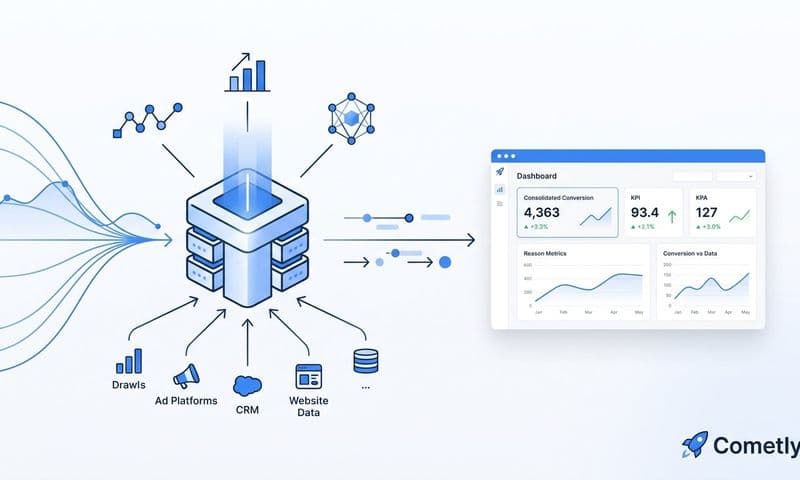
Platforms like Cometly are built specifically for this use case. By connecting your ad platforms, CRM, and website events into a single attribution layer, Cometly gives B2B SaaS marketing teams a unified view of performance that covers the entire customer journey from first ad click to closed-won revenue. With multi-touch attribution, server-side tracking, and AI-powered insights built in, it removes the need to manually reconcile data across disconnected tools.
Success indicator: You can answer the question "which campaign drove the most pipeline this quarter" in under two minutes without opening multiple tabs or building a manual spreadsheet.
Step 6: Establish an Ongoing Data Quality Process to Prevent Future Inconsistencies
Fixing your tracking setup is not a one-time project. New campaigns get launched. Integrations get updated. CRM fields get changed. Any of these events can introduce new tracking breaks, and without a regular process for catching them, you will find yourself back in the same situation months from now.
The foundation of ongoing data quality is a monthly tracking audit. Set aside time each month to verify that all conversion events are firing correctly, that UTM parameters are intact across all active campaigns, and that no new integrations or platform updates have disrupted your existing setup. This does not need to be exhaustive. A structured checklist covering your highest-volume conversion events and most important campaigns is usually enough to catch the issues that matter.
Create a UTM governance document that standardizes naming conventions for source, medium, campaign, and content parameters. When different team members apply different naming conventions to the same type of campaign, your data becomes unfilterable and comparisons across time periods become unreliable. A shared reference document with approved values for each UTM parameter, along with examples, reduces this risk significantly. Make it part of your campaign launch checklist so UTM hygiene is enforced before campaigns go live rather than cleaned up after the fact. Applying proven marketing analytics techniques to your governance process helps turn one-time fixes into repeatable systems.
Assign clear ownership of data quality. Someone on your team should be responsible for monitoring tracking health, not just reporting on outputs. When data quality is everyone's responsibility, it often ends up being no one's priority. Naming a specific owner, whether that is a marketing ops manager, a growth analyst, or a dedicated attribution specialist, creates accountability and ensures issues get addressed promptly.
Document every change to your tracking setup. New integrations, pixel updates, CRM field changes, and attribution model adjustments should all be logged with a date and a description of what changed. When a new discrepancy appears, this change log is often the fastest path to identifying the source.
Invest in first-party data enrichment to fill gaps that third-party cookies and pixels cannot capture. As browser tracking restrictions continue to expand, the gap between pixel-based data and actual conversion activity will only grow. Server-side tracking, Conversion API integrations, and first-party identifier strategies are increasingly the foundation of reliable attribution rather than optional enhancements. Understanding how to use data analytics in marketing at a foundational level helps teams build processes that stay accurate as the tracking landscape continues to evolve.
Success indicator: When a discrepancy appears, your team can diagnose and resolve it within 24 hours rather than spending weeks investigating. Your tracking setup is documented well enough that any team member can understand how it works and trace the source of a new problem.
Putting It All Together
Fixing marketing analytics inconsistencies is not a one-time project. It is an ongoing commitment to data quality that pays dividends every time your team makes a budget decision, optimizes a campaign, or reports performance to leadership.
The six steps in this guide give you a repeatable framework. Audit your sources. Diagnose root causes. Standardize conversion tracking. Align attribution models. Build a unified dashboard. Maintain data quality over time.
Use this quick-reference checklist to confirm you have covered the essentials:
Data source audit: Have you mapped every data source and documented where numbers diverge?
Root cause diagnosis: Have you identified the specific root cause behind each major discrepancy?
Conversion standardization: Are your conversion events standardized and deduplicated across all channels?
Attribution alignment: Has your team agreed on a single attribution model and reporting window for budget decisions?
Unified dashboard: Do you have a single dashboard showing pipeline and revenue attribution across all channels?
Ongoing process: Is there a monthly tracking audit and a UTM governance process in place?
Clean data is not just a reporting nicety. It is the foundation of every smart marketing decision your team will make. When your attribution data is accurate, you can scale what is working with confidence, cut what is not, and justify every dollar of ad spend with evidence rather than gut feel.
Cometly is built specifically to help B2B SaaS marketing teams solve these challenges by connecting ad platforms, CRM data, and website events into a single attribution layer. With server-side tracking, multi-touch attribution, and AI-powered insights, Cometly gives growth teams the accurate, reliable data they need to scale campaigns with confidence. Get your free demo today and start capturing every touchpoint to maximize your conversions.