Choosing the right marketing analytics platform is one of the most consequential decisions a B2B SaaS growth team makes. The wrong choice means flying blind on ad spend, misattributing pipeline, and scaling channels that look good on paper but don't actually close revenue. The right choice gives you a single source of truth connecting every touchpoint from first ad click to closed-won deal.
This guide compares nine marketing analytics platforms across the dimensions that matter most to B2B SaaS teams: attribution depth, data accuracy, integrations, and how well each tool connects marketing activity to actual revenue. Whether you're evaluating your first dedicated analytics platform or replacing a tool that's no longer keeping up, this comparison will help you make a confident, data-backed decision.
We've assessed each platform on core functionality, ideal use case, and pricing transparency so you can match the right tool to your team's specific needs.
1. Cometly
Best for: B2B SaaS teams that need end-to-end attribution from first ad click to closed revenue.
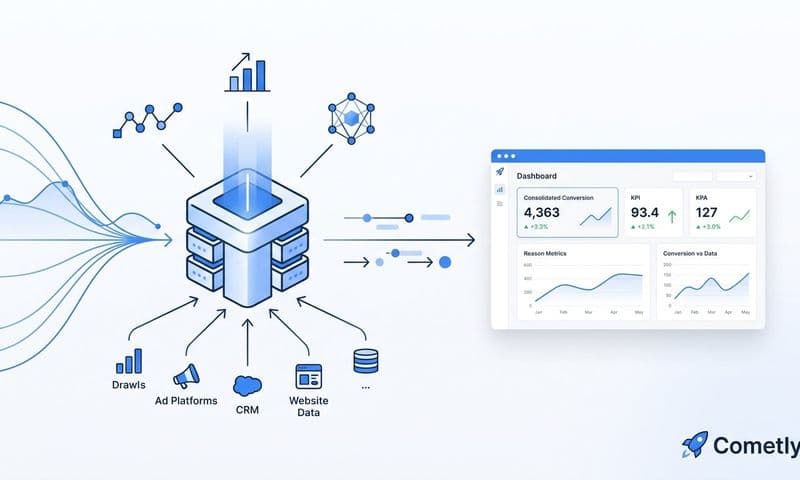
Cometly is a purpose-built marketing attribution and analytics platform designed specifically for B2B SaaS companies that need to connect ad spend to pipeline and closed revenue in real time.
 9 Best Attribution Platforms for Agencies in 2026
Where This Tool Shines
Cometly addresses the core attribution gap that most B2B SaaS teams run into: web analytics tools track sessions and form fills, but they can't tell you which campaigns actually drove closed-won revenue. Cometly closes that loop by connecting your ad platforms, CRM, and payment data into a single, unified view of the customer journey.
The platform's server-side tracking and Conversion API integration make it particularly valuable as browser-based tracking becomes less reliable. Rather than depending on cookies that get blocked or dropped, Cometly captures first-party data accurately and sends enriched conversion events back to Meta, Google, and other ad platforms to improve their targeting algorithms.
Key Features
End-to-End Attribution: Tracks the full journey from first ad click through to closed-won revenue, giving marketing teams visibility into which touchpoints actually drive deals.
Server-Side Tracking and Conversion API: Captures accurate first-party data that isn't affected by ad blockers or browser restrictions, ensuring conversion data stays complete.
AI Ads Manager: Identifies high-performing campaigns and recommends scaling decisions based on actual revenue impact, not just surface-level metrics like clicks or impressions.
Pipeline and Revenue Attribution with Stripe Integration: Connects ad spend directly to Stripe revenue data so you can calculate true ROI at the campaign and channel level.
Customer Journey Analytics: Provides full touchpoint visibility across every session and interaction, so you understand exactly how buyers move from awareness to purchase.
70+ Native Integrations: Connects across ad platforms, CRMs, and data tools without requiring complex custom engineering work.
Best For
Cometly is the strongest fit for B2B SaaS marketing teams and growth leaders who run paid media across multiple channels and need to prove ROI at the revenue level, not just the lead level. It's particularly well-suited for teams that have outgrown GA4 or HubSpot's native attribution and need a dedicated platform built for their sales motion.
Pricing
Pricing is available on request. Plans are designed to accommodate B2B SaaS teams of varying sizes, with options that scale as your ad spend and data volume grow.
2. HubSpot Marketing Hub
Best for: SMB and mid-market teams already using HubSpot CRM who want native attribution reporting.
HubSpot Marketing Hub is an all-in-one marketing platform with built-in attribution reporting that works natively within the HubSpot CRM ecosystem.
 9 Best Ad Attribution Platforms Compared for B2B SaaS Teams in 2026
Where This Tool Shines
If your team already lives in HubSpot, the Marketing Hub's attribution reporting is a natural extension of what you're already doing. Because it's natively connected to your CRM contacts and deals, you can tie campaign activity directly to pipeline without any additional integration work.
The custom attribution report builder gives revenue operations teams flexibility to define how credit is assigned across touchpoints. The tradeoff is that its attribution capabilities are most powerful when your entire funnel runs through HubSpot, which isn't always the case for more complex B2B SaaS stacks.
Key Features
Native Multi-Touch Attribution: Ties attribution directly to HubSpot CRM deals and contacts without requiring third-party connectors.
Campaign Reporting: Covers email, ads, landing pages, and social in a unified campaign view.
Custom Attribution Report Builder: Allows teams to configure how revenue and pipeline credit is distributed across touchpoints.
Ad Spend Integration: Connects with Google, Facebook, and LinkedIn to pull spend data alongside CRM outcomes.
Traffic and Conversion Analytics: Breaks down website traffic and conversion performance by source and campaign.
Best For
HubSpot Marketing Hub works best for SMB and mid-market SaaS companies that use HubSpot as their primary CRM and want attribution without adding another tool to their stack. Teams that rely heavily on Salesforce or have complex multi-system architectures may find its attribution depth limiting.
Pricing
Marketing Hub Professional starts at approximately $800 per month. Enterprise starts at approximately $3,600 per month. Pricing scales with contact volume and feature tier.
3. Marketo Measure (formerly Bizible)
Best for: Enterprise B2B teams running Salesforce who need deep account-based attribution.
Marketo Measure is an Adobe-owned B2B attribution platform built natively for Salesforce, designed for enterprise marketing and revenue operations teams tracking complex, multi-stakeholder buying journeys.
 9 Best Attribution Software for B2B Companies in 2026
Where This Tool Shines
Marketo Measure's core strength is its deep Salesforce integration. It syncs attribution data directly into Salesforce objects, meaning your revenue operations team can build attribution reports without exporting data or relying on manual reconciliation. For enterprise teams where Salesforce is the system of record, this is a significant advantage.
The Boomerang Stage tracking feature is particularly useful for B2B companies where deals move in and out of stages over long sales cycles. It captures recurring pipeline stage transitions rather than just first and last touches, giving a more accurate picture of how deals progress.
Key Features
Salesforce-Native Attribution: Deep CRM data sync that writes attribution directly into Salesforce objects for reporting and analysis.
Account-Based Attribution: Tracks multiple contacts within a buying committee, not just individual leads.
Boomerang Stage Tracking: Captures recurring pipeline stage transitions for deals with complex, non-linear progressions.
Offline Touchpoint Integration: Includes events, direct mail, and other offline channels in attribution models.
Custom Attribution Model Builder: Allows teams to create weighted attribution models tailored to their sales motion.
Best For
Marketo Measure is purpose-built for enterprise B2B organizations with Salesforce as their CRM, dedicated revenue operations teams, and complex buying committees. It's generally over-engineered for smaller SaaS teams and requires meaningful implementation resources to configure properly.
Pricing
Enterprise pricing applies. Contact Adobe or Marketo sales directly for a quote, as pricing is customized based on contract size and feature requirements.
4. Triple Whale
Best for: Ecommerce and DTC brands focused on paid social attribution and creative performance.
Triple Whale is a paid media attribution and analytics platform originally built for ecommerce and DTC brands, offering pixel-based attribution, creative analytics, and ROAS reporting across paid social channels.
 9 Best Marketing Analytics Platforms Compared for B2B SaaS in 2026
Where This Tool Shines
Triple Whale's creative analytics capabilities are among the strongest in the market for teams running high-volume paid social campaigns. The ability to break down performance at the individual ad level, combined with post-purchase survey data, gives DTC marketers a more complete picture than ad platform dashboards alone provide.
The platform has been expanding its capabilities toward B2B use cases, but its core architecture and feature set remain oriented toward ecommerce metrics like ROAS, contribution margin, and customer lifetime value. B2B SaaS teams evaluating Triple Whale should assess whether its reporting framework maps to their pipeline-centric metrics.
Key Features
First-Party Pixel: Provides accurate cross-channel attribution independent of ad platform reporting.
Creative Analytics: Ad-level performance breakdowns that help teams identify which creative assets drive results.
Blended ROAS Dashboards: Combines spend and revenue data across channels into a unified performance view.
Post-Purchase Survey Integration: Supplements pixel data with self-reported attribution from customers.
Cohort Analysis and LTV Tracking: Tracks customer cohort behavior and lifetime value over time.
Best For
Triple Whale is best suited for ecommerce and DTC brands running significant paid social budgets. B2B SaaS teams with long sales cycles and CRM-dependent revenue tracking will likely find the platform's reporting framework doesn't map cleanly to their metrics.
Pricing
Plans start at approximately $129 per month and scale with ad spend volume. Higher tiers unlock advanced features like media mix modeling and incrementality testing.
5. Northbeam
Best for: Growth teams with significant paid media budgets who need ML-powered attribution and spend optimization.
Northbeam is a machine learning-powered attribution and media mix modeling platform designed for growth teams running large paid media budgets across multiple channels.
 9 Best Paid Media Tracking Tools to Maximize Your Ad ROI in 2026
Where This Tool Shines
Northbeam's machine learning attribution engine is built to handle the complexity of multi-channel attribution at scale. Rather than applying a fixed attribution rule, it uses ML models to estimate the true contribution of each channel and touchpoint based on observed conversion patterns. This makes it particularly useful for teams where simple rule-based models consistently over- or under-credit specific channels.
The media mix modeling layer adds a budget allocation dimension that most MTA-only tools lack. Teams can use Northbeam's recommendations to model how shifting spend across channels would affect overall performance, which is valuable for quarterly planning cycles.
Key Features
ML-Based Multi-Touch Attribution: Uses machine learning to estimate channel contribution across paid, organic, and direct traffic.
Media Mix Modeling: Provides budget allocation recommendations based on modeled channel performance.
Predictive Spend Optimization: Forecasts the impact of spend changes across channels before you make them.
Custom Attribution Windows: Configurable lookback windows and model parameters to match your sales cycle.
Cross-Channel Incrementality Testing: Supports holdout experiments to validate attribution model accuracy.
Best For
Northbeam is best suited for growth teams spending meaningfully across multiple paid channels who need more than rule-based attribution. It's a stronger fit for performance-focused teams than for B2B SaaS companies that need deep CRM integration and pipeline-level reporting.
Pricing
Custom pricing based on ad spend volume. Contact Northbeam directly for a quote tailored to your budget and requirements.
6. Google Analytics 4 (GA4)
Best for: Any team needing a free baseline web analytics layer with Google Ads integration.
Google Analytics 4 is Google's free web analytics platform with an event-based tracking model, data-driven attribution, and native Google Ads integration that serves as a baseline analytics layer for most marketing teams.
 11 Best Marketing Analytics Tools to Track and Optimize Campaign Performance in 2026
Where This Tool Shines
GA4's greatest strength is accessibility. It's free, widely supported, and integrates natively with the entire Google ecosystem including Google Ads, Search Console, and BigQuery. For teams that primarily run Google Ads and want to understand web behavior, it provides a solid foundation without any additional cost.
The data-driven attribution model uses machine learning to distribute credit across touchpoints based on observed conversion patterns, which is more sophisticated than simple last-click models. However, GA4's attribution is fundamentally session-based and struggles to connect web events to CRM opportunities and closed revenue, which is the core gap for B2B SaaS teams.
Key Features
Data-Driven Attribution: Machine learning model that distributes conversion credit based on observed touchpoint patterns.
Native Google Ecosystem Integration: Direct connections to Google Ads and Search Console without additional setup.
Event-Based Tracking: Flexible event configuration that can track virtually any user interaction on your site.
Exploration Reports: Funnel analysis, path analysis, and cohort reports for deeper behavioral insights.
BigQuery Export: Raw data export to BigQuery for teams that want to build custom models and dashboards.
Best For
GA4 is a necessary baseline for almost every marketing team, but it should be treated as a starting point rather than a complete attribution solution for B2B SaaS. Teams that need to connect web data to CRM pipeline and closed revenue will need to supplement GA4 with a dedicated attribution platform.
Pricing
GA4 is free for standard use. GA4 360, the enterprise version with higher data limits and SLA guarantees, starts at approximately $50,000 per year.
7. Rockerbox
Best for: Mid-market brands that want a unified view combining MTA, media mix modeling, and survey data.
Rockerbox is a unified marketing measurement platform that combines multi-touch attribution, media mix modeling, and survey-based attribution to give mid-market brands a comprehensive view of marketing performance.
Where This Tool Shines
Rockerbox's differentiated approach is its commitment to triangulating attribution across three methodologies: multi-touch attribution, media mix modeling, and post-purchase surveys. Rather than betting everything on a single measurement approach, it layers them together to give marketers a more confident read on what's actually working.
The de-duplicated channel reporting is particularly valuable for teams running overlapping campaigns across paid search, paid social, and email. Without deduplication, the same conversion often gets claimed by multiple channels, inflating reported performance across the board.
Key Features
Unified Measurement View: Combines MTA, MMM, and post-purchase survey data into a single reporting layer.
De-Duplicated Channel Reporting: Removes double-counting across paid and organic channels for accurate performance measurement.
Incrementality Testing: Supports holdout experiments to validate which channels are driving genuine lift.
Pixel and Server-Side Tracking: Flexible tracking options to maintain data accuracy as cookie reliability declines.
Data Warehouse Integrations: Connects with major ad platforms, CRMs, and data warehouses for centralized analysis.
Best For
Rockerbox fits mid-market brands that have matured beyond single-method attribution and want a more rigorous, triangulated approach to measurement. It's a stronger fit for ecommerce and DTC than for B2B SaaS teams that need deep CRM pipeline integration.
Pricing
Custom pricing based on team size and ad spend. Contact Rockerbox directly for a quote tailored to your specific requirements.
8. Ruler Analytics
Best for: B2B teams that need to attribute offline conversions, calls, and form submissions to marketing source.
Ruler Analytics is a B2B-focused marketing attribution platform that specializes in connecting offline conversions, call tracking, and form submissions back to their originating marketing source across the full lead-to-revenue journey.
Where This Tool Shines
Ruler Analytics fills a specific gap that many web analytics tools leave open: connecting phone calls and form submissions to the exact marketing touchpoints that generated them. For B2B companies where a significant portion of conversions happen offline, this is a meaningful capability that standard pixel-based tracking can't capture.
The platform passes revenue data from your CRM back into marketing reports, which means you can see not just which channels generate leads but which ones generate leads that actually convert to revenue. This closed-loop reporting is what separates it from basic call tracking tools.
Key Features
Call Tracking and Form Attribution: Links phone calls and form submissions to their originating marketing source at the visitor level.
Multi-Touch Attribution: Tracks touchpoints across online and offline channels throughout the full buyer journey.
CRM Revenue Passback: Sends closed revenue data from your CRM back into marketing reports for ROI calculation.
Visitor-Level Journey Tracking: Captures individual visitor behavior across multiple sessions and touchpoints.
Ad Platform Integration: Connects with Google Ads, Facebook, and major CRMs for unified reporting.
Best For
Ruler Analytics is a strong fit for B2B companies with significant phone-based or offline conversion activity who need to connect those conversions to marketing spend. It's particularly useful for agencies managing lead generation campaigns where proving ROI to clients depends on offline conversion data.
Pricing
Plans start at approximately $199 per month and scale based on the volume of tracked calls and sessions. Higher tiers include additional integrations and reporting features.
9. Dreamdata
Best for: B2B companies with complex, multi-stakeholder sales processes that need account-level attribution.
Dreamdata is a B2B revenue attribution platform built for companies with complex, multi-stakeholder sales processes, providing account-level attribution that maps the full buying committee journey from first touch to closed revenue.
Where This Tool Shines
Dreamdata's core strength is account-based attribution. Rather than tracking individual contacts in isolation, it stitches together all the touchpoints from every member of a buying committee into a single account-level journey. For enterprise B2B companies where deals involve multiple decision-makers across months or years, this is a fundamentally more accurate way to measure marketing impact.
The self-serve attribution model comparison feature lets marketing and revenue operations teams toggle between first-touch, last-touch, linear, time-decay, and custom models without waiting for a data analyst. This makes it easier to have informed conversations with leadership about how credit should be assigned across channels and campaigns.
Key Features
Account-Based Attribution: Tracks all contacts in a buying committee and stitches their touchpoints into a unified account journey.
Full Customer Journey Timeline: Maps the complete path from anonymous visit to closed deal, including dark funnel activity.
Pipeline and Revenue Attribution: Syncs with CRM data to connect marketing activity to pipeline stages and closed revenue.
Self-Serve Model Comparison: Allows teams to compare first-touch, linear, time-decay, and custom attribution models side by side.
Broad Integration Coverage: Connects with Salesforce, HubSpot, Google Ads, LinkedIn, and a growing list of data tools.
Best For
Dreamdata is an excellent choice for B2B SaaS companies with long sales cycles, multiple stakeholders per deal, and a need for account-level attribution that contact-based tools can't provide. The free tier makes it accessible for smaller teams to evaluate before committing to a paid plan.
Pricing
A free tier is available for teams getting started. Paid plans start at approximately $999 per month, with pricing scaling based on data volume and feature requirements.
Which Platform Is Right for Your Team
Across these nine platforms, the right choice depends heavily on your sales motion, your existing tech stack, and how mature your attribution needs are. Here's how to think through the decision.
If you're a B2B SaaS team that needs to connect ad spend directly to pipeline and closed revenue, Cometly is the strongest purpose-built option. Its combination of server-side tracking, AI-driven recommendations, Stripe revenue integration, and 70+ native integrations gives growth teams a genuine single source of truth without requiring a data engineering team to maintain it.
For teams already embedded in the HubSpot ecosystem, HubSpot Marketing Hub's native attribution is a pragmatic choice that avoids adding another tool to your stack. It works best when your entire funnel runs through HubSpot CRM. Enterprise teams running Salesforce with complex buying committees should evaluate Marketo Measure, which offers the deepest Salesforce-native attribution available.
Dreamdata is the standout option for account-based B2B attribution, particularly for companies with multi-stakeholder deals and long sales cycles. GA4 remains an essential baseline for any team, but it should be treated as a starting point rather than a complete attribution solution for revenue-focused B2B teams.
Triple Whale and Northbeam are strongest for performance marketers running high-volume paid media, with roots in ecommerce that make them less natural fits for pipeline-centric B2B reporting. Rockerbox and Ruler Analytics serve specific use cases well: Rockerbox for teams that want triangulated measurement across multiple methodologies, and Ruler Analytics for B2B teams with significant offline conversion activity.
The pattern across the best-performing B2B SaaS marketing teams is consistent: they use a dedicated attribution platform that connects ad data to CRM outcomes, supplement it with GA4 as a behavioral layer, and make decisions based on revenue impact rather than surface-level engagement metrics.
Ready to see what that looks like in practice? Get your free demo of Cometly and start connecting every touchpoint to the revenue outcomes that actually matter.