
Enterprise marketing teams are drowning in data but starving for insight. You have campaigns running across dozens of channels, leads flowing through complex funnels, and leadership asking the same question every quarter: what is actually driving revenue?
The platforms on this list are built to answer that question at scale. Each one was evaluated on attribution depth, integration breadth, reporting flexibility, and how well it connects marketing activity to actual pipeline and revenue outcomes. Whether you run a B2B SaaS growth team or manage multi-channel campaigns across global markets, the right tool is here.
Here is what we looked for: multi-touch attribution support, cross-channel data unification, CRM and ad platform integrations, server-side tracking capabilities, and pipeline or revenue visibility.
1. Cometly
Best for: B2B SaaS teams that need to connect ad spend directly to pipeline and closed-won revenue.
Cometly is a marketing attribution and analytics platform built specifically for B2B SaaS companies that want a complete, accurate view of what their ads are actually generating.
 9 Best Attribution Platforms for Agencies in 2026
Where This Tool Shines
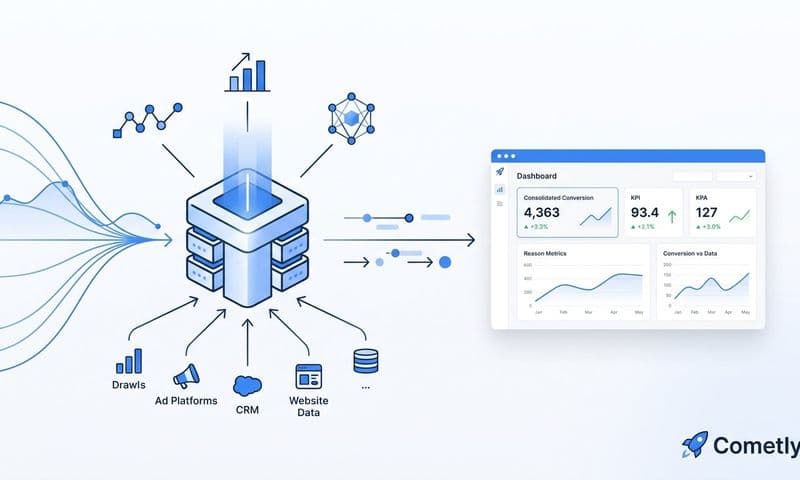
Most analytics platforms tell you what happened at the top of the funnel. Cometly goes further by connecting every ad click to CRM events, pipeline stages, and closed-won revenue, giving marketing and leadership a single source of truth that extends well beyond MQLs.
The platform's server-side tracking and Conversion API integration for Meta and Google make it particularly well-suited for the post-third-party-cookie environment. Instead of losing signal as browser restrictions tighten, Cometly enriches conversion data and sends it back to ad platforms to improve targeting and optimization performance.
Key Features
Multi-Touch Attribution: Compare linear, time-decay, first-touch, last-touch, and data-driven models side by side to understand how each channel contributes across the full journey.
Server-Side Tracking and Conversion API: Capture conversion events server-side for Meta and Google, reducing data loss from browser restrictions and ad blockers.
AI Ads Manager: Identify high-performing campaigns and receive AI-driven recommendations on where to scale and where to cut spend.
Pipeline and Revenue Attribution: Connect Stripe revenue data with ad performance data to see exactly which campaigns are generating actual customers, not just clicks.
Customer Journey Analytics: Visualize every touchpoint across the full customer journey with complete path-level visibility.
70+ Native Integrations: Connect ad platforms, CRMs, and data tools without custom engineering work.
Best For
B2B SaaS marketing teams and growth leaders who need to prove revenue impact, not just traffic or lead volume. Particularly strong for teams running paid campaigns on Meta, Google, and LinkedIn who want to close the loop between ad spend and closed-won revenue.
Pricing
Pricing is available on request. Visit cometly.com to learn more or book a demo.
2. Adobe Analytics
Best for: Large enterprises with dedicated analytics teams and complex behavioral data requirements.
Adobe Analytics is one of the most established enterprise analytics platforms, known for deep customization and powerful segmentation across massive data volumes.
 9 Best AI Marketing Analytics Tools in 2026
Where This Tool Shines
Adobe Analytics gives enterprise teams granular control over how data is collected, structured, and analyzed. The variable configuration system allows organizations to define exactly what gets tracked, making it highly adaptable to complex product and content environments.
Its integration with the broader Adobe Experience Cloud, including Target for personalization and Audience Manager for data management, makes it a strong choice for enterprises already invested in the Adobe ecosystem.
Key Features
Custom Data Collection: Configure variables, props, and eVars to capture exactly the behavioral data your team needs.
Advanced Segmentation: Build complex, multi-condition segments and apply them retroactively across historical data.
Attribution IQ: Compare multiple attribution models within the same report to understand channel contribution from different analytical perspectives.
Real-Time Reporting: Access live data streams for time-sensitive campaign monitoring and rapid decision-making.
Adobe Experience Cloud Integration: Connect seamlessly with Target, Campaign, and Audience Manager for a unified marketing technology stack.
Best For
Large enterprises with dedicated analytics and data engineering resources. Teams already using Adobe Experience Manager, Target, or Campaign will benefit most from the native ecosystem integration. Requires meaningful technical investment to implement and maintain at full capability.
Pricing
Custom enterprise pricing. Contact Adobe directly for a quote based on data volume and feature requirements.
3. Google Analytics 4 (GA4)
Best for: Google-centric teams that want deep integration between web analytics and Google Ads with access to raw data via BigQuery.
Google Analytics 4 is the default web and app analytics platform for most organizations, offering an event-based data model, predictive metrics, and tight integration with the Google ecosystem.
 11 Best Marketing Analytics Tools to Track and Optimize Campaign Performance in 2026
Where This Tool Shines
GA4's event-based architecture is a significant improvement over session-based tracking. Every interaction can be captured as a custom event, giving teams more flexibility in how they define and measure conversions.
The direct BigQuery export is where GA4 becomes genuinely powerful for enterprise teams. Raw event-level data flows into BigQuery, enabling custom analysis, data blending, and integration with broader data warehouse environments without additional engineering complexity.
Key Features
Event-Based Data Model: Track any user interaction as a custom event, replacing the rigid session-based structure of Universal Analytics.
Predictive Metrics: Access purchase probability and churn probability scores generated from machine learning models trained on your own data.
Google Ads Integration: Sync conversion data directly with Google Ads for closed-loop reporting and automated bidding optimization.
BigQuery Export: Export raw event-level data to BigQuery for custom analysis, data blending, and long-term storage.
GA4 360: Enterprise-tier offering with higher data limits, unsampled reporting, and SLA guarantees for mission-critical analytics environments.
Best For
Teams running significant Google Ads budgets who want tighter measurement integration. Also well-suited for organizations with data engineering resources who want to build custom reporting on top of raw event data in BigQuery. Less suited for B2B SaaS teams that need CRM-level pipeline attribution.
Pricing
Standard GA4 is free. GA4 360 enterprise pricing starts at approximately $50,000 per year, with costs scaling based on data volume and usage.
4. Salesforce Marketing Cloud Intelligence (Datorama)
Best for: Enterprise teams embedded in the Salesforce ecosystem that need unified marketing data across dozens of sources.
Salesforce Marketing Cloud Intelligence, formerly known as Datorama, is a marketing intelligence platform that automates data unification and applies AI-driven analysis across complex multi-channel environments.
 9 Best Marketing Analytics Platforms for Enterprises in 2026
Where This Tool Shines
Datorama's core strength is data harmonization at scale. With over 200 marketing connectors, it can pull data from ad platforms, CRMs, email tools, and organic channels and normalize it into a single reporting layer without heavy manual data engineering.
For organizations already running Salesforce CRM and Marketing Cloud, the native integration creates a genuinely connected view from campaign execution through to CRM pipeline, making it one of the stronger options for B2B enterprises already in the Salesforce ecosystem.
Key Features
200+ Marketing Connectors: Automate data ingestion from ad platforms, social channels, email tools, and analytics sources into a unified data model.
AI-Powered Insights: Surface anomaly detection, performance alerts, and AI-generated recommendations across marketing KPIs.
Custom Dashboards: Build flexible, branded dashboards for different stakeholders from channel managers to C-suite leadership.
Salesforce CRM Integration: Connect marketing performance data directly to Salesforce pipeline and revenue records for closed-loop reporting.
Cross-Channel Spend Reporting: Aggregate spend, impressions, clicks, and conversions across every paid channel into a single performance view.
Best For
Enterprises already using Salesforce CRM and Marketing Cloud who need a central marketing intelligence layer. Strong for large marketing operations teams managing complex multi-channel programs across global markets.
Pricing
Custom enterprise pricing. Contact Salesforce directly for a quote based on data sources, users, and feature requirements.
5. HubSpot Marketing Hub (Enterprise)
Best for: B2B teams that want CRM, marketing automation, and attribution reporting in a single connected platform.
HubSpot Marketing Hub Enterprise combines inbound marketing tools, CRM data, and multi-touch attribution reporting into one integrated suite designed to reduce tool sprawl for growing B2B teams.
 9 Best Ad Attribution Platforms Compared for B2B SaaS Teams in 2026
Where This Tool Shines
HubSpot's biggest advantage is the native CRM connection. Because contact records, deal stages, and revenue data all live in the same platform as your marketing campaigns, attribution reporting reflects actual pipeline movement rather than proxy metrics.
The Enterprise tier unlocks multi-touch revenue attribution, custom behavioral events, and advanced contact scoring, making it a meaningful step up from the standard marketing analytics available at lower tiers.
Key Features
Multi-Touch Revenue Attribution: Assign credit to marketing touchpoints across first-touch, last-touch, linear, and time-decay models tied directly to closed revenue.
Native CRM Integration: Connect campaign activity to contact records, deal stages, and revenue outcomes without third-party connectors.
Campaign Reporting: Measure performance across email, paid ads, social, and content from a single campaign-level view.
Custom Behavioral Events: Track specific product or website interactions as custom events and use them in segmentation and scoring.
Ad Attribution Sync: Pull ad performance data from Meta, Google, and LinkedIn and connect it directly to HubSpot contacts and deals.
Best For
B2B marketing teams that want to avoid managing a separate CRM and analytics stack. Best suited for mid-market to enterprise organizations that run primarily inbound and content-driven programs and want attribution tied to HubSpot deal data.
Pricing
Marketing Hub Enterprise starts at $3,600 per month for three seats, with additional costs for higher contact volumes and add-ons.
6. Rockerbox
Best for: Performance marketing teams that need to combine multi-touch attribution with media mix modeling for budget planning.
Rockerbox is a marketing measurement platform designed to give performance teams a complete view of channel contribution across paid, organic, and offline sources.
 9 Best Marketing Analytics Platforms for Enterprises in 2026
Where This Tool Shines
Rockerbox addresses a gap that many attribution tools leave open: the combination of granular multi-touch attribution with broader media mix modeling. This means teams can analyze individual channel and campaign performance while also running scenario planning for budget allocation decisions.
The customer journey visualization is particularly useful for understanding how channels interact. Teams can see which paths lead to conversion most reliably and use that insight to optimize sequencing and spend distribution.
Key Features
Multi-Touch Attribution: Measure credit across paid search, paid social, organic, email, and offline channels using multiple attribution models.
Media Mix Modeling: Run top-down modeling for budget planning and channel optimization, especially useful for channels that are difficult to track at the individual level.
60+ Integrations: Connect major ad platforms, CRMs, and analytics tools without custom data pipelines.
Customer Journey Visualization: Map conversion paths and analyze which channel sequences drive the highest conversion rates.
Incrementality Testing: Run holdout tests to measure the true incremental impact of specific channels or campaigns.
Best For
Performance marketing teams managing large budgets across multiple paid channels who need both granular attribution and strategic-level budget modeling. Works well for direct-to-consumer and ecommerce brands, as well as B2B teams running performance-heavy programs.
Pricing
Custom pricing based on ad spend and data volume. Contact Rockerbox directly for a tailored quote.
7. Triple Whale
Best for: Ecommerce and DTC brands that want first-party attribution, creative analytics, and AI-powered ad insights in one platform.
Triple Whale is a first-party data attribution platform built to give ecommerce brands accurate cross-channel measurement in an environment where native ad platform reporting has become increasingly unreliable.
 9 Best Marketing Analytics Platforms for Enterprises in 2026
Where This Tool Shines
Triple Whale's first-party pixel captures conversion data independently of ad platform reporting, giving brands a more accurate and consistent view of what is actually driving purchases. This matters especially for teams running simultaneous campaigns across Meta, TikTok, and Google, where attribution overlap and reporting discrepancies are common.
The creative analytics module stands out as a genuine differentiator. Teams can see which specific ad creatives are driving the most efficient conversions, not just the most clicks, enabling faster creative iteration and more informed production decisions.
Key Features
First-Party Pixel: Capture conversion data server-side using Triple Whale's own tracking pixel, independent of ad platform reporting.
Creative Analytics: Measure performance at the creative level to identify which ad formats, hooks, and visuals are driving efficient conversions.
AI-Powered Insights: Receive automated spend recommendations and performance alerts based on your own historical data patterns.
Blended ROAS Reporting: View return on ad spend across all channels in a single blended metric alongside contribution margin data.
Platform Integrations: Connect Meta, TikTok, Google, and Klaviyo for a unified cross-channel performance view.
Best For
Ecommerce and DTC brands, particularly those running on Shopify, that want accurate first-party attribution without heavy data engineering. Less suited for B2B SaaS teams but strong for consumer brands managing creative-heavy paid social programs.
Pricing
Plans start at approximately $129 per month. Enterprise pricing is available for higher-volume brands. Contact Triple Whale for custom quotes.
8. Northbeam
Best for: Performance marketers managing large paid budgets who need attribution that works even with degraded tracking signals.
Northbeam is a machine learning-based attribution platform that builds predictive models capable of delivering accurate channel-level measurement even as browser restrictions and privacy changes reduce available tracking data.
Where This Tool Shines
Northbeam's machine learning approach is designed specifically for the signal-degraded environment that performance marketers now operate in. Rather than relying solely on deterministic tracking, it trains models on first-party data to fill gaps created by browser restrictions, iOS changes, and cookie limitations.
The combination of multi-touch attribution and media mix modeling within a single platform gives teams both granular campaign-level insight and the strategic-level view needed for confident budget planning across large spend portfolios.
Key Features
ML-Based Attribution Models: Train predictive attribution models on your own first-party data to maintain accuracy as tracking signals degrade.
Media Mix Modeling: Layer top-down channel modeling alongside multi-touch attribution for a more complete measurement picture.
Real-Time Spend Pacing: Monitor daily spend pacing against targets and receive alerts when campaigns deviate from planned budgets.
Cross-Channel Reporting: Aggregate performance data from Meta, Google, TikTok, and additional paid channels into a unified dashboard.
Custom Attribution Windows: Configure attribution windows and model parameters to match your specific sales cycle and conversion patterns.
Best For
Performance marketing teams managing significant paid media budgets across multiple channels who need attribution that remains reliable as privacy regulations tighten. Strong for ecommerce and direct response advertisers running high-frequency campaigns.
Pricing
Custom pricing based on ad spend. Contact Northbeam directly for a quote tailored to your budget and data requirements.
9. Looker (Google Cloud)
Best for: Enterprise data teams that need a flexible business intelligence layer on top of an existing marketing data warehouse.
Looker is a business intelligence and data exploration platform that enterprise marketing teams use to build custom reporting and dashboards on top of their centralized marketing data infrastructure.
Where This Tool Shines
Looker is not a purpose-built marketing analytics tool, but that flexibility is precisely what makes it valuable for enterprise teams with mature data infrastructure. If your organization already centralizes marketing data in BigQuery, Snowflake, or Redshift, Looker provides a governed, scalable reporting layer that any stakeholder can use without writing SQL.
The LookML modeling language allows data teams to define metrics, dimensions, and relationships once, then expose them consistently across every dashboard and report. This eliminates the metric inconsistency problem that plagues organizations relying on ad-hoc spreadsheet reporting.
Key Features
LookML Modeling: Define custom metrics, dimensions, and data relationships in a reusable modeling layer that ensures consistent reporting across the organization.
Universal Database Connectivity: Connect to any SQL database or cloud data warehouse including BigQuery, Snowflake, and Redshift.
Embedded Analytics: Embed dashboards and reports directly into internal tools or external products with white-label capabilities.
Scheduled Reports: Automate report delivery to stakeholders on custom schedules via email, Slack, or other channels.
Enterprise Governance: Apply granular access controls, data permissions, and audit logging to meet enterprise security and compliance requirements.
Best For
Enterprise marketing and data teams that already have a centralized data warehouse and need a governed, scalable reporting layer on top of it. Requires meaningful data engineering investment to implement well. Less suited for teams that need out-of-the-box attribution without technical resources.
Pricing
Custom enterprise pricing. Contact Google Cloud directly for a quote based on users, data volume, and deployment requirements.
Which Platform Is Right for Your Team
The right marketing analytics platform depends on three things: your tech stack, your team structure, and how mature your attribution strategy already is. There is no universal answer, but there are clear patterns based on use case.
B2B SaaS teams focused on revenue attribution: Start with Cometly. It is the only platform on this list built specifically for connecting ad spend to pipeline and closed-won revenue in a B2B SaaS context, with server-side tracking, Conversion API support, and Stripe revenue integration built in.
Enterprises embedded in the Salesforce ecosystem: Salesforce Marketing Cloud Intelligence (Datorama) is the natural fit. Its 200+ connectors and native CRM integration reduce data engineering overhead for organizations already running Salesforce at scale.
Google-centric teams with strong analytics resources: GA4 combined with BigQuery provides a powerful and cost-effective foundation. Pair it with Looker if you need a governed reporting layer for cross-functional stakeholders.
Teams that need flexible BI on top of a data warehouse: Looker is the right choice, provided you have the data engineering capacity to implement LookML modeling properly.
Ecommerce and DTC brands: Triple Whale and Northbeam both offer strong first-party attribution built for the signal-degraded environment that consumer brands now operate in. Triple Whale is stronger on creative analytics; Northbeam is stronger on ML-based modeling for large spend portfolios.
If you are a B2B SaaS company that wants to move beyond surface-level reporting and connect every ad click to actual revenue, Cometly is built specifically for that outcome. From capturing every touchpoint to feeding enriched conversion data back to Meta and Google, it gives growth teams the clarity they need to scale with confidence.
Ready to see what your ads are actually generating? Get your free demo and start connecting every touchpoint to real revenue outcomes.